
It probably won’t be until mid to late March that we finally roll out McKenzie Wark’s GAM3R 7H30RY Version 10.1, but substantial progress is being made. Here’s a snapshot:

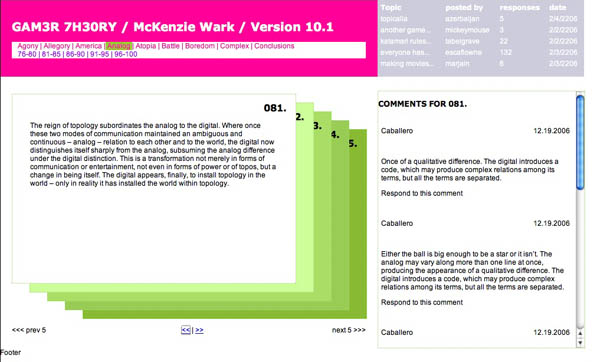
After debating (part 1) our way to a final design concept (part 2), we’re now focused (well, mainly Jesse at this point) on hammering the thing together. We’re using all open source software and placing the book under a Creative Commons Attribution-NonCommercial-ShareAlike 2.0 license. Half the site will consist of a digital edition of the book in Word Press with a custom-built card shuffling interface. As mentioned earlier, Ken has given us an incredibly modular structure to work with (a designer’s dream): nine chapters (so far), each consisting of 25 paragraphs. Each chapter will contain five five-paragraph stacks with comments popping up to the side for whichever card is on top. No scrolling is involved except in the comment field, and only then if there is a substantial number of replies.
The graphic above shows the color scale we’re thinking of for the different chapters. As they progress, each five-card stack will move from light to dark within the color of its parent chapter. Floating below the color spectrum is the proud parent of the born-digital book: McKenzie Wark, Space Invader (an image that will appear in some fashion throughout the site). Right now he’s a fairly mean-looking space invader — on a bombing run or something. But we’re thinking of shuffling a few pixels to give him a friendlier appearance.
You are also welcome to view an interactive mock-up of the card view (click on the image below):
The other half of the site will be a discussion forum set up in PHP Bulletin Board. Actually, it’ll be a collection of nine discussion forums: one for each chapter of the book, each focusing (except for the first, which is more of an introduction) on a specific video game. Here’s how it breaks down:
* Allegory (on The Sims)
* America (on Civilization III)
* Analog (on Katamari Damarcy)
* Atopia (on Vice City)
* Battle (on Rez)
* Boredom (on State of Emergency)
* Complex (on Deus Ex)
* Conclusions (on SimEarth)
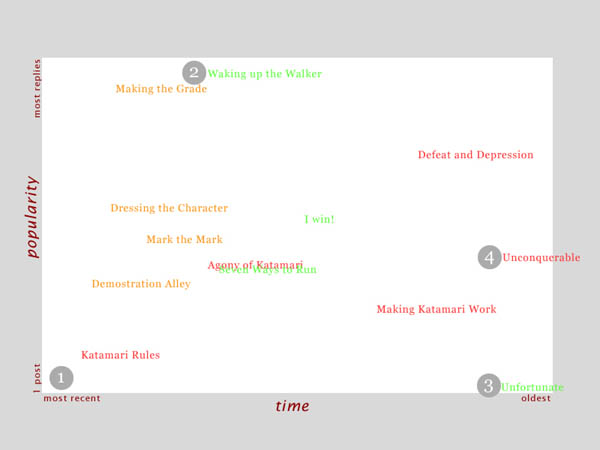
The gateway to each forum will be a two-dimensional topic graph where forum threads float in an x-y matrix. Their position in the graph will be determined by the time they were posted and the number of comments they’ve accumulated so far. Thus, hot topics will rise toward the top while simultaneously being dragged to the left (and eventually off the chart) by the progression of time. Something like this:
At this point there’s no way of knowing for sure which part of the site will be more successful. The book view is designed to gather commentary, and Ken is sincerely interested in reader feedback as he writes and rewrites. There will also be the option of syndicating the book to be digested serially in an RSS reader. We’re very curious to see how readers interact with the text and hope we’ve designed a compelling environment in which to do so.
Excited as we are about the book interface, our hunch is that the discussion forum component has the potential to become the more vital half of the endeavor. The forum will be quite different from the thousands of gaming sites already active on the web in that it will be less utilitarian and more meditative in its focus. This won’t be a place for posting cheats and walk-throughs but rather a reflective space for talking about the experience of gaming and what players take games to mean. Our hope is that people will have quite a bit to say about this — some of which may end up finding its way into the book.
Although there’s still a ways to go, the process of developing this site has been incredibly illuminating in our thinking about the role of the book in the network. We’re coming to understand how the book might be reinvented as social software while still retaining its cohesion and authorial vision. Stay tuned for further developments.
[!] technical difficulties [!]
Dear readers,
We’re in the process of upgrading Movable Type (our esteemed publishing software) to the latest version and inevitably are experiencing a few hiccups — for instance, our feed seems to have acquired the dreaded “[!]” in Bloglines. We should manage to sort out these little details by day’s end. Please do let us know of any other suspicious irregularities.
One thing you might notice if you scroll down the sidebar is that we’ve replaced our confusing categories system with a confusing tag system. Actually, for now we’re keeping them side by side, in the interest of maximizing confusion. Bear with us as we piece together our taxonomic golem and watch it wreak havoc on our poor, quivering blog, which is, as ever, a work in progress.
<<UPDATE>>
The feeds have been reinstated, and the feeds from the old version of MovableType have been rerouted to their holding location. I believe the old feeds were causing the conflict with the new feeds which is making Bloglines choke. -jdw
<<UPDATE>>
We’ve also decided to reinstate trackback on a provisional basis. Movable Type 3.2 seems to have better moderation and junk-filtering tools so hopefully spammers will be deterred. Trackback is dead! Long live trackback! – bv
net-based video creates bandwidth crunch
Apparently the recent explosion of internet video services like YouTube and Google Video has led to a serious bandwidth bottleneck on the network, potentially giving ammunition to broadband providers in their campaign for tiered internet service.
If Congress chooses to ignore the cable and phone lobbies and includes a network neutrality provision in the new Telecommunications bill, that will then place the burden on the providers to embrace peer-to-peer technologies that could solve the traffic problem. Bit torrent, for instance, distributes large downloads across multiple users in a local network, minimizing the strain on the parent server and greatly speeding up the transfer of big media files. But if govenment capitulates, then the ISPs will have every incentive to preserve their archaic one-to-many distribution model, slicing up the bandwidth and selling it to the highest bidder — like the broadcast companies of old.
The video bandwidth crunch and the potential p2p solution nicely illustrates how the internet is a self-correcting organic entity. But the broadband providers want to seize on this moment of inneficiency — the inevitable rise of pressure in the pipes that comes from innovation — and exploit it. They ought to remember that the reason people are willing to pay for broadband service in the first place is because they want access to all the great, innovative stuff developing on the net. Give them more control and they’ll stifle that innovation, even as they say they’re providing better service.
subtitles and the future of reading
After enduring a weeks-long PR pummeling for its dealings in China, Google is hard at work to improve its image in the world, racking up some points for good after slipping briefly into evil. Recently they launched Google.org: a website for the Google Foundation, the corporation’s philanthropic arm and central office of evil mitigation. Paying a visit to the site, the disillusioned among us will be pleased to find that the foundation is already sponsoring a handful of worthy initiatives, along with a grants program that donates free web advertising to nonprofit organizations. And just in case we were concerned that Google might not apply its techno-capitalist wizardry to altruism as zealously as to making profit, they just announced today they’ve named a new director for the foundation by the name of — no joke — Dr. Brilliant. So it seems the world is in capable hands.
One project in particular caught my eye in light of recent discussions about screen-based reading and genre-blending visions of the book. Planet Read is an organization that promotes literacy in India through Same Language Subtitling — a simple but apparently effective technique for building basic reading skills, taking popular visual entertainment like Bollywood movies and adding subtitles in English and Hindi along the bottom of the screen. A number of samples (sadly no Bollywood, just videos or photo montages set to Indian folk songs) can be found on Google Video. Here’s one that I particularly liked:
Watching the video — managing the interplay between moving text and moving pictures — I began to wonder whether there are possibly some clues to be mined here about the future of reading. Yes, Planet Read is designed first and foremost to train basic alphabetic literacy, turning a captive audience into a captive classroom. But in doing so, might it not also be nurturing another kind of literacy?
The problem with contemporary discussions about the future of the book is that they are mired — for cultural and economic reasons — in a highly inflexible conception of what a book can be. People who grew up with print tend to assume that going digital is simply a matter of switching containers (with a few enhancements thrown in the mix), failing to consider how the actual content of books might change, or how the act of reading — which increasingly takes place in a dyanamic visual context — may eventually demand a more dynamic kind of text.
Blurring the lines between text and visual media naturally makes us uneasy because it points to a future that quite literally (for us dinosaurs at least) could be unreadable. But kids growing up today, in India or here in the States, are already highly accustomed to reading in screen-based environments, and so they probably have a somewhat different idea of what reading is. For them, text is likely just one ingredient in a complex combinatory medium.
Another example: Nochnoi Dozor (translated “Night Watch”) is a film that has widely been credited as the first Russian blockbuster of the post-Soviet era — an adrenaline-pumping, special effects-infused, sci-fi vampire epic made entirely by Russians, on Russian soil and on Russian themes (it’s based on a popular trilogy of novels). When it was released about a year and a half ago it shattered domestic box office records previously held by Western hits like Titanic and Lord of the Rings. Just about a month ago, the sequel “Day Watch” shattered the records set by “Night Watch.”

While highly derivative of western action movies, Nochnoi Dozor is moody, raucous and darkly gorgeous, giving a good, gritty feel of contemporary Moscow. Its plot grows rickety in places, and sometimes things are downright incomprehensible (even, I’m told, with fluent Russian), so I’m skeptical about its prospects on this side of the globe. But goshdarnit, Russians can’t seem to get enough of it — so in an effort to lure American audiences over to this uniquely Russian gothic thriller, start building a brand out of the projected trilogy (and presumably pave the way for the eventual crossover to Hollywood of director Timur Bekmambetov), Fox Searchlight just last week rolled the film out in the U.S. on a very limited release.
What could this possibly have to do with the future of reading? Well, naturally the film is subtitled, and we all know how subtitles are the kiss of death for a film in the U.S. market (Passion of the Christ notwithstanding). But the marketers at Fox are trying something new with Nochnoi Dozor. No, they weren’t foolish enough to dub it, which would have robbed the film of the scratchy, smoke-scarred Moscow voices that give it so much of its texture. What they’ve done is played with the subtitles themselves, making them more active and responsive to the action in the film (sounds like some Flash programmer had a field day…). Here’s a description from an article in the NY Times (unfortunately now behind pay wall):
…[the words] change color and position on the screen, simulate dripping blood, stutter in emulation of a fearful query, or dissolve into red vapor to emulate a character’s gasping breaths.
And this from Anthony Lane’s review in the latest New Yorker:
…the subtitles, for instance, are the best I have encountered. Far from palely loitering at the foot of the screen, they lurk in odd corners of the frame and, at one point, glow scarlet and then spool away, like blood in water. I trust that this will start a technical trend and that, from here on, no respectable French actress will dream of removing her clothes unless at least three lines of dialogue can be made to unwind across her midriff.
It might seem strange to think of subtitling of foreign films as a harbinger of future reading practices. But then, with the increasing popularity of Asian cinema, and continued cross-pollination between comics and film, it’s not crazy to suspect that we’ll be seeing more of this kind of textual-visual fusion in the future.
Most significant is the idea that the text can itself be an actor in a perfomance: a frontier that has only barely been explored — though typography enthusiasts will likely pillory me for saying so.
iTunes U: more read/write than you’d think
In Ben’s recent post, he noted that Larry Lessig worries about the trend toward a read-only internet, the harbinger of which is iTunes. Apple’s latest (academic) venture is iTunes U, a project begun at Duke and piloted by seven universities — Stanford, it appears, has been most active. 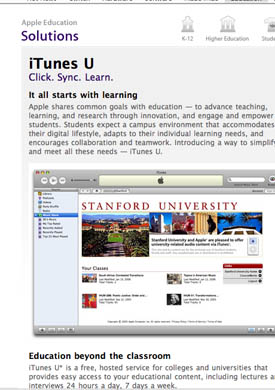 Since they are looking for a large scale roll out of iTunes U for 2006-07, and since we have many podcasting faculty here at USC, a group of us met with Apple reps yesterday.
Initially I was very skeptical about Apple’s further insinuation into the academy and yet, what iTunes U offers is a repository for instructors to store podcasts, with several components similar to courseware such as Blackboard. Apple stores the content on its servers but the university retains ownership. The service is fairly customizable–you can store audio, video with audio, slides with audio (aka enhanced podcasts) and text (but only in pdf). Then you populate the class via university course rosters, which are password protected.
There are also open access levels on which the university (or, say, the alumni association) can add podcasts of vodcasts of events. And it is free. At least for now — the rep got a little cagey when asked about how long this would be the case.
The point is to allow students to capture lectures and such on their iPods (or MP3 players) for the purposes of study and review. The rationale is that students are already extremely familiar with the technology so there is less of a learning curve (well, at least privileged students such as those at my institution are familiar).
What seems particularly interesting is that students can then either speed up the talk of the lecture without changing pitch (and lord knows there are some whose speaking I would love to accelerate) or, say, in the case of an ESL student, slow it down for better comprehension. Finally, there is space for students to upload their own work — podcasting has been assigned to some of our students already.
Part of me is concerned at further academic incorporation, but a lot more parts of me are thinking this is not only a chance to help less tech savvy profs employ the technology (the ease of collecting and distributing assets is germane here) while also really pushing the envelope in terms of copyright, educational use, fair use, etc. Apple wants to only use materials that are in the public domain or creative commons initially, but undoubtedly some of the more muddy digital use issues will arise and it would be nice to have academics involved in the process.
presidents’ day
Few would disagree that Presidents’ Day, though in theory a celebration of the nation’s highest office, is actually one of our blandest holidays — not so much about history as the resuscitation of commerce from the post-holiday slump. Yesterday, however, brought a refreshing change.

Spending the afternoon at the institute was Holly Shulman, a historian from the University of Virginia well known among digital scholarship circles as the force behind the Dolley Madison Project — a comprehensive online portal to the life, letters and times of one of the great figures of the early American republic. So, for once we actually talked about presidential history on Presidents’ Day — only, in this case from the fascinating and chronically under-studied spousal perspective.
Shulman came to discuss possible collaboration on a web-based history project that would piece together the world of America’s founding period — specifically, as experienced and influenced by its leading women. The question, in terms of form, was how to break out of the mould of traditional web archives, which tend to be static and exceedingly hierarchical, and tap more fully into the energies of the network? We’re talking about something you might call open source scholarship — new collaborative methods that take cues from popular social software experiments like Wikipedia, Flickr and del.icio.us yet add new layers and structures that would better ensure high standards of scholarship. In other words: the best of both worlds.
Shulman lamented that the current generation of historians are highly resistant to the idea of electronic publication as anything more than supplemental to print. Even harder to swallow is the open ethos of Wikipedia, commonly regarded as a threat to the hierarchical authority and medieval insularity of academia.
Again, we’re reminded of how fatally behind the times the academy is in terms of communication — both communication among scholars and with the larger world. Shulman’s eyes lit up as we described the recent surge on the web of social software and bottom-up organizational systems like tagging that could potentially create new and unexpected avenues into history.
A small example that recurred in our discussion: Dolley Madison wrote eloquently on grief, mourning and widowhood, yet few would know to seek out her perspective on these matters. Think of how something like tagging, still in an infant stage of development, could begin to solve such a problem, helping scholars, students and general readers unlock the multiple facets of complex historical figures like Madison, and deepening our collective knowledge of subjects — like death and war — that have historically been dominated by men’s accounts. It’s a small example, but points toward something grand.
the bible on dvd: another weird embodiment of the book on screen
The bible has long been a driver of innovation in book design, and this latest is no exception: an ad I saw today on TV for the complete King James Bible on DVD. Not a film, mind you, but an interactive edition of the old and new testaments built around a graphical rendering of an old bible open on a lectern that the reader, uh viewer, uh… reader controls. Each page is synched up to a full-text narration in the “crystal clear, mellow baritone” of Emmy-winning Bible reader Stephen Johnston, along with assorted other actors and dramatic sound effects bringing the stories to life.
There’s the ad to the right (though when I saw it on BET the family was black). You can also download an actual demo (Real format) here. It’s interesting to see the interactivity of the DVD used to mimic a physical book — even the package is designed to suggest the embossed leather of an old bible, opening up to the incongruous sight of a pair of shiny CDs. More than a few analogies could be drawn to the British Library’s manuscript-mimicking “Turning the Pages,” which Sally profiled here last week, though here the pages replace each other with much less fidelity to the real.
There’s no shortage of movie dramatizations aimed at making the bible more accessible to churchgoers and families in the age of TV and the net. What the makers of this DVD seem to have figured out is how to combine the couch potato ritual of television with the much older practice of group scriptural reading. Whether or not you’d prefer to read the bible in this way, with remote control in hand, you can’t deny that it keeps the focus on the text.
Last week, Jesse argued that it’s not technology that’s causing a decline in book-reading, but rather a lack of new technologies that make books readable in the new communications environment. He was talking about books online, but the DVD bible serves just as well to illustrate how a text (a text that, to say the least, is still in high demand) might be repurposed in the context of newer media.
Another great driver of innovation in DVDs: pornography. No other genre has made more creative use of the multiple camera views options that can be offered simulataneously on a single film in the DVD format (I don’t have to spell out what for). They say that necessity is the mother of invention, and what greater necessities than sex and god? You won’t necessarily find the world’s most elegant design, but it’s good to keep track of these uniquely high-demand areas as they are consistently ahead of the curve.
travel blindness
I went to Paris last weekend. I have a friend there with an apartment, flights are cheap in the off season, and I’ve never been there before. As might have been expected, I learned absolutely nothing about France. But I did come away with a lot of food for thought about America – specifically, how books work in the United States. Says Gilles Deleuze: “travel does not connect places, but affirms only their difference.” He’s right: sometimes you needs to get away from a place to think about it.
Three observations, then, on how books work in the United States w/r/t my French observations. This post is perhaps less liberal in its interpretation of books than we usually are around here: bear with me for a bit, there’s still plenty of rampant generalizing.
* * * * *
Wandering around the Sorbonne, my friend & I came upon the Librerie Philosophique J. Vrin and went in. It’s a good-sized bookshop that’s devoted entirely to used and new philosophy books, mostly in French, although the neatly categorized shelves are noticeably peppered with other languages. On the Saturday evening I was there, it was full of browsing customers: it’s obviously a working bookstore. We don’t have philosophy book stores in the U.S. One finds, of course, no end of religious bookstores, but unless I’m tremendously mistaken, there’s none dedicated solely to philosophy. (And as far as I know, there’s only one poetry bookstore remaining in the U.S.)
It’s a(n admittedly minor) shock to find oneself in a philosophy bookstore. But a deeper question tugs at me: why aren’t there philosophy book stores in the United States? I’m certainly not qualified to judge what the existence of J. Vrin says about France, but its lack of an analogue in the U.S. clearly says something (besides the obvious “the market won’t support it”). Are we not thinking about big ideas and shipping them about in books? Are the only people who need to read Plato our neocon overlords? Why don’t we need books like these?
* * * * *
Another thing you notice at J. Vrin, as well as elsewhere in Paris: how monotone the books are. It’s not quite a color-coordinated bookstore but it’s close: just about every spine is white, a smaller number being yellow, a smattering of other colors. If you pull a book out, the cover designs are mostly in a classic French style: lots of space, Didot type, some discreet flourishes. These two are typical:

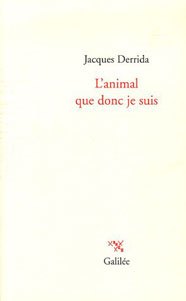
I’m not tremendously interested in French book style of itself, though: I’m more interested in what this minimalist tendency reveals about American book design and the ideas behind it. A trio of comparisons: the French on the left of each pair, the American on the right:

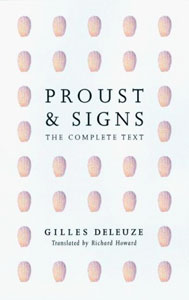
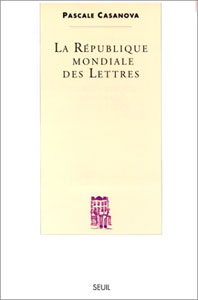
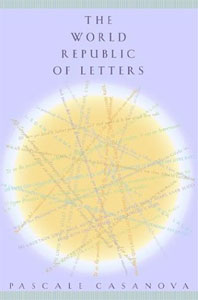

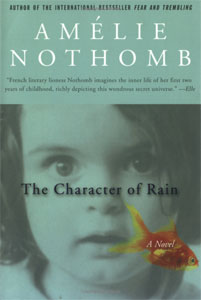
The American covers seem more designed – not necessarily better designed, that goes both ways – but they clearly exist as marketing. The French book covers aren’t advertising in the same way that the American book covers are. The implication here seems to be that French books are for reading, rather than for looking at. Nobody’s going to pick up one of those because of the way the cover looks. It’s presumed that the reader is already interested in the content of the book; what’s on the cover won’t change that interest. There’s a lot more variety in the American books: I might be persuaded to pick up the Deleuze book on Proust (where the quotation above came from) because it looks nice, or dissuaded from picking up the Amélie Nothomb book because it looks so horrible & the title was mangled into something out of Crate & Barrel.
 There’s an essay by Jan Tschichold, the doyen of modern book design, advising the reader that the jacket of a hardcover book should be taken off and thrown away as soon as you get the book home. This seems heretical to a book collector (or designer), but I think his point ultimately makes sense: books shouldn’t exist as art objects, they exist to be read. Design should focus attention on, not deflect attention from, the ideas in the book. American book design has drifted away from that precept. (Tschichold, were he still alive, might argue that it’s failed entirely: that essay appears in a book titled The Form of the Book: Essays on the Morality of Good Design which has hardened into an art object: get a used copy for $102.50.)
Probably I didn’t need to go to France to figure this out: scrutinizing the Spanish and Bangla bookshops and bookcarts in my neighborhood reveals book covers that are closer to French than American design.
* * * * *
Back to advertising: in the windows of wine bars, one sees volumes of Deleuze and Julia Kristeva, not exactly what we usually construe as light café reading. These books are cultural signifiers: presumably the right sort of passersby see them and understand that the winebar is the right sort of place for people like them. Could you do this in the U.S.? You could; by putting Stanley Cavell and Peter Singer in the window, I suspect that you’d attract a lot of confusion and maybe, if you were lucky, some shabby grad students. In Paris: pretty people. (Are they actually interested in Kristeva and Deleuze, or are they just interested in the wine? Again: no idea.)
It’s worth pointing out that Paris didn’t seem technologically reactionary to me: books haven’t succeeded at the expense of newer media. Paris is full of wireless, for example, and URLs are splattered all over advertisements. If anything, books seem to have succeeded with new media: a casual flip through the enormous number of channels on my friend’s television yielded a couple of book review programs. Again: books are part of the cultural discourse there in a way that isn’t the case here.
* * * * *
I haven’t mentioned snobbery yet, though that’s obviously an essential part of this discourse. No one imagines that the majority of the French care that much about Derrida, and it’s clear the French have their own problems which don’t need my interpretations. And more importantly: it would be foolish to jump to the conclusion that America is anti-literary. I’m reminded of the bit in Proust’s Time Regained where the Baron de Charlus, equally drawn to both sides in WWI, declares himself pro-German because he’s surrounded by people parroting pro-French platitudes and he can’t stand them. I won’t deny that there’s a little bit of Charlus in my stance. But I do think that the lens of snobbery can be a useful way to scrutinize how cultural capital works, and this analysis can be broadened to look at the sort of big-picture questions we’re interested in at the Institute. Nor am I the only one who’s noticed this: a better analysis than my own can be found in Pascale Casanova’s The World Republic of Letters (depicted above in both French and American editions), a book from a few years ago:
. . . New York and London cannot be said to have replaced Paris in the structure of literary power: one can only note that, as a result of the generalization of the Anglo-American model and the growing influence of financial considerations, these two capitals tend to acquire more and more power in the literary world. But one must not oversimplify the situation by applying a political analysis that opposes Paris to New York and London, or France to the United States.”
(p. 168.) Casanova’s book is a nice (and readable) study of how literature functions globally as cultural capital; this review by William Deresiewicz in The Nation is a serviceable introduction. It’s a useful text for thinking about how big ideas have historically been “legitimated” (her term) and disseminated. Along the way, she can’t help but make a strong case for Paris being the historic arbiter of much of the world’s taste: Joyce, Faulkner, Borges, Wiesel (a list which could be extended at length) all first came to global prominence through French interest.
Another reminder that things are different in different countries: earlier this week, Pedro Meyer, the Mexican photographer who runs ZoneZero had a long lunch with the Institute, where he reiterated that the way books function in the U.S. is not necessarily the way they function in Latin America, where books are much scarcer and bookshops generally nonexistent. Meyer’s concerns echo those of Nigerian writer Chinua Achebe who blisters at American critics arguing that African novels are universal, only with different names:
“Does it ever occur to these [academics] to try out their game of changing names of characters and places in an American novel, say, a Philip Roth or an Updike, and slotting in African names just to see how it works? But of course it would not occur to them. It would never occur to them to doubt the universality of their own literature. In the nature of things the work of a Western writer is automatically informed by universality. It is only others who must strain to achieve it . . . I should like to see the word ‘universal’ banned altogether from discussions of African literature until such time as people cease to use it as a synonym for the narrow, self-serving parochialism of Europe, until their horizon extends to include all the world.”
(p. 156 in Casanova.) Culture cuts both ways. It’s important to remember that the ways books (and, by extension, their electronic analogues) function in American society isn’t the only way they can or should function. We tend to fall into the assumption that there is no alternative to the way we live. This is myopia, a myopia we need to continually recognize.
lessig: read/write internet under threat
In an important speech to the Open Source Business Conference in San Francisco, Lawrence Lessig warned that decreased regulation of network infrastructure could fundamentally throw off the balance of the “read/write” internet, gearing the medium toward commercial consumption and away from creative production by everyday people. Interestingly, he cites Apple’s iTunes music store, generally praised as the shining example of enlightened digital media commerce, as an example of what a “read-only” internet might look like: a site where you load up your plate and then go off to eat alone.
Lessig is drawing an important connection between the question of regulation and the question of copyright. Initially, copyright was conceived as a way to stimulate creative expression — for the immediate benefit of the author, but for the overall benefit of society. But over the past few decades, copyright has been twisted by powerful interests to mean the protection of media industry business models, which are now treated like a sacred, inviolable trust. Lessig argues that it’s time for a values check — time to return to the original spirit of copyright:
It’s never been the policy of the U.S. government to choose business models, but to protect the authors and artists… I’m sure there is a way for [new models to emerge] that will let artists succeed. I’m not sure we should care if the record companies survive. They care, but I don’t think the government should.
Big media have always lobbied for more control over how people use culture, but until now, it’s largely been through changes to the copyright statutes. The distribution apparatus — record stores, booksellers, movie theaters etc. — was not a concern since it was secure and pretty much by definition “read-only.” But when we’re dealing with digital media, the distribution apparatus becomes a central concern, and that’s because the apparatus is the internet, which at present, no single entity controls.
Which is where the issue of regulation comes in. The cable and phone companies believe that since it’s through their physical infrastructure that the culture flows, that they should be able to control how it flows. They want the right to shape the flow of culture to best fit their ideal architecture of revenue. You can see, then, how if they had it their way, the internet would come to look much more like an on-demand broadcast service than the vibrant two-way medium we have today: simply because it’s easier to make money from read-only than from read/write — from broadcast than from public access.”
Control over culture goes hand in hand with control over bandwidth — one monopoly supporting the other. And unless more moderates like Lessig start lobbying for the public interest, I’m afraid our government will be seduced by this fanatical philosophy of control, which when aired among business-minded people, does have a certain logic: “It’s our content! Our pipes! Why should we be bled dry?” It’s time to remind the media industries that their business models are not synonymous with culture. To remind the phone and cable companies that they are nothing more than utility companies and that they should behave accordingly. And to remind the government who copyright and regulation are really meant to serve: the actual creators — and the public.
yahoo! ui design library
 There are several reasons that Yahoo! released some of their core UI code for free. A callous read of this would suggest that they did it to steal back some goodwill from Google (still riding the successful Goolge API release from 2002). A more charitable soul could suggest that Yahoo! is interested in making the web a better place, not just in their market-share. Two things suggest this—the code is available under an open BSD license, and their release of design patterns. The code is for playing with; the design patterns for learning from.
The code is squarely aimed at folks like me who would struggle mightily to put together a default library to handle complex interactions in Javascript using AJAX (all the rage now) while dealing with the intricacies of modern and legacy browsers. Sure, I could pull together the code from different sources, test it, tweak it, break it, tweak it some more, etc. Unsurprisingly, I’ve never gotten around to it. The Yahoo! code release will literally save me at least a hundred hours. Now I can get right down to designing the interaction, rather than dealing with technology.
The design patterns library is a collection of best practice instructions for dealing with common web UI problems, providing both a solution and a rationale, with a detailed explanation of the interaction/interface feedback. This is something that is more familiar to me, but still stands as a valuable resource. It is a well-documented alternate viewpoint and reminder from a site that serves more users in one day than I’m likely to serve in a year.
Of course Yahoo! is hoping to reclaim some mind-space from Google with developer community goodwill. But since the code is general release, and not brandable in any particular way (it’s all under-the-hood kind of stuff), it’s a little difficult to see the release as a directly marketable item. It really just seems like a gift to the network, and hopefully one that will bear lovely fruit. It’s always heartening to see large corporations opening their products to the public as a way to grease the wheels of innovation.