who really needs to turn the pages?

The following post comes from my friend Sally Northmore, a writer and designer based in New York who lately has been interested in things like animation, video game theory, and (right up our alley) the materiality of books and their transition to a virtual environment. A couple of weeks ago we were talking about the British Library’s rare manuscript digitization project, “Turning the Pages” — something I’d been meaning to discuss here but never gotten around to doing. It turns out Sally had some interesting thoughts about this so I persuaded her to do a brief write-up of the project for if:book. Which is what follows below. Come to think of it, this is especially interesting when juxtaposed with Bob’s post earlier this week on Jefferson Han’s amazing gestural interface design. Here’s Sally… – Ben
The British Library’s collaboration with multimedia impresarios at Armadillo Systems has led to an impressive publishing enterprise, making available electronic 3-D facsimiles of their rare manuscript collection.
“Turning the Pages”, available in CD-ROM, online, and kiosk format, presents the digital incarnation of these treasured texts, allowing the reader to virtually “turn” the pages with a touch and drag function, “pore over” texts with a magnification function, and in some cases, access extras such as supplementary notes, textual secrets, and audio accompaniment.
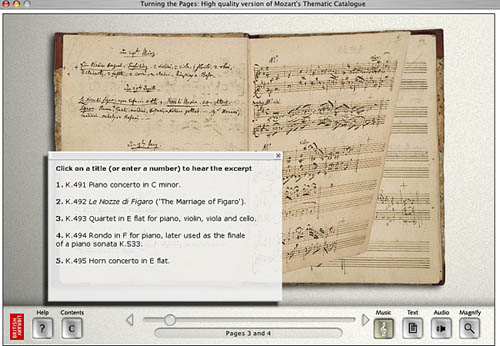
turning pages mozart.jpg
Pages from Mozart’s thematic catalogue — a composition notebook from the last seven years of his life. Allows the reader to listen to works being discussed.
The designers ambitiously mimicked various characteristics of each work in their 3-D computer models. For instance, the shape of a page of velum turning differs from the shape of a page of paper. It falls at a unique speed according to its weight; it casts a unique shadow. The simulation even allows for a discrepancy in how a page would turn depending on what corner of the page you decide to peel from.
Online visitors can download a library of manuscripts in Shockwave although these versions are a bit clunkier and don’t provide the flashier thrills of the enormous touch screen kiosks the British Library now houses.
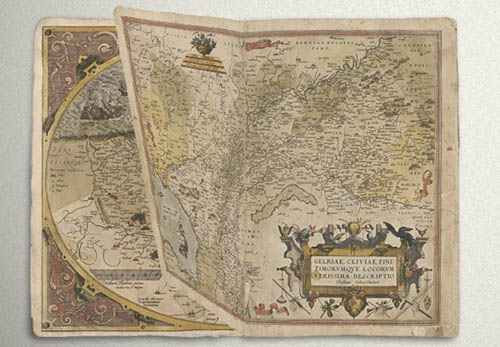
turning pages map.jpg
Mercator’s first atlas of Europe – 1570s
Online, the “Turning the Pages” application forces you to adapt to the nature of its embodiment–to physically re-learn how to use a book. A hand cursor invites the reader to turn each page with a click-and-drag maneuver of the mouse. Sounds simple enough, but I struggled to get the momentum of the drag just right so that the page actually turned. In a few failed attempts, the page lifted just so… only to fall back into place again. Apparently, if you can master the Carpal Tunnel-inducing rhythm, you can learn to manipulate the page-turning function even further, grabbing multiple of pages at once for a faster, abridged read.
The value of providing high resolution scans of rare editions of texts for the general public to experience, a public that otherwise wouldn’t necessarily ever “touch” say, the Lindisfarne Gospels, doesn’t go without kudos. Hey, democratic right? Armadillo Systems provides a list of compelling raisons d’ĂȘtre on their site to this effect. But the content of these texts is already available in reprintable (democratic!) form. Is the virtual page-turning function really necessary for greater understanding of these works, or a game of academic scratch-n-sniff?
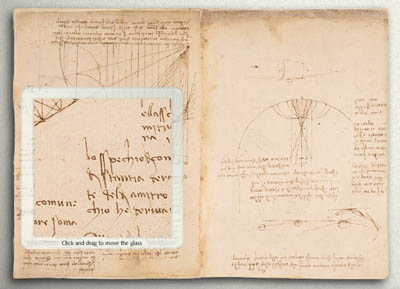
turning pages davinci.jpg
The “enlarge” function even allows readers to reverse the famous mirror writing in Leonardo da Vinci’s notebooks
At the MLA conference in D.C. this past December, where the British Library had set up a demonstration of “Turning the Pages”, this was the question most frequently asked of the BL’s representative. Who really needs to turn the pages? I learned from the rep’s response that, well, nobody does! Scholars are typically more interested studying the page, and the turning function hasn’t proven to enhance or revive scholarly exploration. And surely, the Library enjoyed plenty of biblio-clout and tourist traffic before this program?
But the lure of new, sexy technology can’t be underestimated. From what I understood, the techno-factor is an excellent beacon for attracting investors and funding in multimedia technology. Armadillo’s web site provides an interesting sales pitch:

By converting your manuscripts to “Turning the Pages” applications you can attract visitors, increase website traffic and add a revenue stream – at the same time as broadening access to your collection and informing and entertaining your audience.

The program reveals itself to be a peculiar exercise, tangled in its insistence on fetishizing aspects of the material body of the text–the weight of velum, the karat of gold used to illuminate, the shape of the binding. Such detail and love for each material manuscript went into this project to recreate, as best possible, the “feel” of handling these manuscripts.
Under ideal circumstances, what would the minds behind “Turning the Pages” prefer to create? The original form of the text–the “alpha” manuscript–or the virtual incarnation? Does technological advancement seduce us into valuing the near-perfect simulation over the original? Are we more impressed by the clone, the “Dolly” of hoary manuscripts? And, would one argue that “Turning the Pages” is the best proxy for the real thing, or, another “thing” entirely?
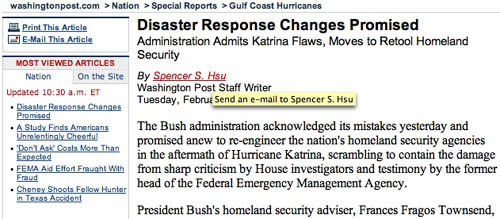

washington post and new york times hyperlink bylines

In an effort to more directly engage readers, two of America’s most august daily newspapers are adding a subtle but potentially significant feature to their websites: author bylines directly linked to email forms. The Post’s links are already active, but as of this writing the Times, which is supposedly kicking off the experiment today, only links to other articles by the same reporter. They may end up implementing this in a different way.
wapo email byline.jpg
screen grab from today’s Post
The email trial comes on the heels of two notoriously failed experiments by elite papers to pull readers into conversation: the LA Times’ precipitous closure, after an initial 24-hour flood of obscenities and vandalism, of its “wikatorials” page, which invited readers to rewrite editorials alongside the official versions; and more recently, the Washington Post’s shutting down of comments on its “post.blog” after experiencing a barrage of reader hate mail. The common thread? An aversion to floods, barrages, or any high-volume influx of unpredictable reader response. The email features, which presumably are moderated, seem to be the realistic compromise, favoring the trickle over the deluge.
In a way, though, hyperlinking bylines is a more profound development than the higher profile experiments that came before, which were more transparently about jumping aboard the wiki/blog bandwagon without bothering to think through the implications, or taking the time — as successful blogs and wikis must always do — to gradually build up an invested community of readers who will share the burden of moderating the discussion and keeping things reasonably clean. They wanted instant blog, instant wiki. But online social spaces are bottom-up enterprises: invite people into your home without any preexisting social bonds and shared values — and add to that the easy target of being a mass media goliath — and your home will inevitably get trashed as soon as word gets out.
Being able to email reporters, however, gets more at the root of the widely perceived credibility problem of newspapers, which have long strived to keep the human element safely insulated behind an objective tone of voice. It’s certainly not the first time reporters’ or columnists’ email addresses have been made available, but usually they get tucked away toward the bottom. Having the name highlighted directly beneath the headline — making the reporter an interactive feature of the article — is more genuinely innovative than any tacked-on blog because it places an expectation on the writers as well as the readers. Some reporters will likely treat it as an annoying new constraint, relying on polite auto-reply messages to maintain a buffer between themselves and the public. Others may choose to engage, and that could be interesting.

this is exciting.

every once in a while we see something that quickens the pulse. Jefferson Han, a researcher at NYU’s Computer Science Dept. has made a video showing a system which allows someone to manipulate objects in real time using all the fingers of both hands. watch the video and get a sense of what it will be like to be able to manipulate data in two and someday three dimensions by using intuitive body gestures.

reading fewer books

We’ve been working on our mission statement (another draft to be posted soon), and it’s given me a chance to reconsider what being part of the Institute for the Future of the Book means. Then, last week, I saw this: a Jupiter Research report claims that people are spending more time in front of the screen than with a book in their hand.

“the average online consumer spends 14 hours a week online, which is the same amount of time they watch TV.”

That is some 28 hours in front of a screen. Other analysts would say it’s higher, because this seems to only include non-work time. Of course, since we have limited time, all this screen time must be taking away from something else.
The idea that the Internet would displace other discretionary leisure activities isn’t new. Another report (pdf) from the Stanford Institute for the Quantitative Study of Society suggests that Internet usage replaces all sorts of things, including sleep time, social activities, and television watching. Most controversial was this report’s claim that internet use reduces sociability, solely on the basis that it reduces face-to-face time. Other reports suggest that sociability isn’t affected. (disclaimer – we’re affiliated with the Annenberg Center, the source of the latter report).
Regardless of time spent alone vs. the time spent face-to-face with people, the Stanford study is not taking into account the reason people are online. To quote David Weinberger:

“The real world presents all sorts of barriers that prevent us from connecting as fully as we’d like to. The Web releases us from that. If connection is our nature, and if we’re at our best when we’re fully engaged with others, then the Web is both an enabler and a reflection of our best nature.”
Fast Company

Hold onto that thought and let’s bring this back around to the Jupiter report. People use to think that it was just TV that was under attack. Magazines and newspapers, maybe, suffered too; their formats are similar to the type of content that flourishes online in blog and written-for-the-web article format. But books, it was thought, were safe because they are fundamentally different, a special object worthy of veneration.

“In addition to matching the time spent watching TV, the Internet is displacing the use of other media such as radio, magazines and books. Books are suffering the most; 37% of all online users report that they spend less time reading books because of their online activities.”

The Internet is acting as a new distribution channel for traditional media. We’ve got podcasts, streaming radio, blogs, online versions of everything. Why, then, is it a surprise that we’re spending more time online, reading more online, and enjoying fewer books? Here’s the dilemma: we’re not reading books on screens either. They just haven’t made the jump to digital.
While there has been a general decrease in book reading over the years, such a decline may come as a shocking statistic. (Yes, all statistics should be taken with a grain of salt). But I think that in some ways this is the knock of opportunity rather than the death knell for book reading.

…intensive online users are the most likely demographic to use advanced Internet technology, such as streaming radio and RSS.

So it is ‘technology’ that is keeping people from reading books online, but rather the lack of it. There is something about the current digital reading environment that isn’t suitable for continuous, lengthy monographs. But as we consider books that are born digital and take advantage of the networked environment, we will start to see a book that is shaped by its presentation format and its connections. It will be a book that is tailored for the online environment, in a way that promotes the interlinking of the digital realm, and incorporates feedback and conversation.
At that point we’ll have to deal with the transition. I found an illustrative quote, referring to reading comic books:

“You have to be able to read and look at the same time, a trick not easily mastered, especially if you’re someone who is used to reading fast. Graphic novels, or the good ones anyway, are virtually unskimmable. And until you get the hang of their particular rhythm and way of storytelling, they may require more, not less, concentration than traditional books.”
Charles McGrath, NY Times Magazine

We’ve entered a time when the Internet’s importance is shaping the rhythms of our work and entertainment. It’s time that books were created with an awareness of the ebb and flow of this new ecology—and that’s what we’re doing at the Institute.

quoting a quote

Bud Parr, author of the blog Chekhov’s Mistress and commenter on if:book, recently posted on a speech given by Susan Sontag, entitled “Literature is Freedom.”
Quoting, his favorite quote:

A writer, I think, is someone who pays attention to the world. That means trying to understand, take in, connect with, what wickedness human beings are capable of; and not be corrupted – made cynical, superficial – by this understanding.

Literature can tell us what the world is like.

Literature can give us standards and pass on deep knowledge, incarnated in language, in narrative.

Literature can train, and exercise, our ability to weep for those who are not us or ours.

At the institute, we often describe the “book” as both a vessel (technology) and text (information) especially as we work on revising our mission statement. Even so, and only speaking for myself, it is still very easy to get caught up in things like networks, copyright policy, and Web 2.0, which are, of course, all important topics. Sontag’s quote is a good reminder of not just what resides in the vessel of the book, but why its contents are valuable.

an argument for net neutrality

Ten years after the initial signing of the Telecommunications Act of 1996, Congress is considering amending it. The original intention of the legislation was to increase competition by deregulating the telecommunication industry. The effects were gigantic, with a main result being that Regional Baby Operating Companies (RBOCs or Baby Bells) formed after the break up of the Ma Bell in 1984, merged into a handful of companies. Verzion nee Bell Atlantic, GTE, and NYNEX. SBC nee Southwestern Bell, PacTel, and Ameritech. Only now, these handful of companies operate with limited regulation.
On Tuesday, Congress heard arguments on the future of pricing broadband access. The question at hand is net neutrality, which is the idea that data transfer should have a single price, regardless of the provider, type or content of media being downloaded or uploaded. Variable pricing would have an effect on Internet companies as Amazon.com that use broadband networks for distributing their services as well as individuals. Cable companies and telecos such as Verizon, Comcast, Bell South, and AT&T are now planing to roll out tiered pricing. Under these new schemes, fees would be higher access to high-speed networks or certain services as downloading movies. Another intention is to charge different rates for downloading email, video, or games.
The key difference between opponents and proponents of net neutrality is their definition of innovation, and who benefits from that innovation. The broadband providers argue that other companies benefit from using their data pipes. They claim that by not being able to profit more from their networks, their incentive to innovate, that is, upgrade their systems, will decrease. While on the other side, firms as Vonage and Google argue the opposite, that uniform access spurs innovation, in terms of novel uses for the network. These kinds of innovations (video on demand) provide useful new services for the public, and in turn increase demand for the broadband providers.
byron.jpgFirst, it is crucial to point that all users are paying for access now. Sen. Byron Dorgan of North Dakota noted:

”It is not a free lunch for any one of these content providers. Those lines and that access is being paid for by the consumer.”

Broadband providers argue that tiered pricing (whether for services or bandwidth) will increase innovation. This argument is deeply flawed. Tier-pricing will not guarntee new and useful services for users, but it will guarantee short term financial gains for the providers. These companies did not invent the Internet nor did they invent the markets for these services. Innovative users (both customers and start-ups) discovered creative ways to use the network. The market for broadband (and the subsequent network) exists because people outgrew the bandwidth capacity of dial-up, as more companies and people posted multimedia on the web. Innovation of this sort creates new demands for bandwidth and increases the customer base and revenue for the broadband providers. New innovative uses generally demand more bandwidth, as seen in p2p, video google, flickr, video ipods, and massively multiplayer online role playing games.
Use of the internet and the WWW did not explode for the mainstream consumer until ISPs as AOL moved to a flat fee pricing structure for their dial-up access. Before this period, most of the innovation of use came from the university, not only researchers, but students who had unlimited access. For these students, they ostensibly paid a flat fee what was embedded in their tuition. The low barrier of access in the early 1990s was essential in the creation of a culture of use that established the current market for Internet services that these broadband providers currently hope to restructure in price.
eric.jpgProf. Eric Von Hippel of MIT’s Sloan School of Management, author of the book, Democratizing Innovation, has done extensive research on innovation. He has found that users innovation a great deal, and much of it is underreported by the industries that capitalize on these improvements to their technology. An user innovator tends to have one great innovation. Therefore, a fundamental requirement for user innovation is offering access to the largest possible audience. In this context, everyone can benefit from net neutrality.
Tiered-pricing proponents argue that charging customers with limited download needs the same rates is unfair. This idea does not consider that the under-utilizers benefit overall from the innovations created by the over-utilizers. In a way, the under-utitlizers subsidize research for services they may use in the future. For example, the p2p community has created proven models and markets of sharing (professional or amateur) movies before the broadband providers (who also strive to become content providers.)
Maintaining democratic access will only fuel innovation, which will create new uses and users. New users translates into growing revenue for the broadband services. These new demands will also create an economic incentive to upgrade and maintain broadband providers’ networks. The key questions that Congress needs to ask itself, is who had been doing the most innovation in the last twenty years and what supported that innovation?

can there be a compromise on copyright?

The following is a response to a comment made by Karen Schneider on my Monday post on libraries and DRM. I originally wrote this as just another comment, but as you can see, it’s kind of taken on a life of its own. At any rate, it seemed to make sense to give it its own space, if for no other reason than that it temporarily sidelined something else I was writing for today. It also has a few good quotes that might be of interest. So, Karen said:

I would turn back to you and ask how authors and publishers can continue to be compensated for their work if a library that would buy ten copies of a book could now buy one. I’m not being reactive, just asking the question–as a librarian, and as a writer.

This is a big question, perhaps the biggest since economics will define the parameters of much that is being discussed here. How do we move from an old economy of knowledge based on the trafficking of intellectual commodities to a new economy where value is placed not on individual copies of things that, as a result of new technologies are effortlessly copiable, but rather on access to networks of content and the quality of those networks? The question is brought into particularly stark relief when we talk about libraries, which (correct me if I’m wrong) have always been more concerned with the pure pursuit and dissemination of knowledge than with the economics of publishing.
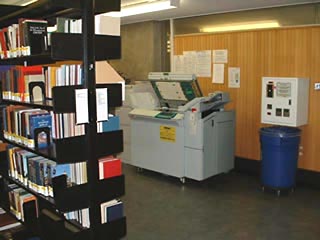
library xerox.jpg Consider, as an example, the photocopier — in many ways a predecessor of the world wide web in that it is designed to deconstruct and multiply documents. Photocopiers have been unbundling books in libraries long before there was any such thing as Google Book Search, helping users break through the commodified shell to get at the fruit within.
I know there are some countries in Europe that funnel a share of proceeds from library photocopiers back to the publishers, and this seems to be a reasonably fair compromise. But the role of the photocopier in most libraries of the world is more subversive, gently repudiating, with its low hum, sweeping light, and clackety trays, the idea that there can really be such a thing as intellectual property.
That being said, few would dispute the right of an author to benefit economically from his or her intellectual labor; we just have to ask whether the current system is really serving in the authors’ interest, let alone the public interest. New technologies have released intellectual works from the restraints of tangible property, making them easily accessible, eminently exchangable and never out of print. This should, in principle, elicit a hallelujah from authors, or at least the many who have written works that, while possessed of intrinsic value, have not succeeded in their role as commodities.
But utopian visions of an intellecutal gift economy will ultimately fail to nourish writers who must survive in the here and now of a commercial market. Though peer-to-peer gift economies might turn out in the long run to be financially lucrative, and in unexpected ways, we can’t realistically expect everyone to hold their breath and wait for that to happen. So we find ourselves at a crossroads where we must soon choose as a society either to clamp down (to preserve existing business models), liberalize (to clear the field for new ones), or compromise.
In her essay “Books in Time,” Berkeley historian Carla Hesse gives a wonderful overview of a similar debate over intellectual property that took place in 18th Century France, when liberal-minded philosophes — most notably Condorcet — railed against the state-sanctioned Paris printing monopolies, demanding universal access to knowledge for all humanity. To Condorcet, freedom of the press meant not only freedom from censorship but freedom from commerce, since ideas arise not from men but through men from nature (how can you sell something that is universally owned?). Things finally settled down in France after the revolution and the country (and the West) embarked on a historic compromise that laid the foundations for what Hesse calls “the modern literary system”:

The modern “civilization of the book” that emerged from the democratic revolutions of the eighteenth century was in effect a regulatory compromise among competing social ideals: the notion of the right-bearing and accountable individual author, the value of democratic access to useful knowledge, and faith in free market competition as the most effective mechanism of public exchange.

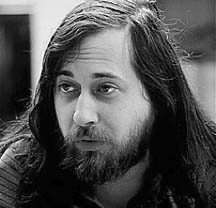
Barriers to knowledge were lowered. A system of limited intellectual property rights was put in place that incentivized production and elevated the status of writers. And by and large, the world of ideas flourished within a commercial market. But the question remains: can we reach an equivalent compromise today? And if so, what would it look like? stallman.jpg Creative Commons has begun to nibble around the edges of the problem, but love it as we may, it does not fundamentally alter the status quo, focusing as it does primarily on giving creators more options within the existing copyright system.
Which is why free software guru Richard Stallman announced in an interview the other day his unqualified opposition to the Creative Commons movement, explaining that while some of its licenses meet the standards of open source, others are overly conservative, rendering the project bunk as a whole. For Stallman, ever the iconoclast, it’s all or nothing.
But returning to our theme of compromise, I’m struck again by this idea of a tax on photocopiers, which suggests a kind of micro-economy where payments are made automatically and seamlessly in proportion to a work’s use. Someone who has done a great dealing of thinking about such a solution (though on a much more ambitious scale than library photocopiers) is Terry Fisher, an intellectual property scholar at Harvard who has written extensively on practicable alternative copyright models for the music and film industries (Ray and I first encountered Fisher’s work when we heard him speak at the Economics of Open Content Symposium at MIT last month).
FisherPhoto6.jpg The following is an excerpt from Fisher’s 2004 book, “Promises to Keep: Technology, Law, and the Future of Entertainment”, that paints a relatively detailed picture of what one alternative copyright scheme might look like. It’s a bit long, and as I mentioned, deals specifically with the recording and movie industries, but it’s worth reading in light of this discussion since it seems it could just as easily apply to electronic books:

….we should consider a fundamental change in approach…. replace major portions of the copyright and encryption-reinforcement models with a variant of….a governmentally administered reward system. In brief, here’s how such a system would work. A creator who wished to collect revenue when his or her song or film was heard or watched would register it with the Copyright Office. With registration would come a unique file name, which would be used to track transmissions of digital copies of the work. The government would raise, through taxes, sufficient money to compensate registrants for making their works available to the public. Using techniques pioneered by American and European performing rights organizations and television rating services, a government agency would estimate the frequency with which each song and film was heard or watched by consumers. Each registrant would then periodically be paid by the agency a share of the tax revenues proportional to the relative popularity of his or her creation. Once this system were in place, we would modify copyright law to eliminate most of the current prohibitions on unauthorized reproduction, distribution, adaptation, and performance of audio and video recordings. Music and films would thus be readily available, legally, for free.
Painting with a very broad brush…., here would be the advantages of such a system. Consumers would pay less for more entertainment. Artists would be fairly compensated. The set of artists who made their creations available to the world at large–and consequently the range of entertainment products available to consumers–would increase. Musicians would be less dependent on record companies, and filmmakers would be less dependent on studios, for the distribution of their creations. Both consumers and artists would enjoy greater freedom to modify and redistribute audio and video recordings. Although the prices of consumer electronic equipment and broadband access would increase somewhat, demand for them would rise, thus benefiting the suppliers of those goods and services. Finally, society at large would benefit from a sharp reduction in litigation and other transaction costs.

While I’m uncomfortable with the idea of any top-down, governmental solution, this certainly provides food for thought.

harper-collins half-heartedly puts a book online

As noted in The New York Times, Harper-Collins has put the text of Bruce Judson’s Go It Alone: The Secret to Building a Successful Business on Your Own online; ostensibly this is a pilot for more books to come.

Harper-Collins isn’t doing this out of the goodness of their hearts: it’s an ad-supported project. Every page of the book (it’s paginated in exactly the same way as the print edition) bears five Google ads, a banner ad, and a prominent link to buy the book at Amazon. Visiting Amazon suggests other motives for Harper-Collins’s experiment: new copies are selling for $5.95 and there are no reader reviews of the book, suggesting that, despite what the press would have you believe, Judson’s book hasn’t attracted much attention in print format. Putting it online might not be so much of a brave pilot program as an attempt to staunch the losses for a failed book.

Certainly H-C hasn’t gone to a great deal of trouble to make the project look nice. As mentioned, the pagination is exactly the same as the print version; that means that you get pages like this, which start mid-sentence and end mid-sentence. While this is exactly what print books do, it’s more of a problem on the web: with so much extraneous material around it, it’s more difficult for the reader to remember where they were. It wouldn’t have been that hard to rebreak the book: on page 8, they could have left the first line on the previous page with the paragraph it belongs too while moving the last line to the next page.

It is useful to have a book that can be searched by Google. One suspects, however, that Google would have done a better job with this.

DRM and the damage done to libraries

nypl.jpg
New York Public Library

A recent BBC article draws attention to widespread concerns among UK librarians (concerns I know are shared by librarians and educators on this side of the Atlantic) regarding the potentially disastrous impact of digital rights management on the long-term viability of electronic collections. At present, when downloads represent only a tiny fraction of most libraries’ circulation, DRM is more of a nuisance than a threat. At the New York Public library, for instance, only one “copy” of each downloadable ebook or audio book title can be “checked out” at a time — a frustrating policy that all but cancels out the value of its modest digital collection. But the implications further down the road, when an increasing portion of library holdings will be non-physical, are far more grave.
What these restrictions in effect do is place locks on books, journals and other publications — locks for which there are generally no keys. What happens, for example, when a work passes into the public domain but its code restrictions remain intact? Or when materials must be converted to newer formats but can’t be extracted from their original files? The question we must ask is: how can librarians, now or in the future, be expected to effectively manage, preserve and update their collections in such straightjacketed conditions?
This is another example of how the prevailing copyright fundamentalism threatens to constrict the flow and preservation of knowledge for future generations. I say “fundamentalism” because the current copyright regime in this country is radical and unprecedented in its scope, yet traces its roots back to the initially sound concept of limited intellectual property rights as an incentive to production, which, in turn, stemmed from the Enlightenment idea of an author’s natural rights. What was originally granted (hesitantly) as a temporary, statutory limitation on the public domain has spun out of control into a full-blown culture of intellectual control that chokes the flow of ideas through society — the very thing copyright was supposed to promote in the first place.
If we don’t come to our senses, we seem destined for a new dark age where every utterance must be sanctioned by some rights holder or licensing agent. Free thought isn’t possible, after all, when every thought is taxed. In his “An Answer to the Question: What is Enlightenment?” Kant condemns as criminal any contract that compromises the potential of future generations to advance their knowledge. He’s talking about the church, but this can just as easily be applied to the information monopolists of our times and their new tool, DRM, which, in its insidious way, is a kind of contract (though one that is by definition non-negotiable since enforced by a machine):

But would a society of pastors, perhaps a church assembly or venerable presbytery (as those among the Dutch call themselves), not be justified in binding itself by oath to a certain unalterable symbol in order to secure a constant guardianship over each of its members and through them over the people, and this for all time: I say that this is wholly impossible. Such a contract, whose intention is to preclude forever all further enlightenment of the human race, is absolutely null and void, even if it should be ratified by the supreme power, by parliaments, and by the most solemn peace treaties. One age cannot bind itself, and thus conspire, to place a succeeding one in a condition whereby it would be impossible for the later age to expand its knowledge (particularly where it is so very important), to rid itself of errors, and generally to increase its enlightenment. That would be a crime against human nature, whose essential destiny lies precisely in such progress; subsequent generations are thus completely justified in dismissing such agreements as unauthorized and criminal.

We can only hope that subsequent generations prove more enlightened than those presently in charge.

GAM3R 7H30RY: part 2

Read Part 1
We had a highly productive face to face meeting with Ken this afternoon to review the prior designs and to try and develop, collaboratively, a solution based on the questions that arose from those designs. We were aiming for a solution that provides a compelling interface for Ken’s book and also encourages open-ended discussion of the themes and specific games treated in the book.
What we came up with was a prototype of a blog/book page that presents the entire text of GAM3R 7H30RY, and a discussion board based around the games covered in the book, each corresponding with a specific chapter. These are:

  • Allegory (on The Sims)
  • America (on Civilization III)
  • Analog (on Katamari Damarcy)
  • Atopia (on Vice City)
  • Battle (on Rez)
  • Boredom (on State of Emergency)
  • Complex (on Deus Ex)
  • Conclusions (on SimEarth)

Unlike the thousand of gaming forums that already exist throughout the web, this discussion space will invite personal and social points of view, rather than just walkthroughs and leveling up cheats.
We also discussed the fact that discussion boards tend towards opacity as they grow, and ways to alleviate that situation. Growth is good; it reflects a rich back and forth between board participants. Opacity is bad; it makes it harder for new voices to join the discussion. To make it easier for people to join the discussion, Ken envisioned an innovative gateway into the boards based on a shifting graph of topics ranked by post date (x-axis) and number of responses (y-axis). This solution was inspired in part by “The Pool” — “a collaborative online environment for creating art, code, and texts” developed by Jon Ippolito at the University of Maine — in which ideas and project proposals float in different regions of a two-dimensional graph depending on quantity and tenor of feedback from the collective.
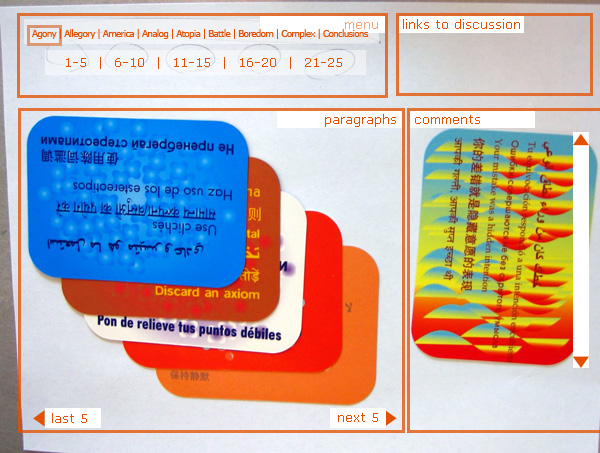
Returning to the book view, to push the boundaries of the blog form, we introduced a presentation format that uniquely fits around McKenzie’s book form—twenty-five regularly sized paragraphs in nine different chapters. Yes, each chapter has exactly 25 paragraphs, making mathematically consistent presentation possible (as an information designer I am elated at this systematic neatness). We decided on showing a cascade of five paragraphs, with one paragraph visible at a time, letting you navigate through chapters and then sets of five paragraphs within a chapter.
As a delightful aside, we started prototyping with a sheet of paper and index cards, but by some sideways luck we pulled out a deck of Brian Eno and Peter Schmidt’s Oblique Strategies cards, which suited our needs perfectly. The resulting paper prototype (photo w/ wireframe cues photoshop’d in):
IMG_0794.jpg
This project has already provided us with a rich discussion regarding authorship and feedback. As we develop the prototypes we will undoubtedly have more questions, but also, hopefully, more solutions that help us redefine the edges and forms of digital discourse.
Ben Vershbow contributed to this post.