
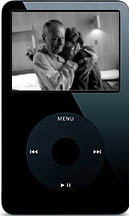
 Pedro Meyer’s I Photograph to Remember is a work originally designed for CD ROM, that became available on the Internet 10 years later. I find it not only beautiful within the medium limitations, as Pedro says on his 2001 comment, but actually perfectly suited for both, the original CD ROM, and its current home on the internet . It is a work of love, and as such it has a purity that transcends all media.
The photographs and their subject(s) have such degree of intimacy that forces the viewer to look inside and avoid all morbidity or voyeurism. The images are accompanied by Pedro Meyer’s voice. His narration, plain and to the point, is as photographic as the pictures are eloquent. The line between text and image is blurred in the most perfect b&w sense. The work evokes feelings of unconditional love, of hands held at moments of both weakness and strength, of happiness and sadness, of true friendship, which is the basis of true love. The whole experience becomes introspection, on the screen and in the mind of the viewer.
IPTR was originally a Voyager CD ROM, and it was the first ever produced with continuous sound and images, a possibility that completes, and complements, image as narration and vice-versa. The other day Bob Stein showed me IPTR on his iPod and expressed how perfectly it works on this handheld device. And, it does. IPTR is still a perfect object, and as those old photographs exist thanks to the magic of chemicals and light, this exists thanks to that “old” CD ROM technology, and will continue to exist inhabiting whatever medium necessary to preserve it.
 I’ve recently viewed Joan de Fontcuberta’s shows in two galleries in Manhattan; Zabriskie and Aperture,) and the connections between IPTR and these works became obsessive to me. Fontcuberta, also a photographer, has chosen the Internet, and computer technology, as the media for both projects. In “Googlegrams,” he uses the Google image search engine to randomly select images from the Internet by controlling the search engine criteria with only the input of specific key words.
These Google-selected images are then electronically assembled into a larger image, usually a photo, of Fontcuberta’s choosing (for example, the image of a homeless man sleeping on the sidewalk reassembled from images of the 24 richest people in the world, Lynddie England reassembled from images of the Abu Ghraib’s abuse, or a porno picture reassembled from porno sites.). The end result is an interesting metaphor for the Internet and the relationship between electronic mass media and the creation of our collective consciousness.
For Fontcuberta, the Internet is “the supreme expression of a culture which takes it for granted that recording, classifying, interpreting, archiving and narrating in images is something inherent in a whole range of human actions, from the most private and personal to the most overt and public.” All is mediated by the myriad representations on the global information space. As Zabriskie’s Press Release says, “the thousands of images that comprise the Googlegrams, in their diminutive role as tiles in a mosaic, become a visual representation of the anonymous discourse of the internet.”
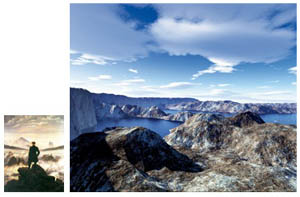 Aperture is showing Fontcuberta’s “Landscapes Without Memory” where the artist uses computer software that renders three-dimensional images of landscapes based on information scanned from two-dimensional sources (usually satellite surveys or cartographic data.) In “Landscapes of Landscapes” Fontcuberta feeds the software fragments of pictures by Turner, Cézanne, Dalí, Stieglitz, and others, forcing the program to interpret this landscapes as “real.”
These painted and photographic landscapes are transformed into three-dimensional mountains, rivers, valleys, and clouds. The result is new, completely artificial realities produced by the software’s interpretation of realities that have been already interpreted by the painters. In the “Bodyscapes” series, Fontcuberta uses the same software to reinterpret photographs of fragments of his own body, resulting in virtual landscapes of a new world. By fooling the computer Fontcuberta challenges the limits between art, science and illusion.
Both Pedro Meyer and Joan de Fontcuberta’s use of photography, technology and the Internet, present us with mediated worlds that move us to rethink the vocabulary of art and representation which are constantly enriched by the means by which they are delivered.
without gods: born again!
Unrest in the Middle East. Cartoons circulated and Danish flags set ablaze (who knew there were so many Danish flags?) A high-profile debate in the pages of the New York Times between a prominent atheist and a Judeo-Christian humanist. Another setback for the “intelligent design” folks, this time in Utah. Things have been busy of late. The world rife with conflict: belief and disbelief, secular pluralism and religious extremism, faith and reason, and all the hazy territory in between.
Mitchell Stephens, too, has been busy, grappling with all the above on Without Gods while trying to muster the opening chapters of his book — the blog serving as both helper and hindrance to his process (a fascinating paradox that haunts the book in the network). To reflect these busy times — and Mitch’s busy mind — the blog has undergone slight renovation, reflecting the busier layout of a newspaper while hopefully remaining accessible and easy to read.

There’s a tag cloud near the top serving as a sort of snapshot of Mitch’s themes and characters, while four topic areas to the side give the reader more options for navigating the site. In some ways the new design also reminds me of the clutter of a writer’s desk — a method-infused madness.
As templates were updated and wrinkles ironed out in the code, Mitch posted a few reflections on the pluses and pitfalls of this infant form, the blog:
Newspapers, too, began, in the 17th century, by simply placing short items in columns (in this case from top down). So it was possible to read on page four of a newspaper in England in 1655 that Cardinal Carassa is one of six men with a chance to become the next pope and then read on page nine of the same paper that Carassa “is newly dead.” Won’t we soon be getting similar chuckles out of these early blogs — where leads are routinely buried under supporting paragraphs; where whim is privileged, coherence discouraged; where the newly dead may be resurrected as one scrolls down.
Early newspapers eventually discovered the joys of what journalism’s first editor called a “continued relation.” Later they discovered layout.
Blogs have a lot of discovering ahead of them.
google: i’ll be your mirror
From notes accidentally published on Google’s website, leaked into the blogosphere (though here from the BBC): plans for the GDrive, a mirror of users’ hard drives.
With infinite storage, we can house all user files, including e-mails, web history, pictures, bookmarks, etc; and make it accessible from anywhere (any device, any platform, etc).
I just got a shiver — a keyhole glimpse of where this is headed. Google’s stock made a shocking dip last week after its Chief Financial Officer warned investors that growth of its search and advertising business would eventually slow down. The sudden panicked thought: how will Google realize its manifest destiny? You know: “organizing the world’s information and making it universally accessible (China notwithstanding) and useful”? How will it continue to feed itself?
Simple: storage.
Google, as it has already begun to do (Gmail, get off my back!), wants to organize our information and make it universally accessible and useful to us. No more worries about backing up data — Google’s got your back. No worries about saving correspondences — Google’s got those. They’ve got your shoebox of photographs, your file cabinet of old college papers, your bank records, your tax returns. All nicely organized and made incredibly useful.
But as we prepare for the upload of our lives, we might pause to ask: exactly how useful do we want to become?
RDF = bigger piles
Last week at a meeting of all the Mellon funded projects I heard a lot of discussion about RDF as a key technology for interoperability. RDF (Resource Description Framework) is a data model for machine readable metadata and a necessary, but not sufficient requirement for the semantic web. On top of this data model you need applications that can read RDF. On top of the applications you need the ability to understand the meaning in the RDF structured data. This is the really hard part: matching the meaning of two pieces of data from two different contexts still requires human judgement. There are people working on the complex algorithmic gymnastics to make this easier, but so far, it’s still in the realm of the experimental.
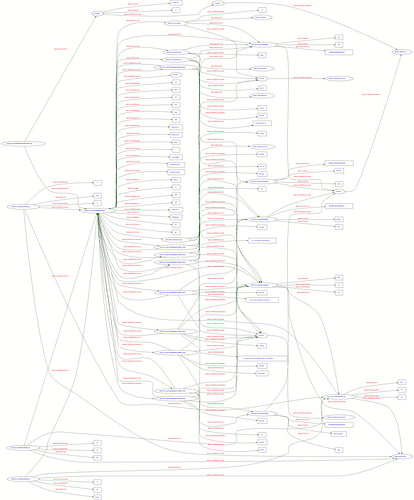
RDF graph of a Flickr Photo
So why pursue RDF? The goal is to make human knowledge, implicit and explicit, machine readable. Not only machine readable, but automatically shareable and reusable by applications that understand RDF. Researchers pursuing the semantic web hope that by precipitating an integrated and interoperable data environment, application developers will be able to innovate in their business logic and provide better services across a range of data sets.
Why is this so hard? Well, partly because the world is so complex, and although RDF is theoretically able to model an entire world’s worth of data relationships, doing it seamlessly is just plain hard. You can spend time developing a RDF representation of all the data in your world, then someone else will come along with their own world, with their own set of data relationships. Being naturally friendly, you take in their data and realize that they have a completely different view of the category “Author,” “Creator,” “Keywords,” etc. Now you have a big, beautiful dataset, with a thousand similar, but not equivalent pieces. The hard part—determining relationships between the data.
We immediately considered how RDF and Sophie would work. RDF importing/exporting in Sophie could provide value by preparing Sophie for integration with other RDF capable applications. But, as always, the real work is figuring out what it is that people could do with this data. Helping users derive meaning from a dataset begs the question: what kind of meaning are we trying to help them discover? A universe of linguistic analysis? Literary theory? Historical accuracy? I think a dataset that enabled all of these would be 90% metadata, and 10% data. This raises another huge issue: entering semantic metadata requires skill and time, and is therefore relatively rare.
In the end, RDF creates bigger, better piles of data—intact with provenance and other unique characteristics derived from the originating context. This metadata is important information that we’d rather hold on to than irrevocably discard, but it leaves us stuck with a labyrinth of data, until we create the tools to guide us out. RDF is ten years old, yet it hasn’t achieved the acceptance of other solutions, like XML Schemas or DTD’s. They have succeeded because they solve limited problems in restricted ways and require relatively simple effort to implement. RDF’s promise is that it will solve much larger problems with solutions that have more richness and complexity; but ultimately the act of determining meaning or negotiating interoperability between two systems is still a human function. The undeniable fact of it remains— it’s easy to put everyone’s data into RDF, but that just leaves the hard part for last.
if:book-back mountain: emergent deconstruction

It’s Oscar weekend, and everyone seems to be thinking and talking about movies, including myself. At the institute we often talk about the discourse afforded by changes in technology, and it seems to be apropos to take a look at new forms of discourse in area of movies. A month or so ago, I was sent the viral Internet link of the week. Someone made a parody of the Brokeback Mountain trailer by taking its soundtrack and tag lines and remixng them with scenes from the flight school action movie, Top Gun. Tom Cruise and Val Kilmer are recast as gay lovers, misunderstood in the world of air to air combat. The technique of remixing a new trailer first appeared in 2005, with clips from the Shining recut as a romantic comedy to hilarious effect. With spot-on voiceover and Peter Gabriel’s “Solsbury Hill” as music, it similarly circulated the Internet, while consuming office bandwidth. The first Brokeback parody is uncertain, however, it inspired the p2p/ mashup (although some purists question whether these trailers are true mashup) community to create dozens of trailers. Virginia Heffernan in the New York Times gives a very good overview of the phenomenon, including the depictions of Fight Club, Heat, Lord of the Rings, and Stars War as a gay love story.
Some spoofs work better than others. The more successful trailers establish the parallels between the loner hero archetype of film and the outsider qualities of gay life. For example, as noted by Heffernana, Brokeback Heat, with limited extra editing, transforms Al Pacino and Robert DeNiro from a detective and criminal into lovers, who wax philosophically on the intrinsic nature of their lives and their lack of desire to live another way. Or in Top Gun 2: Brokeback Squadron, Tom Cruise and Val Kilmer exist in their own hyper-masculine reality outside of the understanding of others, in particular their female romantic counterparts. In Back to the Future, the relationship of mentor and hero is reinterpreted as a cross generational romance. Lord of the Rings: Brokeback Mount Doom successfully captures the analogy between the perilous journey of the hero and the experience of the disenfranchised. Here, the quest of Sam and Frodo is inverted into the quest to find the love that dares not speak its name. The p2p/ mashup community had come to the same conclusion (to, at times, great comic effect) that the gay community arrived at long ago, that male bonding (and its Hollywood representation) has a homoerotic subtext.
The loner heros found in the the Brokeback Mountain remixes are of particular interest. Over time, the successful parodies deconstruct the Hollywood imagery of the hero, and subsequently distill the archetypes of cinema. This process of distillation identifies key elements of the male hero. The common traits of the hero being that he lies outside the mainstream, cannot fight his rebel “nature”, often uses the guidance of a mentor and must travel a perilous journey of self discovery all rise to the surface of these new media texts. The irony plays out, when their hyper-masculinity are juxtaposed next to identical references of the supposed taboo gay experience.
On the other hand, the Arrested Development version contains titles thanking the cast and producers of the cancelled series, clips of Jason Bateman’s television family suggesting his latent homosexuality, and the Brokeback Mountain theme music. The disparate pieces make less sense, rendering it ultimately less interesting as a whole. Likewise, Brokeback Ranger, a riff on Chuck Norris in the Walker, Texas Ranger television series, is a collection of clips of the Norris fighting and solving crimes, with the prerequisite music, and titles that describe Norris ironic superhuman abilities including dividing by zero. Again, the references are not of the hero archetype and the piece, although mildly humorous, has limited depth.
A potentially new form of discourse is being created, in which the archetypes of media text emerge from their repeated deconstruction and subsequent reconstruction. From these works, an understanding of the media text appears through an emergent deconstruction. In that, the individual efforts need not be conscious or even intended. Rather, the funniest and most compelling examples are the remixes which correctly identify and utilize the traditional conventions in the media text. Therefore, their success is directly correlated to their ability to correctly identify the archetype.
The users may not have prior knowledge of the ideas of the hero described by Carl Jung and Joseph Campbell’s The Hero with a Thousand Faces. Nor are they required to have read Umberto Eco’s deconstruction of James Bond, or Leslie Fiedler’s work on the homosexual subtext found in the novel. Further, each individual remix author does not need to set out to define the specific archetypes. What is most extraordinary is that their aggregate efforts gravitate towards the distilled archetype, in this case, the male bonding rituals of the hero in cinema. Some examples will miss the themes, which is inherent in all emergent systems. By the definition and nature of archetypes, the work that most resonate are the ones which most convincingly identify, reference, (and in this case, parody) the archetype. These analyses can be discovered by an individual, as Campbell, Eco, Jung and Fiedler did. Since their groundbreaking works, there is an abundance of deconstructing media text from the last fifty years. Here, the lack of intention, and the emergence of the archetypes through the aggregate is new. An important aspect of these aggregate analyses is that they could only come about through the wide availability of both access to the network and to digital video editing software.
At the institute, we expect that the dissemination of authoring tools and access to the network will lead to new forms of discourse and we look for occurrences of them. Emergent deconstruction is still in its early stages. I am excited by its prospects, but how far it can meaningfully grow is unclear. However, I do know that after watching thirty some versions of the Brokeback Mountain remixed trailers, I do not need to hear its moody theme music any more, but I suppose that is part of the process of emergent forms.
post-doc fellowships available for work with the institute
The Institute for the Future of the Book is based at the Annenberg Center for Communication at USC. Jonathan Aronson, the executive director of the center, has just sent out a call for eight post-docs and one visiting scholar for next year. if you know of anyone who would like to apply, particularly people who would like to work with us at the institute, please pass this on. the institute’s activities at the center are described as follows:
Shifting Forms of Intellectual Discourse in a Networked Culture
For the past several hundred years intellectual discourse has been shaped by the rhythms and hierarchies inherent in the nature of print. As discourse shifts from page to screen, and more significantly to a networked environment, the old definitions and relations are undergoing unimagined changes. The shift in our world view from individual to network holds the promise of a radical reconfiguration in culture. Notions of authority are being challenged. The roles of author and reader are morphing and blurring. Publishing, methods of distribution, peer review and copyright — every crucial aspect of the way we move ideas around — is up for grabs. The new digital technologies afford vastly different outcomes ranging from oppressive to liberating. How we make this shift has critical long term implications for human society.
Research interests include: how reading and writing change in a networked culture; the changing role of copyright and fair use, the form and economics of open-source content, the shifting relationship of medium to message (or form to content).
if you have any questions, please feel free to email bob stein
thinking about blogging 2: democracy
Banning books may be easy, but banning blogs is an exhausting game of Whack-a-Mole for politically repressive regimes like China and Iran.

Farid Pouya, recapping recent noteworthy posts from the Iranian blogosphere last week on Global Voices, refers to one blogger’s observations on the chilled information climate under president Mahmoud Ahmadinejad:
Andishe No (means New Thought) fears that country was pushed back to pre Khatami’s period concerning censorship. He believes that even if many books get banned in twenty first century, government can not stop people getting information. Government wants to control weblogs in Iran and put them in a guideline.
Unlike the fleas that swarm American media and politics, Iran’s cyber-dissidents frequently are the sole conduit for uncensored information — an underground army of chiseler’s, typing away at the barricades. Here we see the blog as a building block for civil society. Electronic samizdat. Basic life forms in a free media ecology, instilling new habits in both writers and readers: habits of questioning, of digging deeper. Individual sites may get shut down, individual bloggers may be jailed but the information finds a way.
Though the situation in Iran is far from enviable, there is something attractive about the moral clarity of its dissident blogging. If one wants the truth, one must find alternatives — it’s that simple. But with alternative media in the United States — where the media ecology is highly developed and corruption more subtle — it’s hard to separate the wheat from the chaff. Political blogs in America may resound with outrage and indignation, but it’s the kind that comes from a life of abundance. All too often, political discourse is not something that points toward action, but an idle picking at the carcass of liberty.
Sure, we’ve seen blogs make a difference in politics (Swift Boats, Rathergate, Trent Lott — 2004 was the “year of the blog”), but generally as a furtherance of partisan aims — a way of mobilizing the groundtroops within a core constituency that has already decided what it believes.

When one looks at this map (admittedly a year old) of the American political blogosphere, one notes with dismay that there are in fact two spheres, mapping out all too cleanly to the polarized reality on the ground. One begins to suspect that America’s political blogs are merely a pressure valve for a population that, though ill at ease, is still ultimately paralyzed.
the email tax: an internet myth soon to become true

After years as an Internet urban myth, the email tax appears to be close at hand. The New York TImes reports that AOL and Yahoo have partnered with startup Goodmail to start offering guaranteed delivery of mass email to organizations for a fee. Organizations with large email lists can pay to have their email go directly to AOL and Yahoo customers’ inboxes, bypassing spam filters. Goodmail claims that they will offer discounts to non-profits.
Moveon.org and the Electronic Frontier Foundation have joined together to create an alliance of nonprofit and public interest organizations to protest AOL’s plans. They argue that this two-tiered system will create an economic incentive to decrease investment into AOL’s spam filtering in order to encourage mass emailers to use the pay-to-deliver service. They have created an online petition called dearaol.com for people to request that AOL stop these plans. A similar protest to Yahoo who intends to launch this service after AOL is being planned as well. The alliance has created unusual bedfellows, including Gun Owners of America, AFL-CIO, Humane Society of United States and Human Rights Campaign, who are resisting the pressure to use this service.
Part of the leveling power of email is that the marginal cost of another email is effectively zero. By perverting this feature of email, smaller businesses, non-profits, and individuals will once again be put at a disadvantage to large affluent firms. Further, this service will do nothing to reduce spam, rather it is designed to help mass emailers. An AOL spokesman, Nicholas Graham is quoted as saying AOL will earn revenue akin to a “lemonade stand” which further questions by AOL would pursue this plan in the first place. Although the only affected parties will initially be AOL and Yahoo users, it sets a very dangerous precedent that goes against the democratizing spirit of the Internet and digital information.
blu-ray, amazon, and our mediated technology dependent lives
A couple of recent technology news items got me thinking about media and proprietary hardware. One was the New York Times report of Sony’s problems with its HD-DVD technology, Blu-Ray, which is causing them to delay the release of their next gaming system, the PS3. The other item was Amazon’s intention of entering the music subscription business in the Wall Street Journal.
The New York Times gives a good overview on the up coming battle of hardware formats for the next generation of high definition DVD players. It is the Betamax VHS war from the 80s all over again. This time around Sony’s more expensive / more capacity standard is pitted against Toshiba’s cheaper but limited HD-DVD standard. It is hard to predict an obvious winner, as Blu-Ray’s front runner position has been weaken by the release delays (implying some technical challenges) and the recent backing of Toshiba’s standard by Microsoft (and with them, ally Intel follows.) Last time around, Sony also bet on the similarly better but more expensive Betamax technology and lost as consumers preferred the cheaper, lesser quality of VHS. Sony is investing a lot in their Blu-Ray technology, as the PS3 will be founded upon Blu-Ray. The standards battle in the move from VHS to DVD was avoided because Sony and Philips decided to scrap their individual plans of releasing a DVD standard and they agreed to share in the revenue of licensing of the Toshiba / Warner Brothers standard. However, Sony feels that creating format standards is an area of consumer electronics where they can and should dominate. Competing standards is nothing new, and date back to at least to the decision of AC versus DC electrical current. (Edison’s preferred DC lost out to Westinghouses’ AC.) Although, it does provide confusion for consumers who must decide which technology to invest in, with the potential danger that it may become obsolete in a few years.
On another front, Amazon also recently announced their plans to release their own music player. In this sphere, Amazon is looking to compete with iTunes and Apple’s dominance in the music downloading sector. Initially, Apple surprised everyone with the foray into the music player and download market. What was even more surprising was they were able to pull it off, shown by their recent celebration of the 1 billionth downloaded song. Apple continues to command the largest market share, while warding off attempts from the likes of Walmart (the largest brick and mortar music retailer in the US.) Amazon is pursuing a subscription based model, sensing that Napster has failed to gain much traction. Because Amazon customers already pay for music, they will avoid Napster’s difficult challenge of convincing their millions of previous users to start paying for a service that they once had for free, albeit illegally. Amazon’s challenge will be to persuade people to rent their music from Amazon, rather than buy it outright. Both Real and Napster only have a fraction of Apple’s customers, however the subscription model does have higher profit margins than the pay per song of iTunes.
It is a logical step for Amazon, who sells large numbers of CDs, DVDs and portable music devices (including iPods.) As more people download music, Amazon realizes that it needs to protect its markets. In Amazon’s scheme, users can download as much music as they want, however, if they cancel their subscription, the music will no longer play on their devices. The model tests to see if people are willing to rent their music, just like they rent DVDs from Netflix or borrow books from the library. I would feel troubled if I didn’t outright own my music, however, I can see the benefits of subscribing to access music and then buying the songs that I liked. However, it appears that if you will not be able to store and play your own MP3s on the Amazon player and the iPod will certainly not be able to use Amazon’s service. Amazon and partner Samsung must create a device compelling enough for consumers drop their iPods. Because the iPod will not be compatible with Amazon’s service, Amazon may be forced to sell the players at heavy discounts or give them to subscribers for free, in a similar fashion to the cell phone business model. The subscription music download services have yet to create a player with any kind of social or technical cachet comparable to the cultural phenomenon of the iPod. Thus, the design bar has been set quite high for Amazon and Samsung. Amazon’s intentions highlight the issue of proprietary content and playback devices.
While all these companies jockey for position in the marketplace, there is little discussion on the relationship between wedding content to a particular player or reader. Print, painting, and photography do not rely on a separate device, in that the content and the displayer of the content, in other words the vessel, are the same thing. In the last century, the vessel and the content of media started to become discreet entities. With the development of transmitted media of recorded sound, film and television, content required a player and different manufacturers could produce vessels to play the content. Further, these new vessels inevitably require electricity. However, standards were formed so that a television could play any channel and the FM radio could play any FM station. Because technology is developing at a much faster rate, the battle for standards occur more frequently. Vinyl records reigned for decades where as CDs dominated for about ten years before MP3s came along. Today, a handful of new music compression formats are vying to replace MP3. Furthermore, companies from Microsoft and Adobe to Sony and Apple appear more willing to create proprietary formats which require their software or hardware to access content.
As more information and media (and in a sense, ourselves) migrate to digital forms, our reliance on often proprietary software and hardware for viewing and storage grows steadily. This fundamental shift on the ownership and control of content radically changes our relationship to media and these change receive little attention. We must be conscious of the implied and explicit contracts we agree to, as information we produce and consume is increasingly mediated through technology. Similarly, as companies develop vertical integration business models, they enter into media production, delivery, storage and playback. These business models create the temptation to start creating to their own content, and perhaps give preferential treatment to their internally produced media. (Amazon also has plans to produce and broadcast an Internet show with Bill Maher and various guests.) Both Amazon and Blu-Ray HD-DVD are just current examples content being tied to proprietary hardware. If information wants to be free, perhaps part of that freedom involves being independent from hardware and software.
thinking about blogging 1: process versus product
Thinking about blogging: where’s it’s been and where it’s going. Recently I found food for thought in a smart but ultimately misguided essay by Trevor Butterworth in the Financial Times. In it, he decries blogging as a parasitic binge:
…blogging in the US is not reflective of the kind of deep social and political change that lay behind the alternative press in the 1960s. Instead, its dependency on old media for its material brings to mind Swift’s fleas sucking upon other fleas “ad infinitum”: somewhere there has to be a host for feeding to begin. That blogs will one day rule the media world is a triumph of optimism over parasitism.
While his critique is not without merit, Butterworth ultimately misses the forest for the fleas, fixating on the extremes of the phenomenon — the tiny tier of popular “establishment” bloggers and the millions of obscure hacks endlessly recycling news and gossip — while overlooking the thousands of mid-level blogs devoted to specialized or esoteric subjects not adequately covered — or not covered at all — by the press. Technorati founder David Sifry recently dubbed this the “magic middle” of the blogosphere — that group of roughly 150,000 sites falling somewhere between the short head and the long tail of the popularity graph. Notable as the establishment bloggers are, I would argue that it’s the middle stratum that has done the most in advancing serious discourse online. Here we are not talking about antagonism between big and small media, but rather a filling out of the media ecosystem — where a proliferation of niches, like pixels on a screen, improves the resolution of our image of the world.
from On Poetry: A Rhapsody (1733)
So, naturalists observe, a flea
Hath smaller fleas that on him prey;
And these have smaller still to bite ’em;
And so proceed ad infinitum.
Thus every poet, in his kind,
Is bit by him that comes behind.
—Jonathan Swift
At their worst, bloggers — like Swift’s reiterative fleas — bounce ineffectually off the press’s opacities. But sometimes the collective feeding frenzy can expose flaws in the system. Moreover, there are some out there that have the knowledge and insight to decode what the press reports yet fails to adequately analyze. And there others still who are not tied so inexorably to the news cycle but follow their own daemon.
To me, Swift’s satire, while humorously portraying the endless cycle of literary derivation, also suggests a healthier notion of process — less parasitic and more cumulative. At best transformative. The natural accretion over time of ideas and tradition. It’s only natural that poets build — or feed — on the past. They feel the nip at their behinds. They channel and reinvent. As do scholars and philosophers.
But having some expertise and knowing how to craft a sentence does not necessarily mean one is meant to blog. In an amusing passage, Butterfield speculates on how things might how gone horribly awry had George Orwell (oft hailed as a proto-blogger) been given the opportunity to maintain a daily journal online (think tedious rambling on the virtues of English cuisine). Good blogging requires not only a voice, but a special commitment — a compulsion even — to air one’s thinking in real time. A relish for working through ideas in the open, often before they’re fully baked.
But evidently Butterfield hasn’t considered the merits of blogging as a process. He remains terminally hung up on the product, concluding that blogging “renders the word even more evanescent than journalism” and is “the closest literary culture has come to instant obsolescence.” Fine. Blogging is in many ways a vaporous pursuit, but then so is conversation — so is theatre. Blogging, in its essence, is about discussion and about working through ideas. And, I would argue, it is as much about reading as it is about writing.
Back in August, I wrote about this notion of the blog as a record of reading — an idea to which I still hold fast. The blog is a tool (for writers and readers alike) for dealing with information overload — for processing an unmanageable abundance of reading material. Most bloggers, the good ones anyway, not only point to links (though the good pointer sites like Arts & Letters Daily are invaluable), they comment upon them (as I am doing here), glossing them for their readers, often quoting at length. The blog captures that wave of energy emitted by the reader’s mind upon contact with an idea or story.
I do think blogging goes a significant ways toward the Enlightenment ideal of a reading public, even if only one percent of that public is worth reading. Hemingway famously said that he wrote 99 pages of crap for every one page of masterpiece. We should apply a similar math to blogs, and hope the tools for filtering out that 99 percent improve over time. After all, one percent of 28 million is no small number (about the population of Buffalo, NY). I’m confident that, in aggregate, this small democratic layer illumines more than it obscures, blazing trails of readings and fostering conversation. And this, I would venture — when combined and balanced with more traditional media sources — offers a more balanced reading diet.