
 Social bookmarking site del.icio.us announced last month that it will give people the option to make bookmarks private — for “those antisocial types who doesn’t like to share their toys.” This a sensible layer to add to the service. If del.icio.us really is to take over the function of local browser-based bookmarks, there should definitely be a “don’t share” option. A next, less antisocial, step would be to add a layer of semi-private sharing within defined groups — family, friends, or something resembling Flickr Groups.
Of course, considering that del.icio.us is now owned by Yahoo, the question of layers gets trickier. There probably isn’t a “don’t share” option for them.
(privacy matters 1)
privacy matters
In a recent post, Susan Crawford magisterially weaves together a number of seemingly disparate strands into a disturbing picture of the future of privacy, first looking at the still under-appreciated vulnerability of social networking sites. Recently ratcheted-up scrutiny on MySpace and other similar episodes suggest to Crawford that some sort of privacy backlash is imminent — a backlash, however, that may come too late.
The “too late” part concerns the all too likely event of a revised Telecommunications bill that will give internet service providers unprecedented control over what data flows through their pipes, and at what speed:
…all of the privacy-related energy directed at the application layer (at social networks and portals and search engines) may be missing the point. The real story in this country about privacy will be at a lower layer – at the transport layer of the internet. The pipes. The people who run the pipes, and particularly the last mile of those pipes, are anxious to know as much as possible about their users. And many other incumbents want this information too, like law enforcement and content owners. They’re all interested in being able to look at packets as they go by their routers, something that doesn’t traditionally happen on the traditional internet.
…and looking at them makes it possible for much more information to be available. Cisco, in particular, has a strategy it calls the “self-defending network,” which boils down to tracking much more information about who’s doing what. All of this plays on our desires for security – everyone wants a much more secure network, right?
Imagine an internet without spam. Sounds great, but at what price? Manhattan is a lot safer these days (for white people at least) but we know how Giuliani pulled that one off. By talking softly and carrying a big broom; the Disneyfication of Times Square etc. In some ways, Times Square is the perfect analogy for what America’s net could become if deregulated.

And we don’t need to wait for Congress for the deregulation to begin. Verizon was recently granted exemption from rules governing business broadband service (price controls and mandated network-sharing with competitors) when a deadline passed for the FCC to vote on a 2004 petition from Verizon to entirely deregulate its operations. It’s hard to imagine how such a petition must have read:
“Dear FCC, please deregulate everything. Thanks. –Verizon”
And harder still to imagine that such a request could be even partially granted simply because the FCC was slow to come to a decision. These people must be laughing very hard in a room very high up in a building somewhere. Probably Times Square.
Last month, when a federal judge ordered Google to surrender a sizable chunk of (anonymous) search data to the Department of Justice, the public outcry was predictable. People don’t like it when the government starts snooping, treading on their civil liberties, hence the ongoing kerfuffle over wiretapping. What fewer question is whether Google should have all this information in the first place. Crawford picks up on this:
…three things are working together here, a toxic combination of a view of the presidency as being beyond the law, a view by citizens that the internet is somehow “safe,” and collaborating intermediaries who possess enormous amounts of data.
The recent Google subpoena case fits here as well. Again, the government was seeking a lot of data to help it prove a case, and trying to argue that Google was essential to its argument. Google justly was applauded for resisting the subpoena, but the case is something of a double-edged sword. It made people realize just how much Google has on hand. It isn’t really a privacy case, because all that was sought were search terms and URLS stored by Google — no personally-identifiable information. But still this case sounds an alarm bell in the night.
New tools may be in the works that help us better manage our online identities, and we should demand that networking sites, banks, retailers and all the others that handle our vital stats be more up front about their procedures and give us ample opportunity to opt out of certain parts of the data-mining scheme. But the question of pipes seems to trump much of this. How to keep track of the layers…
Another layer coming soon to an internet near you: network data storage. Online services that do the job of our hard drives, storing and backing up thousands of gigabytes of material that we can then access from anywhere. When this becomes cheap and widespread, it might be more than our identities that’s getting snooped.
Amazon’s new S3 service charges 15 cents per gigabyte per month, and 20 cents per data transfer. To the frequently asked question “how secure is my data?” they reply:
Amazon S3 uses proven cryptographic methods to authenticate users. It is your choice to keep your data private, or to make it publicly accessible by third parties. If you would like extra security, there is no restriction on encrypting your data before storing it in S3.
Yes, it’s our choice. But what if those third parties come armed with a court order?
blogburst
A small Austin, TX-based company called Pluck is launching a new blog aggregation service called BlogBurst that will filter postings from hundreds of approved bloggers and syndicate their content to major news services (and eventually smaller niche publications as well). Tomorrow, BlogBurst lets rip its fire hose of content at a handful of major newspapers including USA Today publisher Gannett Co., The Washington Post, The San Francisco Chronicle, and local pubs The Austin American-Statesman and San Antonio Express. Some are calling this a further blurring of the boundary between mainstream and independent medias. Seems to me more like an expansion of the umbrella of the former and a buttressing of the oft-lamented “power law” with regard to the latter (how the most popular blogs get entrenched in an “A-list” in spite of popular belief a level playing field). The AP has more.
Any blogger can sign up with BlogBurst but some editorial body there decides which blogs go into the syndication feed. Presumably, if the thing takes off, they’ll start breaking it up into multiple feeds — some generalized, some specialized. Participating publishers are povided with “editorial management tools” called the “publisher workbench.” So if I’m a newspaper, I receive a daily dump of thousands of blog postings, broken down into different topic areas. I fiddle around with those in the workbench, choose the ones I want, and then plug them into various slots in my paper. Technically, it works like this (warning, acroynum blitz):
Content from the BlogBurst network is easily integrated into your site via simple JavaScript calls or robust SOAP or XML APIs.
Incidentally, the name blogburst is a bit of co-opted net jargon describing any coordinated effort by bloggers to flood the web with postings on a particular topic — usually some hot-button issue like the Jyllands-Posten Muhammad cartoons. Search “blogburst” today on Technorati and you’ll find a slew of right wing bloggers on a “guard the borders” rhetorical rampage (ha! idealistic me, I initially thought they meant the borders between mainstream and grassroots media!).
Meanwhile, as I write, thousands march down Broadway in New York — blogging, as it were, with their feet — in support of America’s illegal immigrants.
I wonder how the two-capital-Bs BlogBurst will deal with the political polarization of blogs.
corporate creep

smile for the network
A short article in the New York Times (Friday March 31, 2006, pg. A11) reported that the Smithsonian Institution has made a deal with Showtime in the interest of gaining an “active partner in developing and distributing [documentaries and short films].” The deal creates Smithsonian Networks, which will produce documentaries and short films to be released on an on-demand cable channel. Smithsonian Networks retains the right of first refusal to “commercial documentaries that rely heavily on Smithsonian collection or staff.” Ostensibly, this means that interviews with top personnel on broad topics is ok, but it may be difficult to get access to the paleobotanist to discuss the Mesozoic era. The most troubling part of this deal is that it extends to the Smithsonian’s collections as well. Tom Hayden, general manager of Smithsonian Networks, said the “collections will continue to be open to researchers and makers of educational documentaries.” So at least they are not trying to shut down educational uses of the these public cultural and scientific artifacts.
Except they are. The right of first refusal essentially takes the public institution and artifacts off the shelf, to be doled out only on approval. “A filmmaker who does not agree to grant Smithsonian Networks the rights to the film could be denied access to the Smithsonian’s public collections and experts.” Additionally, the qualifications for access are ill-defined: if you are making a commercial film, which may also be a rich educational resource, well, who knows if they’ll let you in. This is a blatant example of the corporatization of our public culture, and one that frankly seems hard to comprehend. From the Smithsonian’s mission statement:
The Smithsonian is committed to enlarging our shared understanding of the mosaic that is our national identity by providing authoritative experiences that connect us to our history and our heritage as Americans and to promoting innovation, research and discovery in science.
Hayden stated the reason for forming Smithsonian Networks is to “provide filmmakers with an attractive platform on which to display their work.” Yet, it was clearly stated by Linda St. Thomas, a spokeswoman for the Smithsonian, “if you are doing a one-hour program on forensic anthropology and the history of human bones, that would be competing with ourselves, because that is the kind of program we will be doing with Showtime On Demand.” Filmmakers are not happy, and this seems like the opposite of “enlarging our shared understanding.” It must have been quite a coup for Showtime to end up with stewardship of one of America’s treasured archives.
The application of corporate control over public resources follows the long-running trend towards privatization that began in the 80’s. Privatization assumes that the market, measured by profit and share price, provides an accurate barometer of success. But the corporate mentality towards profit doesn’t necessarily serve the best interest of the public. In “Censoring Culture: Contemporary Threats to Free Expression” (New Press, 2006), an essay by André Schiffrin outlines the effects that market orientation has had on the publishing industry:
As one publishing house after another has been taken over by conglomerates, the owners insist that their new book arm bring in the kind off revenue their newspapers, cable television networks, and films do….
To meet these new expectations, publishers drastically change the nature of what they publish. In a recent article, the New York Times focused on the degree to which large film companies are now putting out books through their publishing subsidiaries, so as to cash in on movie tie-ins.
The big publishing houses have edged away from variety and moved towards best-sellers. Books, traditionally the movers of big ideas (not necessarily profitable ones), have been homogenized. It’s likely that what comes out of the Smithsonian Networks will have high production values. This is definitely a good thing. But it also seems likely that the burden of the bottom line will inevitably drag the films down from a public education role to that of entertainment. The agreement may keep some independent documentaries from being created; at the very least it will have a chilling effect on the production of new films. But in a way it’s understandable. This deal comes at a time of financial hardship for the Smithsonian. I’m not sure why the Smithsonian didn’t try to work out some other method of revenue sharing with filmmakers, but I am sure that Showtime is underwriting a good part of this venture with the Smithsonian. The rest, of course, is coming from taxpayers. By some twist of profiteering logic, we are paying twice: once to have our resources taken away, and then again to have them delivered, on demand. Ironic. Painfully, heartbreakingly so.
the age of amphibians
 Momus is a Scottish pop musician, based in Berlin, who writes smart and original things about art and technology. He blogs a wonderful blog called Click Opera — some of the best reading on the web. He wears an eye patch. And he is currently doing a stint as an “unreliable tour guide” at the Whitney Biennial, roving through the galleries, sneaking up behind museum-goers with a bullhorn.
A couple of weeks ago, Dan had the bright idea of inviting Momus — seeing as he is currently captive in New York and interested, like us, in the human migration from analog to digital — to visit the institute. Knowing almost nothing about who we are or what we do, he bravely accepted the offer and came over to Brooklyn on one of the Whitney’s dark days and lunched at our table on the customary menu of falafel and babaganoush. Yesterday, he blogged some thoughts about our meeting.
Early on, as happens with most guests, Momus asked something along the lines of: “so what do you mean by ‘future of the book?'” Always an interesting moment, in a generally blue-sky, thinky endeavor such as ours, when you’re forced to pin down some specifics (though in other areas, like Sophie, it’s all about specifics). “Well,” (some clearing of throats) “what we mean is…” “Well, you see, the thing you have to understand is…” …and once again we launch into a conversation that seems to lap at the edges of our table with tide-like regularity. Overheard:
“Well, we don’t mean books in the literal sense…”
“The book at its most essential: an instrument for moving big ideas.”
“A sustained chunk of thought.”
And so it goes… In the end, though, it seems that Momus figured out what we were up to, picking up on our obsession with the relationship between books and conversation:
It seems they’re assuming that the book itself is already over, and that it will survive now as a metaphor for intelligent conversation in networks.
It’s always interesting (and helpful) to hear our operation described by an outside observer. Momus grasped (though I don’t think totally agreed with) how the idea of “the book” might be a useful tool for posing some big questions about where we’re headed — a metaphorical vessel for charting a sea of unknowns. And yet also a concrete form that is being reinvented.
Another choice tidbit from Momus’ report — the hapless traveler’s first encounter with the institute:
I found myself in a kitchen overlooking the sandy back courtyard of a plain clapperboard building on North 7th Street. There were about six men sitting around a kidney-shaped table. One of them was older than the others and looked like a delicate Vulcan. “I expect you’re wondering why you’re here?” he said. “Yes, I’ve been very trusting,” I replied, wondering if I was about to be held hostage by a resistance movement of some kind.
Well, it turned out that the Vulcan was none other than Bob Stein, who founded the amazing Voyager multi-media company, the reference for intelligent CD-ROM publishing in the 90s.
He took this lovely picture of the office:
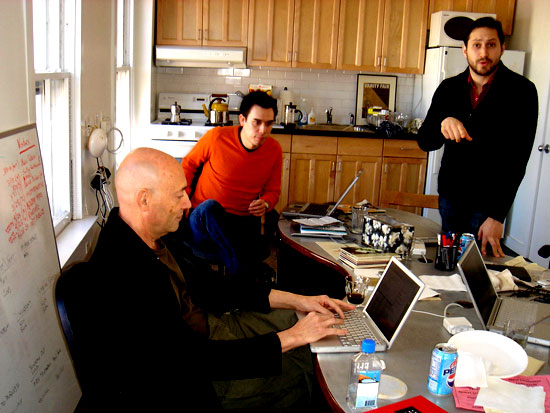
Interestingly, Momus splices his thoughts on us with some musings on “blooks” (books that began as blogs), commenting on the recently announced winners of lulu.com‘s annual Blooker Prize:
What is a blook? It’s a blog that turns into a book, the way, in evolution, mammals went back into the sea and became fish again. Except they didn’t really do that, although undoubtedly some of us still enjoy a good swim.
And expanding upon this in a comment further down:
…the cunning thing about the concept of the blook is that it posits the book as coming after the blog, not before it, as some evolutionist of media forms would probably do. In this reading, blogs are the past of the book, not its future.
To be that evolutionist for a moment, the “blook” is indeed a curious species, falling somewhere under the genus “networked book,” but at the same time resisting cozy classification, wriggling off the taxonomic hook by virtue of its seemingly regressive character: moving from bits back to atoms; live continuous feedback back to inert bindings and glue. I suspect that “the blook” will be looked back upon as an intriguing artifact of a transitional period, a time when the great apes began sprouting gills.
If we are in fact becoming “post-book,” might this be a regression? A return to an aquatic state of culture, free-flowing and gradually accreting like oral tradition, away from the solid land of paper, print and books? Are we living, then, in an age of amphibians? Hopping in and out of the water, equally at home in both? Is the blog that tentative dip in the water and the blook the return to terra firma?

But I thought the theory of evolution had broken free of this kind of directionality: the Enlightenment idea of progress, the great chain gang of being. Isn’t it all just a long meander, full of forks, leaps and mutations? And so isn’t the future of the book also its past? Might we move beyond the book and yet also stay with it, whether as some defined form or an actual thing in our (webbed) hands? No progress, no regress, just one long continuous motion? Sounds sort of like a conversation…
open source DRM?
A couple of weeks ago, Sun Microsystems released specifications and source code for DReaM, an open-source, “royalty-free digital rights management standard” designed to operate on any certified device, licensing rights to the user rather than to any particular piece of hardware. DReaM (Digital Rights Management — everywhere availble) is the centerpiece of Sun’s Open Media Commons initiative, announced late last summer as an alternative to Microsoft, Apple and other content protection systems. Yesterday, it was the subject of Eliot Van Buskirk’s column in Wired:
Sun is talking about a sea change on the scale of the switch from the barter system to paper money. Like money, this standardized DRM system would have to be acknowledged universally, and its rules would have to be easily converted to other systems (the way U.S. dollars are officially used only in America but can be easily converted into other currency). Consumers would no longer have to negotiate separate deals with each provider in order to access the same catalog (more or less). Instead, you — the person, not your device — would have the right to listen to songs, and those rights would follow you around, as long as you’re using an approved device.
The OMC promises to “promote both intellectual property protection and user privacy,” and certainly DReaM, with its focus on interoperability, does seem less draconian than today’s prevailing systems. Even Larry Lessig has endorsed it, pointing with satisfaction to a “fair use” mechanism that is built into the architecture, ensuring that certain uses like quotation, parody, or copying for the classroom are not circumvented. Van Buskirk points out, however, that the fair use protection is optional and left to the discretion of the publisher (not a promising sign). Interestingly, the debate over DReaM has caused a rift among copyright progressives. Van Buskirk points to an August statement from the Electronic Frontier Foundation criticizing DReaM for not going far enough to safeguard fair use, and for falsely donning the mantle of openness:
Using “commons” in the name is unfortunate, because it suggests an online community committed to sharing creative works. DRM systems are about restricting access and use of creative works.
True. As terms like “commons” and “open source” seep into the popular discourse, we should be increasingly on guard against their co-option. Yet I applaud Sun for trying to tackle the interoperability problem, shifting control from the manufacturers to an independent standards body. But shouldn’t mandatory fair use provisions be a baseline standard for any progressive rights scheme? DReaM certainly looks like less of a nightmare than plain old DRM but does it go far enough?
on the importance of the collective in electronic publishing
(The following polemic is cross-posted from the planning site for a small private meeting the Institute is holding later this month to discuss the possible establishment of an electronic press. Also posted on The Valve.)
One of the concerns that often gets raised early in discussions of electronic scholarly publishing is that of business model — how will the venture be financed, and how will its products be, to use a word I hate, monetized? What follows should not at all suggest that I don’t find such questions important. Clearly, they’re crucial; unless an electronic press is in some measure self-sustaining, it simply won’t last long. Foundations might be happy to see such a venture get started, but nobody wants to bankroll it indefinitely.
I also don’t want to fall prey to what has been called the “paper = costly, electronic = free” fallacy. Obviously, many of the elements of traditional academic press publishing that cost — whether in terms of time, or of money, or both — will still exist in an all-electronic press. Texts still must be edited and transformed from manuscript to published format, for starters. Plus, there are other costs associated with the electronic — computers and their programming, to take only the most obvious examples — that don’t exist in quite the same measure in print ventures.
But what I do want to argue for, building off of John Holbo’s recent post, is the importance of collective, cooperative contributions of academic labor to any electronic scholarly publishing venture. For a new system like that we’re hoping to build in ElectraPress to succeed, we need a certain amount of buy-in from those who stand to benefit from the system, a commitment to get the work done, and to make the form succeed.
I’ve been thinking about this need for collectivity through a comparison with the model of open-source software. Open source has succeeded, in large part, due to the commitments that hundreds of programmers have made, not just to their individual projects but to the system as a whole. Most of these programmers work regular, paid gigs, working on corporate projects, all the while reserving some measure of their time and devotion for non-profit, collective projects. That time and devotion are given freely because of a sense of the common benefits that all will reap from the project’s success.
So with academics. We are paid, by and large, and whether we like it or not, for delivering certain kinds of knowledge-work to paying clients. We teach, we advise, we lecture, and so forth, and all of this is primarily done within the constraints of someone else’s needs and desires. But the job also involves, or allows, to varying degrees, reserving some measure of our time and devotion for projects that are just ours, projects whose greatest benefits are to our own pleasure and to the collective advancement of the field as a whole.
If we’re already operating to that extent within an open-source model, what’s to stop us from taking a further plunge, opening publishing cooperatives, and thereby transforming academic publishing from its current (if often inadvertent) non-profit status to an even lower-cost, collectively underwritten financial model?
I can imagine two possible points of resistance within traditional humanities scholars toward such a plan, points that originate in individualism and technophobia.
Individualism, first: it’s been pointed out many times that scholars in the humanities have strikingly low rates of collaborative authorship. Politically speaking, this is strange. Even as many of us espouse communitarian (or even Marxist) ideological positions, and even as we work to break down long-held bits of thinking like the “great man” theory of history, or of literary production, we nonetheless cling to the notion that our ideas are our own, that scholarly work is the product of a singular brain. Of course, when we stop to think about it, we’re willing to admit that it’s not true — that, of course, is what the acknowledgments and footnotes of our books are for — but venturing into actual collaborations remains scary. Moreover, many of us seem to have the same kinds of nervousness about group projects that our students have: What if others don’t pull their weight? Will we get stuck with all of the work, but have to share the credit?
I want to answer that latter concern by suggesting, as John has, that a collective publishing system might operate less like those kinds of group assignments than like food co-ops: in order to be a member of the co-op — and membership should be required in order to publish through it — everyone needs to put in a certain number of hours stocking the shelves and working the cash register. As to the first mode of this individualist anxiety, though, I’m not sure what to say, except that no scholar is an island, that we’re all always working collectively, even when we think we’re most alone. Hand off your manuscript to a traditional press, and somebody’s got to edit it, and typeset it, and print it; why shouldn’t that somebody be you?
Here’s where the technophobia comes in, or perhaps it’s just a desire to have someone else do the production work masquerading as a kind of technophobia, because many of the responses to that last question seem to revolve around either not knowing how to do this kind of publishing work or not wanting to take on the burden of figuring it out. But I strongly suspect that there will come a day in the not too distant future when we look back on those of us who have handed our manuscripts over to presses for editing, typesetting, printing, and dissemination in much the same way that I currently look back on those emeriti who had their secretaries — or better still, their wives — type their manuscripts for them. For better or for worse, word processing has become part of the job; with the advent of the web and various easily learned authoring tools, editing and publishing are becoming part of the job as well.
I’m strongly of the opinion that, if academic publishing is going to survive into the next decades, we need to stop thinking about how it’s going to be saved, and instead start thinking about how we are going to save it. And a business model that relies heavily on the collective — particularly, on labor that is shared for everyone’s benefit — seems to me absolutely crucial to such a plan.
another round: britannica versus wikipedia
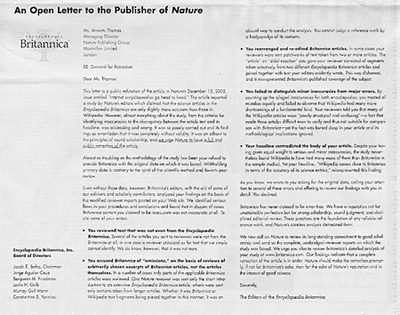 The Encyclopedia Britannica versus Wikipedia saga continues. As Ben has recently posted, Britannica has been confronting Nature on its article which found that the two encyclopedias were fairly equal in the accuracy of their science articles. Today, the editors and the board of directors of Encyclopedia Britannica, have taken out a half page ad in today New York Times (A19) to present an open letter to Nature which requests for a public reaction of the article.
Several interesting things are going on here. Because Britannica chose to place an ad in the Times, it shifted the argument and debate away from the peer review / editorial context into one of rhetoric and public relations. Further, their conscious move to take the argument to the “public” or the “masses” with an open letter is ironic because the New York TImes does not display its print ads online, therefore access of the letter is limited to the Time’s print readership. (Not to mention, the letter is addressed to the Nature Publishing Group located in London. If anyone knows that a similar letter was printed in the UK, please let us know.) Readers here can click on the thumbnail image to read the entire text of the letter. Ben raised an interesting question here today, asking where one might post a similar open letter on the Internet.
Britannica cites many important criticisms of Nature’s article, including: using text not from Britannica, using excerpts out of context, giving equal weight to minor and major errors, and writing a misleading headline. If their accusations are true, then Nature should redo the study. However, to harp upon Nature’s methods is to miss the point. Britannica cannot do anything to stop Wikipedia, except to try to discredit to this study. Disproving Nature’s methodology will have a limited effect on the growth of Wikipedia. People do not mind that Wikipedia is not perfect. The JKF assassination / Seigenthaler episode showed that. Britannica’s efforts will only lead to more studies, which will inevitably will show errors in both encyclopedias. They acknowledge in today’s letter that, “Britannica has never claimed to be error-free.” Therefore, they are undermining their own authority, as people who never thought about the accuracy of Britannica are doing just that now. Perhaps, people will not mind that Britannica contains errors as well. In their determination to show the world that of the two encyclopedias which both content flaws, they are also advertising that of the two, the free one has some-what more errors.
In the end, I agree with Ben’s previous post that the Nature article in question has a marginal relevance to the bigger picture. The main point is that Wikipedia works amazingly well and contains articles that Britannica never will. It is a revolutionary way to collaboratively share knowledge. That we should give consideration to the source of our information we encounter, be it the Encyclopedia Britannica, Wikipedia, Nature or the New York Time, is nothing new.
if not rdf, then what?: part II
I had an exchange about my previous post with an RDF expert who explained to me that API’s are not like RDF and it would be incorrect to try to equate them. She’s right – API’s do not replace the need for RDF, nor do they replicate the functionality of RDF. API’s do provide access to data, but that data can be in many forms, including XML bound RDF. This is one of the pleasures and priviledges of writing on this blog: the audience contributes at a very high level of discourse, and is endowed with extremely deep knowledge about the topics under discussion.
I want to reiterate my point with a new inflection. By suggesting that API’s were an alternative to RDF, I was trying to get at a point that had more to do with adoption than functionality. I admit, I did not make the point well. So let me make a second attempt: API’s are about data access, and that, currently (and from my anecdotal experience) is where the value proposition lies for the new breed of web services. You have your data in someone’s database. That data is accessible to developers to manipulate and represent back to you in new, innovative, and useful ways. Most of the attention in the webdev community is turning towards the development of new interfaces—not towards the development of new tools to manage and enrich the data (again, anecdotal evidence only). Yes, there are people still interested in semantic data; we are indebted to them for continuing to improve the way our systems interact at a data level. But the focus of development has shifted to the interface. API’s make the gathering of data as simple as setting parameters, leaving only the work of designing the front-end experience.
Another note on RDF from my exchange: it was pointed out that practitioners of RDF prefer not to read it in XML, but instead use Notation 3 (N3), which is undeniably easier to read than XML. I don’t know enough about N3 to make a proper example, but I think you can get the idea if you look at the examples here and here.
next text: new media in history teaching and scholarship
The next text project came forth from the realization that twenty-five years into the application of new media to teaching and learning, textbooks have not fully tapped the potential of new media technology. As part of this project, we have invited leading scholars and practitioners of educational technology from specific disciplines to attend meetings with their peers and the institute. Yesterday, we were fortunate to spend the day talking to a group of American History teachers and scholars, some of whom created seminal works in history and new media. Over the course of the day, we discussed their teaching, their scholarship, the creation and use of textbooks, new media, and how to encourage the birth of the next generation born digital textbook. By of the end of the day, the next text project started to take a concrete form. We began to envision the concept of accessing the vast array of digitized primary documents of American History that would allow teachers to formulate their own curricula or use guides that were created and vetted by established historians.
Attendees included:
David Jaffe, City University of New York
Gary Kornblith, Oberlin College
John McClymer, Assumption College
Chad Noyes, Pierrepont School
Jan Reiff, University of California, Los Angeles
Carl Smith, Northwestern University
Jim Sparrow, University of Chicago
Roy Rosenzweig, George Mason University
Kate Wittenberg, EPIC, Columbia University
The group contributed to influential works in the field of History and New Media, including Who Built America, The Great Chicago Fire and The Web of Memory, The Encyclopedia of Chicago, the Blackout History Project, the Visual Knowledge Project, History Matters,the Journal of American History Textbook and Teaching Section, and the American History Association Guide to Teaching and Learning with New Media.
Almost immediately, we found that their excellence in their historical scholarship was equally matched in their teaching. Often their introductions to new media came from their own research. Online and digital copies of historical documents radically changed the way they performed their scholarship. It then fueled the realization that these same tools afforded the opportunity for students to interact with primary documents in a new way which was closer to how historians work. Often, our conversations gravitated back to teaching and students, rather than purely technical concerns. Their teaching led them to the forefront of developing and promoting active learning and constructionist pedagogies, by encouraging an environment of inquiry-based learning, rather than rote memorization of facts, through the use of technology. In these new models, students are guided to multiple paths of self-discovery in their learning and understanding of history.
We spoke at length on the phrase coined by attendee John McClymer, “the pedagogy of abundance.” With access to rich archives of primary documents of American history as well as narratives, they are not faced with the problems of
The discussion also included issues of resistance, which were particularly interesting to us. Many meeting participants mentioned student resistance to new methods of learning including both new forms of presentation and inquiry-based pedagogies. In that, traditional textbooks are portable and offer an established way to learn. They noted an institutional tradition of the teacher as the authoritative interpreter in lecture-based teaching, which is challenged by active learning strategies. Further, we discussed the status (or lack of) of the group’s new media endeavors in both their scholarship and teaching. Depending upon their institution, using new media in their scholarship had varying degrees of importance in their tenure and compensation reviews from none to substantial. Quality of teaching had no influence in these reviews. Therefore, these projects were often done, not in lieu of, but in addition to their traditional publishing and academic professional requirements.
The combination of an abundance of primary documents (particulary true for American history) and a range of teaching goals and skills led to the idea of adding layers on top of existing digital archives. Varying layers could be placed on top of these resources to provide structure for both teachers and students. Teachers who wanted to maintain the traditional march through the course would still be able to do so through guides created by the more creative teacher. Further, all teachers would be able to control the vast breadth of material to avoid overwhelming students and provide scaffolding for their learning experience. We are very excited by this notion, and will further refine the meeting’s groundwork to strategize how this new learning environment might get created.
We are still working through everything that was discussed, however, we left the meeting with a much clearer idea of the landscape of the higher education history teacher / scholar, as well as, possible directions that the born digital history textbook could take.