the social life of books

One of the most exciting things about Sophie, the open-source software the institute is currently developing, is that it will enable readers and writers to have conversations inside of books — both live chats and asynchronous exchanges through comments and social annotation. I touched on this idea of books as social software in my most recent “The Book is Reading You” post, and we’re exploring it right now through our networked book experiments with authors Mitch Stephens, and soon, McKenzie Wark, both of whom are writing books and opening up the process (with a little help from us) to readers. It’s a big part of our thinking here at the institute.
Catching up with some backlogged blog reading, I came across a little something from David Weinberger that suggests he shares our enthusiasm:

I can’t wait until we’re all reading on e-books. Because they’ll be networked, reading will become social. Book clubs will be continuous, global, ubiquitous, and as diverse as the Web.
And just think of being an author who gets to see which sections readers are underlining and scribbling next to. Just think of being an author given permission to reply.
I can’t wait.

Of course, ebooks as currently envisioned by Google and Amazon, bolted into restrictive IP enclosures, won’t allow for this kind of exchange. That’s why we need to be thinking hard right now about an alternative electronic publishing system. It may seem premature to say this — now, when electronic books are a marginal form — but before we know it, these companies will be the main purveyors of all media, including books, and we’ll wonder what the hell happened.

academic publishing as “gift culture”

John Holbo has an excellent piece up on the Valve that very convincingly argues the need to reinvent scholarly publishing as a digital, networked system. John will be attending a meeting we’ve organized in April to discuss the possible formation of an electronic press — read his post and you’ll see why we’ve invited him.
It was particularly encouraging, in light of recent discussion here, to see John clearly grasp the need for academics to step up to the plate and take into their own hands the development of scholarly resources on the web — now more than ever, as Google, Amazon are moving more aggressively to define how we find and read documents online:

…it seems to me the way for academic publishing to distinguish itself as an excellent form – in the age of google – is by becoming a bastion of ‘free culture’ in a way that google book won’t. We live in a world of Amazon ‘search inside’, but also of copyright extension and, in general, excessive I.P. enclosures. The groves of academe are well suited to be exemplary Creative Commons. But there is no guarantee they will be. So we should work for that.

britannica bites back (do we care?)

Www.wikipedia.org_screenshot.png britannica header.gif Late last year, Nature Magazine let loose a small shockwave when it published results from a study that had compared science articles in Encyclopedia Britannica to corresponding entries in Wikipedia. Both encyclopedias, the study concluded, contain numerous errors, with Britannica holding only a slight edge in accuracy. Shaking, as it did, a great many assumptions of authority, this was generally viewed as a great victory for the five-year-old Wikipedia, vindicating its model of decentralized amateur production.
Now comes this: a document (download PDF) just published on the Encyclopedia Britannica website claims that the Nature study was “fatally flawed”:

Almost everything about the journal’s investigation, from the criteria for identifying inaccuracies to the discrepancy between the article text and its headline, was wrong and misleading.

What are we to make of this? And if Britannica’s right, what are we to make of Nature? I can’t help but feel that in the end it doesn’t matter. Jabs and parries will inevitably be exchanged, yet Wikipedia continues to grow and evolve, containing multitudes, full of truth and full of error, ultimately indifferent to the censure or approval of the old guard. It is a fact: Wikipedia now contains over a million articles in english, nearly 223 thousand in Polish, nearly 195 thousand in Japanese and 104 thousand in Spanish; it is broadly consulted, it is free and, at least for now, non-commercial.
At the moment, I feel optimistic that in the long arc of time Wikipedia will bend toward excellence. Others fear that muddled mediocrity can be the only result. Again, I find myself not really caring. Wikipedia is one of those things that makes me hopeful about the future of the web. No matter how accurate or inaccurate it becomes, it is honest. Its messiness is the messiness of life.

vive le interoperability!

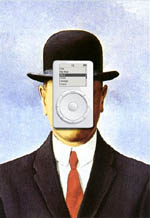
ipodmagritte.jpg A smart column in Wired by Leander Kahney explains why France’s new legislation prying open the proprietary file format lock on iPods and other entertainment devices is an important stand taken for the public good:

French legislators aren’t just looking at Apple. They’re looking ahead to a time when most entertainment is online, a shift with profound consequences for consumers and culture in general. French lawmakers want to protect the consumer from one or two companies holding the keys to all of its culture, just as Microsoft holds the keys to today’s desktop computers.

Apple, by legitimizing music downloading with iTunes and the iPod, has been widely credited with making the internet safe for the culture industries after years of hysteria about online piracy. But what do we lose in the bargain? Proprietary formats lock us into specific vendors and specific devices, putting our media in cages. By cornering the market early, Apple is creating a generation of dependent customers who are becoming increasingly shackled to what one company offers them, even if better alternatives come along. France, on the other hand, says let everything be playable on everything. Common sense says they’re right.
Now Apple is the one crying piracy, calling France the great enabler. While I agree that piracy is a problem if we’re to have a functioning cultural economy online, I’m certain that proprietary controls and DRM are not the solution. In the long run, they do for culture what Microsoft did for software, creating unbreakable monopolies and placing unreasonable restrictions on listeners, readers and viewers. They also restrict our minds. Just think of the cumulative cognitive effect of decades of bad software Microsoft has cornered us into using. Then look at the current ipod fetishism. The latter may be more hip, but they both reveal the same narrowed thinking.
One thing I think the paranoid culture industries fail to consider is that piracy is a pain in the ass. Amassing a well ordered music collection through illicit means is by no means easy — on the contrary, it can be a tedious, messy affair. Far preferable is a good online store selling mp3s at reasonable prices. There you can find stuff quickly, be confident that what you’re getting is good and complete, and get it fast. Apple understood this early on and they’re still making a killing. But locking things down in a proprietary format takes it a step too far. Keep things open and may the best store/device win. I’m pretty confident that piracy will remain marginal.

googlezon and the publishing industry: a defining moment for books?

Yesterday Roger Sperberg made a thoughtful comment on my latest Google Books post in which he articulated (more precisely than I was able to do) the causes and potential consequences of the publisher’s quest for control. I’m working through these ideas with the thought of possibly writing an article, so I’m reposting my response (with a few additions) here. Would appreciate any feedback…
What’s interesting is how the Google/Amazon move into online books recapitulates the first flurry of ebook speculation in the mid-to-late 90s. At that time, the discussion was all about ebook reading devices, but then as now, the publish industry’s pursuit of legal and techological control of digital books seemed to bring with it a corresponding struggle for control over the definition of digital books — i.e. what is the book going to become in the digital age? The word “ebook” — generally understood as a digital version of a print book — is itself part of this legacy of trying to stablize the definition of books amid massively destablizing change. Of course the problem with this is that it throws up all sorts of walls — literal and conceptual — that close off avenues of innovation and rob books of much of their potential enrichment in the electronic environment.
cliffordlynch.jpg Clifford Lynch described this well in his important 2001 essay “The Battle to Define to Define the Future of the Book in the Digital World”:

…e-book readers may be the price that the publishing industry imposes, or tries to impose, on consumers, as part of the bargain that will make large numbers of interesting works available in electronic form. As a by-product, they may well constrain the widespread acceptance of the new genres of digital books and the extent to which they will be thought of as part of the canon of respectable digital “printed” works.

A similar bargain is being struck now between publishers and two of the great architects of the internet: Google and Amazon. Naturally, they accept the publishers’ uninspired definition of electronic books — highly restricted digital facsimiles of print books — since it guarantees them the most profit now. But it points in the long run to a malnourished digital culture (and maybe, paradoxically, the persistence of print? since paper books can’t be regulated so devilishly).
As these companies come of age, they behave less and less like the upstart innovators they originally were, and more like the big corporations they’ve become. We see their grand vision (especially Google’s) contract as the focus turns to near-term success and the fluctuations of stock. It creates a weird paradox: Google Book Search totally revolutionizes the way we search and find connections between books, but amounts to a huge setback in the way we read them.
(For those of you interested in reading Lynch’s full essay, there’s a TK3 version that is far more comfortable to read than the basic online text. Click the image above or go here to download. You’ll have to download the free TK3 Reader first, which takes about 10 seconds. Everything can be found at the above link).

copyright debates continues, now as a comic book

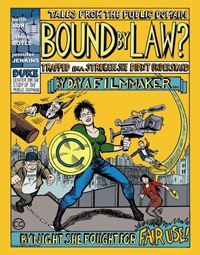
bound_by_law.jpg from amazon.comKeith Aoki, James Boyle and Jennifer Jenkins have produced a comic book entitled, “Bound By Law? Trapped in a Sturggle She Didn’t Understand” which portrays a fictional documentary filmmaker who learns about intellectual property, copyright and more importantly her rights to use material under fair use. We picked up a copy during the recent conference on “Cultural Environmentalism at 10” at Stanford. This work was funded by the Rockefeller Foundation, the same people who funded “Will Fair Use Survive?” from the Free Expression Policy Project of the Brennan Center at the NYU Law School, which was discussed here upon its release. The comic book also relies on the analysis that Larry Lessig covered in “Free Culture.” However, these two works go into much more detail and have quite different goals and audiences. With that said, “Bound By Law” deftly takes advantage of the medium and boldly uses repurposed media iconic imagery to convey what is permissible and to explain the current chilling effect that artists face even when they have a strong claim of fair use.
Part of Boyle’s original call ten years ago for a Cultural Environmentalism Movement was to shift the discourse of IP into the general national dialogue, rather than remain in the more narrow domain of legal scholars. To that end, the logic behind capitalizing on a popular culture form is strategically wise. In producing a comic book, the authors intend to increase awareness among the general public as well as inform filmmakers of their rights and the current landscape of copyright. Using the case study of documentary film, they cite many now classic copyright examples (for example the attempt to use footage of a television in the background playing the”Simpsons” in a documentary about opera stagehands.) “Bound By Law” also leverages the form to take advantage of compelling and repurposed imagery (from Mickey Mouse to Mohammed Ali) to convey what is permissible and the current chilling effect that artists face in attempting to deal with copyright issues. It is unclear if and how this work will be received in the general public. However, I can easily see this book being assigned to students of filmmaking. Although, the discussion does not forge new ground, its form will hopefully reach a broader audience. The comic book form may still be somewhat fringe for the mainstream populus and I hope for more experiments in even more accesible forms. Perhaps the next foray into the popular culture will an episode of CSI or Law & Order, or a Michael Crichton thriller.

relentless abstraction

200px-FirstSketchOfDNADoubleHelix.jpg Quite surprisingly, Michael Crichton has an excellent op-ed in the Sunday Times on the insane overreach of US patent law, the limits of which are to be tested today before the Supreme Court. In dispute is the increasingly common practice of pharmaceutical companies, research labs and individual scientists of patenting specific medical procedures or tests. Today’s case deals specifically with a basic diagnostic procedure patented by three doctors in 1990 that helps spot deficiency in a certain kind of Vitamin B by testing a patient’s folic acid levels.
Under current laws, a small royalty must be paid not only to perform the test, but to even mention it. That’s right, writing it down or even saying it out loud requires payment. Which means that I am in violation simply for describing it above. As is the AP reporter whose story filled me in on the details of the case. And also Michael Crighton for describing the test in his column (an absurdity acknowledged in his title: “This Essay Breaks the Law”). Need I (or may I) say more?
And patents can reach far beyond medical procedures that prevent diseases. They can be applied to the diseases themselves, even to individual genes. Crichton:

…the human genome exists in every one of us, and is therefore our shared heritage and an undoubted fact of nature. Nevertheless 20 percent of the genome is now privately owned. The gene for diabetes is owned, and its owner has something to say about any research you do, and what it will cost you. The entire genome of the hepatitis C virus is owned by a biotech company. Royalty costs now influence the direction of research in basic diseases, and often even the testing for diseases. Such barriers to medical testing and research are not in the public interest. Do you want to be told by your doctor, “Oh, nobody studies your disease any more because the owner of the gene/enzyme/correlation has made it too expensive to do research?”

It seems everything — even “laws of nature, natural phenomena and abstract ideas” (AP) — is information that someone can own. It goes far beyond the digital frontiers we usually talk about here. Yet the expansion of the laws of ownership — what McKenzie Wark calls “the relentless abstraction of the world” — essentially digitizes everything, and everyone.

sharing goes mainstream

sharing.gif Ben’s post on the Google book project mentioned a fundamental tenet of the Institute: the network is the environment for the future of reading and writing, and that’s why we care about network-related issues. While the goal of the network isn’t reducable to a single purpose, if you could say it was any one thing it would be: sharing. It’s why Tim Berners-Lee created it in the first place—to share scientific research. It’s why people put their lives on blogs, their photos on flickr, their movies on YouTube. And it is why the people who want to sell things are so anxious about putting their goods online. The bottom line is this: the ‘net is about sharing, that’s what it’s for.
Time magazine had an article in the March 20th issue on open-source and innovation-at-the-edges (by Lev Grossman). Those aren’t new ideas around office, but when I saw the phrase the “authorship of innovation is shifting from the Few to the Many” I realized that, for the larger public, they are still slightly foreign, that the distant intellectual altruism of the Enlightenment is being recast as the open-source movement, and that the notion of an intellectual commons is being rejuvenated in the public consciousness. True, Grossman puts out the idea of shared innovation as a curiosity—it’s a testament to the momentum of our contemporary notions of copyright that the cultural environment is antagonistic to giving away ideas—but I applaud any injection of the open-source ideal into the mainstream. Especially ideas like this:

Admittedly, it’s counterintuitive: until now the value of a piece of intellectual property has been defined by how few people possess it. In the future the value will be defined by how many people possess it.

I hope the article will seed the public mind with intimations of a world where the benefits of intellectual openness and sharing are assumed, rather than challenged.
Raising the public consciousness around issues of openness and sharing is one of the goals of the Institute. We’re happy to have help from a magazine with Time’s circulation, but most of all, I’m happy that the article is turning public attention in the direction of an open network, shared content, and a rich digital commons.

the book is reading you, part 3

News broke quietly a little over a week ago that Google will begin selling full digital book editions from participating publishers. This will not, Google makes clear, extend to books from its Library Project — still a bone of contention between Google and the industry groups that have brought suit against it for scanning in-copyright works (75% of which — it boggles the mind — are out of print).

glasses on book.jpg Let’s be clear: when they say book, they mean it in a pretty impoverished sense. Google’s ebooks will not be full digital editions, at least not in the way we would want: with attention paid to design and the reading experience in general. All you’ll get is the right to access the full scanned edition online.
Much like Amazon’s projected Upgrade program, you’re not so much buying a book as a searchable digital companion to the print version. The book will not be downloadable, printable or shareable in any way, save for inviting a friend to sit beside you and read it on your screen. Fine, so it will be useful to have fully searchable texts, but what value is there other than this? And what might this suggest about the future of publishing as envisioned by companies like Google and Amazon, not to mention the future of our right to read?
About a month ago, Cory Doctorow wrote a long essay on Boing Boing exhorting publishers to wake up to the golden opportunities of Book Search. Not only should they not be contesting Google’s fair use claim, he argued, but they should be sending fruit baskets to express their gratitude. Allowing books to dwell in greater numbers on the internet saves them from falling off the digital train of progress and from losing relevance in people’s lives. Doctorow isn’t talking about a bookstore (he wrote this before the ebook announcement), or a full-fledged digital library, but simply a searchable index — something that will make books at least partially functional within the social sphere of the net.
This idea of the social life of books is crucial. To Doctorow it’s quite plain that books — as entertainment, as a diversion, as a place to stick your head for a while — are losing ground in a major way not only to electronic media like movies, TV and video games (that’s been happening for a while), but to new social rituals developing on the net and on portable networked devices.
Though print will always offer inimitable pleasures, the social life of media is moving to the network. That’s why we here at if:book care so much about issues, tangential as they may seem to the future of the book, like network neutrality, copyright and privacy. These issues are of great concern because they make up the environment for the future of reading and writing. We believe that a free, neutral network, a progressive intellectual property system, and robust safeguards for privacy are essential conditions for an enlightened digital age.
We also believe in understanding the essence of the new medium we are in the process of inventing, and about understanding the essential nature of books. The networked book is not a block on a shelf — it is a piece of social software. A web of revisions, interactions, annotations and references. “A piece of intellectual territory.” It can’t be measured in copies. Yet publishers want electronic books to behave like physical objects because physical objects can be controlled. Sales can be recorded, money counted. That’s why the electronic book market hasn’t materialized. Partly because people aren’t quite ready to begin reading books on screens, but also because publishers have been so half-hearted about publishing electronically.
They can’t even begin to imagine how books might be enhanced and expanded in a digital environment, so terrified are they of their entire industry being flushed down the internet drain — with hackers and pirates cannibalizing the literary system. To them, electronic publishing is grit your teeth and wait for the pain. A book is a PDF, some DRM and a prayer. Which is why they’ve reacted so heavy-handedly to Google’s book project. If they lose even a sliver of control, so they are convinced, all hell could break loose.
But wait! Google and Amazon are here to save the day. They understand the internet (naturally — they helped invent it). They understand the social dimension of online spaces. They know how to harness network effects and how to read the embedded desires of readers in the terms and titles for which they search. So they understand the social life of books on the network, right? And surely they will come up with a vision for electronic publishing that is both profitable for the creators and every bit as rich as the print culture that preceded it. Surely the future of the book lies with them?

chicken_b_003.jpg Sadly, judging by their initial moves into electronic books, we should hope it does not. Understanding the social aspect of the internet also enables you to cunningly restrict it, more cunningly than any print publishers could figure out how to do.
Yes, they’ll give you the option of buying a book that lives its life on line, but like a chicken in a poultry plant, packed in a dark crate stuffed with feed tubes, it’s not much of a life. Or better, let’s evaluate it in the terms of a social space — say, a seminar room or book discussion group. In a Google/Amazon ebook you will not be allowed to:
– discuss
– quote
– share
– make notes
– make reference
– build upon
This is the book as antisocial software. Reading is done in solitary confinement, closely monitored by the network overseers. Google and Amazon’s ebooks are essentially, as David Rothman puts it on Teleread, “in a glass case in a museum.” Get too close to the art and motion sensors trigger the alarm.
So ultimately we can’t rely on the big technology companies to make the right decisions for our future. Google’s “fair use” claim for building its books database may be bold and progressive, but its idea of ebooks clearly is not. Even looking solely at the searchable database component of the project, let’s not forget that Google’s ranking system (as Siva Vaidhyanathan has repeatedly reminded us) is non-transparent. In other words, when we do a search on Google Books, we don’t know why the results come up in the order that they do. It’s non-transparent librarianship. Information mystery rather than information science. What secret algorithmic processes are reordering our knowledge and, over time, reordering our minds? And are they immune to commercial interests? And shouldn’t this be of concern to the libraries who have so blithely outsourced the task of digitization? I repeat: Google will make the right choices only when it is in its interest to do so. Its recent actions in China should leave no doubt.
Perhaps someday soon they’ll ease up a bit and let you download a copy, but that would only be because the hardware we are using at that point will be fitted with a “trusted computing” module, which which will monitor what media you use on your machine and how you use it. At that point, copyright will quite literally be the system. Enforcement will be unnecessary since every potential transgression will be preempted through hardwired code. Surveillance will be complete. Control total. Your rights surrendered simply by logging on.

toward the establishment of an electronic press

A few months ago, Kathleen Fitzpatrick, a tenured professor of English and Media Studies at Pomona College, published an important statement at The Valve: On the Future of Academic Publishing, Peer Review, and Tenure Requirements. Not just another lament about the sorry state of scholarly publishing, Fitzpatrick’s piece is a manifesto calling for the creation of an electronic press whose goal is nothing less than establishing born-digital electronic scholarship as an equal to print.
A meeting we held in november with a group of leading academic bloggers raised many of the problems that people face trying to gain respect for online scholarship. Since that meeting we’ve been trying to understand what role the institute might play in changing the landscape. Reading and discussing Fitzpatrick’s manifesto catalyzed our thoughts.
We invited Kathleen to visit us in NY and proposed working with her to establish an electronic press that would be hosted by the Annenberg Center for Communication at USC (which is also the home of the Institute for the Future of the Book). Based on our preliminary discussions we think that the press should concentrate at first on work in the area of media studies. The projects themselves will take many different electronic forms – long, short; media-rich, text-only; linear, non-linear; etc. These projects will be subjected to strong peer-review, but we hope to develop a process that is tailored to the rhythms and structures of online publishing.
How might our conception of a press be updated for the networked age? How do we create a publishing ecology that supports discourse at all levels — from blog to working paper to monograph — focusing less on the products of scholarship and more on the process? In practical terms, how might this process make use of the linking, commenting, and versioning technologies developed by blogs and wikis in order to enrich the discrete and fixed scholarly text with an evolving, interactive network of discourse that encourages conversation, debate, reflection, and revision? How might peer review be reinvented as peer-to-peer review?
We’ve assembled a fantastic roster of over a dozen professors in english, media studies, film and the information sciences to gather for an ambitious one-day meeting in Los Angeles in late April at USC’s Annenberg Center for Communication to begin answering these questions. The goal is to survey the current landscape of scholarly publishing, to evaluate and learn from existing innovative efforts, and to begin talking seriously about the establishment in the very near future of a groundbreaking electronic press. Since this is quite a lot to cover in a single day, we’ve set up a blog to get the conversation going in advance. Kathleen currently has a terrific post laying out some of the first-order questions, which we expect to evolve through feedback into a concrete meeting agenda. Her original Valve essay is also there.
There’s still more than a month till folks gather in L.A., so in the meantime we’d like to invite anyone who’s interested to take part in the discussion on the blog and to help lay the groundwork for what we hope will be a very important meeting.