
Jesse and I have just arrived at the Yale University to police barricades, blocked of streets, bus loads of demonstrators, and general confusion. I wish I could say that it was in support of protecting open and accessible knowledge, as we are here to attend the Access 2 Knowledge conference. However, the crowds of Falun Gong supporters (with a few Free Tibet activists in the mix) were protesting the arrival of President Hu Jintao from China. Wandering the streets of New Haven to find an unblocked entrance to the law school, Jesse and I reflected a bit on the irony of the difficulty of physically “accessing” the building where we will hear current thinking and planning on the making knowledge accessible.
The conference’s stated goal is to “bring together leading thinkers and activists on access to knowledge policy from North and South, in order to generate concrete research agendas and policy solutions for the next decade…The A2K Conference aims to help build an intellectual framework that will protect access to knowledge both as the basis for sustainable human development and to safeguard human rights.” Sessions will cover peer production, economics of a2k, copyright, access to science and medicine, network neutrality and privacy.
We very excited to be here, as presenters include some of our favorite IP / Copyright / Open Content thinkers: Yochai Benkler, Eric Von Hippel, Susan Crawford, and Terry Fisher. We’re sure that by Sunday, we’ll have more to add to the list.
Stay tuned for more.
google scholar
Google announced a new change to Google Scholar to improve the results of a search. The results can now be ordered by a confluence of citations, date of publication, and keyword relevance, instead of just the latter. From the Official Google Blog:
It’s not just a plain sort by date, but rather we try to rank recent papers the way researchers do, by looking at the prominence of the author’s and journal’s previous papers, how many citations it already has, when it was written, and so on. Look for the new link on the upper right for “Recent articles” — or switch to “All articles” for the full list.
Another feature, which I wasn’t aware of, is the “group of X”, located just at the end of the line. It points to papers that are very similar in topic. Researchers can use this feature to delve deeper into a topic, as opposed to skipping across the surface of a topic. This reflects the deep user-centered thinking that went into the design of the results, which is broken down in more detail here.
Though many professors lament the use of Google as students first and last research resource, the continual improvements of Google Scholar and the Google Book project (when combined with access rights afforded by a university library) provide an increasingly potent research environment. Google Scholar, by displaying the citation count, provides a significant piece of secondary data that improves decision making dramatically compared to unguided topic searches in the library. By selecting uncredited quotations and searching for them in Google Book project, students can get information on the primary text, read a little of the additional context, and decide whether or not to procure the book from the library. I feel like I’m overselling Google, but my real point has nothing to do with any specific corporation. The real point is: in the future, all the value is in the network.
da vinci, copyright of non-fiction, and intelligent search
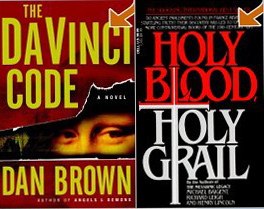
Two of the authors of “Holy Blood, Holy Grail,” recently lost their copyright infringement suit against genre thriller author, Dan Brown, for his book the “Da Vinci Code.” Brown heavily relied on the theories of the secret lineage of Jesus found in Holy Blood (a best seller in its own time.) Both books were published by Random House, but that did not stop Michael Baigent and Richard Leigh from suing their own publisher for copyright infringement. A judge found that Baigent and Leigh could not prove (or even define) the central themes of their book were stolen and further did not think it was a good idea to have authors of “pretend historical books” scour over fiction works looking for stolen ideas.
Mark Stephens, a media lawyer for the losing side lawyer stated:
“Whilst the decision shows that he didn’t infringe copyright, his moral behavior is more, in my view, open to question. It’s clear that he used the fundamental themes and ideas of ‘Holy Blood, Holy Grail,’ and many people will think that morally, Dan Brown owes a debt to Baigent, Leigh and Lincoln.”
Of course, Dan Brown owes a “creative” debt to the authors of Holy Blood, Holy Grail. Just like all fiction authors who use non-fiction (and in this case, I’m using the word loosely), own a debt to the research they do. Claims for compensation for it goes against the centuries old traditions of how culture is created.
Aside note: In my original search, for my post on the Da Vinci code, I mistyped “Devinci Code” in the nytimes.com search, and come up with this:
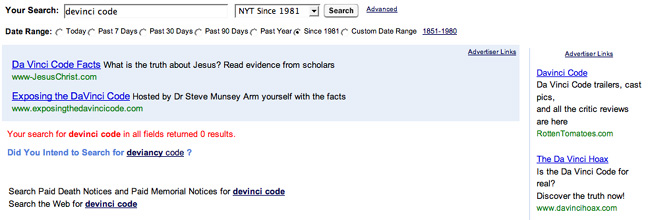
The nytimes.com article search engine couldn’t find anything. Amusingly, it suggested I was searching for “deviancy code.” Maybe it knows something I do not. And of course, the related sponsor ads on the top and right hand side, showed correctly identified and relevant links.
learning to read
 Somebody interviewed Bob for a documentary a few months ago. I don’t remember who this was, because I was in the other room busy with something else, but I was half-listening to what was being discussed: how the book is changing, what precisely the Institute does, in short, what we discuss from day to day on this blog. One statement captured my ear: Bob offhandedly declared that “we don’t really know how to read Wikipedia yet”. I made a note of it at the time; since then I’ve been periodically pulling his statement out at idle moments and rolling it over and over in my mind like a pebble in my pocket, trying to decide exactly what it could mean.
There’s something appealing to me about the flatness of the statement: “We don’t really know how to read Wikipedia yet.” It’s obvious but revelatory: the reason that we find the Wikipedia frustrating is that we need to learn how to read it. (By we I mean the reading public as a whole. Perhaps you have; judging from the arguments that fly back and forth, it would seem that the majority of us haven’t.) The problem is, of course, that so few people actually bother to state this sort of thing directly and then to unpack the repercussions of it.
What’s there to learn in reading the Wikipedia? Let’s start with a sample sentence from the entry on Marcel Proust:
In addition to the grief that attended his mother’s death, Proust’s life changed due to a very large inheritance (in today’s terms, a principal of about $6 million, with a monthly income of about $15,000).
Criticizing the Wikipedia for being poorly written is like shooting fish in a barrel, but bear with my lack of sportsmanship for a second. Imagine that you found the above sentence in a printed reference work. A printed reference book that seems to be written in the voice of a sixth grade student deeply interested in matters financial might worry you. It would worry me. It’s worried many critics of the Wikipedia, who point out that this clearly isn’t the sort of manicured prose we’re used to reading in books and magazines.
But this prose is also conceptually different. A Wikipedia article is not constructed in the same way that a magazine article is written. Nor is the content of a Wikipedia article at one particular instant in time – content that has probably been different, and might certainly change – analogous to the content of a print magazine article, which is always, from the moment of printing, exactly the same. If we are to keep using the Wikipedia, we’ll have to get used to the solecisms endemic there; we’ll also need to readjust they way we give credence to media. (Right now I’m going to tiptoe around the issue of text and authority, which is of course an enormous can of worms that I’d prefer not to open right now.) But there’s a reason that the above quotation shouldn’t be that worrying: it’s entirely possible, and increasingly probable as time goes on, that when you click the link above, you won’t be able to find the sentence I quoted.
This faith in the long run isn’t an easy thing, however. When we read Wikipedia we tend to apply to it the standards of judgment that we would apply to a book or magazine, and it often fails by these standards, as might be expected. When we’re judging Wikipedia this way, we presuppose that we know what it is formally: that it’s the same sort of thing as the texts we know. This seems arrogant: why should we assume that we already know how to read something that clearly behaves differently from the text we’re used to? We shouldn’t, though we do: it’s a human response to compare something new to something we already know, but often when we do this, we miss major formal differences.
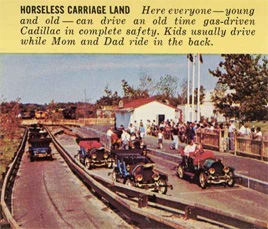 This isn’t the best way to read something new. It’s akin to the “horseless carriage” analogy that Ben’s used: when you think of a car as a carriage without a horse, you miss whatever it is that makes a car special. But there’s a problem with that metaphor, in that it carries with it ideas of displacement. Evolution is often perceived as being transformative: one thing turns into, and is then replaced by, another, as the horse was replaced by the car for purposes of transportation. But it’s usually more of a splitting: there’s a new species as well as the old species from which it sprung. The old species may go extinct, or it may not. To finish that example: we still have horses.
Figuratively, what’s happened with the Wikipedia is that a new species of text has arisen and we’re still wondering why it won’t eat the apples we’re proffering it. The Wikipedia hasn’t replaced print encyclopedias; in all probability, the two will coexist for a while. But I don’t think we yet know how to read Wikipedia. We judge it by what we’re used to, and everyone loses. Were you to judge a car by a horse’s attributes, you wouldn’t expect to have an oil crisis in a century.
Perhaps a useful way to think about this: a few paragraphs of Proust, found on a trip through In Search of Lost Time with Bob’s statement bouncing around my head. The Guermantes Way, the third part of the book, feels like the longest: much of this volume is about failing to recognize how things really are. Proust’s hapless narrator alternately recognizes his own mistakes of judgment and makes new ones for six hundred pages, with occasional flashes of insight, like this reflection:
. . . . There was a time when people recognized things easily when they were depicted by Fromentin and failed to recognize them at all when they were painted by Renoir.
Today people of taste tell us that Renoir is a great eighteenth-century painter. But when they say this they forget Time, and that it took a great deal of time, even in the middle of the nineteenth century, for Renoir to be hailed as a great artist. To gain this sort of recognition, an original painter or an original writer follows the path of the occultist. His painting or his prose acts upon us like a course of treatment that is not always agreeable. When it is over, the practitioner says to us, “Now look.” And at this point the world (which was not created once and for all, but as often as an original artist is born) appears utterly different from the one we knew, but perfectly clear. Women pass in the street, different from those we used to see, because they are Renoirs, the same Renoirs we once refused to see as women. The carriages are also Renoirs, and the water, and the sky: we want to go for a walk in a forest like the one that, when we first saw it, was anything but a forest – more like a tapestry, for instance, with innumerable shades of color but lacking precisely the colors appropriate to forests. Such is the new and perishable universe that has just been created. It will last until the next geological catastrophe unleashed by a new painter or writer with an original view of the world.
(The Guermantes Way, pp.323–325, trans. Mark Treharne.) There’s an obvious comparison to be made here, which I won’t belabor. Wikipedia isn’t Renoir, and its entry for poor Eugène Fromentin, whose paintings are probably better left forgotten, is cribbed from the 1911 Encyclopædia Britannica. But like the gallery-goers who needed to learn to look at Renoir, we need to learn to read Wikipedia, to read it as a new form that certainly inherits some traits from what we’re used to reading, but one that differs in fundamental ways. That’s a process that’s going to take time.
dyson weighs in on goodmail
Here is a follow up on the our post about Goodmail. A few weeks ago Esther Dyson wrote an op-ed piece in the New York Times in support of the Goodmail service, a start up which charges fees to senders of email to ensure their delivery. She argues that the services by either Goodmail or others are inevitable and will provide value of email recipients by eliminating spam. While I agree that customers should be allowed to chose whatever services they want, many of Dyson’s claims need to further examined to see if they make sense.
Dyson claims:
“I agree that pretty soon sending most e-mail will cost money, but I think that’s only right. It costs money to guarantee quality and safety. Moreover, I think the market will work, and that it will not shut out deserving senders, if we only let it work freely…”
“…In the short run, AOL and others will serve as the recipients’ proxies. If they don’t do a good job of ensuring that customers get the mail they want, even from nonpaying senders, they will lose their customers…
I’m not clear on how market competition requires additional cost to users. People are already free to chose email providers based on their spam filters. Email earns revenue for providers. Even yahoo, gmail and hotmail earn money through ads and sponored links. Adding another layer of fees will only give email providers an economic incentive to abandon their spam filters, which will make senders of email feel obligated to pay for these extra services. Email providers currently have incentives to continually improve their spam filters, which work rather well. Employing more strategies along the lines of improved mechanisms for users to report spam seem to be a more fairly distribution of the costs of insuring the delivery of email.
“And in the long run, recipients will be able to use services like Goodmail to set their own prices for receiving mail.
In my case, I’d have a list. I’d charge nothing for people I know, 50 cents for anyone new (though if I add the sender to my list after reading the mail, I’ll cancel the 50 cents) and $3 for random advertisers. Ex-boyfriends pay $10.”
I doubt the practicality of this scheme. It would only work if people receive email, open it, and approve new addresses, in a timely matter. People do not read all their email, as I’ve seen Inboxes with thousands of emails, many of them unopened. People forget that they have requested information, which would lead to disputed charged. People abandon email addresses and they accidentally erase email from servers. People change their minds on what spam is. Sometimes, email updates which people sign up to receive and later the become spam. If a firm buys an email list in good faith, are they open to these fines as well? The thought of resolving all these disputes of who wanted what email would be a bureaucratic mess.
“If people like those little stamps that mark their mail as safe and wanted or as commercial transactions, then let the customers have them. And let other companies compete with Goodmail to offer better and less expensive service.”
Goodmail is not passing on costs to receivers, but to senders. The companies who will feel the most effect are the ones with less resources, for example as she notes, non-profit organizations. Why this has to be true is still unclear to me.
wealth of networks
 I was lucky enough to have a chance to be at The Wealth of Networks: How Social Production Transforms Markets and Freedom book launch at Eyebeam in NYC last week. After a short introduction by Jonah Peretti, Yochai Benkler got up and gave us his presentation. The talk was really interesting, covering the basic ideas in his book and delivered with the energy and clarity of a true believer. We are, he says, in a transitional period, during which we have the opportunity to shape our information culture and policies, and thereby the future of our society. From the introduction:
This book is offered, then, as a challenge to contemporary legal democracies. We are in the midst of a technological, economic and organizational transformation that allows us to renegotiate the terms of freedom, justice, and productivity in the information society. How we shall live in this new environment will in some significant measure depend on policy choices that we make over the next decade or so. To be able to understand these choices, to be able to make them well, we must recognize that they are part of what is fundamentally a social and political choice—a choice about how to be free, equal, productive human beings under a new set of technological and economic conditions.
During the talk Benkler claimed an optimism for the future, with full faith in the strength of individuals and loose networks to increasingly contribute to our culture and, in certain areas, replace the moneyed interests that exist now. This is the long-held promise of the Internet, open-source technology, and the infomation commons. But what I’m looking forward to, treated at length in his book, is the analysis of the struggle between the contemporary economic and political structure and the unstructured groups enabled by technology. In one corner there is the system of markets in which individuals, government, mass media, and corporations currently try to control various parts of our cultural galaxy. In the other corner there are individuals, non-profits, and social networks sharing with each other through non-market transactions, motivated by uniquely human emotions (community, self-gratification, etc.) rather than profit. Benkler’s claim is that current and future technologies enable richer non-market, public good oriented development of intellectual and cultural products. He also claims that this does not preclude the development of marketable products from these public ideas. In fact, he sees an economic incentive for corporations to support and contribute to the open-source/non-profit sphere. He points to IBM’s Global Services division: the largest part of IBM’s income is based off of consulting fees collected from services related to open-source software implementations. [I have not verified whether this is an accurate portrayal of IBM’s Global Services, but this article suggests that it is. Anecdotally, as a former IBM co-op, I can say that Benkler’s idea has been widely adopted within the organization.]
Further discussion of book will have to wait until I’ve read more of it. As an interesting addition, Benkler put up a wiki to accompany his book. Kathleen Fitzpatrick has just posted about this. She brings up a valid criticism of the wiki: why isn’t the text of the book included on the page? Yes, you can download the pdf, but the texts are in essentially the same environment—yet they are not together. This is one of the things we were trying to overcome with the Gamer Theory design. This separation highlights a larger issue, and one that we are preoccupied with at the institute: how can we shape technology to allow us handle text collaboratively and socially, yet still maintain an author’s unique voice?
the networked book: an increasingly contagious idea
 Farrar, Straus and Giroux have ventured into waters pretty much uncharted by a big commercial publisher, putting the entire text of one of their latest titles online in a form designed to be read inside a browser. “Pulse,” a sweeping, multi-disciplinary survey by Robert Frenay of “the new biology” — “the coming age of systems and machines inspired by living things” — is now available to readers serially via blog, RSS or email: two installments per day and once per day on weekends.
Naturally, our ears pricked up when we heard they were calling the thing a “networked book” — a concept we’ve been developing for the past year and a half, starting with Kim White’s original post here on “networked book/book as network.” Apparently, the site’s producer, Antony Van Couvering, had never come across if:book and our mad theories before another blogger drew the connection following Pulse’s launch last week. So this would seem to be a case of happy synergy. Let a hundred networked books bloom.
The site is nicely done, employing most of the standard blogger’s toolkit to wire the book into the online discourse: comments, outbound links (embedded by an official “linkologist”), tie-ins to social bookmarking sites, a linkroll to relevant blog carnivals etc. There are also a number of useful tools for exploring the book on-site: a tag cloud, a five-star rating system for individual entries, a full-text concordance, and various ways to filter posts by topic and popularity.
My one major criticism of the Pulse site is that the site is perhaps a little over-accessorized, the design informed less by the book’s inherent structure and themes than by a general enthusiasm for Web 2.0 tools. Pulse clearly was not written for serialization and does not always break down well into self-contained units, so is a blog the ideal reading environment or just the reading environment most readily at hand? Does the abundance of tools perhaps overcrowd the text and intimidate the reader? There has been very little reader commenting or rating activity so far.
But this could all be interpreted as a clever gambit: perhaps FSG is embracing the web with a good faith experiment in sharing and openness, and at the same time relying on the web’s present limitations as a reading interface (and the dribbling pace of syndication — they’ll be rolling this out until November 6) to ultimately drive readers back to the familiar print commodity. We’ll see if it works. In any event, this is an encouraging sign that publishers are beginning to broaden their horizons — light years ahead of what Harper Collins half-heartedly attempted a few months back with one of its more beleaguered titles.
I also applaud FSG for undertaking an experiment like this at a time when the most aggressive movements into online publishing have issued not from publishers but from the likes of Google and Amazon. No doubt, Googlezon’s encroachment into electronic publishing had something to do with FSG’s decision to go ahead with Pulse. Van Couvering urges publishers to take matters into their own hands and start making networked books:
Why get listed in a secondary index when you can be indexed in the primary search results page? Google has been pressuring publishers to make their books available through the Google Books program, arguing (basically) that they’ll get more play if people can search them. Fine, except Google may be getting the play. If you’re producing the content, better do it yourself (before someone else does it).
I hope tht Pulse is not just the lone canary in the coal mine but the first of many such exploratory projects.
Here’s something even more interesting. In a note to readers, Frenay talks about what he’d eventually like to do: make an “open source” version of the book online (incidentally, Yochai Benkler has just done something sort of along these lines with his new book, “The Wealth of Networks” — more on that soon):
At some point I’d like to experiment with putting the full text of Pulse online in a form that anyone can link into and modify, possibly with parallel texts or even by changing or adding to the wording of mine. I like the idea of collaborative texts. I also feel there’s value in the structure and insight that a single, deeply committed author can bring to a subject. So what I want to do is offer my text as an anchor for something that then grows to become its own unique creature. I like to imagine Pulse not just as the book I’ve worked so hard to write, but as a dynamic text that can continue expanding and updating in all directions, to encompass every aspect of this subject (which is also growing so rapidly).
This would come much closer to the networked book as we at the institute have imagined it: a book that evolves over time. It also chimes with Frenay’s theme of modeling technology after nature, repurposing the book as its own intellectual ecosystem. By contrast, the current serialized web version of Pulse is still very much a pre-network kind of book, its structure and substance frozen and non-negotiable; more an experiment in viral marketing than a genuine rethinking of the book model. Whether the open source phase of Pulse ever happens, we have yet to see.
But taking the book for a spin in cyberspace — attracting readers, generating buzz, injecting it into the conversation — is not at all a bad idea, especially in these transitional times when we are continually shifting back and forth between on and offline reading. This is not unlike what we are attempting to do with McKenzie Wark’s “Gamer Theory,” the latest draft of which we are publishing online next month. The web edition of Gamer Theory is designed to gather feedback and to record the conversations of readers, all of which could potentially influence and alter subsequent drafts. Like Pulse, Gamer Theory will eventually be a shelf-based book, but with our experiment we hope to make this networked draft a major stage in its growth, and to suggest what might lie ahead when the networked element is no longer just a version or a stage, but the book itself.
funding serious games
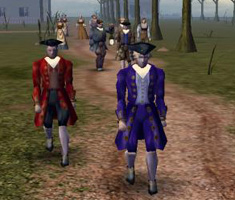 In his recent article “Why We Need a Corporation for Public Gaming,” David Rejeski proposes the creation of a government funded entity for gaming to be modeled after the Corporation for Public Broadcasting (CPB). He compares the early days of television to the early days of video gaming. 20 years after the birth of commercial broadcast television, he notes that the Lyndon Johnson administration created CPB to combat to the “vast wasteland of television.” CPB started with an initial $15 million budget (which has since grown to $300 million). Rejeski propose a similar initial budget for a Corporation for Public Gaming (CPG). For Rejeski, video games are no longer sequestered to the bedroom of teenage boys, and are as an important medium in our culture as is television. He notes “that the average gamer is 30 years old, that over 40 percent are female, and that most adult gamers have been playing games for 12 years.” He also cites examples of how a small but growing movement of “serious games” are being used towards education and humanitarian ends. By claiming that a diversity of video games is important for the public good, and therefore important for the government to fund, he implies that these serious games are good for democracy.
Rejeski raises an important idea (which I agree with), that gaming has more potential activities than saving princesses or shooting everything in sight. Fortunately, he acknowledges that government funded game development will not cure all the ill effects he describes. In that, CPB funded television programs did not fix television programming and has its own biases. Rejeski admits that ultimately “serious games, like serious TV, are likely to remain a sidebar in the history of mass media.” My main contention with Rejeski’s call is his focus on the final product or content, in this case, comparing a video game with a television program. His analogy fails to recognize the equally important components of the medium, production and distribution. If we look at video games in terms of production, distribution as well as content, the allocation of government resources envision a different outcome. In this analysis, a more efficient use of funds would be geared towards creating tools to create games, insuring fair and open access to the network, and less emphasis funded towards the creation of actual games.
1. Production:
Perhaps, rather than television, a better analogy would be to look at the creation of the Internet, which supports many to many communication and production. What started as a military project under DARPA, Internet protocols and networks became a tool which people used for academic, commercial, and individual purposes. A similar argument could be made for the creation of a freely distributed game development environment. Although the costs associated with computation and communication are decreasing, high-end game development budgets for titles such as the Sims Online and Halo 2 are estimated to run in the tens of millions of dollars. The level of support are required to create sophisticated 3D and AI game engines.
Educators have been modding games of this caliber. For example, the Education Arcade’s game, Revolution, teaches American History. The game was created using the Neverwinter Nights game engine. However, problems often arise because the actions of characters are often geared towards the violent, and male and female models are not representative of real people. Therefore, rather than focusing on the funding of games, creating a game engine and other game production tools to be made open source and freely distributed would provide an important resource for the non-commerical gaming community.
There are funders who support the creation of non-commerical games, however as with most non-commerical ventures, resources are scare. Thus, a game development environment, released under a GPL-type licensing agreement, would allow serious game developers to use their resources for design and game play, and potentially address issues that may be too controversial for the government to fund. Issues of government funding over controversial content, be it television or games, will be addressed further in this analysis.
2.Distribution:
In Rejecki’s analogy of television, he focuses on the content of the one to many broadcast model. One result of this focus is the lack of discussion on the equally important use of CPB funds to support the Public Broadcast Services (PBS) that air CPB funded programs. By supporting PBS, an additional voice was added to the three television networks which in theory is good for a functioning democracy. The one to many model also discounts the power of the many to many model that is enabled by a fairly accessible network.
In the analogy of television and games, air waves and cables are tightly controlled through spectrum allocation and private ownership of cable wires. Individual production of television programming is limited to public access cable. The costs of producing and distributing on-air television content is extremely expensive, and does not decreasingly scale. That is, a two minute on-air television clip is still expensive to produce and air. Where as, small scale games can be created and distributed with limited resources. In the many to many production model, supporting issues as network neutrality or municipal broadband (along with new tools) would allow serious games to increase in sophistication, especially as games increasingly rely on the network for not only distribution, but game play as well. Corporation for Public Gaming does not need to pay for municipal broadband networks. However, legislative backers of a CPG need to recognize that an open network are equally linked to non-commerical content, as the CPB and PBS are. Again, keeping the network open will allow more resources to go toward content.
3. Content:
The problem with government funded content, whether it be television programs or video games, is that the content will always been under the influence of the mainstream cultural shifts. It may be hard to challenge the purpose of creating games to teach people about children diabetics glucose level management or balancing state budgets. However, games to teach people about HIV/AIDS education, evolution or religion are harder for the government to fund. Or better yet, take Rejeski’s example of the United Nation World Food Program game on resource allocation for disaster relief. What happens with this simulation gets expanded to include issues like religious conflicts, population control, and international favoritism?
Further, looking at the CPB example, it is important to acknowledge the commercial interests in CPB funded programs. Programs broadcast on PBS receive funding from CPB, private foundations, and corporate sponsorship, often from all three for one program. It becomes increasingly hard to defend children’s television as “non-commerical,” when one considers the proliferation of products based on CPB funded children’s educational shows, such as Sesame Street’s “Tickle me Emo” dolls. Therefore, we need to be careful, when we discuss the CPB and PBS programs as “non-commercial.”
Therefore, commercial interests are involved in the production of “public television,” and will be effected by commerical interests, even if it is to a lesser degree than commercial network programming. Investment in fair distribution and access to the network , as well as the development of accessible tools for gaming production would allow more opportunity for the democratization of game development that Rejeski is suggesting.
Currently, many of the serious games being created are niche games, with a very specific, at times, small audience. Digital technologies excel in this many to many model. As opposed to the one to many communication model of television, the many to many production of DYI game design allows for many more voices. Some segment of federal grants to support these games will fall prey to criticism, if the content strays too far from the current mainstream. The vital question than, is how do we support the diversity of voices to maintain a democracy in the gaming world given the scare resource of federal funding. Allocating resources towards tools and access may then be more effective overall in supporting the creation of serious games. Although I agree with Rejeski’s intentions, I suggest the idea of government funded video games needs to expand to include production and distribution, along with limited support of content for serious games.
italian videobloggers create open source film
 An article in today’s La Repubblica reports that Italian videobloggers are at work creating an “open source film” about the recent election there. A website called Nessuno.TV is putting together a project called Le mie elezioni (“My Elections”). Visitors to the site were invited to submit their own short films. Director Stefano Mordini plans to weld them together into an hour-long documentary in mid-May.
 The raw materials are already on display: they’ve acquired an enormous number of short films which provide an interesting cross section of Italian society. Among many others, Davide Preti interviews a husband and wife about their opposing views on the election. Stiletto Paradossale‘s series “That Thing Called Democracy” interviews people on the street in the small towns of Serrapetrona and Caldarola about what’s important about democracy. In a neat twist, Donne liberta di stampa interview a reporter from the BBC about what she thinks about the elections. And Robin Good asks the children what they think.
Not all the films are interviews. Maurizio Dovigi presents a self-filmed open letter to Berlusconi. ComuniCalo eschews video in “Una notta terribile!”, a slideshow of images from the long night in Rome spent waiting for results. And Luna di Velluto offers a sped-up self-portrait of her reaction to the news on that same nights.
 It’s immediately apparent that most of these films are for the left. This isn’t an isolated occurance: the Italian left seems to have understood that the network can be a political force. In January, I noted the popularity of comic Beppe Grillo’s blog. Since then, it’s only become more popular: recent entries have averaged around 3000 comments each (this one, from four days ago, has 4123). Nor is he limiting himself to the blog: there are weekly PDF summaries of issues, MeetUp groups, and a blook/DVD combo. Compare this hyperactivity to the staid websites of Berlusconi’s Forza Italia party and the Silvio Berlusconi Fans Club.
The Italian left’s embrace of the Internet has partially been out of necessity: as Berlusconi owns most of the Italian media, views that counter his have been largely absent. There’s the perception that the mainstream media has stagnated, though there’s clearly a thirst for intelligent commentary: an astounding five million viewers tuned in to an appearance by Umberto Eco on TV two months ago. Bruno Pellegrini, who runs Nessuno.TV, suggests that the Internet can offer a corrective alternative:
We want to be a TV ‘made by those who watch it. A participatory TV, in which the spectators actively contribute to the construction of a palimpsest. We are riding the tendencies of the moment, using the technologies available with the lowest costs, and involving those young people who are convinced that an alternative to regular TV can be constructed, and we’re starting that.
They’re off to an impressive start, and I’ll be curious to see how far they get with this. One nagging thought: most of these videos would have copyright issues in the U.S. Many use background music that almost certainly hasn’t been cleared by the owners. Some use video clips and photos that are probably owned by the mainstream press. The dread hand of copyright enforcement isn’t as strong in Italy as it is in the U.S., but it still exists. It would be a shame if rights issues brought down such a worthy community project.
G4M3R 7H30RY: part 4

We’ve moved past the design stage with the GAM3R 7H30RY blog and forum. We’re releasing the book in two formats: all at once (date to be soon decided), in the page card format, and through RSS syndication. We’re collecting user input and feedback in two ways: from comments submitted through the page-card interface, and in user posts in the forum.
The idea is to nest Ken’s work in the social network that surrounds it, made visible in the number of comments and topics posted. This accomplishes something fairly radical, shifting the focus from an author’s work towards the contributions of a work’s readers. The integration between the blog and forums, and the position of the comments in relation to the author’s work emphasizes this shift. We’re hoping that the use of color as an integrating device will further collapse the usual distance between the author and his reading (and writing) public.
To review all the stages that this project has been through before it arrived at this, check out Part I, Part II, and Part III. The design changes show the evolution of our thought and the recognition of the different problems we were facing: screen real estate, reading environment, maintaining the author’s voice but introducing the public, and making it fun. The basic interaction design emerged from those constraints. The page card concept arose from both the form of Ken’s book—a regimented number of paragraphs with limited length—and the constraints of screen real estate (1024×768). The overlapping arose from the physical handling of the ‘Oblique Strategies’ cards, and helps to present all the information on a single screen. The count of pages (five per section, five sections per chapter) is a further expression of the structure that Ken wrote into the book. Comments were lifted from their usual inglorious spot under the writer’s post to be right beside the work. It lends them some additional weight.
We’ve also reimagined the entry point for the forums with the topic pool. It provides a dynamic view of the forums, raising the traditional list into the realm of something energetic, more accurately reflecting the feeling of live conversation. It also helps clarify the direction of the topic discussion with a first post/last post view (visible in the mouseover state below). This simple preview will let users know whether or not a discussion has kept tightly to the subject or spun out of control into trivialities.

We’ve been careful with the niceties: the forum indicator bars turned on their sides to resemble video game power ups; the top of the comments sitting at the same height as the top of their associated page card; the icons representing comments and replies (thanks to famfamfam).
Each of the designed pages changed several times. The page cards have been the most drastically and frequently changed, but the home page went through a significant series of edits in a matter of a few days. As with many things related to design, I took several missteps before alighting on something which seems, in retrospect, perfectly obvious. Although the ‘table of contents’ is traditionally an integrated part of a bound volume, I tried (and failed) to create a different alignment and layout with it. I’m not sure why—it seemed like a good idea at the time. I also wanted to include a hint of the pages to come—unfortunately it just made it difficult for your eye move smoothly across the page. Finally I settled on a simpler concept, one that harmonized with the other layouts, and it all snapped into place.


With that we began the production stage, and we’re making it all real. Next update will be a pre-launch announcement.