
With the coming release of Sophie and our recent attendence at the Access 2 Knowledge conference, I find myself thinking about open source software development. The operating system Linux is often used as the shining example of the open source software movement. Slashdot reported an interesting ZDNet UK article, which quoted the head maintainer of the Linux production kernal, Andrew Morton, saying that he is concerned about the large number of long standing bugs in the 2.6 kernal. Software always has bugs being worked out, even the long standing ones that Morton describes. Therefore, the statement is not all that shocking or surprising.
What intrigued me was this following statement:
“One problem is that few developers are motivated to work on bugs, according to Morton. This is particularly a problem for bugs that affect old computers or peripherals, as kernel developers working for corporations don’t tend to care about out-of-date hardware, he said. Nowadays, many kernel developers are employed by IT companies, such as hardware manufacturers, which can cause problems as they can mainly be motivated by self-interest.
“If you’re a company that employs a kernel maintainer, you don’t have an interest in working on a five-year-old peripheral that no one is selling any more. I can understand that, but it is a problem as people are still using that hardware. The presence of that bug affects the whole kernel process, and can hold up the kernel — as there are bugs, but no one is fixing them,” said Morton.
Keeping contributors motivated is crucial to open source endeavors. Reputation is a major factor in what drives people to submit code to the Linux development team. In retrospect, the importance of adding code for new features over adding mundane code for bug fixes, as part of reputation building makes sense. The street cred for fixing old bugs does not seem to be sexy enough; eventhough, some of these bugs could have long term effects on the quality of the Linux OS.
Are there solutions? One solution posited by Morton is to dedicate the entire next release to fixing long standing bugs. Although it is not clear to me how open source developers would react to this constraint. Another solution might try to expand the talent pool by encouraging young, gifted (even student) programmers to work on the bugs. Their motivations might be different from current developers, and any kind of participation might offer enough motivation.
Open source software development is still a fairly new phenomenon and is far from being completely understood. As we see more clearly how motivation factors work and what they produce in the open source production model, it will be increasingly important to document, analyze and learn from these observations. The future sustainability for open source software will rely on learning how to best maintain the developers’ incentives to contribute code. Therefore, we must remind ourselves that the open source development movement is something that must be continuously nurtured. And while we can cite Linux as a success story, the project itself is not on autopilot, nor will it ever be.
war machinima
Ray, Bob and I spent last week out in Los Angeles at our institutional digs (the Annenberg Center for Communication at USC), where we held a pair of meetings with professors from around the US and Canada to discuss various coups we are attempting to stage within the ossified realm of scholarly and textbook publishing. Following these, we were able to stick around for a fun conference/media festival organized by Annenberg’s Networked Publics project.
The conference was a mix of the usual academic panels and a series of curated mini-exhibits of “do-it-yourself” media, surveying new genres of digital folk art currently proliferating across the net such as political remix movies, anime music videos, “digital handmade” art projects (which featured the near and dear Alex Itin — happy birthday, Alex!), and of course, machinima: films made inside of video game engines.
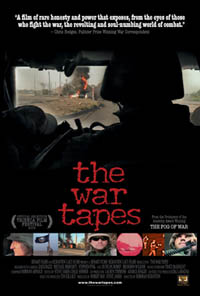 As we enjoyed this little feast of new media, I was vaguely aware that the Tribeca film festival was going on back in New York. As I casually web-surfed through one of the panels — in the state of continuous partial attention that is now the standard state of being all these networky conferences — I came across an article about one of the more talked about films appearing there this year: “The War Tapes.” Like Gunner Palace and Occupation Dreamland, “The War Tapes” is a documentary about American soldiers in Iraq, but with one crucial difference: all the footage was shot by actual soldiers.
Back in 2004, director Deborah Scranton gave video cameras to ten members of the New Hampshire National Guard who were about to depart for a yearlong tour in Iraq. They went on to shoot a combined 800 hours of film, the pared-down result of which is “The War Tapes.” Reading about it, I couldn’t help but think that here was a case of real-life machinima. Give the warriors cameras and glimpse the war machine from the inside — carve out a new game within the game.
Granted, it’s a far from perfect analogy. Machinima involves a total repurposing of the characters and environment, foregoing the intended objectives of the game. In “The War Tapes,” the soldiers are still on their mission, still within the chain of command. And of course, war isn’t a video game. But isn’t it advertised as one?
Time Square, New York City (the military-entertainment complex)
There’s something undeniably subversive about giving cameras to GIs in what is such a thoroughly mediated war, a sort of playing against the game — if not of the game of occupation as a whole, then at least the game of spin. “I’m not supposed to talk to the media,” says one soldier to Steve Pink, one of the film’s main subjects, as he attempts to conduct an interview. To which Pink replies: “I’m not the media, dammit!”
In the clips I found on the film’s promotional site (the general release is later this summer), the overriding impression is of the soldiers’ isolation and fear: the constant terror of roadside bombs, frantic rounds fired into the green night-vision darkness, swaddled in helmets and humvees and hi-tech weaponry. It’s a frightening game they play. Deeply impersonal and anonymous, and in no way resembling the pumped-up, guitar-screeching game that the military portrays as war in its recruiting ads. This is the horrible truth at the bottom of the “Army of One” slogan: you are a lone digit in a massive calculation. Just pray you don’t become a zero.
Yet naturally, they find their own games to play within the game. One clip shows the tiny, gruesome spectacle of two soldiers, in a moment of leisure, pitting a scorpion against a spider inside a plastic tub, reenacting their own plight in the language of the desert.
At the Net Publics conference, we did see see one example of genuine machinima that made its own spooky commentary on the war: a hack of Battlefield 2 by Swedish game forum Snoken that brilliantly apes the now-famous Sony Bravia commercial, in which 250,000 colored plastic balls were filmed cascading through the streets of a San Francisco.
Here’s Battlefield:
And here’s the original Sony ad:
McKenzie Wark doesn’t address machinima in GAM3R 7H30RY (which launches in about a week), but he does discuss video games in the context of the “military entertainment complex”: the remaking of postmodern capitalist society in the image of the digital game, in which every individual is a 1 or a 0 locked in senseless competition for advancement through the levels, each vying to “win” the game:
The old class antagonisms have not gone away, but are hidden beneath levels of rank, where each agonizes over their worth against others in the price of their house, the size of their vehicle and where, perversely, working longer and longer hours is a sign of winning the game. Work becomes play. Work demands not just one’s mind and body but also one’s soul. You have to be a team player. Your work has to be creative, inventive, playful – ludic, but not ludicrous.
Video games (which can actually be won) are allegories of this imperfect world that we are taught to play like a game, as though it really were governed by a perfect (and perfectly fair) algorithm — even the wars that rage across its hemispheres:
Once games required an actual place to play them, whether on the chess board or the tennis court. Even wars had battle fields. Now global positioning satellites grid the whole earth and put all of space and time in play. Warfare, they say, now looks like video games. Well don’t kid yourself. War is a video game – for the military entertainment complex. To them it doesn’t matter what happens ‘on the ground’. The ground – the old-fashioned battlefield itself – is just a necessary externality to the game. Slavoj Zizek: “It is thus not the fantasy of a purely aseptic war run as a video game behind computer screens that protects us from the reality of the face to face killing of another person; on the contrary it is this fantasy of face to face encounter with an enemy killed bloodily that we construct in order to escape the Real of the depersonalized war turned into an anonymous technological operation.” The soldier whose inadequate armor failed him, shot dead in an alley by a sniper, has his death, like his life, managed by a computer in a blip of logistics.
How does one truly escape? Ultimately, Wark’s gamer theory is posed in the spirit that animates the best machinima:
The gamer as theorist has to choose between two strategies for playing against gamespace. One is to play for the real. (Take the red pill). But the real is nothing but a heap of broken images. The other is to play for the game (Take the blue pill). Play within the game, but against gamespace. Be ludic, but also lucid.
a network of books
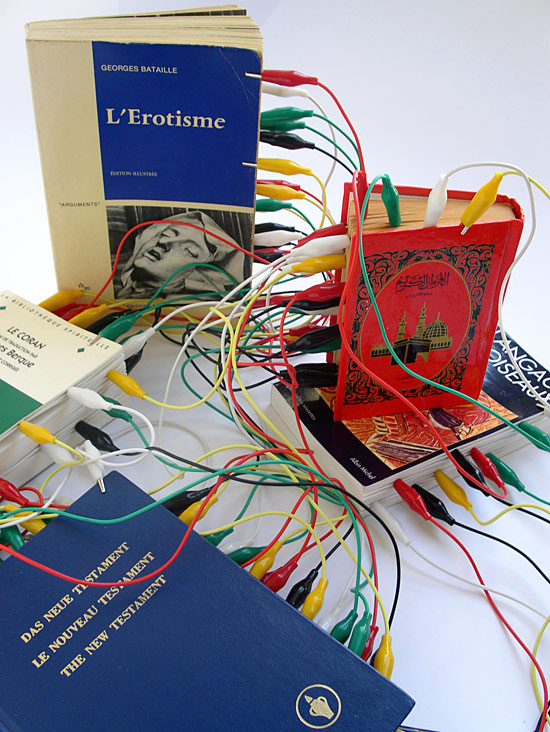
This is the “cover” (it’s an email mag) of the latest issue of artkrush. Part of a 2004 installation by Moroccan artist Mounir Fatmi called “The Connections.”
Connections is the outcome of a reflection which began in the early Nineties, at the time of the war in the Gulf…. At that time, the operations Desert Storm and Desert Fox, preceding the last operation which could be named “Desert, full stop”, established the era of a media oriented war, therefore a war of image, on the very spot of the Revelation, that of the three sacred books, a historic place dedicated to communication. They clearly showed the lack of means of communication and even the lack of communication power of the Arab countries as well as the resurgent fear of technology.
In our calendar, that of Hegira, we are today in 1420, eternally nomads. Our roots are clearly set in the future, as the Arab poet Adonis wrote it. For me, it is an attempt to enter this desert, this collective memory, to remove sand from objects which may lose their identity through the changing of material but will still keep their memory.
A recent comment from Adam Greenfield, author of the just-published “Everyware: The Dawning Age of Ubiquitous Computing,” seems apropos:
I’ve become all but unable to think of the objects around me except in terms of Actor-Network theory, as sort of depositions or instantiations of a great deal of matter, energy and information moving through the world. And of course, a book is nothing but a snapshot in that regard; you have to do a lot of extra work if you want to prise out and examine the flows it is a part of, or even those it has set up.
ip watch: this week at wipo
As Jesse posted earlier, we attended the Access 2 Knowledge Conference 2006. It was informative and we got a chance to listen to and talk with a great variety of people working in this area.
One very important issue that was surprisingly only raised on occasion and receives even less coverage in the mainstream media is the Treaty for the Protection of the Rights of Broadcasting, Cablecasting and Webcasting Organizations being presented this week at the World Intellectual Property Organization (WIPO) in Geneva. A panelist at A2K, Jamie Love, who is from the Consumer Project on Technology posted on the Huffingpost last year on this treaty. CPT is a great resource for drafts of the Treaty and well as analysis from various media covering the issue. Thiru Balasubramaniam also gives a good update on the controversial treaty.
The proposed treaty seeks to add a new layer of IP over any broadcast media, including the media delivered via the Internet. Here, webcasting refers to not only the colloquial meaning for streaming video but also the general transmission of web content over the Internet. Love notes that this treaty grants to webcasters IP rights over what they transmit, which is “separate and in addition to the rights (if any) of copyright owners.” Therefore, webcasters would retain rights over even material in the public domain.
Love further gives this explaination:
“If you download a file from the Internet, you would have to get the permission of the web page operator before you could republish the data elsewhere. This permission would be in addition to any permissions you would need from the actual copyright owner, and it would even be required if you are seeking to publish something that was either in the public domain under copyright law, or that had been licensed for distribution under something like a creative commons license.”
This treaty would dramatically change the IP landscape of broadcasting. Aside from the fact that the treaty would give rights to broadcasters that never existed before in the US, its passage would severely limit the democratic culture of self publishing that made the Internet important in the first place.
defining the networked book: a few thoughts and a list
The networked book, as an idea and as a term, has gained currency of late. A few weeks ago, Farrar Straus and Giroux launched Pulse , an adventurous marketing experiment in which they are syndicating the complete text of a new nonfiction title in blog, RSS and email. Their web developers called it, quite independently it seems, a networked book. Next week (drum roll), the institute will launch McKenzie Wark’s “GAM3R 7H30RY,” an online version of a book in progress designed to generate a critical networked discussion about video games. And, of course, the July release of Sophie is fast approaching, so soon we’ll all be making networked books.

The institue will launch McKenzie Wark’s GAM3R 7H30RY Version 1.1 on Monday, May 15
The discussion following Pulse highlighted some interesting issues and made us think hard about precisely what it is we mean by “networked book.” Last spring, Kim White (who was the first to posit the idea of networked books) wrote a paper for the Computers and Writing Online conference that developed the idea a little further, based on our experience with the Gates Memory Project, where we tried to create a collaborative networked document of Christo and Jeanne-Claude’s Gates using popular social software tools like Flickr and del.icio.us. Kim later adapted parts of this paper as a first stab at a Wikipedia article. This was a good start.
We thought it might be useful, however, in light of recent discussion and upcoming ventures, to try to focus the definition a little bit more — to create some useful boundaries for thinking this through while holding on to some of the ambiguity. After a quick back-and-forth, we came up with the following capsule definition: “a networked book is an open book designed to be written, edited and read in a networked environment.”
Ok. Hardly Samuel Johnson, I know, but it at least begins to lay down some basic criteria. Open. Designed for the network. Still vague, but moving in a good direction. Yet already I feel like adding to the list of verbs “annotated” — taking notes inside a text is something we take for granted in print but is still quite rare in electronic documents. A networked book should allow for some kind of reader feedback within its structure. I would also add “compiled,” or “assembled,” to account for books composed of various remote parts — either freestanding assets on distant databases, or sections of text and media “transcluded” from other documents. And what about readers having conversations inside the book, or across books? Is that covered by “read in a networked environment”? — the book in a peer-to-peer ecology? Also, I’d want to add that a networked book is not a static object but something that evolves over time. Not an intersection of atoms, but an intersection of intentions. All right, so this is a little complicated.
It’s also possible that defining the networked book as a new species within the genus “book” sows the seeds of its own eventual obsolescence, bound, as we may well be, toward a post-book future. But that strikes me as too deterministic. As Dan rightly observed in his recent post on learning to read Wikipedia, the history of media (or anything for that matter) is rarely a direct line of succession — of this replacing that, and so on. As with the evolution of biological life, things tend to mutate and split into parallel trajectories. The book as the principal mode of discourse and cultural ideal of intellectual achievement may indeed be headed for gradual decline, but we believe the network has the potential to keep it in play far longer than the techno-determinists might think.
But enough with the theory and on to the practice. To further this discussion, I’ve compiled a quick-and-dirty list of projects currently out in the wild that seem to be reasonable candidates for networked bookdom. The list is intentionally small and ridden with gaps, the point being not to create a comprehensive catalogue, but to get a conversation going and collect other examples (submitted by you) of networked books, real or imaginary.
* * * * *
Everyone here at the institute agrees that Wikipedia is a networked book par excellence. A vast, interwoven compendium of popular knowledge, never fixed, always changing, recording within its bounds each and every stage of its growth and all the discussions of its collaborative producers. Linked outward to the web in millions of directions and highly visible on all the popular search indexes, Wikipedia is a city-like book, or a vast network of shanties. If you consider all its various iterations in 229 different languages it resembles more a pan-global tradition, or something approaching a real-life Hitchhiker’s Guide to the Galaxy. And it is only five years in the making.
But already we begin to run into problems. Though we are all comfortable with the idea of Wikipedia as a networked book, there is significant discord when it comes to Flickr, MySpace, Live Journal, YouTube and practically every other social software, media-sharing community. Why? Is it simply a bias in favor of the textual? Or because Wikipedia – the free encyclopedia — is more closely identified with an existing genre of book? Is it because Wikipedia seems to have an over-arching vision (free, anyone can edit it, neutral point of view etc.) and something approaching a coherent editorial sensibility (albeit an aggregate one), whereas the other sites just mentioned are simply repositories, ultimately shapeless and filled with come what may? This raises yet more questions. Does a networked book require an editor? A vision? A direction? Coherence? And what about the blogosphere? Or the world wide web itself? Tim O’Reilly recently called the www one enormous ebook, with Google and Yahoo as the infinitely mutable tables of contents.
Ok. So already we’ve opened a pretty big can of worms (Wikipedia tends to have that effect). But before delving further (and hopefully we can really get this going in the comments), I’ll briefly list just a few more experiments.
>>> Code v.2 by Larry Lessig
From the site:
“Lawrence Lessig first published Code and Other Laws of Cyberspace in 1999. After five years in print and five years of changes in law, technology, and the context in which they reside, Code needs an update. But rather than do this alone, Professor Lessig is using this wiki to open the editing process to all, to draw upon the creativity and knowledge of the community. This is an online, collaborative book update; a first of its kind.
“Once the project nears completion, Professor Lessig will take the contents of this wiki and ready it for publication.”
Recently discussed here, there is the new book by Yochai Benkler, another intellectual property heavyweight:
>>> The Wealth of Networks
Yale University Press has set up a wiki for readers to write collective summaries and commentaries on the book. PDFs of each chapter are available for free. The verdict? A networked book, but not a well executed one. By keeping the wiki and the text separate, the publisher has placed unnecessary obstacles in the reader’s path and diminished the book’s chances of success as an organic online entity.
>>> Our very own GAM3R 7H30RY
On Monday, the institute will launch its most ambitious networked book experiment to date, putting an entire draft of McKenzie Wark’s new book online in a compelling interface designed to gather reader feedback. The book will be matched by a series of free-fire discussion zones, and readers will have the option of syndicating the book over a period of nine weeks.
>>> The afore-mentioned Pulse by Robert Frenay.
Again, definitely a networked book, but frustratingly so. In print, the book is nearly 600 pages long, yet they’ve chosen to serialize it a couple pages at a time. It will take readers until November to make their way through the book in this fashion — clearly not at all the way Frenay crafted it to be read. Plus, some dubious linking made not by the author but by a hired “linkologist” only serves to underscore the superficiality of the effort. A bold experiment in viral marketing, but judging by the near absence of reader activity on the site, not a very contagious one. The lesson I would draw is that a networked book ought to be networked for its own sake, not to bolster a print commodity (though these ends are not necessarily incompatible).
>>> The Quicksilver Wiki (formerly the Metaweb)
A community site devoted to collectively annotating and supplementing Neal Stephenson’s novel “Quicksilver.” Currently at work on over 1,000 articles. The actual novel does not appear to be available on-site.
>>> Finnegans Wiki
A complete version of James Joyce’s demanding masterpiece, the entire text placed in a wiki for reader annotation.
>>> There’s a host of other literary portals, many dating back to the early days of the web: Decameron Web, the William Blake Archive, the Walt Whitman Archive, the Rossetti Archive, and countless others (fill in this list and tell us what you think).
Lastly, here’s a list of book blogs — not blogs about books in general, but blogs devoted to the writing and/or discussion of a particular book, by that book’s author. These may not be networked books in themselves, but they merit study as a new mode of writing within the network. The interesting thing is that these sites are designed to gather material, generate discussion, and build a community of readers around an eventual book. But in so doing, they gently undermine the conventional notion of the book as a crystallized object and begin to reinvent it as an ongoing process: an evolving artifact at the center of a conversation.
Here are some I’ve come across (please supplement). Interestingly, three of these are by current or former editors of Wired. At this point, they tend to be about techie subjects:
>>> An exception is Without Gods: Toward a History of Disbelief by Mitchell Stephens (another institute project).
“The blog I am writing here, with the connivance of The Institute for the Future of the Book, is an experiment. Our thought is that my book on the history of atheism (eventually to be published by Carroll and Graf) will benefit from an online discussion as the book is being written. Our hope is that the conversation will be joined: ideas challenged, facts corrected, queries answered; that lively and intelligent discussion will ensue. And we have an additional thought: that the web might realize some smidgen of benefit through the airing of this process.”
>>> Searchblog
John Battelle’s daily thoughts on the business and technology of web search, originally set up as a research tool for his now-published book on Google, The Search.
>>> The Long Tail
Similar concept, “a public diary on the way to a book” chronicling “the shift from mass markets to millions of niches.” By current Wired editor-in-chief Chris Anderson.
>>> Darknet
JD Lasica’s blog on his book about Hollywood’s war against amateur digital filmmakers.
>>> The Technium
Former Wired editor Kevin Kelly is working through ideas for a book:
“As I write I will post here. The purpose of this site is to turn my posts into a conversation. I will be uploading my half-thoughts, notes, self-arguments, early drafts and responses to others’ postings as a way for me to figure out what I actually think.”
>>> End of Cyberspace by Alex Soojung-Kim Pang
Pang has some interesting thoughts on blogs as research tools:
“This begins to move you to a model of scholarly performance in which the value resides not exclusively in the finished, published work, but is distributed across a number of usually non-competitive media. If I ever do publish a book on the end of cyberspace, I seriously doubt that anyone who’s encountered the blog will think, “Well, I can read the notes, I don’t need to read the book.” The final product is more like the last chapter of a mystery. You want to know how it comes out.
“It could ultimately point to a somewhat different model for both doing and evaluating scholarship: one that depends a little less on peer-reviewed papers and monographs, and more upon your ability to develop and maintain a piece of intellectual territory, and attract others to it– to build an interested, thoughtful audience.”
* * * * *
This turned out much longer than I’d intended, and yet there’s a lot left to discuss. One question worth mulling over is whether the networked book is really a new idea at all. Don’t all books exist over time within social networks, “linked” to countless other texts? What about the Talmud, the Jewish compendium of law and exigesis where core texts are surrounded on the page by layers of commentary? Is this a networked book? Or could something as prosaic as a phone book chained to a phone booth be considered a networked book?
In our discussions, we have focused overwhelmingly on electronic books within digital networks because we are convinced that this is a major direction in which the book is (or should be) heading. But this is not to imply that the networked book is born in a vacuum. Naturally, it exists in a continuum. And just as our concept of the analog was not fully formed until we had the digital to hold it up against, perhaps our idea of the book contains some as yet undiscovered dimensions that will be revealed by investigating the networked book.
on appropriation
The Tate Triennial 2006, showcasing new British Art, brings together thirty-six artists who explore the reuse and reshaping of cultural material. Curated by Beatrix Ruf, director of the Kunsthalle in Zurich, the exhibition includes artists from different generations who explore reprocessing and repetition through painting, drawing, sculpture, photography, film, installations and live work.

Marc Camille Chaimowicz
Here and There… 1979-2006
Historically, the appropriation of images and other cultural matter has been practiced by societies as the reiteration, reshuffling, and eventual transformation of artistic and intellectual human manifestations. It covers a vast range from tribute to pastiche. When visual codes are combined, the end product is either a cohesive whole where influences connect into new and very personal languages, or disparate combinations where influences compete and clash. In today’s art, the different guises of repetition, from collage and montage to file sharing and digital reproduction highlight the existing codes or reveal the artificiality of the object. Today’s combination of codes alludes to a collective sense of memory in a moment when memories have become literally photographic.
One comes out of this exhibition thinking about Duchamp‘s “readymades,” Rauschenberg’s “combines,” and other forms of conceptual “gluing,” (the literal meaning of the word “collage,”) as precursors and/or manifestations of the postmodern condition. This show is a perfect representation of our moment. As Beatrix Ruf says in the catalogue: “Artists today are forging new ways of making sense of reality, reworking ideas of authenticity, directness and social relevance, looking again into art practices that emerged in the previous century.”

Jonathan Monk
Twelve Angry Women, 2005
We have artists like Michael Fullerton, who paints contemporary figures in the style of Gainsborough, or Luke Fowler‘s use of archive material to explore the history of Cornelius Cardew’s Scratch Orchestra. Repetition goes beyond inter-referentiality in the work of Marc Camille Chaimowicz, who combines works he made in the 70s with projected images of himself as a young man and as an adult, within a space where a vase of flowers set on a Marcel Breuer’ table and a pendulum swinging back and forth position the images of the past solidly in the present. In “Twelve Angry Women,” Jonathan Monk affixes to the wall twelve found drawings by an unknown artist from the 20s, using different colored pins that work as earrings. Mark Leckey uses Jeff Koons’ silver bunny as a mirror into his studio in the way 17th century masters painted theirs. Liam Gillick creates sculptures of hanging texts made out of factory signage.
Art itself is cumulative. Different generations build upon previous ones in a game of action and reaction. One interesting development in art today is the collective. Groups of artists coming together in couples, teams, or cyberspace communities, sometimes under the identity of a single person, sometimes a single person assuming a multiple identity. Collectives seem to be a new phenomenon, but their roots go back to the concept of workshops in antiquity where artistic collaboration and copying from casts of sculptural masterpieces was the norm. The notion of the individual artist producing radically new and original art belongs to modernity. The return to collectives in the second part of the 20th century, and again now, has a lot to do with the nature of representation, with the desire to go beyond the limits of artistic mimesis or individual interpretation.
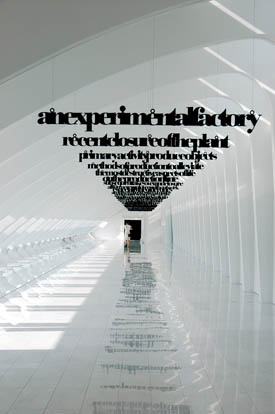
Liam Gillick
Övningskörning (Driving Practice), 2004
On the other hand, appropriation as a form of artistic expression is a postmodern phenomenon. Appropriation is the language of today. Never before the advent of the Internet had people appropriated knowledge, spaces, concepts, and images as we do today. To cite, to copy, to remix, to modify are part of our everyday communication. The difference between appropriation in the 70s and 80s and today resides in the historical moment. As Jean Verwoert says in the Triennial 2006 catalogue:
The standstill of history at the height of the Cold War had, in a sense, collapsed the temporal axis and narrowed the historical horizon to the timeless presence of material culture, a presence that was exacerbated by the imminent prospect that the bomb could wipe everything out at any time. To appropriate the fetishes of material culture, then, is like looting empty shops at the eve of destruction. It is the final party before doomsday. Today, on the contrary, the temporal axis has sprung up again, but this time a whole series of temporal axes cross global space at irregular intervals. Historical time is again of the essence, but this historical time is not the linear or unified timeline of steady progress imagined by modernity: it is a multitude of competing and overlapping temporalities born from the local conflicts that the unresolved predicaments of the modern regimes still produce.
Today, the challenge is to rethink the meaning of appropriation in a moment when capitalist commodity culture has become the determinant of our daily lives. The Internet is perhaps our potential Utopia (though “dystopian” seems to be the adjective of choice now.) But, can it be called upon to fulfill the unfulfilled promises of 20th century’s utopias? To appropriate is to resist the notion of ownership, to appropriate the products of today’s culture is to expose the unresolved questions of a world shaped by the information era. The disparities between those who are entering the technology era and those forced to stay in the times of early industrialization are more pronounced than ever. As opposed to the Cold War, where history was at a standstill, we live in a time of extreme historicity. Permanence is constantly challenged, how to grasp it all continues to be the elusive task.
how people read online
There’s a series of recent posts (1, 2, 3, 4) up at Ron Silliman’s blog where he analyzes a recent study (by Simmons B. Buntin of terrain.org) of how people read and write poetry online. This is of interest even to those uninterested in poetry: Silliman is doing some very careful work in scrutinizing how and why people read online. In doing so, he’s touching on a number of things we’re interested in here, not least the roles of reputation, legitimization, and distribution in electronic reading and writing.
The study Silliman’s looking at was mostly answered by those who write as well as read poetry, so there’s a certain amount of bias in the responses he’s looking at. But this selective skew provides a useful look at cutting edge attitudes. While respondents read a wide variety on online poetry and criticism, word of mouth remains a primary method of finding new things to read: social interaction seems to be critical. Of particular interest is the different roles he sees assigned to print and online publication: most respondents found no difference in quality between print and online work, although there was the perception that online work took more risks and was generally more experimental (there seem to be broader extremes in online publication).
What do people like about publishing online? First (by a wide margin) the accessibility that it affords; second, the possibility of real-time interaction. Cost comes in third: it’s interesting that again the perception of the need for social interaction shows itself. It’s also interesting (and not tremendously surprising) that the efforts on which the most money has been spent (Poetry, which recently received an enormous bequest, has sunk $100 million into their website) don’t seem to be the most influential – blogs and forums, which are more interaction-based, come out ahead.
What doesn’t work about online publishing? The look & feel of online work, as well as poorly-designed websites, was the most frequent complaint. The ephemerality of the web is another issue: many websites seem to disappear as soon as they spring up, and Silliman suggests the need for archiving online work is a problem that needs to be resolved. A number of respondents complained about devices, arguing that it’s not as pleasant to read on a screen than on a page – which Silliman, who’s done a fair amount of reading on a Palm Pilot, qualifies by arguing that this seems to be more a software problem than a hardware problem.
an interview with bruno pellegrini
Last week I posted about Le mie elezioni, a film about the recent Italian elections constructed from footage shot by the general public, mostly part of Italy’s videoblogging community. Le mie elezioni will be released on the 15th of May: according to an article in Il manifesto more than 150 videobloggers have submitted more than 50 hours of materials which are being furiously edited right now. You can watch a rough cut of the trailer here.
 The footage is being put together into an hour-long film by the website Nessuno.TV a portal for Italian videobloggers, which is run by Bruno Pellegrini, who also teaches the sociology of communications at the Universitá di Architettura in Rome. I sent him an email asking about the project; while Bruno happened to be in the U.S. last week, but his (and our) travel schedule didn’t allow him to stop by the Institute. Nonetheless, we conducted an interview, via email. My questions are in bold; his responses are indented.
Can you describe how the project came about?
It was born in a very natural way, as some of the vloggers who already participated at BlogTV (the first ever TV station broadcasting user-generated content) suggested covering the election together. Then the idea of the movie came up.
Is this project part of a larger Italian web response to media consolidation? How widely do people share your belief that the perception that big media has failed to cover things it should be covering?
I do not think this project is specific to Italy. Although the situation in my country is embarrassing I believe it is only a little ahead compared to what is going on abroad. Big media has failed (sometimes deliberately) to cover things all over the world for the last decades and the web has given people a chance to re-balance the power. Whereever and whenever there are major needs for a democracy, you can be sure something is going to happen . . . With regards to people, only a small part is conscious about what is going on, and the others are not helped by mass information . . . In general there is a common sense of distrust of politics, media and power.
In the U.S., the 2004 elections brought out – for the first time – a huge number of political bloggers; this seemed to be the first time that the blogosphere registered in the mainstream media, and there’s the perception that the U.S. blogosphere exploded at that point. Have these elections done the same thing in Italy? Or did people turn to the Internet earlier?
Not at all, unfortunately. The Italian blogosphere is not as mature as it is in the U.S. We still lack a common identity and, most of all, consciousness of the power of being media . . . Hopefully this will happen in the next political campaign, and I suspect it will come out not from the classic political separation (left and right) but from an increasing fight between young and old people with the latter trying to keep their undeserved priviledges . . .
How big is the videoblogging community in Italy? We periodically look in on it in the U.S., and while everyone loves Rocketboom, it doesn’t really seem to have taken off here as much as everyone expected (although maybe things like YouTube and Google Video are changing that). Did you find people getting interested in videoblogging because of the project, or was there already a vibrant community?
Vibrant is not exactly the right word, maybe promising would be more appropriate. I think it is a matter of critical mass and once reached it will grow exponentially like all the network related trends.
The question of copyright. Watching the clips, I couldn’t help but notice the music – songs by the Arctic Monkeys & Caparezza playing in the background, as well as video clips from the news and I think a couple of press photographs. In the U.S. documentary film makers increasingly have problems with clearance issues – the owners of the songs charge thousands of dollars for the rights to use even a few seconds of them. We’ve been covering this issue of fair use rather closely because it seems to figure in many of the things you can do with multimedia. I’m curious how much of a problem it is in Italy – is this something you worry about there?
So far it is not a problem at all and we can deal with the fair use regulation. I believe the majors will play harder in the future, especially with music and movies, but there are already good open access libraries and the Creative Commons movement is getting stronger in Italy too.
Many thanks to Bruno Pellegrini for being so generous with his time. If people have more questions about this project, don’t hesitate to leave them in the comments section.
questions on libraries, books and more
Last week, Vince Mallardi contacted me to get some commentary for a program he is developing for the Library Binding Institute in May. I suggested that he send me some questions, and I would take a pass at them, and post them on the blog. My hope that is, Vince, as well as our colleagues and readers will comment upon my admittedly rough thoughts I have sketched out, in response to his rather interesting questions.
1. What is your vision of the library of the future if there will be libraries?
Needless to say, I love libraries, and have been an avid user of both academic and public libraries since the time I could read. Libraries will be in existence for a long time. If one looks at the various missions of a library, including the archiving, categorization, and sharing of information, these themes will only be more relevant in the digital age for both print and digital text. There is text whose meaning is fundamentally tied to its medium. Therefore, the creation and thus preservation of physical books (and not just its digitization) is still important. Of course, libraries will look and function in a very different way from how we conceptualize libraries today.
As much as, I love walking through library stacks, I realize that it is a luxury of the North, which was made more clear to me at the recent Access to Knowledge conference my colleague and I were fortunate enough to attend. In the economic global divide of the North and South, the importance of access to knowledge supersedes my affinity for paper books. I realize that in the South, digital libraries are a much efficient use of resources to promote sustainable knowledge, and hopefully economic, growth.
2. How much will self-publishing benefit book manufacturers, indeed save them?
Recently, I have been very intrigued with the notion of Print On Demand (POD) of books. My hope is that the stigma will be removed from the so-called “vanity press.” Start-up ventures, such as LuLu.com, have the potential to allow voices to flourish, where in the past they lacked access to traditional book publishing and manufacturing.
Looking at the often cited observation that 57% of Amazon book sales comes from books in the Long Tail (here defined as the catalogue not typically available in the 100,000 books found in a B&N superstore,) I wonder if the same economic effect could be reaped in the publishing side of books. Increasing efficiency of digital production, communication, and storage, relieve economic pressures of the small run printing of books. With print on demand, costs such as maintaining inventory are removed, as well, the risk involved in estimating the demand for first runs is reduced. Similarly, as I stated in my first response, the landscape of book manufacturing will have to adapt as well. However, I do see potential for the creation of more books rather than less.
3. What co-existence do you foresee between the printed and electronic book, as co-packaged, interactive via barcodes or steganography? etc.
Paper based books will still have its role in communication in the future. Paper is still a great technology for communication. For centuries, paper and books were the dominate medium because that was the best technology available. However, with film, television, radio and now digital forms, it is not longer always true. Thus the use of print text must be based upon the decision by the author that paper is the best medium for her creative purposes. Moving books into the digital allows for forms that cannot exist as a paper book, for instance the inclusion of audio and video. I can easily see a time when an extended analysis of a Hitchcock movie will be an annotated movie, with voice over commentary, text annotation and visual overlays. These features cannot be reproduced in traditional paper books.
Rather, that try to predict specific applications, products or outcomes, I would prefer to open the discussion to a question of form. There is fertile ground to explore the relationship between paper and digital books, however it is too early for me to state exactly what that will entail. I look forward to seeing what creative interplay of print text and digital text authors will produce in the future. The co-existence between the print and electronic book in a co-packaged form will only be useful and relevant, if the author consciously writes and designs her work to require both forms. Creating a pdf of Proust’s Swann Way’s is not going to replace the print version. Likewise, printing out Moulthrop’s Victory Garden do not make sense either.
4. Can there be literacy without print? To the McLuhan Gutenberg Galaxy proposition.
Print will not fade out of existence, so the question is a theoretical one. Although, I’m not an expert in McLuhan, I feel that literacy will still be as vital in the digital age as it is today, if not more so. The difference between the pre-movable type age and the electronic age, is that we will still have the advantages of mass reproduction and storage that people did not have in an oral culture. In fact, because the marginal cost of digital reproduction is basically zero, the amount of information we will be subjected to will only increase. This massive amount of information which we will need to process and understand will only heighten the need for not only literacy, but media literacy as well.
a2k wrap-up
Access to knowledge means that the right policies for information and knowledge production can increase both the total production of information and knowledge goods, and can distribute them in a more equitable fashion.
—Jack Balkin, from opening plenary
—Jack Balkin, from opening plenary
I’m back from the A2K conference. The conference focused on intellectual property regimes and international development issues associated with access to medical, health, science, and technology information. Many of the plenary panels dealt specifically with the international IP regime, currently enshrined in several treaties: WIPO, TRIPS, Berne Convention, (and a few more. More from Ray on those). But many others, instead of relying on the language in the treaties, focused developing new language for advocacy, based on human rights: access to knowledge as an issue of justice and human dignity, not just an issue of intellectual property or infrastructure. The Institute is an advocate of open access, transparency, and sharing, so we have the same mentality as most of the participants, even if we choose to assail the status quo from a grassroots level, rather than the high halls of policy. Most of the discussions and presentations about international IP law were generally outside of the scope of our work, but many of the smaller panels dealt with issues that, for me, illuminated our work in a new light.
In the Peer Production and Education panel, two organizations caught my attention: Taking IT Global and the International Institute for Communication and Development (IICD). Taking IT Global is an international youth community site, notable for its success with cross-cultural projects, and for the fact that it has been translated into seven languages—by volunteers. The IICD trains trainers in Africa. These trainers then go on to help others learn the technological skills necessary to obtain basic information and to empower them to participate in creating information to share.
“What I’m talking about is the fact that ‘global peripheries’ are using technologies to produce their own cultural products and become completely independent from ‘cultural industries.'”
—Ronaldo Lemos
—Ronaldo Lemos
The ideology of empowerment ran thick in the plenary panels. Ronaldo Lemos, in the Political Economy of A2K, dropped a few figures that showed just how powerful communities outside the scope and target of traditional development can be. He talked about communities at the edge, peripheries, that are using technology to transform cultural production. He dropped a few figures that staggered the crowd: last year Hollywood produced 611 films. But Nigeria, a country with only ONE movie theater (in the whole nation!) released 1200 films. To answer the question of how? No copyright law, inexpensive technology, and low budgets (to say the least). He also mentioned the music industry in Brazil, where cultural production through mainstream corporations is about 52 CDs of Brazilian artists in all genres. In the favelas they are releasing about 400 albums a year. It’s cheaper, and it’s what they want to hear (mostly baile funk).
We also heard the empowerment theme and A2K as “a demand of justice” from Jack Balkin, Yochai Benkler, Nagla Rizk, from Egypt, and from John Howkins, who framed the A2K movement as primarily an issue of freedom to be creative.
The panel on Wireless ICT’s (and the accompanying wiki page) made it abundantly obvious that access isn’t only abut IP law and treaties: it’s also about physical access, computing capacity, and training. This was a continuation of the Network Neutrality panel, and carried through later with a rousing presentation by Onno W. Purbo, on how he has been teaching people to “steal” the last mile infrastructure from the frequencies in the air.
Finally, I went to the Role of Libraries in A2K panel. The panelists spoke on several different topics which were familiar territory for us at the Institute: the role of commercialized information intermediaries (Google, Amazon), fair use exemptions for digital media (including video and audio), the need for Open Access (we only have 15% of peer-reviewed journals available openly), ways to advocate for increased access, better archiving, and enabling A2K in developing countries through libraries.
Human rights call on us to ensure that everyone can create, access, use and share information and knowledge, enabling individuals, communities and societies to achieve their full potential.
—The Adelphi Charter
—The Adelphi Charter
The name of the movement, Access to Knowledge, was chosen because, at the highest levels of international politics, it was the one phrase that everyone supported and no one opposed. It is an undeniable umbrella movement, under which different channels of activism, across multiple disciplines, can marshal their strength. The panelists raised important issues about development and capacity, but with a focus on human rights, justice, and dignity through participation. It was challenging, but reinvigorating, to hear some of our own rhetoric at the Institute repeated in the context of this much larger movement. We at the Institute are concerned with the uses of technology whether that is in the US or internationally, and we’ll continue, in our own way, to embrace development with the goal of creating a future where technology serves to enable human dignity, creativity, and participation.