
The other day, Ben’s recent post on the “Novel Twists” and the “exquisite corpse” got us talking for a minute or two, on some children books loosely based on the “exquisite corpse.” The conversation got me reminiscing about other forms of children’s books that pushed the conventions of the book while remaining within confines of the printed page. In retrospect, as we gain clarity on the present and near future of digital books, I appreciate how for years, authors felt a need to overcome the limitations of the print book. While these books are not digital they do add interactivity to the experience, by both exploring interfaces and giving over some control to the reader.
Here is a quick run down of a few examples. (The format takes a cue from Ben’s post on the networked book.)
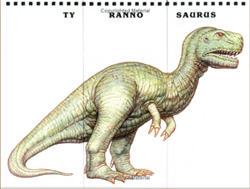
Mix and Match
Based on the idea of the “exquisite corpse,” these spiral bound books allow readers to combine various pages to creating their own images. In this example, the reader invents new dinosaurs, complete with remixed names. The spiral binding encourages the idea of ever turning pages. Thus, this non-linear book is not designed to be read front to back, but rather it is designed to be played with.

Pop – Up Book
My earliest memory of a pop-up book was from “Star Wars,” this gem from the late 70s is still available on ebay. Mark Hiner, a self-described “Paper Engineer” has build a great website on pop-up books, showing samples, an historical overview of pop-up books, as well as, instructions on creating your own. Pop-Up Books break the conventions of the static two dimensional page. Although, they still read linearly, pop-up books break into three dimensions, and add interactivity by including tabs to pull which create movement in a pop-up figure.
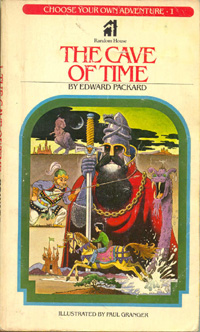
Choose Your Adventure
These pre-cursors to hyper-linked fiction were a big fad when they were first published in the late 70s and early 80s. In these books, readers are presented with the opportunity to chose the direction of the narrative. After a situation is described over a few pages, the reader is offered paths in a forking narrative. Each choice had a different page number, and the reader went to the correct page and proceeded with his selected narrative. I spent many hours reading and re-reading books from this classic series. In what was most likely my first attempt to “game the system” I recall finding an “ending” I liked, and working backwards to figure out how to get there. Reading in this way also lead to my first experience at reading a book backwards.
I have many memories of reading these kinds of books. Print books of this nature, however, are inevitably regulated to the realm of children. As I grew older and my reading became more “sophisticated,” the books I read stopped including these innovative features. In the case of fiction, pictures and illustrations were also eventually eliminated. Although, I do understand the idea that at times, visuals can become a crutch, which allow authors to become lazy with their writing. I must further admit that I was pleased to see visual representations of handwriting and letters from a “hangman” game included in David Mitchell’s Black Swan Green, a “serious” work of fiction. They were used sparingly and appropriately. Perhaps, the author felt these breaks in formalism were allowed as a special case because the book’s narrator is a thirteen year old boy.
I find it wonderfully ironic that we can look at these books for children for insight on the transition from printed page to screen, even-though these examples are still bounded by the technology of paper. By reflecting upon spiral binding, 3D pages, and hyper-linked pages, we are informed as we move further into the digital. What will the result be as mix and match books closer towards the original Surrealist game, where readers can include their own “parts?” How will pop-up books evolve with the integration of sound and video? Which hyper-linked fiction work, foreshadowed by Choose Your Adventure books, will become the first New York Times best seller?
good discussion(s) of kevin kelly article
In the New York Times own book discussion forum, one rirutsky opines eloquently on the problems with Kelly’s punch-drunk corporate optimism:
…what I find particularly problematic is the way that Kelly’s “analysis”–as well as most of the discussion of it–omits any serious mention of what is actually at stake in the utopian scheme of a universal library (which Borges, by the way, does not promote, but debunks). It has little to do with enabling creativity, but rather, with enabling greater corporate profits. Kelly is actually most close to the mark when [he] characterizes the conflict over digital books as a conflict between two business models. Of course, one gets the impression from some of Kelly’s writings that for him business and creativity are more or less the same thing….
….A more serious consideration of these issues would move away from the “old” binary antagonisms that Kelly outlines (surely, these are a relic of a pre-digital age) and think seriously about how society at large is changed by digital technologies and techniques. Who has the right to copy or to make use of data and who does not? In a world of such vast informational clutter, doesn’t power accrue to those who can afford to advertise? It is worth remembering, too, that searching is not, after all, a value-free operation. Who ultimately will control the searching and indexing of digital information? Should the government–or private corporations–be allowed to data mine the searches that people make? In short, who benefits and who loses from these technological changes? Where, precisely, is power consolidated?
Kelly does not even begin to deal with these sorts of serious social issues.
And from a typically immense Slashdot thread (from highlights conveniently collected by Branko Collin at Teleread) — this comes back to the “book is reading you” question:
Will all these books and articles require we login to view them first? I think having every book, article, movie, song, etc available for use anytime is a great idea and important for society but I don’t want to have to login and leave a paper trail of everything I’m looking at.
And we have our own little thread going here.
on ebay: collaborative fiction, one page at a time
Phil McArthur is not a writer. But while recovering from a recent fight with cancer, he began to dream about producing a novel. Sci-fi or horror most likely — the kind of stuff he enjoys to read. But what if he could write it socially? That is, with other people? What if he could send the book spinning like a top and just watch it go?
Say he pens the first page of what will eventually become a 250-page thriller and then passes the baton to a stranger. That person goes on to write the second page, then passes it on again to a third author. And a fourth. A fifth. And so on. One page per day, all the way to 250. By that point it’s 2007 and they can publish the whole thing on Lulu.
The fruit of these musings is (or will be… or is steadily becoming) “Novel Twists”, a ongoing collaborative fiction experiment where you, I or anyone can contribute a page. The only stipulations are that entries are between 250 and 450 words, are kept reasonably clean, and that you refrain from killing the protagonist, Andy Amaratha — at least at this early stage, when only 17 pages have been completed. Writers also get a little 100-word notepad beneath their page to provide a biographical sketch and author’s notes. Once they’ve published their slice, the subsequent page is auctioned on Ebay. Before too long, a final bid is accepted and the next appointed author has 24 hours to complete his or her page.
Networked vanity publishing, you might say. And it is. But McArthur clearly isn’t in it for the money: bids are made by the penny, and all proceeds go to a cancer charity. The Ebay part is intended more to boost the project’s visibility (an article in yesterday’s Guardian also helps), and “to allow everyone a fair chance at the next page.” The main point is to have fun, and to test the hunch that relay-race writing might yield good fiction. In the end, McArthur seems not to care whether it does or not, he just wants to see if the thing actually can get written.
Surrealists explored this territory in the 1920s with the “exquisite corpse,” a game in which images and texts are assembled collaboratively, with knowledge of previous entries deliberately obscured. This made its way into all sorts of games we played when we were young and books that we read (I remember that book of three-panel figures where heads, midriffs and legs could be endlessly recombined to form hilarious, fantastical creatures). The internet lends itself particularly well to this kind of playful medley.
if:book in library journal (and kevin kelly in n.y. times)
 The Institute is on the cover of Library Journal this week! A big article called “The Social Life of Books,” which gives a good overview of the intersecting ideas and concerns that we mull over here daily. It all started, actually, with that little series of posts I wrote a few months back, “the book is reading you” (parts 3, 2 and 1), which pondered the darker implications of Google Book Search and commercial online publishing. The article is mostly an interview with me, but it covers ideas and subjects that we’ve been working through as a collective for the past year and a half. Wikipedia, Google, copyright, social software, networked books — most of our hobby horses are in there.
I also think the article serves as a nice complement (and in some ways counterpoint) to Kevin Kelly’s big article on books and search engines in yesterday’s New York Times Magazine. Kelly does an excellent job outlining the thorny intellectual property issues raised by Google Book Search and the internet in general. In particular, he gives a very lucid explanation of the copyright “orphan” issue, of which most readers of the Times are probably unaware. At least 75% of the books in contention in Google’s scanning effort are works that have been pretty much left for dead by the publishing industry: works (often out of print) whose copyright status is unclear, and for whom the rights holder is unknown, dead or otherwise prohibitively difficult to contact. Once publishers’ and authors’ groups sensed there might finally be a way to monetize these works, they mobilized a legal offensive.
Kelly argues convincingly that not only does Google have the right to make a transformative use of these works (scanning them into a searchable database), but that there is a moral imperative to do so, since these works will otherwise be left forever in the shadows. That the Times published such a progressive statement on copyright (and called it a manifesto no less) is to be applauded. That said, there are other things I felt were wanting in the article. First, at no point does Kelly question whether private companies such as Google ought to become the arbiter of all the world’s information. He seems pretty satisfied with this projected outcome.
And though the article serves as a great introduction to how search engines will revolutionize books, it doesn’t really delve into how books themselves — their form, their authorship, their content — might evolve. Interlinked, unbundled, tagged, woven into social networks — he goes into all that. But Kelly still conceives of something pretty much like a normal book (a linear construction, in relatively fixed form, made of pages) that, like Dylan at Newport in 1965, has gone electric. Our article in Library Journal goes further into the new networked life of books, intimating a profound re-jiggering of the relationship between authors and readers, and pointing to new networked modes of reading and writing in which a book is continually re-worked, re-combined and re-negotiated over time. Admittedly, these ideas have been developed further on if:book since I wrote the article a month and a half ago (when a blogger writes an article for a print magazine, there’s bound to be some temporal dissonance). There’s still a very active thread on the “defining the networked book” post which opens up many of the big questions, and I think serves well as a pre-published sequel to the LJ interview. We’d love to hear people’s thoughts on both the Kelly and the LJ pieces. Seems to make sense to discuss them in the same thread.
digital comics
If you want to learn how to draw comics you can go to the art section of any bookstore and pick up books that will tell you how to draw the marvel way, how to draw manga, how to draw cutting edge comics, how to draw villains, women, horror, military, etc. But drawing characters is different than making comics. Will Eisner was the generator of the term ‘sequential art’ and the first popular theory of comics. Scott McCloud is his recent successor. Eisner created the vocabulary of sequential art in his long-running course at the School of Visual Arts in NYC. McCloud helped a generation of comic book readers grasp that vocabulary in Understanding Comics, by creating a graphic novel that employed comic art to explain comic theory. But both Eisner and McCloud wrote about a time when comic delivery was bound to newspapers and twenty-two page glossy, stapled pages.
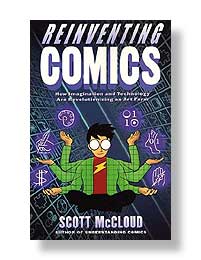
Whither the network? McCloud treats the possibilities of the Internet in his second book, Reinventing Comics, but mostly as a distribution mechanism. We shouldn’t overlook the powerful affect the ‘net has had on individual producers who, in the past, would have created small runs of photocopied books to distribute locally. Now, of course, they can put their panels on the web and have a potential audience of millions. Some even make a jump from the web into print. Most web comics are sufficiently happy to ride the network to a wider audience without exploring the ‘net as vehicle to transform comics into uniquely non-print artifacts with motion, interactivity, sound.
But how might comics mutate on the web? At the recent ITP Spring show I saw a digital comics project from Tracy Ann White’s class. The class asks the question: “What happens when comics evolve from print to screen? How does presentation change to suit this shift?” Sounds like familiar territory. White, a teacher at ITP, has been a long time web comic artist (one of the first on the web, and certainly one of the first to incorporate comments and forums as part of the product.
When I did a little research on her, I found an amazing article on Webcomics Review discussing the history of web comics. (There’s also more from White there.) There has been some brilliant work done, making use of scrolling as part of the “infinite canvas,” but more importantly, work that could have no print analog due the incorporation of sound and motion. The discussion in Webcomics Review covers all of the transformative effects of online publishing that we talk about here at the Institute: interlinking, motion, sound, and more profoundly, the immediacy and participative aspects of the network. As an example, James Kochalka, well known for his Monkey vs. Robot comics and a simplistic cartoon style, publishes An American Elf. The four panel personal vignette is published daily-blogging with comics.
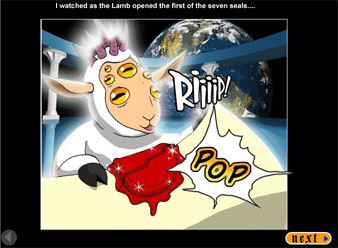
Other ground breaking work: Nowhere Girl by Justine Shaw, a long form graphic novel that proved that people will read lengthy comics online. Apocamon by Patrick Farley, is a mash up of Pokemon and The Book of Revelations. There is a well known series of bible stories in comic strip format – this raises that tradition to the level of heavenly farce (with anime). Apocamon judiciously uses sound and minor animation effects to create a rich reading experience, but relies on pages—a mode immediately familiar to comic book readers. The comics on Magic Inkwell (Cayetano Garza) use music and motion graphics in a more experimental way. And in Broken Saints we find an example where comic conventions (words in a comic style font, speech bubbles, and sequential images) fade into cinema.
As new technology enables stylistic enhancements to web comics, the boundaries between comics and other media will become more blurred. White says, “In terms of pushing interactive storytelling online games are at the forefront.” This is true, but online games dispense with important conventions that make comics comics. The next step for online comics is to enhance their networked and collaborative aspect while preserving the essential nature of comics as sequential art.
legal scholarship through blogging
The Berkman Center for Internet & Society at Harvard Law School held the “Bloggership Symposium” on April 28,2006. The first event of its kind looked at how blogs are changing law school, legal scholarship and the practice of law by inviting leading law professor blogger to present papers, that can be found on the Social Science Research Network. The paper topics range from libel, tenure, and scholarship trade-offs. We have been advocates for experimenting with new forms of academic scholarship, and I am glad to be see that various disciplines are beginning to acknowledge and study this evolution as well.
love through networked screens
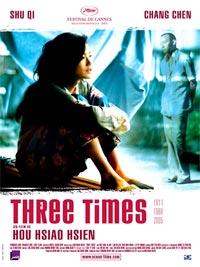 This past weekend, I saw a remarkable film: “Three Times,” by Taiwanese director Hou Hsiao-hsien. It’s a triptych on love set in Taiwan in three separate periods — 1966, 1911, and 2005 — each section focusing on a young man and woman, played by the same actors. Hou does incredible things with time. Each of the episodes, in fact, is a sort of study in time, not just of a specific time in history, but in the way time moves in love relationships. The opening shots of the first episode, “A Time for Love,” announce that things will be operating in a different temporal register. Billiard balls glide across a table. You don’t yet understand the rules of the game that is being played. Characters gradually emerge and the story unfolds through strange compressions and contractions of time that comprise a weird logic of yearning.
This is the first of Hou’s films that I’ve seen (it’s only the second to secure an American release). I was reminded of Tarkovsky in the way Hou uses cinema to convey the movement of time, both across the eras and within individual episodes. There’s much to say about this film, and I hope to see it again to better figure out how it does what it does. The reason I bring it up here is that the third story — “A Time for Youth,” set in contemporary Taipei — contains some of the most profound and visually arresting depictions of the mediation of intimate relationships through technology that I’ve ever seen. Cell-phones and computers have been popping up in movies for some time now, usually for the purposes of exposition or for some spooky haunted technology effect, like in “The Matrix” or “The Ring.” In “Three Times,” these new modes of contact are probed more deeply.
The story involves a meeting of an epileptic lounge punk singer and an admiring photographer, while the singer’s jilted female lover lurks in the margins.  Hou weaves back and worth between intense face-to-face meetings and asynchronous electronic communication. At various times, the screen of the movie theater (the IFC in Greenwich Village) is completely filled with an extreme close-up of a cell-phone screen or a computer monitor, the text of an SMS or email message as big as billboard lettering. The pixelated Chinese characters are enormous and seem to quiver, or to be on the verge of melting. A cursor blinking at the end of an alleged suicide note typed into a computer is a dangling question of life and death, or perhaps just a sulky dramatic gesture.
What’s especially interesting is that the most expressive speech in “A Time for Youth” is delivered electronically. Face-to-face meetings are more muted and indirect. There’s an eerie episode in a nightclub where the singer is performing on stage while the photographer and another man circle her with cameras, moving as close as they can without actually touching her, shooting photos point blank.
But it was the use of screens that really struck me. By filling our entire field of vision with them — you almost feel like you’re swimming in pixels — Hou conveys how tiny channels of mediated speech can carry intense, all-consuming feeling. The weird splotchiness of digital text at close range speaks of great vulnerability. Similarly, the revelation of the singer’s epilepsy is not through direct disclosure, but happens by accident when she leaves behind a card with instructions for what to do in case of a seizure, after spending the night at the photographer’s apartment. This all strikingly follows up the previous episode, “A Time for Freedom,” which is done as a silent film with all the dialogue conveyed on placards.
It’s one of those things that suddenly you viscerally understand when a great artist shows you: how these technologies spin a web of time around us, sending voices and gestures across space instantly, but also placing a veil between people when they actually share a space. In many ways, these devices bring us closer, but they also fracture our attention and further insulate us. Never are you totally apart, but seldom are you totally together.
“Three Times” is currently out in a few cities across the US and rolling out progressively through June in various independent movie houses (more info here).
sculpture as book
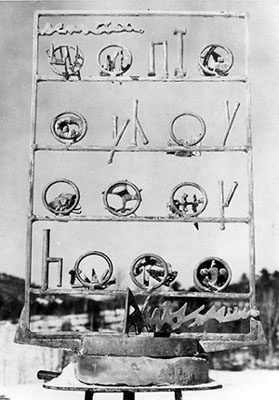
Last weekend, I found myself in the familiar position of racing to catch a long-running art show before it closed. This time it was the David Smith retrospective at the Guggengheim. (The show ends on May 14th.) The collection includes sculptural nods to Abstract Expressionism and Surrealism, as well as, foreshadowing Minimalism. Once an ironmonger, Smith employs found objects, he molds and welds into sculpture influenced as much by painting as the traditions of sculpture. While I generally prefer his larger scale pieces he produced late in his career, I was struck by a fascinating mid-career piece entitled, “The Letter” (1950).
The sculpture is a representation of a letter, that begins with a salutation in the upper right hand corner and closes with a signature. A range of theories abound to its meaning. Are the glyphs letters, words, human figures, or scenes? Is this a letter to his wife? One art historian suggests the text references a line from Wonderful Town and about leaving the state Ohio, where Smith spent part of this youth.
Or could it be a response to an author’s writing? The audio tour offered interpretations of a hint to the work of James Joyce that Smith gave in an interview. Listening to these following quotes from Joyce’s Finnegans Wake (0:40 – 1:16 of the audio fiie) while looking at the piece, I see and hear relevance to our work at the institute.
“ruled barriers, along which the traced words run, march, halt, walk, stumble”
and
“lines of litters slittering up and louds of ladders slettering down”
Whether it is our overarching discussion of the shift of print text to the computer screen or an overheard criticism of the latest sacrilegious film adaptation of a beloved book, the evolution of text beyond the printed page is clearly a dynamic process. We are aided when any creative mind can demonstrate these emerging relationships in a meaningful way.
In “the Letter,” Smith coyly reveals partial hints to the artist’s intentions, freeing the viewer to create her own insights. Smith is able to simultaneously display a multitude of reflections of meaning, with each suggestion containing a seemingly direct message to the viewer (as seen by the wide ranging interpretations.) Although the iconography could and does represent letters, words and bodies, I remain continuously enamored with the Joycian interpretation.
In that, Smith transforms a book into a sculpture. “The Letter” is bounded like a book, but within those boundaries, the gestures of abstracted forms (rather than letters), the use of open space, and the three dimensionality of the work surpasses that which it mimics. Further, the abstracted sculptural forms with their multiple readings comment upon the various meanings we take from words, which are also open to multiple readings. Therefore, Smith’s vision leaves us with a physical object that embodies not just the words, themes, and emotions of the book (that is the content), but also comments on the limitations of the book as an object (or vessel which holds the content).
Smith’s work, now 56 years old, seemingly poses to us two challenges. First, when we translate print text into the digital or create born-digital books, “the Letter” reminds us that in deciding to keep or reject aspects of both the content and the vessel of the traditional book, we must be conscious of the choices we make in that process. What are we willing to sacrifice in order to achieve something greater? Second, it asks us to look at these new forms with eyes unfettered by past conventions and to focus on, appreciate, and take advantage of the potentials of the new medium.
machinima agitprop elucidates net neutrality
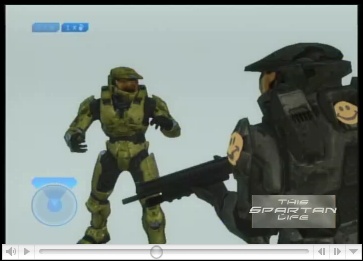
This Spartan Life, our favorite talk show in Halo space, just posted a hilarious video blog entry making the case for network neutrality. In some ways, this is the perfect medium for illustrating a threat to virtual spaces, conveying more in a couple of minutes than several weeks worth of op-eds. Enjoy it now before the party’s over.
(In case you missed it, here’s TSL’s interview with Bob.)
wikipedia — mainstream media sighting
In his op-ed piece today, NY Times columnist, Paul Krugman, quotes from the Wikipedia to define conspiracy theory:
A conspiracy theory, says Wikipedia, “attempts to explain the cause of an event as a secret, and often deceptive, plot by a covert alliance.”
This is the first time I’ve seen the Wikipedia used as an authoritative reference in the Times or any other major media outlet.