wikimania day 1: wrap up

wikimania logoThere was something of a valedictory feeling around Wikimania yesterday, springing perhaps from Jimmy Wales’s plenary talk: the feeling that a magnificent edifice had been constructed, and all that remained was to convince people to actually use it. If we build it, they will come & figure it out. Wales declared that it was time to stop focusing on quantity in Wikipedia and to start focusing on quality: Wikipedia has pages for just about everything that needs a page, although many of the pages aren’t very good. I won’t disagree with that, but there’s something else that needs to happen: the negotiation involved as their new technology increasingly hits the rest of the world.

This was the narrative arc traced by Larry Lessig in his plenary: speaking about how he got more and more enthusiastic about the potential of freely shared media before running into the brick wall of the Supreme Court. At that point, he realized, it was time to regroup and assess what would be politically & socially necessary to bring free media to the masses. There’s something similar going on in the wiki community as a whole. It’s a tremendously fertile time technologically, but there are increasingly social issues that scream for engagement.

One of the most interesting presentations that I saw yesterday afternoon was Daniel Caeton’s presentation on negotiating truth. Caeton’s talk was based on his upcoming book entitled The Wild, Wild Wiki: Unsettling the Frontiers of Cyperspace. Caeton teaches writing at California State University in Fresno; he experimented in having students explore & contribute to the WIkipedia. The issues that arose surprised him. His talk focused on the experiences of Emina, a Bosnian Muslim student: she looked at how Bosnian Muslims were treated in the Wikipedia and found immensely diverging opinions. She found herself in conversation with other contributors about the meaning of the word “Bosniak”. In doing so she found herself grappling with the core philosophy of Wikipedia: that truth is never objective, always in negotiation. Introducing this sort of thinking is something that needs to be taught just as much as Wiki markup syntax, though it hasn’t had nearly as much attention.

Today there’s a whole track on using Wikis in education: I’ll be following & reporting back from that.

transmitting live from cambridge: wikimania 2006

wikimania logoI’m at the Wikimania 2006 conference at Harvard Law School, from where I’ll be posting over the course of the three-day conference (schedule). The big news so far (as has already been reported in a number of blogs) came from this morning’s plenary address by Jimmy Wales, when he announced that Wikipedia content was going to be included in the Hundred Dollar Laptop. Exactly what “Wikipedia content” means isn’t clear to me at the moment – Wikipedia content that’s not on a network loses a great deal of its power – but I’m sure details will filter out soon.

This move is obvious enough, perhaps, but there are interesting ramifications of this. Some of these were brought out during the audience question period during the next panel that I attended, in which Alex Halavis talked about issues of evaluating Wikipedia’s topical coverage, and Jim Giles, the writer of the Nature study comparing the Wikipedia & the Encyclopædia Britannica. The subtext of both was the problem of authority and how it’s perceived. We measure the Wikipedia against five hundred years of English-language print culture, which the Encyclopædia Britannica represents to many. What happens when the Wikipedia is set loose in a culture that has no print or literary tradition? The Wikipedia might assume immense cultural importance. The obvious point of comparison is the Bible. One of the major forces behind creating Unicode – and fonts to support the languages used in the developing world – is SIL, founded with the aim of printing the Bible in every language on Earth. It will be interesting to see if Wikipedia gets as far.

three glimpses at the future of television

radio_tv.jpg
1. When radio was the main electronic media source, families would gather around the radio and listen to music, news, or entertainment programming, not unlike traditional television viewing. Today, radio listening habits have shifted, and I only hear the radio in cars and offices. Television viewing (if you can even call it that) is experiencing a similar shift, as people multitask at home, with the television playing in the background. With the roll out of Digital Multimedia Broadcasting (DMB) in South Korean last year, the use of television is starting to resemble radio even more. DBM is a digital radio transmission system which allows television signals to play on mobile devices. Since its 2005 debut, a slew of DMB capability devices, such as GPS units and the PM80 PDA from LG have been released in Korea. DBM systems are being planned throughout Europe and Asia, which may make mobile television viewing ubiquitous and the idea of a family sitting in front of a television at home seem quaint.
nbc_logo.jpg2. I recently posted on a partnership between youtube and NBC, which will create a channel on the video sharing site to promote new shows from NBC this autumn. NBC seems to have taken the power of youtube to heart as is producing new episodes of the failed WB pilot, “Nobody’s Watching,” which never aired. The pilot was leaked to youtube and viewed by over 450,000 people. I’m waiting to see how far NBC is willing experiment proactively with youtube and its community to create better programming.

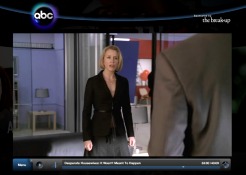
head_abc_video2.jpg
3. In the US, the shifting of television from large boxes residing in living rooms to desktops, laptops, and portable media players, has often meant viewing pirated programming uploaded onto video sharing sites like youtube or downloading files from bit torrent. For those who don’t want to break the law, Jeff Jarvis reports that legal streamed and downloaded content will be helped by an announcement by ABC that 87% of viewers of their streamed video were able to recall its advertising, which is over 3 times the average recall of standard television advertising. While legal content is important, I hope it doesn’t kill remix culture or the anyone can be a star ability that youtube provides.

review: the access principle

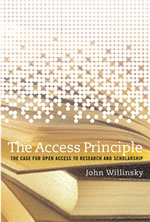
open_access.jpg
In his book “The Access Principle– The Case for Open Access to Research and Scholarship,” John Willinsky, from the University of British Columbia, tackles the idea that scholarship needs to be more open and accessible than it currently is. He offers a comprehensive and persuasive argument that covers the ethical, political and economic reasons for making scholarship accessible to both scholars and the public. He lives by his words, as a full text version is now available for download on the MIT Press website. The book is an important resource for anyone who is concerned with scholarly communicate. We were also fortunate to have his attendance at our meeting on the formulation of an scholarly press.
Many people have spoken to the situation that raising journal subscription costs and shrinking library acquisition budgets are quickly reaching their limits of feasibility, and now Willinsky provides in one place, a clear depiction of the status quo and the reasons on how it arrived there. He then takes the argument for open access deeper by widening the discussion to address the developing world and the general public.
Willinsky documents a promising trend that several large institutions including the NIH and prestigious journals such as the New England Journal of Medicine, are making their research available. They use different models releasing the research. For example, NEJM makes article accessible six months after its paid publication is released. In attempting to encourage this trend of open access to scholarly work, Willinsky devotes much of “Open Access” to document the business models of scholarly publishing and shows in detail the economic feasibility of open access publishing. He clearly maintains that making scholarship accessible is not necessarily making it free. Walking through the current economic models of academic publishing, Willinsky gives a good overview of the range of publishing models with varying degrees of accesibility. As well, he devotes an entire chapter which proposes an intriguing model of how a journal could be operated by scholars as a cooperative.
To coincide with this effort to argue for the open access of scholarship, Willinsky also works with a group of developers to create an open source and free publication platform, called the Open Journal System. The OJS provides a journal a way to reduce their costs by providing digital tools for editing, management and distribution. Although, it is clear that scholars and publishers still hold on to print as the ideal medium, even as it is becoming increasing economically infeasible to maintain. However, when the breaking point eventually comes to pass, the point in time when shrinking library budgets and raising subscription rates eventually become unworkable, viable options will fortunately already exist. A sample list of journals using OJS shows the breadth of subject matter and international use of the tool.
It is the last chapters of the book, “Reading,” “Indexing” and “History” which leave the biggest impact. In “Reading,” Willinsky explores how the way people read is already being influenced by screen-based text. Initially, the focus on digital publishing was relevant in his analysis and proposals, because the efficiencies gained by digital publishing can be used to balance the costs of accessing print publishing. However, in the shift to digital online publishing, he notes that there exists an opportunity to aid the comprehension of readers that is unrelated to the economics and ethics of access.
He uses the example of how students read a primary history text very differently than a historian reads. A historian quickly jumps from the top to bottom looking for clues concerning geography, time of the events depicted and the time document was written, in order to understand the historical context of the document. On the other hand, a student will typically read a document from start to finish, with less emphasis on building a context for the document.
Scholars’ readings of journal articles have similarities to the way historians read their source documents. Just as there are techniques to assist student of history how to read, there also ways to assist the reading of all scholarly work. Most importantly, these techniques can be integrated into the reading environment of the open and online journal. Addressing and utilizing the potential of digital and networked text, in the end, can assist the overall arguments of Willinsky. Because Willinsky comes from an education and pedagogy background, it is not surprising that he uses an “scaffolding” approach to support learning and reading. In this context, scaffolding refers to the pedagogical idea that knowledge transfer is increased when readers (or learners) are given tools and resources to support their learning experience with the main text.
Currently, there are of course features in print journal publishing to aid the reader. He cites that abstracts, footnotes and citations are ubiquitous tools to aid the reader. In the online environment, these tools can be expanded even further. While Willinsky acknowledges that open access will change the readership of scholarly publishing and that the medium must adapt for these new readers, he does not mean to say that the level of writing itself necessarily has to change. Scholars should still write to expand their field.
One very basic feature that is included the Open Journal System is the ability to comment. This simple feature has the ability to narrow the gap between author and reader. Although as far as I can tell, it is not often used. Also included, “Reading Tools” are basic but significant additions to the reading experience, currently providing supportive information by searching open access databases with author-proscribed key words. Willinsky states these tools are still undergoing development, which is not surprising because our understanding of the digital networked text is still in the formative stage as well. Because OJS is open source, it allows new feature sets to be added into the system as new forms of reading are understood and can be applied onto a large scale. Radical experimentation is not always appropriate. Just getting the journals into an online environment is a significant achievement. It is telling that the default setting for “Reading Tools” is off, although it is being used by some journals.
The chapter “Indexing,” flips the analysis to look at how online and accessibility will change how scholarship is stored, indexed and retrieved on the publisher side. Willinsky notes that in countries as Bangalore, universities cannot even afford the collected abstracts of journals, let alone subscriptions to the actual journal. However, the developing world is starting to benefit from the growing open indexes such as PubMed, ERIC, and CiteSeer.IST and HighWire.
He goes deeper into the issues of indexing by exploring how indexing of schloarly literature can be “more comprehensive, integrated and automated” while being open and accessible. Collaborative indexing is one such route to explore, which begins to blur the lines between publisher, author and reader. Willinsky has documented how fragmented current indexing service are, which leads to overlap and confusion over where journal are indexed. He aptly points out that indexing needs to evolve in step with open access because the amount of information to search vastly increases. Information that cannot located, even if it is openly accessible, has limited social value.
The Access Principle closes with a wonderful look at the historical relationship between scholarship and publishing in the aptly named chapter, “History.” In the early ears of the printing press, scholars where often found at the presses themselves, working with printers to produce their work. Once the printing press matured, a disconnect between the scholar and the press developed. Intermediaries emerged who ordered their subscription preferences and texts were sent off publishers and editors, as scholars moved further away from the physical press. Today, the shift to the digital has allowed the scholar to redevelop a closer relationship with the entire process of publishing. Blogging, print on demand, wikis, online journals and tagging tools are a few examples of how scholars now interact with “not only fonts and layout, but to the economics of distribution and access.”
It’s important that the book closes here, because it illuminates how publishing technology has always been a distruptive force on the way knowledge is stored and shared. Willinsky’s concern is to argue for open access but to also show how interrelated the digital is to that access. Further, there is the opportunity to “improve the quality and value of that access.”
Our work at the institue, including Sophie, MediaCommon, Gamer Theory, and nexttext all point to these new directions that Willinsky share, which not surprisingly make his book particularly relevant to me. However, Willinsky describes something relevant to all scholars as well.

working in the open

From 1984 to 1996 i had the good fortune to be a part of Voyager, an innovative publisher known for The Criterion Collection, which started in 1984 as a series of laser videodiscs, innovative cd-roms, the first credible electronic books in the Expanded Books series, and even a few landmarks on the web including the first audio webcast which fielded questions from remote listeners. We were a wide-eyed group inventing things as we went along. Nothing happened without intense in-house discussion and debate over the complex new relationships between form and content afforded by new technologies. But realistically the discussion was limited at the most to the hundred or so people at any one time who were involved in development of Voyager’s titles.
Through another stroke of luck i’ve managed to be part of a second wonderfully creative group which is having as much fun navigating uncharted waters as we did at Voyager. However this time, thanks to the network, my colleagues and i are working out in the open. And because others are able to listen in as we “think out loud” and then “chime-in” if they have something to contribute, the discussion is ever so much broader, deeper and fundamentally useful.
This thought came to me this morning when i looked at the discussion on if:book about MediaCommons and realized how remarkable a group of people had contributed so far and how much quicker the discussion is developing than it ever could have if it had just been my colleagues and i discussing this around a table.

now playing: academics in the role of the public intellectual

Last week, in light of Middle East expert and blogger Juan Cole’s recent experience with the hiring process of Yale University, the Chronicle of Higher Education posted commentary on the career risks of academic blogging from several well-known academic bloggers, including:
Siva Vaidhyanathan
Glenn Reynolds
Daniel W. Drezner
Ann Althouse
J. Bradford DeLong
Michael Bérubé
Erin O’Connor
The last comment is from Juan Cole, himself, and he closes with:
“The role of the public intellectual is my career. And it is a hell of a career. I recommend it.”
It appears that Juan Cole has few regrets. Although not getting the position at Yale certainly is disappointing, he can still teach, carry on with his formal scholarly research, and of course blog, at the University of Michigan. His ability to be a public intellectual has not suffered. (Due to the nature of tenure and the university system, his public courting by a potential competing employer will have a much less adverse effect than if he was employed in the private sector.)
By the nature of his area of expertise, he ideas were going to have detractors. Anyone who write on the Middle East is destined to be decried as either too pro-Israel or pro-Arab. Cole could have remained behind the protective walls of the academy that tenure affords. Juan Cole made a decision to blog and seems satisfied the outcomes.
Clearly, he views his role as public intellectual as part of his job. Although, some of his fellow bloggers do not necessarily take the same viewpoint. This discrepancy leads to the question, what is the job description of the higher education professor? More specifically, if outreach to the public is part of the job, how is the role of the academic public intellectual evaluated in the hiring and promotion process?
J. Bradford DeLong provides an good list of the possible activities of academics.
“A great university has faculty members who do a great many things — teaching undergraduates, teaching graduate students, the many things that are “research,” public education, public service, and the turbocharging of the public sphere of information and debate that is a principal reason that governments finance and donors give to universities. Web logs may well be becoming an important part of that last university mission.”
Of course, academics are involved in these areas in varying degrees. I do not mean to suggest that every professor needs to blog. However, on the whole, university presidents and department heads needs to acknowledge that they do have an obligation to make their scholarship accessible to the public. Scholarship for its own sake or its own isolated community has little or no social value.
Therefore, the public university which receives funding from the state government, has a responsibility to give back the results from the resources that society gives it. Further, we also as a society give private higher ed schools protective benefits (such as special tax status) because there is an implied idea that they provide a service to the overall community. Therefore, one can argue that part of higher education’s duty includes not only teaching and scholarship, but outreach as well. Some professors will have a natural tendency towards outreach and acting as a public intellectual, and universities need to support their activities as part of their reason for being hired in the first place.
The difficulty has arisen because within the academy there is history of a certain distain through those who pursued becoming a public intellectual. Drezner mentions how television was a legacy of being regarded with similar negativity. However, the web is a much more disruptive force than television in this regard. In that, it has dramatically changed how the university public intellectual can access people. Blogging specifically has lower the barrier of entry for academics (and anyone for that matter) to interact with the public. Now, they no longer need to rely on traditional media outlets to reach a mass audience. The biggest resource, then, is considerable time on the part of the professor.
Siva Vaidhyanathan states, “There has never been a better time to be a public intellectual, and the Web is the big reason why…
“I’m thrilled to see the membrane between the academy and the public more permeable and transparent than ever.”
If direct outreach is an essential part of the professional duty of the academic (which I argue it is,) then the academy needs to understand how to evaluate the medium. Blogging is not scholarly publishing, and needs to be interpreted with an understanding of the form. Because the hiring and tenure process is often closed, it is not clear how and if they are evaluating academic blogging as Ann Althouse notes:
“Those who are making a judgment about whether to offer a blogger a new career opportunity ought to have the sense to recognize satire and hyperbole and to understand that blog writing is done quickly, instinctively, and without an editor. But surely they are entitled to look at it as evidence of the quality of the blogger’s mind.”
In the short term, Yale is free to hire whomever they chose, as Erin O’Connor correctly asserts. However, there are long term effects to their decisions. The academy needs to be careful to insure that they are remain relevant to society. Cole’s blog get 200,000 viewers a month, and people are obviously interested in what he has to say. Playing it safe is a precarious position, because they may isolate themselves into obsolescence — particularly because (for better or worse) our society is increasingly business/ results/ ROI oriented.
Daniel W. Drezner states:
“Blogs and prestigious university appointments do not mix terribly well. That is because top departments are profoundly risk-averse when it comes to senior hires. In some ways, that caution is sensible — hiring a senior professor is the equivalent of signing a baseball player to a lifetime contract without any ability to release or trade him. In such a situation, even small doubts about an individual become magnified.”
In general, innovation tends to occur on the fringe. Being on the fringe often means organizations or individuals are unencumbered, and more free to take risks. Therefore, its not surprising that Drezner says that the top-tier institutes tend to be more conservative. At some point, what was once fringe gains acceptance and becomes mainstream. Therefore, the acceptance of academic blogging as part of a professor’s job will start at the fringes and move towards the mainstream and at some point top tier universities. However, if they are too slow to adapt, they will ironically risk losing the reputations they are seeking to protect.
The spectrum of reactions given by the commentators shows that the academy does not know yet how to handle blogging. ls it a personal activity, a professional pursuit, or something in between the two? Not all of them would agree that their blogging is formal part of the job as academics. Their opinions to Juan Cole’s blogging and experience with Yale, shows where they fall in that range. An interesting follow-up question to pose to them, is “Why Blog?” As well, there range of reactions and opinions point out the overall lack of guidelines on how to treat blogging for both academics and hiring committees. This is very different from the usual “rules” for promotion and hiring that are very well defined.
As stated previously, a university can create their own criteria for who they hire. The situations of tenure and promotion are quite different, because the faculty member is already employed by the organization when dealing with promotion. Even within a field, departments within an individual school will have specific guidelines on their expectations for teaching, research, grants and publishing.
With promotion, the importance of guidelines is even more crucial because junior faculty’s energy under the current system is so focused on progressing through the tenure track. If this ambiguity continues, we are bound to hear about new additions to the list of faculty being denied jobs and promotions. This could lead to academics abandoning blogging which would be a great loss for the public and the academy.

MediaCommons 3: continuing the discussion

All of us working on MediaCommons are extremely gratified by the reception that our introduction of the project has had, ranging from the supportive emails we’ve received, the posts on numerous other blogs, the articles in other publications, and, most importantly, in the lively conversation and substantive feedback we’ve gotten here. We’ve already started following up on these ideas and we’ll be posting more in the days to come, raising more particular issues for our collective consideration. We will also be taking the insightful suggestions and constructive criticisms we’ve received into our next face-to-face meeting in a few weeks’ time, after which we’ll respond more fully to your concerns and seek your feedback and input once again. For the moment, however, thanks to all of you — and please stay actively involved in these conversations.
We would also like to take the opportunity to announce that we’ll be representing at the upcoming Flow Conference, October 26-28, 2006, at the University of Texas at Austin. We will be participating on an open-forum roundtable discussing the future of digital publishing, which should prove fruitful for both generating ideas and continuing to build the strong community network for this project. If you can attend, we’ll hope to see you there.
— Kathleen Fitzpatrick, Avi Santo, Bob Stein, Ben Vershbow

network v. multimedia

During Bob’s synchronous chat with the Chronicle of Higher Education on Wednesday, I was reminded of the distinction he’s drawn between digital books that incorporate multimedia–text, audio, still and moving images–and those that are networked (and, as such, seem more dynamic and/or alive). Of course these two attributes are not mutually exclusive–and Bob never states/implies/screams that they are–but these two features, media-rich and networked, do seem to comprise the salient features of digital texts and the ways in which they part company with their paper counterparts. Moreover, the networked aspect of digital texts and all that it implies has NEVER escaped me–I wrote an hypertextual Master’s thesis complicating this very notion–still, I have bristled each time I’ve heard Bob’s proclamation that “it’s all about the network,” though I couldn’t seem to account for this reaction. Until, that is, I noticed other academics reacting similarly…
It hit me when the other day when Bob was asked a question by Michael Roy (one which reiterates a query from H. Stephen Straight) which said:

I was curious about your quote in the Chronicle article that suggests your change in focus away from multimedia texts towards networked texts. Can you elaborate on why you feel that the priority in development of new genres of electronic texts should be on their ‘networkedness’ rather than in the use of media?

Bob’s answer?:

it’s not really a move away from multimedia, just a re-orientation of its [sic] centrality in the born-digital movement. when i started working in this area full-time — twenty-six years ago — the public network that we know as the internet didn’t exist. our model at the time was the videodisc, an analog medium that suggested the book of the future would be just like the book of the past, i.e. a standalone, frozen, authoritative object. it took me a long time to realize that locating “books” inside the network would over time cause more profound shifts in our idea of what a book is than the simple addition of audio and video.

As I read this exchange it occurred to me why I/we have been harping on this issue and it has to do with our training. Poststructuralist theory taught us that there is no single book frozen in time; we have long since abandoned the notion of the authoritative tome. Foucault, for instance, posited the ‘author function,’ a position in a discourse community, one that contributed to the social construction of knowledge. Books, by extension, are always-already (given Jacque D’s recent passing, a little nod and an enactment of my point here), networked; they are part of a larger oeuvre and refer to each other extensively–thus they contain copious links, even if said links are a good deal more metaphoric in nature than the hyperlink of the networked text.
Moreover, reader response theorists such as Wolfgang Iser and Louise Rosenblatt taught us that the reader never approaches a text without bringing her own perspective to bear on it–a notion that renders each reading act as discrete–and each act of reading by the same reader is unique from the read that preceded it. In this world, then, the notion of a dynamic book versus one that is “frozen in time” becomes a non-issue. Indeed, in some respects, the networked book is in fact More traditional if it depends on textual language to conduct the interaction. Look at GAM3R 7H30RY–the method is unique but in terms of the knowledge made/gained etc, it is perhaps business as usual except for an accelerated and maybe more inclusive pace. By contrast, were you to put out a multimedia networked ‘book,’ and have it reviewed IN MEDIA-RICH language, that would be revolutionary.

teaching in a “collaborative, interactive, multimediated, networked, nonliear, and multi-accented” environment

Ed note: John McClymer of Assumption College, MA is a teacher and scholar of American History, who attended our nexttext history meeting last spring.
The string of adjectives in my title comes from Kathleen Fitzpatrick’s fascinating “Introducing MediaCommons” of July 17, 2006. Fitzpatrick uses them to describe the “new scholarship” MediaCommons can help promote. They apply with equal force to the teaching this new environment can foster, as Avi Santo’s post on revised pedagogies demonstrates. He sets forth the goals we need to pursue. My task is to explore a specific set of pedagogies suited to teaching history.
Ever since I attended my first workshop on the internet, I have been groping towards such a pedagogy. I think that I am now coming within hailing distance. So I extend an invitation to peers to take a look at what I will be seeking to do in an upper-level course on the history of the Gilded Age and Progressive Era this fall.
First I need to say a few words about history as a field of study. It is what some cognitive psychologists call “ill-structured.” Chemistry, for example, is well-structured. There is nothing equivalent to the Periodic Table in history. There are no formulae, no model problems. Nothing is reproducible. The historian never can isolate a particular phenomenon. We can never measure anything precisely. The evidence we need to make sense of comes in a wide array of forms, ranging from sermons to furniture, from battle plans to cartoons. No matter what the topic, furthermore, we know there are crucial missing pieces. Some we can someday discover. The rest is simply lost forever. As a result, say the cognitive specialists, history as a discipline requires a very high degree of intellectual flexibility.
Because it does, it is especially ill-served by what we can call pedagogies of scarcity. Consider the standard U.S. survey textbook. Despite its bulk, its authors have had to make innumerable painful choices about what to leave out. There is exciting new scholarship about, let us say, women in the antebellum South. If that is going to be included in a new edition, something of equal length must come out because the overall size of the text is fixed. So is the number of illustrations. Authors and editors must choose one painting to represent the Ash Can School. They must select one way of explaining the abolition movement. They must pretend, in short, that history is a well-structured field.
This necessarily carries over to the tasks we assign students to undertake. “Discuss the rise of imperialism in late nineteenth-century America” we ask. What is wrong with such a question? It is bogus. Students CAN solve for x; they CAN prove that two geometrical figures are congruent. They CANNOT “discuss” the rise of imperialism. They can only demonstrate that they know the version of the story found in their textbook or that they transcribed in their notes. Scarcity routinely leads historians to ask inauthentic questions. One proof is that we ask students to write an in-class essay on the rise of imperialism but caution the same student that the topic, as phrased, is too broad for a term paper.
History as a discipline does not admit of closure. We can prove theorems. We cannot state definitively the significance of race in American history. Yet we routinely pretend that we “cover” topics in our lectures. And we make students pretend that they understand topics whose mysteries continue to perplex us. All the adjectives in my title are antonyms for such inauthentic learning.
The course site contains a discussion of what authentic means in history, so I will not rehearse that here. Instead I will discuss why I approach the course in the ways I do. I will also highlight questions that continue to bedevil me as I continue to work on this course.
Creating a Community of Learners In and Outside the Classroom
My course builds upon work done over a number of semesters in an American Studies course at the University of Virginia that uses an online version of Alan Trachtenberg’s classic The Incorporation of America: Culture and Society in the Gilded Age. Over several semesters students in that course have created web sites that explore Trachtenberg’s ideas. My students and I, therefore, will be joining an existing scholarly community, albeit unbeknownst to the large majority of its members whose work of semesters past we will use. Their work provides us with models as well as information and ideas. Our work, we hope, will do as much for other classes on other campuses.
We will work as a community in class as well. All of us will read Trachtenberg’s chapters and hold a preliminary discussion for each. Then participants will pick among an array of resources relevant to a particular chapter. They will report their findings, first to me an hour before class via email. Then they will report them to each other. I insert myself here in the process for several reasons. One is quality control. I have no desire to encourage class discussion for its own sake. The format I’ve adopted guarantees that students will do the great majority of the talking. What I need to insure is that the most interesting ideas get a full and fair hearing. As a result, I need to know in advance who has what to say.
I take the best posts and create a web page. I do not hesitate to edit student notes, usually by deleting extraneous material. It is not uncommon for a student post running a page or more in length to show up on the course page as a paragraph or sometimes a sentence. All of this provides immediate feedback to the students. Some of it is negative, at least by implication. But the overall message is positive. Whenever I ask a student to contribute it is because I know that she has something worthwhile to add to the discussion. This means that students can relax.
Providing Multiple Points of Entry
Because they choose the materials they will work on, students can play to their strengths and their interests. This is, in fact, how practicing historians choose their own projects. Sometimes students rue specific choices, but most of the time they are enthusiastic about what they selected to work on. Further, they learn from each other in a non-competitive setting. The student reporting on the trial of “Big Bill” Haywood is not in competition with the one reporting on the “Uprising of the 20,000.” Instead both are puzzling over the labor movement in the early twentieth century. Each gains from the quality of the other’s work.
Structuring Access to Abundance
On line resources grow richer every day. We live in a world of intellectual abundance. Unfortunately this is daunting as well as liberating. Perhaps the key challenge in developing appropriate pedagogies for this new era is to figure out how to provide structured access to this abundance. Here the fact that University of Virginia students have already worked over some of the resources is an enormous plus. Even so, I have to group resources in clusters that are intellectually coherent, that offer diverse approaches to some central topic, and do not overwhelm the students seeking to use them. In its current form, I am reasonably satisfied that I have met the first two challenges for the course. I have not begun to meet the last. I will have to break out subsets of materials in each of the clusters I have set up. And I welcome all the help I can get in doing so.
Producing as well as Consuming Educational Resources
The goal of any pedagogy of abundance is to empower students to produce as well as consume knowledge. Currently the student-as-consumer model rules American education. My college, for example, has just hired a new vice president in charge of student recruitment and retention. The position was created on the advice of the marketing firm that carried out an extensive survey of how we should best position ourselves. I file no brief against any of this. I merely observe that the same set of notions shapes the academic as well as the other aspects of student life. And students act like consumers. Tuition is expensive and becoming more so every year. They want their money’s worth.
In some areas they are informed consumers. They know what the recreation centers and dorms are like at other schools, for example. In the classroom, on the other hand, they do not know nearly so much. Course evaluation forms often ask if the professor made reference to the most recent research in the relevant field. Few are the students capable of answering that question. And they understand even less of pedagogy. They know that they have been in classes where they learned a lot. They know they have been bored to tears on occasion. They have not had the opportunity to think about how specific disciplines impose specific constraints and provide specific intellectual challenges.
If they were more informed, history students would demand to be more active. Most students in most history courses spend their time listening to lectures, taking notes, and highlighting things in the textbook they suspect may show up on a quiz or exam. Most do not appreciate what a travesty of historical learning this is. Historians puzzle over evidence that is partial, contradictory, various, and fascinating. That is what they should be doing as well. Historians realize that, however exhaustive their research, they will never have the last word on anything. They also realize that their research can nonetheless contribute something lasting. Students need to be able to make the same claims about their work.
This raises a critically important question for which I have only very tentative answers: What are the appropriate student projects in an interactive, mediated world of abundance?
The student web sites at the University of Virginia provide one model. 1896, created by Rebecca Edwards and several of her students at Vassar, provides another. 1896 is a collaborative project of the students in History 276, “A House Divided: The United States, 1830-1890” taught by Professor Edwards. It contains a wealth of resources about the 1896 election along with suggestions by her on how to use the site in the classroom.
Both are final projects. Are there meaningful intermediate products students can produce and share? What might those look like? One idea I am currently playing with derives from the Women and Social Movements on line journal, http://www.alexanderstreet6.com/wasm/. The journal publishes documentary projects. All collect relevant primary sources around a question such as “From Wollstonecraft to Mill: What British and European Ideas and Social Movements Influenced the Emergence of Feminism in the Atlantic World, 1792-1869?” Some of the authors are recognized experts. Nancy Hewitt, for example, did “From Wollstonecraft to Mill.” Others are Ph.D. candidates drawing upon dissertation research. So my undergraduates will not be able to produce projects of the same scope or professionalism. But they can collect half a dozen primary sources bearing upon a topic, write a 750-1000 word overview, and provide a head note for each source. I can then post their work on the college’s server or, perhaps, in an appropriate MediaCommons node. I would be most interested in getting reactions to this idea, and I would love to hear of other ideas for authentic student projects.

wikipedia lampooned in onion

The Onion takes a shot at Wikipedia this week:

Wikipedia, the online, reader-edited encyclopedia, honored the 750th anniversary of American independence on July 25 with a special featured section on its main page Tuesday.

Not bad, though it kinda beats the Wikipedia-is-error-prone point into the ground. But the fact that it’s being satirized says something.
Naturally, the piece has already been noted on Wikipedia’s article on The Onion. The talk page points to another, funnier, wiki-themed “news brief” from last September: “Congress Abandons WikiConstitution.”