encouraging

The following was posted on Sunday by Mitch Stephens on Without Gods (for those of you still unfamiliar with it, Without Gods is the public work diary for Mitch’s forthcoming history of atheism, which we’ve been hosting for the past eight months — wow, has it been that long?!).

Thanks
The quality of the comments here lately has seemed, to me, extraordinarily high.
One of the purposes of blogging a book as it is being written is to have ideas tested and, possibly, sharpened, transformed or overturned. This has repeatedly occurred — although I have not often weighed in with comments of my own acknowledging that. Please take this as a blanket acknowledgement and expression of appreciation.

GAM3R 7H30RY may be flashier, and more technically ambitious, but in many ways Without Gods has been a more revelatory experiment in networked writing. As Mitch acknowledges, the sustained activity, and quality, of the comment streams has been impressive, and above all, interesting to read. It’s fascinating to follow this evolving collaboration between author and reader, and to watch Mitch come into his own as a skilled moderator of blog-based discussion. It remains to be seen how these conversations will end up shaping the finished book, but for some examples of a tangible collaboration taking place, take a look at these recent “Author Needs Advice” posts (part 1, part 2), in which Mitch asks for feedback on specific sections of the work-in-progress. Whatever the outcome, it’s clear that this reconfiguration of the writing process is yielding real rewards.

notable wikipedians

simonpulsifer.jpg

Simon Pulsifer: “the king of Wikipedia”
“He lives at home and doesn’t have a girlfriend.”
(photo: Bill Grimshaw/The Globe and Mail)

I just came across this story in The Toronto Globe and Mail about a young man from Ottawa by the name of Simon Pulsifer who, under the moniker SimonP, is Wikipedia’s most prolific contributor: “with 78,000 entries edited and 2,000 to 3,000 new articles to his name. He can’t remember the exact number.”
Pulsifer is also the subject of an article in Wikipedia, which, like many of the vanity stubs devoted to the encyclopedia’s editors, was nominated for deletion, only to be voted a keeper after some discussion. Justin Hall, a colleague of ours at USC, often cited as the first blogger, and a distinguished Wikipedian in his own right, offered the following in defense of the Pulsifer page:

As Wikipedia grows in importance and global reach, the most passionate participants in this collective editing experiment become important global intellectuals. Simon Pulsifer is one of the first public Wikipedians – with a great number of articles, a passion for editing under-developed subjects, and a strong sense of the mission of Wikipedia. He might not care to have an article about him here, but already mainstream media outlets (a Canadian newspaper) and online news sites (digg.com) have saluted his work. That attention and importance is only likely to increase. Let’s keep this article because Simon Pulsifer has already reached a greater number of people than many of the “historic” individuals described on Wikipedia.

Both Pulsifer and Hall are members of what could be considered the Wikipedia elite, the “notable Wikipedians“. Many of these probably deserve a good share of the credit for Wikipedia’s success. Now, though, I’m more interested in how Wikipedia’s corps of editors might gradually expand to include a greater slice of the public: teacher, students, and people from all walks of life.
Zealous Wikipedia hobbyists like Pulsifer, god love ’em, will hopefully, over time, be considered the exceptions that prove the general rule of participation: editing as a more modest pursuit that one builds into one’s intellectual life and lifelong learning regimen. If enough people begin to take part in this way, Wikipedia could become more diverse, more exhaustive, and more accurate than it already is. The Pulsifers and Halls might end up being its governors, its civil servants, its politicians. Of course, it is the process that is most important: the kind of civic participation and engagement over points of dissent that collaborating on Wikipedia entails. Bob explained this eloquently last week. Or, as Pulsifer describes it:

You write an article and you think you’ve made it as good as it can be and then you put it out there for everyone to see and edit. And within just a few minutes, you have started a dialogue over how best to represent a subject.

pinkwater dips his toes (and quill) into the web

The Institute is back in Los Angeles at USC, our home away from home in academe, where, for the next two days, we’re holding an introductory “boot camp” session with a small group of professors who will begin using Sophie in their classes this fall. USC is just southwest of downtown LA, right near the La Brea Tar Pits, which, incidentally, is the starting point of the latest book by one of my favorite childhood writers, Daniel Manus Pinkwater, who, I just read in Publishers Weekly, is publishing his newest book online.

pinkwater neddiad.jpg

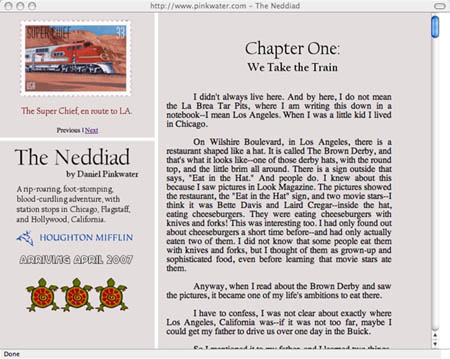
Pinkwater, author of Lizard Music, The Hoboken Chicken Emergency, the Snarkout Boys novels, and many, many others, is publishing his newest effort, The Neddiad, “a rip-roaring, foot-stomping, blood-curdling adventure, with station stops in Chicago, Flagstaff, and Hollywood, California,” free on his website as a serial.
With the blessing of his publisher, Houghton Mifflin, Pinkwater has set up a simple, very readable little site, where readers can imbibe the book, in slightly raw form, one chapter per week.

What we are presenting is the original author’s manuscript. There are some typos, and editorial corrections, and changes by me are not included. So the published book will be slightly different. I am a careful writer, and worked with a fine editor, so the differences are not great, but I thought it might be of interest for some to see what the book was like when handed in.

In many ways, this is a very PInkwater move — plugging his book into an electrical socket and watching it glow. There’s also a discussion forum, so it’s something of a networked book:

Readers are welcome to post comments, criticisms, complaints, and exchange remarks–a link will be provided, and I may periodically chime in to discuss and argue with the posters.

Pinkwater told PW:

When I was younger a circus hand showed me how they let kids sneak into the circus. If they were bold enough to try, they got to stay. I’m trying to keep that feeling for kids with this project. It lets kids sneak into the tent. We’re deliberately keeping it from looking slick; there are no ads. Of course, it’s with Houghton Mifflin’s kind permission that we can offer this, but it’s still a bit of homebrew, slightly different from the finished version. We hope that the readers who enjoy what they find online will want to buy the book, too.

If nothing else, Pinkwater has grasped an important (and counterintuitive) principle of web publishing: that giving stuff away can help sell books. It helps facilitate a discussion about that stuff, and can make readers feel better disposed toward you and your work (i.e. more likely to buy it in print). One chapter per week is a rather dribbling pace, however (recall the somewhat disingenuous serialization of Pulse by FSG), and might be a bit like Chinese water torture for Pinkwater’s ardent fans. But we’ll see.

the trouble with wikis in china

I’ve just been reading about this Chinese online encyclopedia, modeled after Wikipedia, called “e-Wiki,” which last month was taken offline by its owner under pressure from the PRC government. Reporters Without Borders and The Sydney Morning Herald report that it was articles on Taiwan and the Falun Gong (more specifically, an article on an activist named James Lung with some connection to FG) that flagged e-Wiki for the censors.

baidu logo.gif

Baidu: the heavy paw of the state.

Meanwhile, “Baidupedia,” the user-written encyclopedia run by leading Chinese search engine Baidu is thriving, with well over 300,000 articles created since its launch in April. Of course, “Baidu Baike,” as the site is properly called, is heavily censored, with all edits reviewed by invisible behind-the-scenes administrators before being published.
Wikipedia’s article on Baidu Baike points out the following: “Although the earlier test version was named ‘Baidu WIKI’, the current version and official media releases say the system is not a wiki system.” Which all makes sense: to an authoritarian, wikis, or anything that puts that much control over information in the hands of the masses, is anathema. Indeed, though I can’t read Chinese, looking through it, pages on Baidu Baike do not appear to have the customary “edit” links alongside sections of text. Rather, there’s a text entry field at the bottom of the page with what seems to be a submit button. There’s a big difference between a system in which edits are submitted for moderation and a totally open system where changes have to be managed, in the open, by the users themselves.
All of which underscores how astonishingly functional Wikipedia is despite its seeming vulnerability to chaotic forces. Wikipedia truly is a collectively owned space. Seeing how China is dealing with wikis, or at least, with their most visible cultural deployment, the collective building of so-called “reliable knowledge,” or encyclopedias, underscores the political implications of this oddly named class of web pages.
Dan, still reeling from three days of Wikimania, as well as other meetings concerning MIT’s One Laptop Per Child initiative, relayed the fact that the word processing software being bundled into the 100-dollar laptops will all be wiki-based, putting the focus on student collaboration over mesh networks. This may not sound like such a big deal, but just take a moment to ponder the implications of having all class writing assignments being carried out wikis. The different sorts of skills and attitudes that collaborating on everything might nurture. There a million things that could go wrong with the One Laptop Per Child project, but you can’t accuse its developers of lacking bold ideas about education.
But back to the Chinese. An odd thing remarked on the talk page of the Wikipedia article is that Baidu Baike actually has an article about Wikipedia that includes more or less truthful information about Wikipedia’s blockage by the Great Firewall in October ’05, as well as other reasonably accurate, and even positive, descriptions of the site. Wikipedia contributor Miborovsky notes:

Interestingly enough, it does a decent explanation of WP:NPOV (Wikipedia’s Neutral Point of View policy) and paints Wikipedia in a positive light, saying “its activities precisely reflects the web-culture’s pluralism, openness, democractic values and anti-authoritarianism.”

But look for Wikipedia on Baidu’s search engine (or on Google, Yahoo and MSN’s Chinese sites for that matter) and you’ll get nothing. And there’s no e-Wiki to be found.

u.c. offers up stacks to google

APTFrontPage.jpg
The APT BookScan 1200. Not what Google and OCA are using (their scanners are human-assisted), just a cool photo.

Less than two months after reaching a deal with Microsoft, the University of California has agreed to let Google scan its vast holdings (over 34 million volumes) into the Book Search database. Google will undoubtedly dig deeper into the holdings of the ten-campus system’s 100-plus libraries than Microsoft, which is a member of the more copyright-cautious Open Content Alliance, and will focus primarily on books unambiguously in the public domain. The Google-UC alliance comes as major lawsuits against Google from the Authors Guild and Association of American Publishers are still in the evidence-gathering phase.
Meanwhile, across the drink, French publishing group La Martiniè re in June brought suit against Google for “counterfeiting and breach of intellectual property rights.” Pretty much the same claim as the American industry plaintiffs. Later that month, however, German publishing conglomerate WBG dropped a petition for a preliminary injunction against Google after a Hamburg court told them that they probably wouldn’t win. So what might the future hold? The European crystal ball is murky at best.
During this period of uncertainty, the OCA seems content to let Google be the legal lightning rod. If Google prevails, however, Microsoft and Yahoo will have a lot of catching up to do in stocking their book databases. But the two efforts may not be in such close competition as it would initially seem.
Google’s library initiative is an extremely bold commercial gambit. If it wins its cases, it stands to make a great deal of money, even after the tens of millions it is spending on the scanning and indexing the billions of pages, off a tiny commodity: the text snippet. But far from being the seed of a new literary remix culture, as Kevin Kelly would have us believe (and John Updike would have us lament), the snippet is simply an advertising hook for a vast ad network. Google’s not the Library of Babel, it’s the most sublimely sophisticated advertising company the world has ever seen (see this funny reflection on “snippet-dangling”). The OCA, on the other hand, is aimed at creating a legitimate online library, where books are not a means for profit, but an end in themselves.
Brewster Kahle, the founder and leader of the OCA, has a rather immodest aim: “to build the great library.” “That was the goal I set for myself 25 years ago,” he told The San Francisco Chronicle in a profile last year. “It is now technically possible to live up to the dream of the Library of Alexandria.”
So while Google’s venture may be more daring, more outrageous, more exhaustive, more — you name it –, the OCA may, in its slow, cautious, more idealistic way, be building the foundations of something far more important and useful. Plus, Kahle’s got the Bookmobile. How can you not love the Bookmobile?

clifford lynch takes on computation and open access

Academic Commons mentions that Clifford Lynch has written a chapter, entitled, “Open Computation: Beyond Human-Reader-Centric Views of Scholarly Literatures” in an upcoming book on open access edited by Neil Jacobs of the Joint Information Committee. His chapter, which is available online, looks at the potential computational analyses that could be formed by collecting scholarly literature into a digital repository. These “large scholarly literature corpora” would be openly accessible and used for new branches of research currently not possible.
He takes cues from the current work in text mining and large scale collections of scholarly documents, such as the Persus Digital Library hosted by Tufts Unviersity. Lynch also acknowledges the skepticism that many scholars hold to the value of text mining analysis in the humanities. Further, he discusses the limitations that current intellectual property regimes place on the creation of a large, accessible scholarly corpora. Although many legal and technical obstacles exist, his proposal does seem more feasible than something like Ted Nelson’s Project Xanadu because the corpora he describes have boundaries, as well as supporters who believe that these bodies of literature should be accessible.
Small scale examples show the challenges Lynch’s proposal faces. I am reminded of the development of meta-analysis in the field of statistics. Although the term meta-analysis is much older, the contemporary usage refers to statistical techniques developed in the 1970s to aggregate results from a group of studies. These techniques are particularly popular in the medical research and the public health sciences (often because their data sets are small.) Thirty years on, these methods are frequently used and their resulted published. However, the methods are still questioned in certain circles.
Gene Glass gives a good overview of meta-analysis, concluding with a reflection on how the criticisms of its use reveal insights on fundamental problems with research in his field of education research. He notes the difference in the “fundamental unit” of his research, which is a study, versus physics, which is lower level, accessible and generalizable. Here, even taking a small step back reveals new insights on the fundamentals of his scholarship.
Lynch speculates on how the creation of corpora might play out, but he doesn’t dwell on the macro questions that we might investigate. Perhaps it is premature to think about these ideas, but the possible directions of inquiry are what lingered in my mind after reading Lynch’s chapter.
I am struck by the challenge of graphically representing the analysis of these corpora. Like the visualizations of the blogosphere, these technologies could not only analyze the network of citations, but also word choice and textual correlations. Moreover, how does the body of literature change over time and space, as ideas and thoughts emerge or fall out of favor. In the humanities, can we graphically represent theoretical shifts from structuralist to post-structuralist thought, or the evolution from pre-feminist to feminist to post-feminist thought? What effect did each of these movements have on each other over time?
The opportunity also exists of exploring the possible ways of navigating corpora of this size. Using the metaphor of Google Earth, where one can zoom in from the entire Earth down to a single home, what can we gain from being able to view the sphere of scholarly literature in such a way? Glass took one step back to analyze groups of studies, and found insight on the nature of education research. What are the potential insights can we learn from viewing the entire corpus of scholarly knowledge from above?
Lynch describes expanding our analysis beyond the human scale. Even if his proposal never reaches fruition, his thought experiments revealed (at least to me) how knowledge acquisition occurs over a multidimensional spectrum. You can have a close reading of a text or merely skim the first sentence of each paragraph. Likewise, you can read an encyclopedia entry on a field of study or spend a year reading 200 books to prepare for a doctoral qualifying exam. However, as people, we have limits to the amount of information we can comprehend and analyze.
Purists will undoubtedly frown upon the use of computation that cannot be replicated by humans in scholarly research. Another example is the use of computational for solving proofs in mathematics, which is still controversial. The humanities will be no different, if not more so. A close reading of certain texts will always be important, however the future that Lynch offers just may give that close reading an entirely new context and understanding. One of the great things about inquiry is that sometimes you do not know where you will end up until you get there.

jaron lanier’s essay on “the hazards of the new online collectivism”

In late May John Brockman’s Edge website published an essay by Jaron Lanier“Digital Maoism: The Hazards of the New Online Collectivism”. Lanier’s essay caused quite a flurry of comment both pro and con. Recently someone interested in the work of the Institute asked me my opinion. I thought that in light of Dan’s reportage from the Wikimania conference in Cambridge i would share my thoughts about Jaron’s critique of Wikipedia . . .
I read the article the day it was first posted on The Edge and thought it so significant and so wrong that I wrote Jaron asking if the Institute could publish a version in a form similar to Gamer Theory that would enable readers to comment on specific passages as well as on the whole. Jaron referred me to John Brockman (publisher of The Edge), who although he acknowledged the request never got back to us with an answer.
From my perspective there are two main problems with Jaron’s outlook.
a) Jaron misunderstands the Wikipedia. In a traditional encyclopedia, experts write articles that are permanently encased in authoritative editions. The writing and editing goes on behind the scenes, effectively hiding the process that produces the published article. The standalone nature of print encyclopedias also means that any discussion about articles is essentially private and hidden from collective view. The Wikipedia is a quite different sort of publication, which frankly needs to be read in a new way. Jaron focuses on the “finished piece”, ie. the latest version of a Wikipedia article. In fact what is most illuminative is the back-and-forth that occurs between a topic’s many author/editors. I think there is a lot to be learned by studying the points of dissent; indeed the “truth” is likely to be found in the interstices, where different points of view collide. Network-authored works need to be read in a new way that allows one to focus on the process as well as the end product.
b) At its core, Jaron’s piece defends the traditional role of the independent author, particularly the hierarchy that renders readers as passive recipients of an author’s wisdom. Jaron is fundamentally resistant to the new emerging sense of the author as moderator — someone able to marshal “the wisdom of the network.”
I also think it is interesting that Jaron titles his article Digital Maoism, with which he hopes to tar the Wikipedia with the brush of bottom-up collectivism. My guess is that Jaron is unaware of Mao’s famous quote: “truth emerges in the course of struggle [around ideas]”. Indeed, what I prize most about the Wikipedia is that it acknowledges the messiness of knowledge and the process by which useful knowledge and wisdom accrete over time.

harpercollins takes on online book browsing

In general, people in the US do not seem to be reading a lot of books, with one study citing that 80% of US families did not buy or read a book last year. People are finding their information in other ways. Therefore it is not surprising that HarpersCollins announced it “Browse Inside” feature, which to allows people to view selected pages from books by ten leading authors, including Michael Crichton and C.S. Lewis. They compare this feature with “Google Book Search” and Amazon’s “Search Inside.”
The feature is much closer to “Search Inside” than “Google Book Search.” Although Amazon.com has a nice feature “Surprise Me” which comes closer to replicating the experience of flipping randomly to a page in a book off the shelf. Of course “Google Book Search” actually lets you search the book and comes the closest to giving people the experiences of browsing through books in a physical store.
In the end, HarperCollins’ feature is more like a movie trailer. That is, readers get a selected pages to view that were pre-detereminded. This is nothing like the experience of randomly opening a book, or going to the index to make sure the book covers the exact information you need. The press release from HarperCollins states that they will be rolling out additional features and content for registered users soon. However, for now, without any unique features, it is unclear to me, why someone would go to the HarperCollins site to get a preview of only their books, rather than go to the Amazon and get previews across many more publishers.
This initiative is a small step in the correct direction. At the end of the day, it’s a marketing tool, and limits itself to that. Because they added links to various book sellers on the page, they can potentially reap the benefits of the long tail, by assisting readers to find the more obscure titles in their catalogue. However, their focus is still on selling the physical book. They specifically stated that they do not want to be become booksellers. (Although through their “Digital Media Cafe,” they are experimenting with selling digital content through their website.)
As readers increasingly want to interact with their media and text, a big question remains. Is Harper Collins and the publishing industry ready to release control they traditionally held and reinterpret their purpose? With POD, search engines, emergent communities, we are seeing the formation of new authors, filters, editors and curators. They are playing the roles that publishers once traditional filled. It will be interesting to see how far Harper Collins goes with these initiatives. For instance, Harper Collins also has intentions to start working with myspace and facebook to add links to books on their site. Are they prepared for negative commentary associated with those links? Are they ready to allow people to decide which books get attention?
If traditional publishers do not provide media (including text) in ways we are increasingly accustomed to receiving it, their relevance is at risk. We see them slowly trying to adapt to the shifting expectations and behaviors of people. However, in order to maintain that relevance, they need to deeply rethink what a publisher is today.

controversy in a MMORPG

image source: confessions of an aca/fan
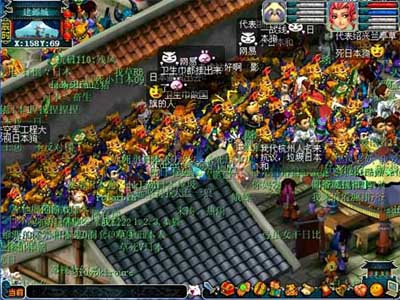
Henry Jenkins gives a fascinating account of an ongoing controversy occurring in a MMORPG in the People’s Republic of China, the fastest growing market for these online games. Operated by Netease, Fantasy Westward Journey (FWJ) has 22 million users, with an average of over 400,000 concurrent players. Last month, game administrators locked down the account of an extremely high ranking character, for having an anti-Japanese name, as well as leading a 700 member guild with a similarly offensive name. The character would be “jailed” and his guild would be dissolved unless he changed his character and guild’s name. The player didn’t back down and went public with accusations of ulterior motives by Netease. Rumors flew across FWJ about its purchase by a Japanese firm which was dictating policy decisions. A few days late, an alarming protest of nationalism broke out, consisting of 80,000 players on one of the gaming servers, which was 4 times the typical number of players on a server.
The ongoing incidents are important for several reasons. One is that it is another demonstration of how people (from any nation) bring their conceptualization of the real world into the virtual space. Sino-Japanese relations are historically tense. Particularly, memories of war and occupation by the Japan during World War II are still fresh and volatile in the PRC. In a society whose current calender year is 4703, the passage of seventy years accounts for a relatively short amount of time. Here, political and racial sentinment seamlessly interweave between the real and the virtual. However, these spaces and the servers which house them are privately owned.
The second point is that concentrations of economic and cultural production is being redistributed across the globe. The points where the real and the virtual worlds become porous are likewise spreading to places throughout Asia. Therefore, coverage of these events outside of Asia should not be considered fringe, but I see important incentives to track, report and discuss these events as I would local and regional phenomenon.

wikimania: the importance of naming things

wikimania logoI’ll write up what happened on the second day of Wikimania soon – I saw a lot of talks about education – but a quick observation for now. Brewster Kahle delivered a speech after lunch entitled “Universal Access to All Knowledge”, detailing his plans to archive just about everything ever & the various issues he’s confronted along the way, not least Jack Valenti. Kahle learned from Valenti: it’s important to frame the terms of the debate. Valenti explained filesharing by declaring that it was Artists vs. Pirates, an obscuring dichotomy, but one that keeps popping up. Kahle was happy that he’d succeeded in creating a catch phrase in naming “orphan works” – a term no less loaded – before the partisans of copyright could.

Wikimania is dominated by Wikipedia, but it’s not completely about Wikipedia – it’s about wikis more generally, of which Wikipedia is by far the largest. There are people here using wikis to do immensely different things – create travel guides, create repositories of lesson plans for K–12 teachers, using wikis for the State Department’s repositories of information. Many of these are built using MediaWiki, the software that runs Wikipedia, but not all by any means. All sorts of different platforms have been made to create websites that can be edited by users. All of these fall under the rubric “wiki”. we could just as accurately refer to wikis as “collaboratively written websites”, the least common denominator of all of these sites. I’d argue that the word has something to do with the success of the model: nobody would feel any sense of kinship about making “collaboratively written websites” – that’s a nebulous concept – but when you slap the name “wiki” on it, you have something easily understood, a form about which people can become fanatical.