

That’s now the name of the $100 laptop, or one laptop per child. Fits up to six children inside.
Why is it that the publicity images of these machines are always like this? Ghostly showroom white and all the kids crammed inside. What might it mean? I get the feeling that we’re looking at the developers’ fantasy. All this well-intentioned industry and aspiration poured into these little day-glo machines. But totally decontextualized, in a vacuum.

This ealier one was supposed to show poor, brown hands reaching for the stars, but it looked more to me like children sinking in quicksand.
Indian Education Secretary Sudeep Banerjee, explaining last month why his country would not be placing an order for Negroponte’s machines, put it more bluntly. He called the laptops “pedagogically suspect.”
ADDENDUM
An exhange in the comments below made me want to clarify my position here. Bleak humor aside, I really hope that the laptop project succeeds. From the little I’ve heard, it appears that the developers have some really interesting ideas about the kind of software that’ll go into these things.
Dan, still reeling from three days of Wikimania earlier this month, as well as other meetings concerning OLPC, relayed the fact that the word processing software being bundled into the laptops will all be wiki-based, putting the focus on student collaboration over mesh networks. This may not sound like such a big deal, but just take a moment to ponder the implications of having all class writing assignments being carried out wikis. The different sorts of skills and attitudes that collaborating on everything might nurture. There a million things that could go wrong with the One Laptop Per Child project, but you can’t accuse its developers of lacking bold ideas about education.
Still, I’m skeptical that those ideas will connect successfully to real classroom situations. For instance, we’re not really hearing anything about teacher training. One hopes that community groups will spring into action to help develop and implement new pedagogical strategies that put the Children’s Machines to good use. But can we count on this happening? I’m afraid this might be the fatal gap in this otherwise brilliant project.
librarians, hold google accountable
I’m quite disappointed by this op-ed on Google’s library intiative in Tuesday’s Washington Post. It comes from Richard Ekman, president of the Council of Independent Colleges, which represents 570 independent colleges and universities in the US (and a few abroad). Generally, these are mid-tier schools — not the elite powerhouses Google has partnered with in its digitization efforts — and so, being neither a publisher, nor a direct representative of one of the cooperating libraries, I expected Ekman might take a more measured approach to this issue, which usually elicits either ecstatic support or vociferous opposition. Alas, no.

To the opposition, namely, the publishing industry, Ekman offers the usual rationale: Google, by digitizing the collections of six of the english-speaking world’s leading libraries (and, presumably, more are to follow) is doing humanity a great service, while still fundamentally respecting copyrights — so let’s not stand in its way. With Google, however, and with his own peers in education, he is less exacting.
The nation’s colleges and universities should support Google’s controversial project to digitize great libraries and offer books online. It has the potential to do a lot of good for higher education in this country.
Now, I’ve poked around a bit and located the agreement between Google and the U. of Michigan (freely available online), which affords a keyhole view onto these grand bargains. Basically, Google makes scans of U. of M.’s books, giving them images and optical character recognition files (the texts gleaned from the scans) for use within their library system, keeping the same for its own web services. In other words, both sides get a copy, both sides win.
If you’re not Michigan or Google, though, the benefits are less clear. Sure, it’s great that books now come up in web searches, and there’s plenty of good browsing to be done (and the public domain texts, available in full, are a real asset). But we’re in trouble if this is the research tool that is to replace, by force of market and by force of users’ habits, online library catalogues. That’s because no sane librarian would outsource their profession to an unaccountable private entity that refuses to disclose the workings of its system — in other words, how does Google’s book algorithm work, how are the search results ranked? And yet so many librarians are behind this plan. Am I to conclude that they’ve all gone insane? Or are they just so anxious about the pace of technological change, driven to distraction by fears of obsolescence and diminishing reach, that they are willing to throw their support uncritically behind the company, who, like a frontier huckster, promises miracle cures and grand visions of universal knowledge?

We may be resigned to the steady takeover of college bookstores around the country by Barnes and Noble, but how do we feel about a Barnes and Noble-like entity taking over our library systems? Because that is essentially what is happening. We ought to consider the Google library pact as the latest chapter in a recent history of consolidation and conglomeratization in publishing, which, for the past few decades (probably longer, I need to look into this further) has been creeping insidiously into our institutions of higher learning. When Google struck its latest deal with the University of California, and its more than 100 libraries, it made headlines in the technology and education sections of newspapers, but it might just as well have appeared in the business pages under mergers and acquisitions.
So what? you say. Why shouldn’t leaders in technology and education seek each other out and forge mutually beneficial relationships, relationships that might yield substantial benefits for large numbers of people? Okay. But we have to consider how these deals among titans will remap the information landscape for the rest of us. There is a prevailing attitude today, evidenced by the simplistic public debate around this issue, that one must accept technological advances on the terms set by those making the advances. To question Google (and its collaborators) means being labeled reactionary, a dinosaur, or technophobic. But this is silly. Criticizing Google does not mean I am against digital libraries. To the contrary, I am wholeheartedly in favor of digital libraries, just the right kind of digital libraries.
What good is Google’s project if it does little more than enhance the world’s elite libraries and give Google the competitive edge in the search wars (not to mention positioning them in future ebook and print-on-demand markets)? Not just our little institute, but larger interest groups like the CIC ought to be voices of caution and moderation, celebrating these technological breakthroughs, but at the same time demanding that Google Book Search be more than a cushy quid pro quo between the powerful, with trickle-down benefits that are dubious at best. They should demand commitments from the big libraries to spread the digital wealth through cooperative web services, and from Google to abide by certain standards in its own web services, so that smaller librarians in smaller ponds (and the users they represent) can trust these fantastic and seductive new resources. But Ekman, who represents 570 of these smaller ponds, doesn’t raise any of these questions. He just joins the chorus of approval.

What’s frustrating is that the partner libraries themselves are in the best position to make demands. After all, they have the books that Google wants, so they could easily set more stringent guidelines for how these resources are to be redeployed. But why should they be so magnanimous? Why should they demand that the wealth be shared among all institutions? If every student can access Harvard’s books with the click of a mouse, than what makes Harvard Harvard? Or Stanford Stanford?
Enlightened self-interest goes only so far. And so I repeat, that’s why people like Ekman, and organizations like the CIC, should be applying pressure to the Harvards and Stanfords, as should organizations like the Digital Library Federation, which the Michigan-Google contract mentions as a possible beneficiary, through “cooperative web services,” of the Google scanning. As stipulated in that section (4.4.2), however, any sharing with the DLF is left to Michigan’s “sole discretion.” Here, then, is a pressure point! And I’m sure there are others that a more skilled reader of such documents could locate. But a quick Google search (acceptable levels of irony) of “Digital Library Federation AND Google” yields nothing that even hints at any negotiations to this effect. Please, someone set me straight, I would love to be proved wrong.
Google, a private company, is in the process of annexing a major province of public knowledge, and we are allowing it to do so unchallenged. To call the publishers’ legal challenge a real challenge, is to misidentify what really is at stake. Years from now, when Google, or something like it, exerts unimaginable influence over every aspect of our informated lives, we might look back on these skirmishes as the fatal turning point. So that’s why I turn to the librarians. Raise a ruckus.
UPDATE (8/25): The University of California-Google contract has just been released. See my post on this.
the wisdom of fortune cookies: “your reputation is your wealth”
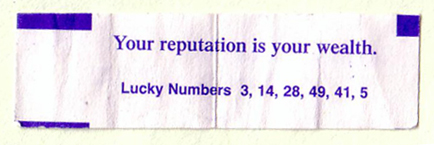
Over cold jasmine tea and quartered oranges in Chinatown, I got this little gem of a fortune. I chuckled at its relevance to our work at the institute. With the rise of self publishing (blogs, wikis, and POD), being google searchable, and content being freely given away, I wonder what our readers think about reputations being our wealth. Is this truth, nothing new, tom foolery, or just a fad? Has the concept of “reputation” changed? Have you and your work felt an effect as well? If so, how? I’m looking forward to hearing your thoughts.
speed dating sophie
Last Tuesday I was formally introduced to Sophie. Our first date left me dazed and confused. She is a powerful multimedia application from New York, well funded and growing under healthy cosmopolitan influences, while I am a digitally challenged graduate student with a dreadful Third World education.  Despite the obvious mismatch, Sophie was surprisingly responsive. For a program that is still a month away from even entering beta purgatory, to freeze up once in a while is perfectly normal. My reaction, on the other hand, was childish and immature. I protested out loud, argued with developers, worried about details, and became permanently infatuated. Now I can’t stop thinking about Sophie.
The problem is that she lies at the core of everything I want to do. During the next couple of decades I would like to participate in the collaborative development of multimedia ecosystems. Ok, that sounds awfully pretentious. What I really want is to work and play with a bunch of friends in a huge toy factory. My favorite toys are multimedia creatures.
For a while (and halfway-tongue-in-cheek) I have been training myself to think about all kinds of cultural artifacts in evolutionary terms. When I play around with a good old printed book, for example, I try to think about it as a potentially feature-rich creature that, so far as I am concerned, is working very well in frozen text mode. All other noisier and flashier possible forms of behavior have been muted, so to speak, in order to maximize the cultural value of the reading experience.
I think Sophie fascinates me precisely because her future depends so much on achieving a creative balance between simplicity and complexity. If everything goes well, Sophie will be able to handle very intricate tasks in rather plain terms. The program already has an unobtrusive but intuitive interface that would allow first time users to assemble rich multimedia documents in a matter of minutes. A highly sophisticated Sophie document can be embedded as a whole into another Sophie document. Placing an entire library of interconnected multimedia artifacts in a corner of a page within a Sophie “book” would only take a few mouse clicks.
An open source multimedia assembling program is always welcome. Sophie will be particularly good at doing difficult things the easy way, and that is a bonus in an industry cluttered with “advanced” applications that seem to be going in the opposite direction. Given the proper planetary alignment, a nurturing community could grow around the development of extensions and additions to the program. Eventually, Sophie would be unrecognizable, and that is the best thing that can happen to an evolving living thing.
Did I mention that the application has also been conceived as a platform independent application for collaborative multimedia assembling? That’s right; Sophie would eventually allow people to join efforts in authoring and managing complex documents over a network. These are my kind of toys: evolving multimedia artifacts, born on a network, raised by a virtual village, and assembled with a tool that is being develop along similar principles. Very cool stuff.
Strategically speaking, however, the development of Sophie, and the model of collaborative multimedia creation in general, could be better implemented using the notion of software as a service. Downloading an application that would reside in the desktop and then using it to handle files over a network is relatively cumbersome. This model requires periodic updating of the program and a high volume of general traffic up and down the servers.
Under the current paradigm, Sophie is being developed just like Microsoft Word but I would rather work on something more along the lines of Writely. An Ajax-based version of Sophie within a regular web browser like Firefox would maximize the networking capabilities of the application. Full assembly functionality could be hard to achieve this way, but in a tradeoff between fancy multimedia features and wider potential for collaboration I would tend to favor the latter. The evolutionary success of a networked book will depend on the qualities of the network rather than the features of the book.
Online collaboration can be achieved more efficiently by sideloading rather than constantly uploading and downloading files. In an ideal world we would only need to upload original raw files, and only once. Everything else would happen at the server level. Every user would have access to every file and any combination of files at every step during the assembling process, from any computer connected to the internet.
This late in its development, altering the nature of an application like Sophie at this radical level is too difficult. Perhaps the best way to go about it is to release a beta version of the program, in order to broaden its community of developers, and hope that a team of Ajax-savvy people decides to create a browser-based alternative interface for Sophie. In the meantime she should consider setting up a series of dates with the guys at Ajax13. I promise I won’t be jealous.
“highbrow” video games?
 Recently in the gaming blog Gamersutra, Ernest Adams questions why aren’t there highbrow video games.” His article comes one month after an Esquire article, where Chuck Klosterman wondered why isn’t there good video game criticism and makes the claim that video games needs its own Lester Bangs. As the video game market grows, it is not surprising that fans and advocates of gaming will want to form to grow and mature as well.
Adams’ call for “highbrow” games is rooted in a desire to add creditability and legitimacy to video games. As someone who has dedicated his career to making and writing about video games, the never-ending criticism about the violence in games by various groups looking for easy political targets must be frustrating to endure. I can appreciate the motivations behind Adam’s conclusion, however, his description of highbrow video games is ultimately too narrowly defined and overlooks impressive experiments of video games.
I hesitate to even try to deem games “high” or “low” because the terms are not that useful. Adams specifically points out that the films he aspires video games to emulate are not “art films,” which he describes as a “short low-budget titles filled with impenetrable weirdness.” Therefore, his definition of highbrow edge towards the problematic “I know it when I see it” definitions of art. Further, we can gather insight on culture and ourselves by interacting will both high and low culture and valuing one form over another is problematic.
From his description of a highbrow video game, I think what Adams is really asking for is better interactive narratives in gaming. He alludes to the films of Ishmail Merchant and James Ivory, who are best known for adopting the novels of E.M. Forester, often with screenwriter Ruth Prawer Jhabvala. Their films tend to be beautiful, well crafted analyses of class. Although, they are not generally know for pushing the boundaries of film.
Last year, Adams gave a talk which he published on his website, in which he assesses the state of interactive narrative. It provides more insight on his train of thought. In it, one of his references in video game scholarship is Janet Murray’s Hamlet on the Holodeck which uses a theatrical frame of reference in postulating the future of interactive narrative. Also, Adams offers a model of a “structured” approach to the narrative of video games and reveals that he is particularly wedded to the idea of single player games over the shared gaming experience of MMORPGs which are increasingly popular. In his current essay, his description of states that the highbrow video game “would reward close attention and playing more than once.” This implies that he still leans towards single player role playing games in his conceptualization of highbrow games.
However, video games that are pushing the form in more “artistic” ways are occurring outside the bounds of single player game. For example, we-make-money-not-art reported on The Endless Forest, which is a gorgeous MMORPG in which players assume the identity of a deer. Developed by the Belgian studio Tale of Tales, The Endless Forest has an elegant interface and darkly rich art direction. Although it lacks an explicit narrative, the gameplay engages users without the typical violence and sexually charged themes of many games. The Endless Forest limits the use of language. Therefore, it does not include a chat function and players are “named” with pictograms rather than words. However, as more of these kinds of games are created, they are unlikely to lessen the criticism of the negative social effects of video games.
As for criticism, the notion of elevating video game criticism to a higher form is rather ironic, as it comes at the same time when the New York Times critic A.O. Scott finds himself defending film criticism. While not a music critic, Scott describes the critics’ predicament that often panned movies are still hugh box offices successes. Media critics want the new and interesting, which is somewhat expected if it is your job to watch and write about movies, music, or video games everyday. Their standards are quite different from the typical audience member. Lester Bangs was a polarizing figure, who wanted to raise the standards of writing on music. He appeared at a time when people were ready for similar standards. It may be that a critical mass of audience for a similar kind of criticism for gaming is beginning to emerge.
As previously stated, most gamers will still want “mainstream” titles. Because games are expensive, they will still rely on criticism which Klosterman dismissives as “customer advice.” That is, many gamers, if not most, will still mostly be interested in reading reviews which describe gameplay, graphics and sound design, rather than thematic and issues of meaning. Many gamers don’t like the academic scholarly writing on video games, which is in adbundance, but is not what Klosterman wants to read. We learned about their attitutdes in initial reactions and comments posted across the gaming blogosphere about our project “GAM3R 7H30RY.” It’s not clear to me what is bad about gaming publications serving the desires of the video game playing community.
 My guess is that both boundary pushing video games and criticism will be begin to get more exposure fairly soon. For the actual video games, I would look towards Europe and Asia, where more government funding exists for developing these kinds of endeavors. I don’t expect many of the big gaming companies in the US to create experimental games of this nature. Although, they might in the future, after the proven economic viability of them. In that, major movie studios started funding more smaller films after they saw successful crossover of films of the Merchant Ivory variety. Although, Rockstar (the maker of Grand Theft Auto) have the upcoming and already controversial game Bully, where you must navigate a boarding school as a new student. It was described by the New York TImes as having, “an open world for the players to explore, tightly defined and memorable characters, a strong story line, [and] high-end voice acting,” which is precisely what Adams call for in his article.
Regardless of who moves video games and its coverage further, it’s bound to happen. Although, these new forms may not look exactly has Adams and Klosterman describe or wish. Media takes time to evolve, just compare the “highbrow” television series the HBO produces as compared to rather “lowbrow” television from the 50s. (I will admit that I don’t prefer one over the other.) For a great example of how a medium transforms the perspective of an artist, see Scott McCloud’s description of the movement from comic book fan to student to professional to genre pushing pioneer in Understanding Comics. If someone really wants to write video game criticism in the style of Lester Bangs, then the current low barriers of entry to electronic self-publishing allows her to do so. Creating video games, of course, requires a lot more resources. However, in closing, Adams states, “maybe I’ll design one myself, just for the fun of it.”
call for papers: what to do with a million books
The Humanities Division at the University of Chicago and the College of Science and Letters at the Illinois Institute of Technology are hosting an intriguing colloquium on the future of research in the humanities in response to the rapid growth of digital archives. They are currently accepting paper proposals, which are due at the end of August.
Here is the call for papers:
What to Do with a Million Books: Chicago Colloquium on Digital Humanities and Computer Science
Sponsored by the Humanities Division at the University of Chicago and the College of Science and Letters at the Illinois Institute of Technology.
Chicago, November 5th & 6th, 2006
Submission Deadline: August 31st, 2006
The goal of this colloquium is to bring together researchers and scholars in the Humanities and Computer Sciences to examine the current state of Digital Humanities as a field of intellectual inquiry and to identify and explore new directions and perspectives for future research.
In the wake of recent large-scale digitization projects aimed at providing universal access to the world’s vast textual repositories, humanities scholars, librarians and computer scientists find themselves newly challenged to make such resources functional and meaningful.
As Gregory Crane recently pointed out (1), digital access to “a million books” confronts us with the need to provide viable solutions to a range of difficult problems: analog to digital conversion, machine translation, information retrieval and data mining, to name a few. Moreover, mass digitization leads not just to problems of scale: new goals can also be envisioned, for example, catalyzing the development of new computational tools for context-sensitive analysis. If we are to build systems to interrogate usefully massive text collections for meaning, we will need to draw not only on the technical expertise of computer scientists but also learn from the traditions of self-reflective, inter-disciplinary inquiry practiced by humanist scholars.
The book as the locus of much of our knowledge has long been at the center of discussions in digital humanities. But as mass digitization efforts accelerate a change in focus from a print-culture to a networked, digital-culture, it will become necessary to pay more attention to how the notion of a text itself is being re-constituted. We are increasingly able to interact with texts in novel ways, as linguistic, visual, and statistical processing provide us with new modes of reading, representation, and understanding. This shift makes evident the necessity for humanities scholars to enter into a dialogue with librarians and computer scientists to understand the new language of open standards, search queries, visualization and social networks.
Digitizing “a million books” thus poses far more than just technical challenges. Tomorrow, a million scholars will have to re-evaluate their notions of archive, textuality and materiality in the wake of these developments. How will humanities scholars, librarians and computer scientists find ways to collaborate in the “Age of Google?”
(1) http://www.dlib.org/dlib/march06/crane/03crane.html
Colloquium Website
http://dhcs.uchicago.edu/announcement/
Date
November 5th & 6th, 2006
Location
The University of Chicago
Ida Noyes Hall
1212 East 59th Street
Chicago, IL 60637
Keynote Speakers
Greg Crane (Professor of Classics, Tufts University) has been engaged since 1985 in planning and development of the Perseus Project, which he directs as the Editor-in-Chief. Besides supervising the Perseus Project as a whole, he has been primarily responsible for the development of the morphological analysis system which provides many of the links within the Perseus database.
Ben Shneiderman is Professor in the Department of Computer Science, founding Director (1983-2000) of the Human-Computer Interaction Laboratory, and Member of the Institute for Advanced Computer Studies and the Institute for Systems Research, all at the University of Maryland. He is a leading expert in human-computer interaction and information visualization and has published extensively in these and related fields.
John Unsworth is Dean of the Graduate School of Library and Information Science and Professor of English at the University of Illinois at Urbana-Champaign. Prior to that, he was on the faculty at the University of Virginia where he also led the Institute for Advanced Technology in the Humanities. He has published widely in the field of Digital Humanities and was the recipient last year of the Lyman Award for scholarship in technology and humanities.
Program Committee
Prof. Helma Dik, Department of Classics, University of Chicago
Dr. Catherine Mardikes, Bibliographer for Classics, the Ancient Near East, and General Humanities, University of Chicago
Prof. Martin Mueller, Department of English and Classics, Northwestern University
Dr. Mark Olsen, Associate Director, The ARTFL Project, University of Chicago
Prof. Shlomo Argamon, Computer Science Department, Illinois Institute of Technology
Prof. Wai Gen Yee, Computer Science Department, Illinois Institute of Technology
Call for Participation
Participation in the colloquium is open to all. We welcome submissions for:
1. Paper presentations (20 minute maximum)
2. Poster sessions
3. Software demonstrations
Suggested submission topics
* Representing text genealogies and variance
* Automatic extraction and analysis of natural language style elements
* Visualization of large corpus search results
* The materiality of the digital text
* Interpreting symbols: textual exegesis and game playing
* Mashup: APIs for integrating discrete information resources
* Intelligent Documents
* Community based tagging / folksonomies
* Massively scalable text search and summaries
* Distributed editing & annotation tools
* Polyglot Machines: Computerized translation
* Seeing not reading: visual representations of literary texts
* Schemas for scholars: field and period specific ontologies for the humanities
* Context sensitive text search
* Towards a digital hermeneutics: data mining and pattern finding
Submission Format
Please submit a (2 page maximum) abstract in either PDF or MS Word format to dhcs-submissions@listhost.uchicago.edu.
Important Dates
Deadline for Submissions: August 31st
Notification of Acceptance: September 15th
Full Program Announcement: September 15th
Contact Info
General Inquiries: dhcs-conference@listhost.uchicago.edu
Organizational Committee
Mark Olsen, mark@gide.uchicago.edu, Associate Director, ARTFL Project, University of Chicago.
Catherine Mardikes, mardikes@uchicago.edu, Bibliographer for Classics, the Ancient Near East, and General Humanities, University of Chicago.
Arno Bosse, abosse@uchicago.edu, Director of Technology, Humanities Division, University of Chicago.
Shlomo Argamon, argamon@iit.edu, Department of Computer Science, Illinois Institute of Technology.
kairos turns ten
Last week marked the release of the ten year anniversary issue of Kairos, the online refereed journal of rhetoric, technology and pedagogy. The anniversary issue looks both back and forward. This milestone is notable because ten web years feels like dog years. Just consider the state of the web in 1996, where amazon.com was one year old, altavista was the leading search engine, Flash 1 got its release, and javascript was the cutting edge in web programming. Started by graduate students, Kairos has always focused on webtexts which explored the new potentials of the web as a medium, rather than simply uploading the static text of a print journal.
The issue contains interviews with people reflecting upon their experiences with rhetoric/ composition and digital technology and Kairos. As well, Jim Kalmbach gives a good overview of the scholarship which took place within Kairos over the past ten years. He concludes with this following statement:
“…we do not need ever more stunning hypermediated essays; we need new forms of scholarship; we need to think about new ways of using digital writing spaces to make meaning.”
His statement is a good transition to a new section in Kairos called Inventio, which will publicly track an article through the editorial process from inception to publication. As described, this section will:
(a) to provide a publication venue for experimental scholarly texts that push technological boundaries, and (b) to make Kairos’ editorial and peer-review decisions for innovative scholarly webtexts more explicit.
I’m looking forward to seeing the first article from this section to appear in the fall of next year. It is another project along the same lines as our project, MediaCommons. People from many directions are clearly realizing the potential in pursuing more ways to develop and share academic scholarship. I excited to see that it is starting to occur on many fronts, and I am happy that the institute, as well as, this pioneering journal are part of it.
shifting forms of graffiti
A few weekends ago, I was returning into Manhattan from upstate New York. Coming down the FRD along the East River, we past Keith Haring’s “Crack is Wack” mural on 128th and 2nd. I remember the first time I saw it in the 80s on a family day trip into the city. The work is strikes me as quite extraordinary, even 20 years after its creation in 1986. By that time, Haring was established in the art world, having already shown at the Venice Biennale and the Whitney Biennial and had solo shows at the Tony Shafrazi Gallery and the Leo Castelli Gallery. Even though Haring was part of that contemporary/ high brow art world, he still maintained a connection to his roots of skirting the lines between public street art and illegal graffiti. “Crack is Wack” mixed of graffiti street culture, political and social messages, and high art. Although, the mural was quickly placed under the protection and jurisdiction of the City Department of Parks.
Haring took cues from graffiti, among other sources of influence, and created his own style and form. Revisiting “Crack is Wack” got me thinking about graffiti and how it has evolved of the past few decades. The funny thing about living in New York is that, after a while, you start seeing through the visual chaos of our surroundings. When you take a moment to stop and look, it is amazing what you can actually see. The things that you walk by everyday, especially stand out.
Graffiti, which had faded into the background visual noise of New York, was back on my radar screen. It was, of course, everywhere, but it had also changed since I really paid attention to it. Ben posted about a show on graffiti at the Brooklyn Museum, and that was just one aspect of how graffiti has expanded beyond the traditional notions of the form. At the institute, we spend a lot of time thinking about the evolution of media, and it seems that graffiti is no different.
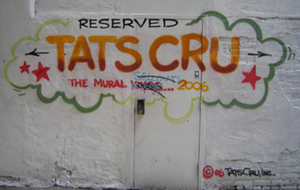 On a side street near Little Italy, there used to be an advertisement for the Sony PSP done by the graffiti artists Tat’s Cru. Now, the brick space has a place holder of an advertisement for these graffiti artists for hire. An interesting comment was left by a rival tagger, saying “sell out.” And then someone else left their tag over the unsolicited commentary. I love the on-going asynchronous dialogue occurring on this brick wall of this corner deli. It is not surprising that others would be upset at Tat’s Cru getting paid by advertisers for marketing. The website shows a piece that they did for BP. Working for the oil industry certainly will raise doubts to the authenticity and street credibility by purists of the form.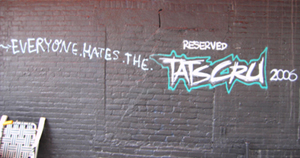
Perhaps, the work of the Tats Cru has not branched off to the new genre of graffiti but circled back to another form. Take this painted billboard for the debut solo record by Radiohead frontman Thom Yorke. The billboard appeared in Williamsburg in the weeks leading up to its release. Within moments, my initial thought that it was some hard core fan’s ode to British rock was replaced with the realization that this was paid for by a record label.
Referencing graffiti in advertising is nothing new. Turning actual graffiti into the advertising was the obvious next step. If graffiti is paid for and created for marketing purposes, at what point does it stop being graffiti? Has it turned into something else? Is it just a style of art using spray paint to create forms referencing hip-hop?
 Sometime after seeing Haring work, I passed this stoop a few blocks north of Chinatown. There was another similar work by the same artist I saw in the Lower East Side, however, I couldn’t find it again.
But the work kept on reappearing. And then, I noticed another one a few blocks from the institute’s office in Brooklyn. I probably walked past it hundreds of times before stopping to notice it. You can see where someone tried to tear it off, because in fact, the figures are not drawn on the wall, but on paper. The image is then transferred to the wall. Is this cheating? Suddenly, form and material are being challenged.
I did stumble upon Ping Magazine, when a friend sent me another article from the site. I finally learned that these pieces were created by an artist who goes by Swoon. She gave an interview for the New York Times, and describes herself as street artist, but considers her work graffiti. More importantly, she does not talk about the legal nature or the materiality of her work, but focuses on its location in public spaces and its direction interaction with people.
Keith Haring ended up being a great starting point, because of his work is a hybrid many forms and influences, including graffiti but also things beyond it. His mural reminded me that graffiti has embodied a range of politics, material and cultures for decades. Forms of expression emerge, branch off and circle back. Subsequent generations focus on different areas, be it monetary or expressive. Today, art and advertising are often re-appropriations of each other, as forms blend into one another. Empty spaces are filled with media by both artists and advertisers. The arts organization the Wooster Collective shows how broadly the concept of street art can extended. Trying to restrict these forms to bounded definitions is marginally useful, and often futile.
In this investigation, I was surprised at what I found, and amused at how often I circled back to the question of what is graffiti? The question or process of re-seeing something itself is not that surprising, particularly in the context of our work at the institute. Although, we focus more time on textual media, many of the questions remain the same. As we witness the evolving forms of text and the book, we can learn from other forms that turn into something slightly familiar but also remarkably new.
google on mars
Apparently, this came out in March, but I ‘ve only just stumbled on it now. Google has a version of its maps program for the planet Mars, or at least the part of if explored and documented by the 2001 NASA Mars Odyssey mission. It’s quite spectacular, especially the psychedelic elevation view:
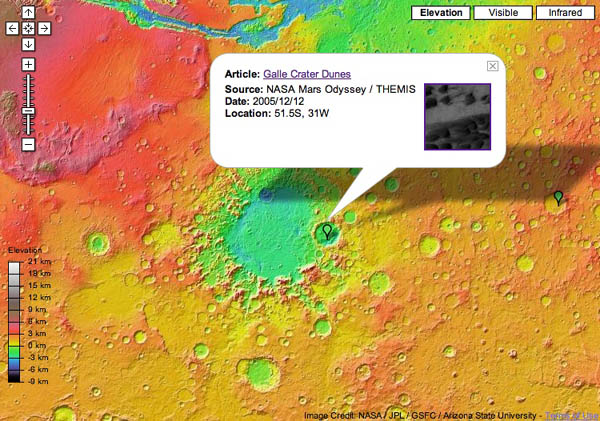
There’s also various info tied to specific coordinates on the map: location of dunes, craters, planes etc., as well as stories from the Odyssey mission, mostly descriptions of the Martian landscape. It would be fun to do an anthology of Mars-located science fiction with the table of contents mapped, or an edition of Bradbury’s Martian Chronicles. Though I suppose there’d a fair bit of retrofitting of the atlas to tales written out of pure fancy and not much knowledge of Martian geography (Marsography?). If nothing else, there’s the seeds of a great textbook here. Does the Google Maps API extend to Mars, or is it just an earth thing?
can advertising liberate textbooks?
The aptly named Freeload Press is giving away free PDFs (free as in free beer, or free market) of over 100 textbooks titles (mostly in business and finance, though more is planned). All students have to do is fill out an online survey and then the download is theirs, to use on a computer or to print out. Where does the money come from? Ads. Ads in the pages of the textbooks.

An ad for FedEx Kinkos in a sample Freeload textbook. Hmmm, wonder where I should get this thing printed?
Ads in textbooks is undoubtedly a depressing thought. Even more depressing, though, is the outlandish cost of textbooks, and the devious, often unethical, ways that textbook publishers seek to thwart the used book market. This Washington Post story gives a quick overview of the problem, and profiles the St. Paul, Minnesota-based Freeload.
Though making textbooks free to students is an admirable aim, simply shifting the cost to advertisers is not a good long-term solution, further eroding as it does the already much-diminished borderline between business and education (I suppose, though, that ads in business ed. textbooks in some ways enact the underlying precepts being taught). There are far better ideas out there for, as Freeload promises, “liberating the textbook” (a slogan that conjures the Cheney-esque: the textbooks will greet us as liberators).
One of them comes from Adrian Lopez Denis, a PhD candidate in Latin American history at UCLA. I’m reproducing a substantial chunk of a brilliant comment he posted last month to the Chronicle of Higher Ed’s Wired Campus blog in response to their coverage of our announcement of MediaCommons. We just met with Adrian while in Los Angeles and will likely be collaborating with him on a project based on the ideas below. Basically, his point is that teachers and students should collaborate on the production of textbooks.
Students are expected to produce a certain amount of pages that educators are supposed to read and grade. There is a great deal of redundancy and waste involved in this practice. Usually several students answer the same questions or write separately on the same topic, and the valuable time of the professionals that read these essays is wasted on a rather repetitive task.
[…]
As long as essay writing remains purely an academic exercise, or an evaluation tool, students would be learning a deep lesson in intellectual futility along with whatever other information the course itself is trying to convey. Assuming that each student is writing 10 pages for a given class, and each class has an average of 50 students, every course is in fact generating 500 pages of written material that would eventually find its way to the campus trashcans. In the meantime, the price of college textbooks is raising four times faster that the general inflation rate.
The solution to this conundrum is rather simple. Small teams of students should be the main producers of course material and every class should operate as a workshop for the collective assemblage of copyright-free instructional tools. Because each team would be working on a different problem, single copies of library materials placed on reserve could become the main source of raw information. Each assignment would generate a handful of multimedia modular units that could be used as building blocks to assemble larger teaching resources. Under this principle, each cohort of students would inherit some course material from their predecessors and contribute to it by adding new units or perfecting what is already there. Courses could evolve, expand, or even branch out. Although centered on the modular production of textbooks and anthologies, this concept could be extended to the creation of syllabi, handouts, slideshows, quizzes, webcasts, and much more. Educators would be involved in helping students to improve their writing rather than simply using the essays to gauge their individual performance. Students would be encouraged to collaborate rather than to compete, and could learn valuable lessons regarding the real nature and ultimate purpose of academic writing and scholarly research.
Online collaboration and electronic publishing of course materials would multiply the potential impact of this approach.
What’s really needed is for textbooks to liberated from textbook publishers. Let schools produce their own knowledge, and spread the wealth.