on business models in web publishing

waiting cart.jpg

Waiting cart stacked with newspaper advertising inserts — by www.DaveWard.net, via Flickr

Here at the Institute, we’re generally more interested in thinking up new forms of publishing than in figuring out how to monetize them. But one naturally perks up at news of big money being made from stuff given away for free. Doc Searls points to a few items of such news.
First, that latest iteration of the American dream: blogging for big bucks, or, the self-made media mogul. Yes, a few have managed to do it, though I don’t think they should be taken as anything more than the exceptions that prove the rule that most blogs are smaller scale efforts in an ecology of niches, where success is non-monetary and more of the “nanofame” variety that iMomus, David Weinberger and others have talked about (where everyone is famous to fifteen people). But there is that dazzling handful of popular bloggers that rival the mass media outlets, and they’re raking in tens, if not hundreds, of thousands of dollars in ad revenues.
Some sites mentioned in the article:
TechCrunch: “$60,000 in ad revenue every month” (not surprising — its right column devoted to sponsors is one of the widest I’ve seen)
Boing Boing: “on track to gross an estimated $1 million in ad revenue this year”
paidContent.org: over a million a year
Fark.com: “on pace to become a multimillion-dollar property.
Then, somewhat surprisingly, is The New York Times. Handily avoiding the debacle predicted a year ago by snarky bloggers like myself when the paper decided to relocate its op-ed columnists and other distinctive content behind a pay wall, the Times has pulled in $9 million from nearly 200,000 web-exclusive Times Select subscribers, while revenues from the Times-owned About.com continue to skyrocket. There’s a feeling at the company that they’ve struck a winning formula (for now) and will see how long they can ride it:

When I ask if TimesSelect has been successful enough to suggest that more material be placed behind the wall, Nisenholtz [senior vice president for digital operations] replies, “The strategy isn’t to move more content from the free site to the pay site; we need inventory to sell to advertisers. The strategy is to create a more robust TimesSelect” by using revenue from the service to pay for more unique content. “We think we have the right formula going,” he says. “We don’t want to screw it up.”

***Subsequent thought: I’m not so sure. Initial indicators may be good, but I still think that the pay wall is a ticket to irrelevance for the Times’ columnists. Their readership is large and (for now) devoted enough to maintain the modestly profitable fortress model, but I think we’ll see it wither over time.***
Also, in the Times, there’s this piece about ad-supported wiki hosting sites like Wikia, Wetpaint, PBwiki or the swiftly expanding WikiHow, a Wikipedia-inspired how-to manual written and edited by volunteers. Whether or not the for-profit model is ultimately compatible with the wiki work ethic remains to be seen. If it’s just discrete ads in the margins that support the enterprise, then contributors can still feel to a significant extent that these are communal projects. But encroach further and people might begin to think twice about devoting their time and energy.
***Subsequent thought 2: Jesse made an observation that makes me wonder again whether the Times Company’s present success (in its present framework) may turn out to be short-lived. These wiki hosting networks are essentially outsourcing, or “crowdsourcing” as the latest jargon goes, the work of the hired About.com guides. Time will tell which is ultimately the more sustainable model, and which one will produce the better resource. Given what I’ve seen on About.com, I’d place my bets on the wikis. The problem? You, or your community, never completely own your site, so you’re locked into amateur status. With Wikipedia, that’s the point. But can a legacy media company co-opt so many freelancers without pay? These are drastically different models. We’re probably not dealing with an either/or here.***
We’ve frequently been asked about the commercial potential of our projects — how, for instance, something like GAM3R 7H30RY might be made to make money. The answer is we don’t quite know, though it should be said that all of our publishing experiments have led to unexpected, if modest, benefits — bordering on the financial — for their authors. These range from Alex selling some of his paintings to interested commenters at IT IN place, to Mitch gradually building up a devoted readership for his next book at Without Gods while still toiling away at the first chapter, to McKenzie securing a publishing deal with Harvard within days of the Chronicle of Higher Ed. piece profiling GAM3R 7H30RY (GAM3R 7H30RY version 1.2 will be out this spring, in print).
Build up the networks, keep them open and toll-free, and unforseen opportunities may arise. It’s long worked this way in print culture too. Most authors aren’t making a living off the sale of their books. Writing the book is more often an entree into a larger conversation — from the ivory tower to the talk show circuit, and all points in between. With the web, however, we’re beginning to see the funnel reversed: having the conversation leads to writing the book. At least in some cases. At this point it’s hard to trace what feeds into what. So many overlapping conversations. So many overlapping economies.

dexter sinister and just in time publishing

ds_closeup.jpgDeep in Manhattan where the lines between Chinatown and the Lower East Side blur, the basement of a non-descript building houses a graphic design firm / publishing house / bookstore. The entrance is easy to miss, with a small spray-painted trumpet, taken from Thomas Pynchon’s The Crying Lot of 49, marking a handrail. However on Saturdays, hinged metal basement doors are left open, signaling that “Dexter Sinister: Just-In-Time Workshop & Occasional Bookstore” is open.
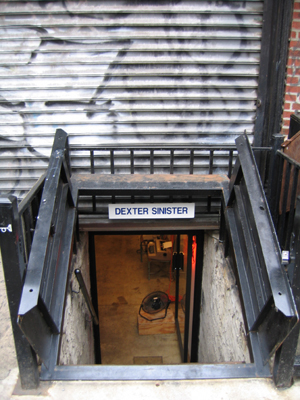
Dexter Sinister is the moniker that designers David Reinfurt and Stuart Bailey adopted last spring to describe the various forms their work takes. I’ve known David for a number of years, but haven’t talked to him in a while. A few Saturdays ago I stopped by Dexter Sinister catch up with him to see “Just in Time Workshop” in action.
Before stopping by, I checked out their website, and saw that they are playing with and pushing against traditions of publishing in some interesting ways.
From their site:
“In the basement at 38 Ludlow Street we will set up a fully-functioning Just-In-Time workshop, against waste and challenging the current state of over-production driven by the conflicting combination of print economies-of-scale (it only makes financial sense to produce large quantities) and the contained audiences of art world marketing (no profit is really expected, and not many copies really need to be made.) These divergent criteria are too often manifested in endless boxes of unsaleable stock taking up space which needs to be further financed by galleries, distributors, bookstores, etc. This over-production then triggers a need to overcompensate with the next, and so on and so on. Instead, all our various production and distribution activities will be collapsed into the basement, which will double as a bookstore, as well as a venue for intermittent film screenings, performance and other events.”
The Occasional bookstore sells copies of works of their own, their colleagues, and work put out from other small presses. The inventory consists of a handful of these titles at a time, which can fit on one shelf in the corner, in my estimation without irony. In fact, the bookstore’s size precisely fits the overall Dexter Sinister ethos.dextersinister02.jpg
Further back, I saw a mimeograph, an Apple Image Write printer and an IBM electric typewriter that were all lined up in a row. David noted that he does not overly romanticize the mechanical age of print technology with these similarly monochromatic tan-brown machines. This is, his interest is not in retro for retro’s own sake. Rather, when printer technology was mostly mechanical (rather than computerized,) designers and publishers could tinker, fix and modify their equipment. Car enthusiasts have noted a similar loss, as automobiles have become increasingly computerized as well.
Dexter Sinister produce their books in small runs that are meant to sell out. Further, their publications tend to be highly selective, limited, and personal. However, they aren’t gatekeepers. Instead, the overall impression is that they are interested in supportive projects that matter to them. For instance, Dexter Sinister now produces “dot dot dot,” the design periodical that Stuart co-edited and designed while living in the Netherlands. When the print runs do sell out, they can issue re-prints in any number of printing options depending upon the circumstance, if they want to, or not.
bs_POSITIVE.gifSome of their publications are printed on their mimeograph. While being well designed, the printing is fast and inexpensive, but avoids feeling overly cheap. Although, the final result reminds me of the pirated textbooks I encountered in China in the mid 90s. Inexpensive doesn’t necessarily mean boring and poor quality. Rather, it provides another design constraint under which to find new solutions. They’re also experimenting with lulul.com and have done born-digital projects as well.
What’s really interesting to me is that DS and the institute share many ideas in common. However the execution of these ideas and solutions are entirely different. Although, the institute’s foci are often pointed at the digital, we certainly support the future of print (despite the fact that we get asked to comment or qualify the position of “death of print” quite often.) Distribution of digital media via the network is one vector. Small run, niche, highly curated, print publishing is another. In both cases, we have run into the failures of the current economic models of many traditional kinds of publishing. I’m reminded of the analogy of water, flowing down a mountain, seeking a path of minimal resistance. Similarly, information “wants” to intrinsically find its expression by the easiest pathways.
Later in a follow-up email exchange, we were talking about these various new modes of publishing. David noted that, “it feels like some particular in-between moment, just in general, with an overall apocalyptic vibe. It’s definitely the end of something and I suppose the beginning of something else.” Exactly.

library wisdom

Bob and I have been impressed with what we’ve been reading on a series of sites maintained by Joyce Valenza, a teacher-Librarian at the Springfield Township High School Library in Erdenheim, Pennsylvania. Of particular interest is a chart she’s put together entitled “30 Years of Information and Educational Change: How should our practice respond?” which records the dramatic technological shifts that have taken place since she began studying library science nearly three decades ago, and how her thinking has evolved:

I graduated with an MLS in 1977 and had to return and redo most of the credits in 1987/1988 to get education credentials. While I learned programming the first time around and personal computer applications the second time around, the rate of change has dramatically altered the landscape.
I see an urgent need for librarians to retool. We cannot expect to assume a leadership role in information technology and instruction, we cannot claim any credibility with students, faculty, or administrators if we do not recognize and thoughtfully exploit the paradigm shift of the past two years. Retooling is essential for the survival of the profession.

The role of the librarian has traditionally to guide the user into a dense grove of knowledge, instructing them how best to penetrate, navigate and reference a relatively stable corpus. But with the explosion of personal computers and networks comes the explosion of the library. The librarian becomes a strategic advisor at the gateway to a much larger and continually shifting array of resources and tools that extends well beyond the physical boundaries of the library. The user no longer needs to be guided inward, but guided outward, and in multiple directions. The librarian in an academic or school setting must help students and scholars to match up the right materials with the right modes of communication, while also fostering a critical and ethical outlook in a world awash in information. The librarian is more crucial than ever.
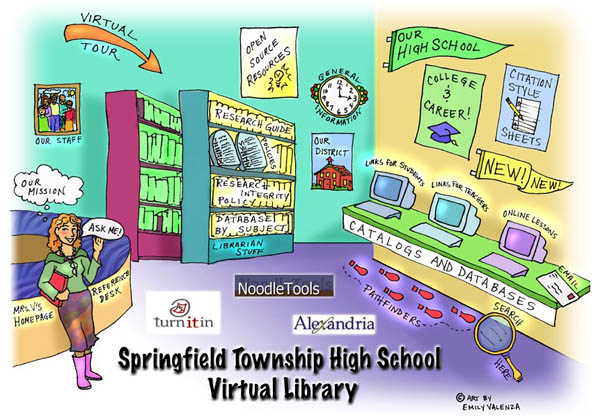
The physical space of the library is still vital too, Valenza argues, and nowhere is this better conveyed than in this charming “virtual library” page she has constructed for the library’s home page (that’s her standing by the reference desk):
valenza library.jpg
It seems almost too obvious to use the physical library as an interface, but I was immediately struck by how intuitive and useful this page is, and how, so simply and with such spirit, it creates an almost visceral link between the physical library and its online dimensions.
(Also check out Valenza’s blog, NeverEnding Search.)

google offers public domain downloads

Google announced today that it has made free downloadable PDFs available for many of the public domain books in its database. This is a good thing, but there are several problems with how they’ve done it. The main thing is that these PDFs aren’t actually text, they’re simply strings of images from the scanned library books. As a result, you can’t select and copy text, nor can you search the document, unless, of course, you do it online in Google. So while public access to these books is a big win, Google still has us locked into the system if we want to take advantage of these books as digital texts.
A small note about the public domain. Editions are key. A large number of books scanned so far by Google have contents in the public domain, but are in editions published after the cut-off (I think we’re talking 1923 for most books). Take this 2003 Signet Classic edition of the Darwin’s The Origin of Species. Clearly, a public domain text, but the book is in “limited preview” mode on Google because the edition contains an introduction written in 1958. Copyright experts out there: is it just this that makes the book off limits? Or is the whole edition somehow copyrighted?
Other responses from Teleread and Planet PDF, which has some detailed suggestions on how Google could improve this service.

documentary licensed through creative commons to play in second life

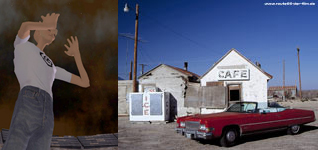
route66.jpg
Route 66: An American Bad Dream is an independent documentary film starring three Germans road tripping across the legendary US highway. What makes this film notable is that they released the film under the Creative commons license. Also, it had its premiere in the virtual world of Second Life on Aug 10th. The success of that showing prompted them to host an additional viewing this Thursday August 31 at 4PM SL in Kula 4, which will be presented by its creator Gonzo Oxberger. In the Open Source spirit of this project, they are making the video and audio project files available to anyone with a serious interest in remixing the film.

book trailers, but no network

We often conceive of the network as a way to share culture without going through the traditional corporate media entities. The topology of the network is created out of the endpoints; that is where the value lies. This story in the NY Times prompted me to wonder: how long will it take media companies to see the value of the network?
The article describes a new marketing tool that publishers are putting into their marketing arsenal: the trailer. As in a movie trailer, or sometimes an informercial, or a DVD commentary track.

“The video formats vary as widely as the books being pitched. For well-known authors, the videos can be as wordy as they are visual. Bantam Dell, a unit of Random House, recently ran a series in which Dean Koontz told funny stories about the writing and editing process. And Scholastic has a video in the works for “Mommy?,” a pop-up book illustrated by Maurice Sendak that is set to reach stores in October. The video will feature Mr. Sendak against a background of the book’s pop-ups, discussing how he came up with his ideas for the book.”

Who can fault them for taking advantage of the Internet’s distribution capability? It’s cheap, and it reaches a vast audience, many of whom would never pick up the Book Review. In this day and age, it is one of the most cost effective methods of marketing to a wide audience. By changing the format of the ad from a straight marketing message to a more interesting video experience, the media companies hope to excite more attention for their new releases. “You won’t get young people to buy books by boring them to death with conventional ads,” said Jerome Kramer, editor in chief of The Book Standard.”
But I can’t help but notice that they are only working within the broadcast paradigm, where advertising, not interactivity, is still king. All of these forms (trailer, music video, infomercial) were designed for use with television; their appearance in the context of the Internet further reinforces the big media view of the ‘net as a one-way broadcast medium. A book is a naturally more interactive experience than watching a movie. Unconventional ads may bring more people to a product, but this approach ignores one of the primary values of reading. What if they took advantage of the network’s unique virtues? I don’t have the answers for this, but only an inkling that publishing companies would identify successes sooner and mitigate flops earlier, that the feedback from the public would benefit the bottom line, and that readers will be more engaged with the publishing industry. But the first step is recognizing that the network is more than a less expensive form of television.

discursions II: networked architecture, a networked book

I’m pleased to announce a new networked book project the Institute will begin working on this fall. “Discursions, II” will explore the history and influence of the Architecture Machine Group, the amazing research collective of the late 60s and 70s that later morphed into the MIT Media Lab. The book will be developed in collaboration with Kazys Varnelis, an architectural historian whom we met this past year at the Annenberg Center at USC, when he was a visiting fellow leading the “Networked Publics” research project.

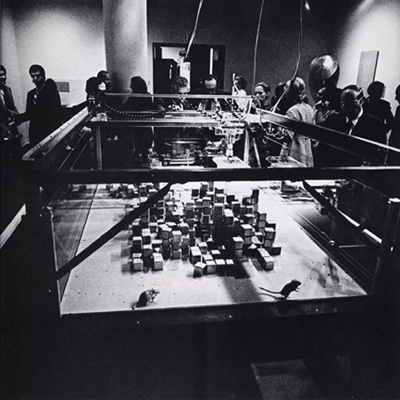
arcmac seek.jpg

“Seek,” Architecture Machine Group, 1969-70

As its name suggests, the Architecture Machine Group was originally formed to explore how computers might be used in the design of architecture. From there, it went on to make history, inventing many of the mechanisms and metaphors of human-machine interaction that we live, work and play with to this day. Lately, Kazys’ focus has been on contemporary architecture and urbanism in the context of network technologies, and how machine-mediated interactions are becoming a key feature of human environments. So he’s pretty uniquely positioned to weave together the diverse threads of this history. Most important from the Institute’s perspective, he’s interested in playing around with the form and feel of publication.
And good news. Kazys recently resettled here on the east coast, where he will be heading up the new Network Architecture Lab (NetLab) at Columbia’s Graduate School of Architecture, Planning, and Preservation. One of the lab’s first projects will be this joint venture with the Institute. Unlike Without Gods and GAM3R 7H30RY, both of which are print-network hybrids, “Discursions, II” will grow one hundred percent on the network, beginning from its initial seeds: a dozen videos of seminal ARCMac demos, originally published on a video disc called “Discursions”. The book will also go much further into collaborative methods of work, and into blurring the boundaries of genre and media form, employing elements of documentary film, textual narrative, and oral history (and other strategies yet to be determined).
From the NetLab press release (AUDC, mentioned below, is Kazys’ nonprofit architectural collective):

Formed in 2001, AUDC [Architecture Urbanism Design Collaborative] specializes in research as a form of practice. The AUDC Network Architecture Lab is an experimental unit at Columbia University that embraces the studio and the seminar as venues for architectural analysis and speculation, exploring new forms of research through architecture, text, new media design, film production and environment design.
Specifically, the Network Architecture Lab investigates the impact of computation and communications on architecture and urbanism. What opportunities do programming, telematics, and new media offer architecture? How does the network city affect the building? Who is the subject and what is the object in a world of networked things and spaces? How do transformations in communications reflect and affect the broader socioeconomic milieu? The NetLab seeks to both document this emergent condition and to produce new sites of practice and innovative working methods for architecture in the twenty-first century. Using new media technologies, the lab aims to develop new interfaces to both physical and virtual space. This unit is consciously understood as an interdisciplinary entity, establishing collaborative relationships with other centers both at Columbia and at other institutions.
The NetLab begins operations in September 2006 with “Discursions, II” an exploration of history of architecture, computation, and new media interfaces at the Architecture Machine Group at MIT done in collaboration with the Institute for the Future of the Book.

For a better idea of Kazys’ interests and voice, take a look at this fascinating and wide-ranging interview published recently on BLDGBLOG. Here, he talks a bit more about what we’re hoping to do with the book:

The goal, then, is to create a new form of media that we’re calling the Networked Book. It’s a multimedia book, if you will, that can evolve on the internet and grow over time. We’re now hoping to get the original players involved, and to get commentary in there. The project won’t be just the voice of one author but the voices of many, and it won’t be just one form of text but, rather, all sorts of media. We don’t really know where it will go, in fact, but that’s part of the project: to let the material take us; to examine the past, present, and future of the computer interface; and to do something that’s really bold. It’s not that we don’t know what we’re doing [laughter] – it’s that we have a wide variety of options.

Congratulatons, Kazys, on the founding of the NetLab. We can’t wait to move forward with this project.

showtiming our libraries

uc seal.png google book search.jpg Google’s contract with the University of California to digitize library holdings was made public today after pressure from The Chronicle of Higher Education and others. The Chronicle discusses some of the key points in the agreement, including the astonishing fact that Google plans to scan as many as 3,000 titles per day, and its commitment, at UC’s insistence, to always make public domain texts freely and wholly available through its web services.
But there are darker revelations as well, and Jeff Ubois, a TV-film archivist and research associate at Berkeley’s School of Information Management and Systems, hones in on some of these on his blog. Around the time that the Google-UC deal was first announced, Ubois compared it to Showtime’s now-infamous compact with the Smithsonian, which caused a ripple of outrage this past April. That deal, the details of which are secret, basically gives Showtime exclusive access to the Smithsonian’s film and video archive for the next 30 years.
The parallels to the Google library project are many. Four of the six partner libraries, like the Smithsonian, are publicly funded institutions. And all the agreements, with the exception of U. Michigan, and now UC, are non-disclosure. Brewster Kahle, leader of the rival Open Content Alliance, put the problem clearly and succinctly in a quote in today’s Chronicle piece:

We want a public library system in the digital age, but what we are getting is a private library system controlled by a single corporation.

He was referring specifically to sections of this latest contract that greatly limit UC’s use of Google copies and would bar them from pooling them in cooperative library systems. I vocalized these concerns rather forcefully in my post yesterday, and may have gotten a couple of details wrong, or slightly overstated the point about librarians ceding their authority to Google’s algorithms (some of the pushback in comments and on other blogs has been very helpful). But the basic points still stand, and the revelations today from the UC contract serve to underscore that. This ought to galvanize librarians, educators and the general public to ask tougher questions about what Google and its partners are doing. Of course, all these points could be rendered moot by one or two bad decisions from the courts.