
MIT Media Lab founder Nicholas Negroponte is developing a line of laptop computers that will sell for less than $100 a piece. The textbook of the future?….
>>BBC article
little red book
Very interesting review of McKenzie Wark‘s A Hacker Manifesto, recently published by Harvard University Press. In the manifesto (shorter version), Wark outlines a class struggle over “vectors” – the information channels of a society. In his words:
 “With the commodification of information comes its vectoralisation. Extracting a surplus from information requires technologies capable of transporting information through space, but also through time. The archive is a vector through time just as communication is a vector that crosses space. The vectoral class comes into its own once it is in possession of powerful technologies for vectoralising information.–The vectoral class may commodify information stocks, flows, or vectors themselves. A stock of information is an archive, a body of information maintained through time that has enduring value. A flow of information is the capacity to extract information of temporary value out of events and to distribute it widely and quickly. A vector is the means of achieving either the temporal distribution of a stock, or the spatial distribution of a flow of information. Vectoral power is generally sought through the ownership of all three aspects.”
collecting and archiving the future book
The collection and preservation of digital artworks has been a significant issue for museum curators for many years now. The digital book will likely present librarians with similar challenges, so it seems useful to look briefly at what curators have been grappling with.
At the Decade of Web Design Conference hosted by the Institute for Networked Cultures. Franziska Nori spoke about her experience as researcher and curator of digital culture for digitalcraft at the Museum for Applied Art in Frankfurt am Main. The project set out to document digital craft as a cultural trend. Digital crafts were defined as “digital objects from everyday life,” mostly websites. Collecting and preserving these ephemeral, ever-changing objects was difficult, at best. A choice had to be made between manual selection, or automatic harvesting. Nori and her associates chose manual selection. The advantage of manual selection was that critical faculties could be employed. The disadvantage was that subjective evaluations regarding an object’s relevance were not always accurate, and important work might be left out. If we begin to treat blogs, websites, and other electronic ephemera as cultural output worthy of preservation and study (i.e. as books), we will have to find solutions to similar problems.
The pace at which technology renews and outdates presents a further obstacle. There are, currently, two ways to approach durability of access to content. The first, is to collect and preserve hardware and software platforms, but this is extremely expensive and difficult to manage. The second solution, is to emulate the project in updated software. In some cases, the artist must write specs for the project, so it can be recreated at a later date. Both these solutions are clearly impractical for digital librarians who must manage hundreds of thousand of objects. One possible solution for libraries, is to encourage proliferation of objects. Open source technology might make it possible for institutions to share data/objects, thus creating “back-up” systems for fragile digital archives.
Nori ended her presentation with two observations. “Most societies create their identity through an awareness of their history.” This, she argues, compells us to find ways to preserve digital communications for posterity. She notes that cultural historians, artists, and researchers “are worried about a future where these artifacts will not be accessible.”
the tomorrow book
 “The Jan van Eyck Academie and the Charles Nypels Foundation invite designers, book critics, book theoreticians and book makers to submit project proposals in the context of the research project ‘The tomorrow book. Navigating to, within and beyond the book’. ‘The tomorrow book’ intends to query the future of the book from a multi-disciplinary standpoint. In doing so, the following aspects will be treated: editing, typography, book design, publishing and distribution. The umbrella theme of the project is navigation towards, inside and outside of the book. Research candidates can submit project proposals for ‘The tomorrow book’ up to 15 April 2005.”
More information on “the tomorrow book” research…
from aspen to A9
Amazon’s search engine A9 has recently unveiled a new service: yellow pages “like you’ve never seen before.”
“Using trucks equipped with digital cameras, global positioning system (GPS) receivers, and proprietary software and hardware, A9.com drove tens of thousands of miles capturing images and matching them with businesses and the way they look from the street.”
 All in all, more than 20 million photos were captured in ten major cities across the US. Run a search in one of these zip codes and you’re likely to find a picture next to some of the results. Click on the item and you’re taken to a “block view” screen, allowing you to virtually stroll down the street in question (watch this video to see how it works). You’re also allowed, with an Amazon login, to upload your own photos of products available at listed stores. At the moment, however, it doesn’t appear that you can contribute your own streetscapes. But that may be the next step.
I can imagine online services like Mapquest getting into, or wanting to get into, this kind of image-banking. But I wouldn’t expect trucks with camera mounts to become a common sight on city streets. More likely, A9 is building up a first-run image bank to demonstrate what is possible. As people catch on, it would seem only natural that they would start accepting user contributions.  Cataloging every square foot of the biosphere is an impossible project, unless literally everyone plays a part (see Hyperlinking the Eye of the Beholder on this blog). They might even start paying – tiny cuts, proportional to the value of the contribution. Everyone’s a stringer for A9, or Mapquest, or for their own, idiosyncratic geo-caching service.
A9’s new service does have a predecessor though, and it’s nearly 30 years old. In the late 70s, the Architecture Machine Group, which later morphed into the MIT Media Lab, developed some of the first prototypes of “interactive media.” Among them was the Aspen Movie Map, developed in 1978-79 by Andrew Lippman – a program that allowed the user to navigate the entirety of this small Colorado city, in whatever order they chose, in winter, spring, summer or fall, and even permitting them to enter many of the buildings. The Movie Map is generally viewed as the first truly interactive computer program. Now, with the explosion of digital photography, wireless networked devices, and image-caching across social networks, we might at last be nearing its realization on a grand scale.
what’s at stake
High-definition TV pioneer and Dallas Mavericks owner Mark Cuban talks about what’s at stake in the upcoming Supreme Court case MGM vs. Grokster in an article drawn from a recent post on his blog.  Skip down to the section titled “Taking a Wrong Turn.” There, Cuban describes what could be lost if entertainment industry giants are able to convince the court that peer-to-peer file sharing is first and foremost a tool for theft.
“In the MGM v. Grokster case, the fewer than 50 companies who control less than 1 percent of all digital information are trying to take control of innovation in the technology industry and pry it away from the rest of us. Everything our imagination creates and touches that can be made digital is at risk if Grokster loses.
“What innovations will be condemned by law before they have a chance to come to market, because they could have an impact on Hollywood and the music industry? We have no idea, and that is a very scary prospect.”
the performing book
We’ve been talking about reading modes, but let’s imagine, for a moment, that the future book will change reading itself. Perhaps it will combine the performance aspects of television, film, animation, and theatre with the interactive aspects of the world wide web to forge a book that reads you as you read it.
Science fiction writer Neal Stephenson imagines such a book in his novel, The Diamond Age. The main character is a book–an illustrated primer that functions almost like an artificial intelligence. It bonds with its reader, notices things about her life, and uses those bits of information to create instructional narratives on the fly. These stories are performed by live “ractors” (human actors working in reactive/interactive scenarios) and broadcast on the pages of a book. The physical book is leather bound, with “smart” paper pages that support electronic text and animated images. The primer looks like an old-fashioned book, but acts (or reacts) like a book of the future. In Stephenson’s imagination, it’s this element of interactivity and performance that distinguishes the future book from its predecessor.
But lest you worry that I’m basing my research on the imaginings of my favorite science fiction writer, I can assure you that the performing book is already here in its nascent incarnations. In the image of Stephenson’s primer, a company called Touchsmart is developing a book with “smart” paper that functions like a touch screen, allowing readers to find answers to their questions instantly, through a wireless connection to the internet and to other electronic devices that broadcast content.
Publisher, Peak Interactive Books, whose stated mission is to, look beyond the print book, beyond television, beyond the web page, to the interactive book of the future, is publishing interactive multimedia textbooks including: Cryosurgery for Prostate Cancer, and Using Interactive Media to Communicate.
The interactive CD Roms published by Voyager are an excellent touchstone in the history of performing books. TK3 software, which has been used to make everything from textbooks, to performing paintings, also draws on the performing book model. The institute is presently developing “Sophie,” ebook authoring software that will allow most currently available media to be incorporated into an electronic book.
As for the book reading you. Ben’s recent post “finally, I have a Memex!” describes how the semantic web will add a new dimension to the growing power of search engines. Their ability to collect personal information has already been incorporated into the recreational and academic reading experience. What we are waiting for is the book that builds its content out of the bits it gathers from our lives.
incredible shrinking book
 A couple morsels today on textually.org lending credence to our theory that cellphones/PDAs are the incubation niche for the eventual widespread adoption of ebooks. One on fashionable new casings Nokia is bringing out for mobile devices (re Kim’s leather-bound fantasy ebook). Another on plans by Chinese tech giant Lenovo to embed “mobile book software technology” into phones, allowing users to read fully illustrated books, as well as watch movies, listen to audio, play video games, and browse periodicals. Mobile phones are emerging, at least in China, as the ultimate mass-consumer media processor – affordable and eminently portable. And each year, notebook computers become lighter, sleeker, and easier to tote around. Are they just shrinking into palm pilots? How much serious work can you get done on a palm pilot?
“finally, I have a Memex!”
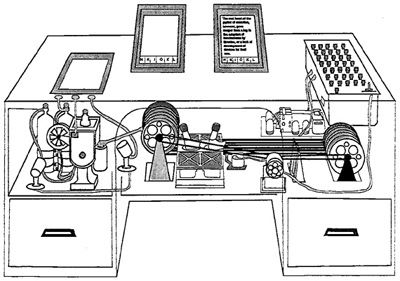
There’s an essay worth reading in the ny times book review this past sunday by Steven Johnson about a powerful semantic desktop management and search tool recently released for Macs.  The software (called DEVONthink) not only helps organize and briskly sift through readings, clippings, quotes, and one’s own past writings, but assists in the mysterious mental processes that are at the heart of writing – associative trains, useful non sequiturs, serendipitous stumbles. In effect, we now have a tool resembling the Memex device described in the seminal 1945 essay, As We May Think by visionary engineer Vannevar Bush. Working with the cutting edge technologies of his day – microfilm, thermionic tubes, and punch, or “Hollerith,” cards – Bush pondered how technology might help humanity to manage and make use of its vast systems of information. His recognition of the basic problem is no less relevant today: “Our ineptitude in getting at the record is largely caused by the artificiality of systems of indexing.” Fast forward to 2005. Now, the holy grail of search is the Semantic Web – moving beyond the artificiality of crude content-based queries and bringing meaning, relevance, and associations into the mix.
“Consider a future device for individual use, which is a sort of mechanized private file and library. It needs a name, and to coin one at random, “memex” will do. A memex is a device in which an individual stores all his books, records, and communications, and which is mechanized so that it may be consulted with exceeding speed and flexibility. It is an enlarged intimate supplement to his memory.” – Vannevar Bush
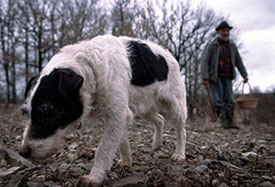
It’s quite suggestive that DEVONthink’s semantic search function can to an extent be trained, taking the obnoxious little puppy on Windows search toward its full potential – a sleek, truffle-tuned hound. When Johnson loads his body of work onto the computer, the hound picks up the distinctive scent of his writing, which in turn suggests affinities, similarities, and connections to other materials – truffles – that will find their way into later works.
 Says Johnson on his latest blog post, which goes into much greater detail than the Times piece:
“I have pre-filtered the results by selecting quotes that interest me, and by archiving my own prose. The signal-to-noise ratio is so high because I’ve eliminated 99% of the noise on my own.”
But it is significant that DEVONthink is not useful for searching entire books (the author’s own manuscripts notwithstanding). Currently, the tool is ideal for locating chunks of text that fall within the “sweet spot” of 50-500 words. If your archives include entire book-length texts, then the honing power is diminished. DEVONthink is optimal as a clip searcher. File searching remains a frustrating enterprise.
Johnson makes note of this:
“So the proper unit for this kind of exploratory, semantic search is not the file, but rather something else, something I don’t quite have a word for: a chunk or cluster of text, something close to those little quotes that I’ve assembled in DevonThink. If I have an eBook of Manual DeLanda’s on my hard drive, and I search for “urban ecosystem” I don’t want the software to tell me that an entire book is related to my query. I want the software to tell me that these five separate paragraphs from this book are relevant. Until the tools can break out those smaller units on their own, I’ll still be assembling my research library by hand in DevonThink.”
Another point (from the Times piece) worth highlighting here, which relates to our discussion of the networked book:
“If these tools do get adopted, will they affect the kinds of books and essays people write? I suspect they might, because they are not as helpful to narratives or linear arguments; they’re associative tools ultimately. They don’t do cause-and-effect as well as they do ‘x reminds me of y.’ So they’re ideally suited for books organized around ideas rather than single narrative threads: more ‘Lives of a Cell’ and ‘The Tipping Point’ than ‘Seabiscuit.'”
 And what about other forms of information – images, video, sound etc.? These media will come to play a larger role in the writing process, given the ease of processing them in a PC/web context. Images and music trump language in their associative power (a controversial assertion, please debate it!), and present us with layers of meaning that are harder to dissect, certainly by machine. It is an inchoate hound to be sure.
from the nouveau roman to the nouveau romance
from the nouveau roman . . .
I’ve been working out of the Brooklyn Public Library lately, which has free wireless internet and an interesting collection of books. The organizing principle seems to be, as far as I can tell, that everything remotely interesting gets stolen. This means, in practice, that they have an exceptional collection of criticism of the French nouveau roman, which seems to have gathered dust on the shelves there since the early 1960s. The nouveaux romanciers were a loosely-knit group of novelists from the 1960s determined to shake the French novel out of existential doldrums through the use of new styles of narrative. Nathalie Sarraute and Alain Robbe-Grillet’s microscopic examinations of everyday life might be seen as exemplary of the movement, though the novels of Marguerite Duras are probably the most widely read today.
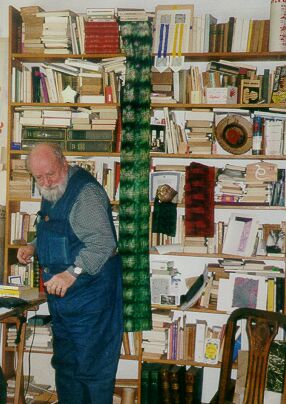 To me, the most interesting of them is Michel Butor, who wrote four increasingly experimental novels in the early 1960s, and then tired of writing novels altogether. Mobile, his next major production, confused the critics immensely, some of whom declared that not only was it not a novel, it wasn’t a book at all. Mobile is fantastic: it’s a travel guide to the United States presented as a collage, abandoning the author’s voice for bits of history, advertising, and found text. Following the example of Stéphane Mallarmé, the texts are spread over the pages, an analogue to the spatial journey the book describes, presenting a range of sensory (and historical) impressions of America. The French version has the text rotated 90 degrees so you have to hold the book sideways, a feature sadly not carried over into Richard Howard’s otherwise wonderful English translation (recently republished by the Dalkey Archive). While the author’s voice seems to be absent in favor of his found materials, there’s clearly a subtext: the history of racism underlying the country from it’s deep history to the present Butor found in 1964. More than a book, the effect on the reader is like that of the film-essays of Chris Marker (I’m thinking particularly of A Grin without a Cat) and Agnes Varda.
Butor continued to experiment with forms: he made radioplays for simultaneous voices, and has worked in collaboration with just about any sort of artist that can be imagined. Though he’s produced an enormous amount of work since the 1960s, only a tiny fraction of it has been independent work. One of the first of his collaborations was with the composer Henry Pousseur; in the late 1960s, the two of them wrote an opera called Votre Faust, “your Faust”. It was a modern retelling of the Faust story, but with a twist: at certain points during the production, the audience was asked to vote on what should happen next. Depending on how the audience voted (or failed to vote, which was also taken into account), the opera might have any of 25 different endings. After a long public gestation, it was finally produced in 1969 in Milan. It went over like a lead balloon, and subsequently largely vanished from sight, though the critics’ pre-performance excitement remains frozen in time at the Brooklyn Public Library. LPs were evidently put out at the time. I’m curious what exactly was on them – was it a full recording of all the possible music, letting home listeners construct their own personal opera, or did it only contain one version?
Butor is still happily alive and still churning out poetry and other works; at some point in the nineties, he had his own website, though he doesn’t look to have updated it in a while. His art, though, seems to have been perpetually ahead of his time: while Votre Faust didn’t work in a live setting, it might have made a fine CD-ROM or DVD. I don’t know if he’s ever written specifically for electronic media, as Chris Marker has; I’d love to see what he would do with it.
. . . to the nouveau romance
 “Harlequin” has achieved brand ubiquity: a “harlequin” is a trashy, disposable romance novel, just like a “kleenex” is a tissue and a “xerox” is a copy. We don’t even bother thinking about the word any more than we usually think about romance novels. Do the romance novel and the Future of the Book have anything in common? Of course not! any right-thinking future-bookist would angrily declare. The future, as everybody knows, is the domain of science fiction, not the romance. A look at eharlequin.com, Harlequin’s website, suggests that this might not be the case. The first surprise: how much content they have online. The second surprise: how much is interactive, and how much is devoted to the process of writing. Look at how much there is in the writing bulletin board, dedicated to helping the users write their own romance: templates for various varieties of romances that Harlequin publishes, advice on business, suggestions for those with writer’s block.
 There’s also participatory authoring: in the Writing Round Robin, participants take turns writing chapters of a novel, and critiquing others’ chapters. Unlike some of the open source and wiki novels elsewhere on the web, this is highly moderated writing: note the rules here. This might be expected: Harlequin, after all, is a publishing house, and experimentation isn’t being done for experimentation’s sake, but because it fits into a business model.
But to bring this back around to Butor’s opera: consider eharlequin’s Interactive Novel, where chapters are added one at a time, and the readers vote on how the work should progress: a chapter’s written (or put online) accordingly. Right now the meddling readers are worrying themselves over whether or not Tess is pregnant with Derek’s baby.
It’s become a truism that porn drives technology: see here for one of the many observations of this. (Who first made this connection? Does it date back to before the VCR?) It might not be so surprising that seems romance is doing the same thing in the popular arena of the novel. Even more surprising might be that it’s romance where this is happening. Sarah Glazer, writing in the New York Times Book Review was surprised to find that the biggest current growth market for ebooks is in romances. Is the future of the book to be found in the romance? It seems counterintuitive, but there seems to be more of a participatory literary culture at Harlequin’s website than a quick scrutiny of some scifi publishers’ websites would reveal. (I’d love to be proved wrong about this – can anyone provide examples?)
There’s almost certainly no direct line that goes from Butor and Pousseur’s Votre Faust to eharlequin.com’s Interactive Read, except, I suppose, in the head of this particular reader. There’s a whole history of interactive fiction that I’ve omitted – Julio Cortázar’s Hopscotch, Milorad Pavić’s Dictionary of the Khazars, a whole slew of Choose-Your-Own-Adventure books. But it’s interesting that Butor & Pousseur’s unsuccessful attempt (“It was very difficult to play. . . But we both have made many efforts to make it easy to realize. Without success.” notes Butor in an online interview) should be taken up in such an unlikely form.
The romance novel, everyone concurs, is not art. There’s not a great deal of critical theory thrown around about romances. The New Novelists were all about creating critical context for their fiction: Robbe-Grillet kicked things off with Pour un nouveau roman, a collection of essays on the novel’s past and present, and Butor wrote a piece titled “The Future of the Book”, among many others. This might be why the nouveau roman is generally considered a failure: it didn’t end up remaking the mainstream of fiction. The contrast with eharlequin might be instructive: outside of the critical eye (and with the support of publishers) romance readers are becoming authors, seemingly constructing their own possible future of the book.