Last Friday, the Association of American University Presses (AAUP) sent Google a long letter expressing concern over what might amount to “systematic infringement of copyright on a massive scale” in its library project. BusinessWeek reports. The AAUP letter can be read here. Much of it asks Google to clarify its position on a number of points – to provide, as it were, the fine print on Google Print. Here’s a great item:
Snippet is used so consistently in describing Google Print for Libraries that it’s taking on the status of a technical term, and thus requires a specific definition. How long is a “snippet?”
Google defends its mass digitization project on the grounds of “fair use” (Section 107 of the US Copyright Act). In other words, it asserts the right to copy copyrighted materials and make them browseable on the web for research purposes as long as they restrict the amount that can be seen for free. Any commercial use of the text will take place only in the context of a publisher agreement. Publishers have the right to opt out, and apparently a couple already have, though most are holding their breath and waiting to see if they might be able to profit from Google’s project. The tricky question is, can a book that has been withheld from the publisher program be included in the library program?
You could say that the web is one enormous copying machine. And so fair use questions are more important than ever before. Will Google be the juggernaut that breaks down the door into a more permissive fair use era for all? Or will they use their power to establish an exclusive, Google-only, fair use zone, and set up a cartel with publishers? Or will a few well aimed law suits sink the project before it gets off the ground?
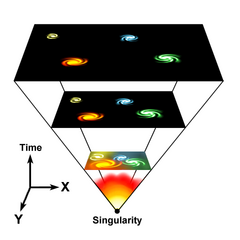 What does this have to do with twentieth century media? More than you might think. Industrialization and the development of telecommunications resulted in the centralization of communication forms into a kind of super-dense, super-heated singularity of their own: the mass media. Its power to drive a consumer economy through advertising, and blanket entire populations with messages and imagery has been so impressive, so all-consuming, that in a very short time it has come to seem all but inevitable.
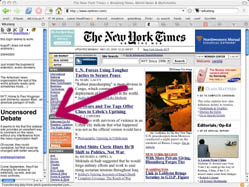 About a week ago, I attended a fascinating workshop at USC on
 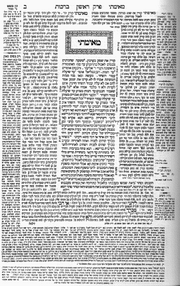 Sparks fly between juxtaposed texts. While hyperlinks enable the reader to leap between textual worlds, they suck you down a wormhole to a distant place. Sometimes it’s better to be in both spaces at the same time (like keeping two browser windows open at once). Think of the Talmud, the great Jewish compendium of law and exegesis. On each page, commentaries are arrayed around a core text. Wikalong may seem insignificant next to this ancient hypertext system, but it points to a related sort of spatial intertextuality that should theoretically be possible in the new medium. If a flat page can be so multi-dimensional, think of how far we might be able to go in a virtual space.