
Starting in September, the NY Times will charge an annual subscription fee for a “Select” service, including editorials, op-eds, and archives. Basic news content will remain free. Times chair Arthur Sulzberger Jr remarked that though online advertising is undergoing exponential growth, it is just a matter of time until it flattens out and assumes regular cycles, like in print advertising. Is the free content joyride gradually coming to an end? Or is the Times pounding nails into its own coffin?
“transliteracies” conference
“How are people today “reading” in digital, networked environments? For example, what is the relation between reading and browsing, or searching? Or between reading and multimedia? Can innovations in technologies or interfaces increase the productivity, variety, and pleasure of these new kinds of reading? How can the historical diversity of human reading practices help us gauge the robustness of the new digital practices; and, inversely, how can contemporary practices provide new ways to understand the technical, social, and cultural dimensions of historical reading?”
June 17-18 at UC Santa Barbara, kicking off the Transliteracies Project: “Research in the Technological, Social, and Cultural Practices of Online Reading”.
(thanks, Grand Text Auto)
incredible shrinking newspaper
Facing slipping circulation and massive migration to the web by younger news consumers, a number of top tier newspapers are switching from the traditional broadsheet format to the more handy tabloid, including the European and Asian editions of the Wall Street Journal.
But is this enough? One British advertiser remarks: “We want newspapers to come up with a solution to the threat of marginalization in a digitalized world. But they have to do more than just play around with the size of paper they’re printed on.”
The International Herald Tribune ran this story yesterday. I’ve plugged it before, but the IHT is noteworthy as one of the few online newspapers to eschew vertical scrolling for the layout of articles. Instead, they have simple, attractive (and I would argue, much more readable) horizontal scrolling across fixed, three-column plates. With its long vertical fields, you might say that web news, too, is stuck in the broadsheet model. The problem is that, unlike a print newspaper, a computer screen can’t be folded to improve readability, or to isolate a desired area of the page.
student papers with a purpose
One of the most exciting presentations at the recent Share, Share Widely conference was Natalie Jeremijenko‘s student-authored wiki “How Stuff is Made”. According to the website FAQ page, HSIM is a visual encyclopedia documenting the manufacturing processes, labor conditions and environmental accounts of contemporary products. It is collaboratively produced, independent, academic, wiki-based publication. Encyclopedia entries are summative photo essays created by engineering, design and art students guided by faculty who ensure high standards of evidence.
In her conference abstract, “Changing Structures of Participation In New Media Education,” Dr. Jeremijenko claims that the HSIM project provides …evidence that the way we structure participation changes what information is produced, who produces it, and how it circulates. Additionally, the work provides material to question what these changes may mean for learning.
libraries improve the front end
 There’s a nice article in yesterday’s NY Times on how some university libraries are rethinking how they arrange their space – moving, or redistributing print collections to make way for an “electronic information commons.” It’s not about abandoning the books, or relegating them to a lesser status. It’s more about re-positioning them as a sort of physical database. If a library is a big computer, than the database exists toward the back end. These days, digging through the stacks, even if it results in a paper return, is generally done digitally. That’s the front end, or the interface, and this is what smart libraries are seeking to improve. Research and scholarly production may be going digital, but the social, conversational space of the university, and in turn, the library, is still vital. The strategy for the libraries, then, is to restructure and expand that space as a compelling social software environment – one that is both physical and virtual. Sounds good in theory, but I’m not sure that’s how these facilities will actually be used. Turning libraries into a hi-tech rec center might be sacrificing more than it saves.
The article focuses on reorganization efforts at the University of Texas at Austin. Press release here concerning the transformation of the Flawn Academic Center (likely a more durable link than the Times story).
(image: Perry-Castañeda Library at UT Austin)
BBC rhapsody
Etymology: Latin rhapsodia, from Greek rhapsoidia recitation of selections from epic poetry, rhapsody, from rhapsoidos rhapsodist, from rhaptein to sew, stitch together – Merriam-Webster OnLine
The BBC is moving into web services, allowing the public to build applications that repurpose BBC content.
See also:
“your news, your pictures”
“find it rip it mix it share it”
the blog and the book
A couple of interesting experiments going on with blogs and books..
Dave Munger is taking the blog on a test drive as an ebook reader, putting together what he calls a “blook.” To show he means business, he’s chosen Moby Dick as the pilot text (but before starting, he’s working out formatting issues with Melville’s short story Bartleby, the Scrivener). I’m intrigued by the idea of using the blog form to generate discussion of a text – breaking it up into serial posts, jotting notes and analysis in the comment stream. It could make for a nice communal reading experience, as in a lit class, or virtual book club. It’s a game: drop the book in the blog and it ripples; different subjective worlds (of the readers) converge and collide. It’s very suggestive to combine this most conversational of media with the frozen, linear novel. For solitary reading, however, I’m not convinced that this would be a useful format.
Spark Armada, a “digital lifestyle, social software, creativity and science fiction conversation hub” in Israel, recently kicked off the “Keyboard” project, inviting bloggers to post stories on their sites that will be considered for inclusion in a print anthology. The idea seems to be to use the blogosphere’s mode of interwoven conversation as a way to generate creative work. The endpoint may be a conventional printed object, but Keyboard is interested in taking a different route in getting there.
could this be a textbook?
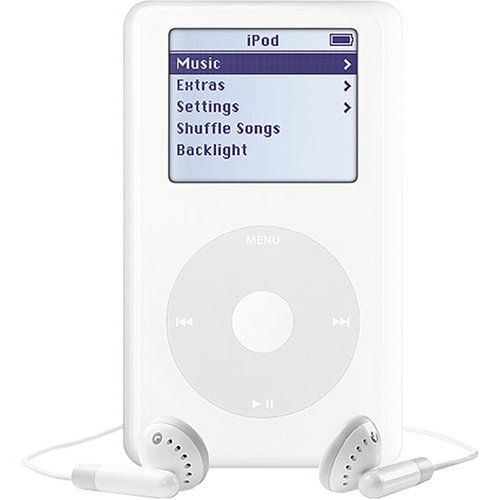
 Aural learning. Podcasting your reading assignment. New powers for students to time-shift materials and work. Load up chapter five on your iPod and take it to go.
Dyslexia’s defeat?
Publishers must be noticing all the earbuds in students’ ears.. how can they make some noise in that space?
But how do you take notes, make annotations on audio? How do you evaluate learning? Could this be anything more than a supplement?
sharing teachers, connecting classrooms
An initiative in Maine is using technology to provide advanced placement programming to high school students in rural areas. The Maine Distance Learning Project “identifies Maine teachers and schools that are interested in offering Advanced Placement programming to be delivered over distance to students in Maine via the state-wide ATM network during the 2005/2006 school year.”
According to a recent article in Newsweek, Reaching Rural Students, support was provided by the University of Maine. The University set up “a network of cameras in AP classes like Brendan Murphy’s calculus and statistics class. These classes were broadcast to five other schools across the state. 90 other schools have a set up like Carrabec’s. Each site’s classroom has a three-foot television screen split into quadrants, and two cameras in each room.”
valuing nonmarket production
As the mother of a toddler, I’m keenly aware of how grueling the 24/7 unpaid work of parenthood really is. A friend of mine sent around a mother’s day email that added up all the little things we do and arrived at a salary of about $131,000. Slave wages compared to the figure in Jennifer Steinhauer’s Times article, The Economic Unit Called Supermom which came up with “an estimated $707,126 annual paycheck.”
Problem is, no one will ever pay me $700K to do what I do for free. So is there any point in speculating about the market value of mothering? Perhaps there is. Steinhauer tells us that In 2003, the Bureau of Labor Statistics conducted its first-ever Time Use Survey, which examined the doings of 21,000 Americans over a 24-hour period. “There were a number of economists who were interested in valuing nonmarket production,” said Diane Herz, the survey’s project manager.
Many social scientists have explored the “social capital” gained by participating in these otherwise uncompensated activities. Social scientists argue, for example, that test scores go up in schools where parent volunteerism is highest, and that crime is reduced in communities with high civic participation. “Social capital is usually defined as the networks and relationships we have, as well as the trust and sense of mutuality that arise from them,” said Amy Caiazza, a study director working with Ms. Hartmann.
So this got me thinking about digital networks and I started wondering how much web content is created, nurtured and maintained without compensation. And how apropos the term “nonmarket production” is for most web activity. The networked book, for example, relies on free contributions and other forms of non-commercial support. What does this mean for the future of books? Does the web have the potential to turn the book industry into an unpaid labor of love?