
The New Yorker has never seemed terribly interested in going digital. Despite maintaining the obligatory website, with a smattering of free content and online features, the magazine exists somewhat apart from the daily swarm of the web. The print format still works quite well for them, and they have the legions of loyal subscribers to prove it.
But their latest publishing project does take them into digital territory. This October, in a big legacy move, the venerable weekly will release 4,109 issues – every single page since the February 1925 founding and the 80th anniversary issue this year – on an eight-DVD set. “The Complete New Yorker” (see NY Times story) will go for about $100 (though Walmart is already listing it for $59.22), and will also contain a 123-page book with an introduction by editor David Remnick. A big improvement on microfilm, the discs will allegedly be searchable by computer, though how granular the search is remains to be seen. For it to be more than just a collector’s item, it should be fully structured and offer fine-toothed find functionality. Remnick confirms, however, that readers will have the option of browsing just the cartoons (as many of us do).
visual bookmarks
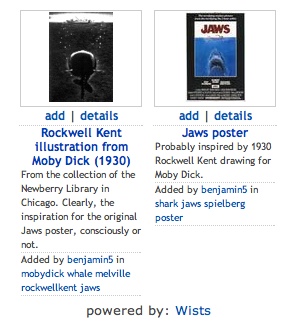 Wists is a visual bookmarking system for the web, doing for images what del.icio.us does for web pages. It’s like browsing the web with a camera, or creating your own hand-selected Google image search. Find an image you want to keep track of and Wists will create a thumbnail for you, linking back to the original site. If it’s a whole page you want to capture, Wists will take an automatic screenshot of the entire page. Add a title, tags and description and it goes into the system – a photo album of the web. Much like del.icio.us, Wists arranges popular tags on the sidebar and allows you to browse the latest entries. It also enables you to add other users’ bookmarks to your own gallery, clearing the slate for your own tags and descriptions. Best of all, it keeps track of people you’ve taken items from, and people who have taken items from you. Trails become apparent and the archive becomes interconnected. Here’s a grab of my “jaws” tag page – combing around for images, I found an amusing juxtaposition.
These are the kind of basic curatorial tools that would be great on Flickr. Currently, you are only able to apply tags to your own photos, or the those of friends, family or mutual contacts. But part of the fun of Flickr is browsing the photos of total strangers. You can comment on any photo or mark it as a favorite, but there is no way to curate your own collection of images from the community at large. Wists suggests how the gap between del.icio.us and Flickr might be bridged.
useful fun with Technorati tags
You may have noticed a new line of metadata at the bottom of posts on if:book – Technorati tags. Technorati is perhaps the most dynamic blog-tracking site on the web, scanning over 10 million weblogs and ranking their authority according to the number of links they receive from around the blogosphere. Technorati tags are socially constructed classification terms – keywords or categories that authors apply to their entries so that they show up in Technorati searches. Taken together, these thousands of tags are what make up the Technorati folksonomy – a taxonomic system created by users from the bottom-up, instead of by an information architect (like a librarian) from the top-down. Folksonomies are less rigid than shelf-based hierarchies (see “the only group that can organize everything is everybody”). They can cope with subtle but crucial differences between synonyms like movies, films, flicks, and cinema – or devlish distinctions like art versus entertainment. Tags can help bloggers reach small niche areas of interest, trickling content down into the hard-to-reach corners. But being highly idiosyncratic, folksonomic tags tend to proliferate rapidly. Most are too obscure or particularly worded to become widely adopted points of reference. Right now, sites like Technorati or Flickr deal with this problem by ranking. The irony is that, for all the promise of personal expression through folksonomy, the tags that make it to the top of the pile tend to be pretty conventional. Less formal than a library catalogue, to be sure, but nothing terribly colorful (nuance fares better in personal bookmarking systems like del.icio.us). And again, we are struck with this problem, endemic on the web, of authority meaning simply who’s popular. In that regard, the web is still a lot like high school.
(Mechanics: we’re able to ping specific tags with the great Technorati Tag plugin for Movable Type)
Google Print gets its own address
Google Print now has its own exclusive search page. But make no mistake, this is not a library. Google makes it very clear in a paragraph intended to reassure nervous publishers:
Google Print is a book marketing program, not an online library, and as such your entire book will not be made available online unless you expressly permit it.
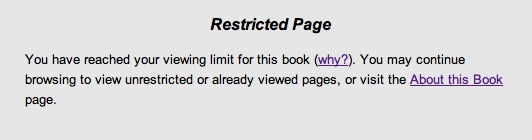
If you reach your limit of permitted pages you get this:
(Technorati Tags: Google, ebook, Library)
a computer to withstand the wind and rain
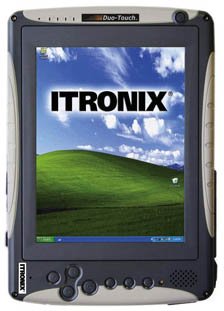
This expensive new tablet PC is built to withstand “rain, snow, wind, dust, vibration, shock, chemical exposure, and temperature extremes, from minus 4 to 140 degrees” (see article).
poetry off the page
Poetry was originally intended as oral/aural medium. It was language as song, performed for an audience practiced in the art of listening. The way a poem looked on the page was relatively meaningless until the advent of print technologies. Now, as digital media makes it possible for poets to publish their work as audio tracks, we may see poetry begin a natural migration back to its traditional form–performance art.
A good place to find some of these aural treats, try PennSound, an ongoing project at the University of Pennsylvania, committed to producing new audio recordings and preserving existing audio archives of poets performing their work. According to the PENNsound Manifesto, every project on its database “must be free and downloadable.” Sounds good to me, I visited the archive and downloaded Tracie Morris’ From Slave Sho to Video aka Black but Beautiful, which was performed at the Whitney Museum’s 2002 Biennial Exhibit.
Tracie’s work is extremely hard to come by, so I was thrilled when I found this. I can’t think of a better artist to represent the off-the-page digital instinct. Tracie’s poem uses broken and remixed language–so ubiquitous in our media saturated atmosphere–to present a conflicted inner dialogue about racial identity and cultural conceptions (or misconceptions) of beauty.
easy listening?
After several decades of near-unbroken consolidation of radio broadcasters, the spoken word is enjoying a much needed renaissance driven by satellite radio and podcasting. Audio books too – the much-maligned little nephew of book publishing – have undergone an unprecedented boom, driven by faster internet connections, online retailers devoted exclusively to audio (most notably Audible), and the ubiquity of portable mp3 players that can hold hundreds, even thousands, of hours of audio. For a society of multitaskers, this is undoubtedly a good thing, but the debate rages as to whether listening to a book can in any way compare to reading it with one’s eyes. The NY Times ran a story yesterday about the new craze in auditory reading, and about the stigma that is frequently attached to audio books:
Some critics are dismayed at the migration to audio books. The virtue of reading, they say, lies in the communion between writer and reader, the ability to pause, to reread a sentence, and yes, read it out loud – to yourself. Listeners are opting for convenience, they say, at the expense of engaging the mind and imagination as only real reading can.
Or, as Harold Bloom (quoted in the Times piece) puts it:
Deep reading really demands the inner ear as well as the outer ear. You need the whole cognitive process, that part of you which is open to wisdom. You need the text in front of you.
Scott Esposito over at Conversational Reading agrees. He insists that listening does not equal reading, end of story.
But I would not be so quick to dismiss audio books. They are admittedly a different kind of reading – a subset of visual reading – but important and potentially enriching nonetheless.  For many – the blind, the visually impaired, the learning disabled – people for whom visual reading is either impossible or an agonizing trial – this subset of reading is reading. Dolphin, a British software developer, makes EaseReader, an ebook reader for PCs that “combines electronic text with pre-recorded audio.” As you listen, it pages through the book, highlighting the text that is being spoken, and allowing you to jump around, pinpointing passages – re-listening – with incredible precision. For the millions with reading disabilities, this could provide the accessibility of audio without sacrficing close reading of the visual page. Pearson, the biggest educational publisher in America, just announced a strategic partnership with Audible to produce downloadable audio study guides, and perhaps eventually, entire textbooks. In a recent press release, they maintain that:
There is compelling research that identifies 30% of our population as auditory learners. By coupling this research with the growing popularity of downloadable audio, we believe these study guides can make a significant difference in student performance by accommodating diverse learning and life styles. Students today want the option to be untethered from traditional modes of learning. This product line fills a much-needed gap in learning content for a mobile and multitasking generation.
And what about these multitaskers? – the principal target of derision by literary purists.. Few would argue that you can fully engage with a book while simultaneously scooping out a gutter or paying bills. But there are plenty of activities that, while requiring the full involvement of the body, otherwise leave the mind to drift. I read most of my books in the traditional way – with hands and eyes – and for me, this is undoubtedly the fullest, richest kind of engagement. But with audio books, I’m able to read at other, less sedentary, times. When I was little, I listened to books on tape while building Lego cities or Brio trains. I listened over and over to the unabridged “Secret Garden,” “Three Children and It” and the Paddington Bear stories. I also read print books – tons of them – but these trance-like experiences of slowly absorbing the story while moving one’s hands – this was tremendously valuable. And since I listened to them repeatedly, I would argue that I knew those stories better than if I had read them once with my eyes and then shelved the book. You could say that books on tape helped me make the transition from being read to by my parents and becoming a fully independent reader.
Nowadays, I like to run, and for me, the thing that makes running hardest is not the demands it makes on my legs or respiratory system, but rather the way that it fails to occupy my brain. The mind revolts – the customary patter of thoughts, large and small, becomes a kind of torture. Unless you can slow your mind down, it’s impossible to stop thinking: “when is this going to end?” “has it only been eight minutes?!” “why didn’t I just watch TV?”… Sometimes, you can get your mind to behave and sort of synch up with the steadiness of the breathing. It helps to run in a beautiful place. But this isn’t always possible, especially when you live in a big city and a treadmill in a gym is your only option. Lately I’ve been listening to books on an iPod. Not only has it made exercise feel less like a chore, it’s allowing me to absorb “The Devil in the White City” by Erik Larson – a charming popular history of the 1893 Columbian Exposition in Chicago that I never would have had time to read otherwise. While running, I’m a totally captive audience, and the rhythm of the body and the breath actually turns off the rotating critical knives that so frequently hijack my visual reading experience. As I move, the White City is slowly erected in my mind’s eye. If I miss a bit, I simply reread, er, rewind.
Audio books can also be a boon to people who spend a lot of time cooped up in cars. My grandmother is constantly zigzagging all over the northeast United States in her Subaru, and with audio books she’s able to use this time productively. Over the past year, she’s absorbed half a dozen books on the founding period of the American republic. Now I can’t get her to stop talking about Alexander Hamilton and Dolly Madison. For a natural lifelong learner like my grandmother, audio books have yielded great rewards.
self-destructing books
In January I bought my first ebook (ISBN: B0000E68Z2), which is published by Wiley. I have one copy on my laptop and a backup on my external harddrive. Last week, I downloaded and installed Adobe Professional (writer 6.0) from our company network (Norwegian School of Management, BI) – during the installation some files from the Adobe version that I downloaded and installed when I bought the ebook (from Amazon.com UK) were deleted. Since then, I have not been able to access my ebook – I have tried to get help from our computer staff but they have not been able to help me.
Adobe thinks that I’m using another computer, while I’m not – and it didn’t help to activate the computer through some Adobe DRM Activator stuff. Now I have spent at least 10 hours trying to access my ebook – hope you can help…
Boing Boing points to this story illustrating the fundamental flaws of digital rights management (DRM) – about a Norwegian prof who paid $172 for an ebook on Amazon UK only to have it turn to unreadable code jibberish after updating his Acrobat software. He made several pleas for help – to Acrobat, to Wiley (the publisher), and to Amazon. All were in vain. It turns out that after reading the story in Boing Boing (in the past 24 hours, I guess), Wiley finally sent a replacement copy. But the problem of built-in obsolescence in ebooks goes unaddressed.
I’m convinced that encrypting single “copies” is lunacy. For everything we gain with electronic texts – search, multimedia, connection to the network etc. – we lose much in the way of permanence and tactility. DRM software only makes the loss more painful. Publishers need to get away from the idea of selling “copies” and start experimenting with charging for access to a library of titles. You pay for the service, not for the copy. Digital books are immaterial – so the idea of the “copy” has to be revised.
Another example of old thinking with new media is the New York Public Library’s ebook collection. That “copies” of electronic titles are set to expire after 21 days is not surprising. The “copy” is “returned” automatically and you sweep the expired file like a husk into the trash. What’s incredible is that the library only allows one “copy” to be checked out a time, entirely defeating one of the primary virtues of electronic books: they can always be in circulation. Clearly terrified by the implications of the new medium (or of the retribution of publishers), the NYPL keeps ebooks on an even tighter tether than they do their print books. As a result, they’ve set up a service that’s too frustrating to use. They should rethink this idea of the single “copy” and save everyone the “quote” marks.
devices converge
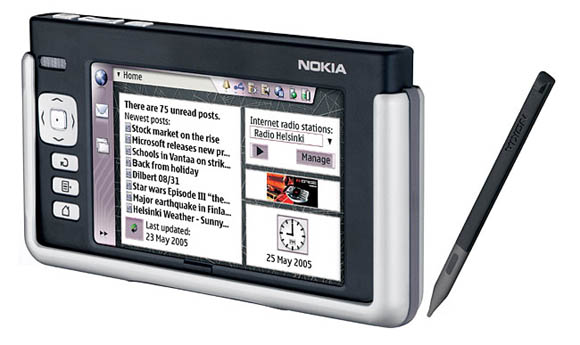
 Nokia is preparing to release the Internet Tablet, a handheld, Linux-based device with wireless web browsing capability and a variety of multimedia options (video, audio, internet radio). $350 is the asking price. Problems seem to be that it doesn’t come with a lot of memory, and that it doesn’t support Microsoft media formats. But it edges a little closer to the “can I take it into bed with me?” criterion. We’ll see if any interesting e-reading formats are developed for it. Most likely just a footnote on the way to something better.
Mentioned here in Wired. Here with the Linux angle. Pros and cons laid out here.
the city writes its book
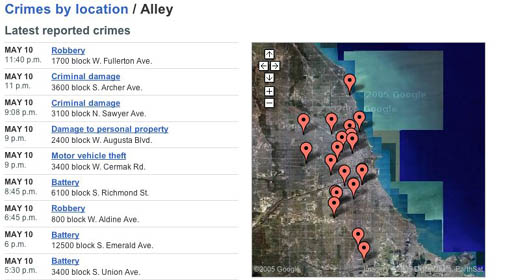
chicagocrime.org, the best use of Google Maps I’ve seen to date, has been making the web rounds over the past week. It generates maps using information scraped from Citizen ICAM, a public portal to the Chicago Police Department’s database of reported crime. You can view by type of crime, street, date, police district, location type (i.e. alley, ATM, residence etc.), or a map of the whole city.
This is the latest in a series of living documents that have sprung up recently – web spaces tied by a thousand strings to real, physical places. I can imagine chicagocrime being integrated into a larger Chicago area web hub, or aggregator. Ideally, these hubs (see here and here) will combine the conviviality of the blog, the utility of craigslist, the diversity of Flickr or ourmedia, and the collective vigilance of citizen journalism. Other recently launched intitiatives of note are Bayosphere (“…of, by and for the Bay Area) and mnspeak.com (“twin cities: all day, all night”). The more people participate, the truer the picture of that place at that time. Are we moving past the primacy of the editor? Or will editors prove more important than ever before?