
 in june i decided to explore the podcast phenomenon. i downloaded a number of different programs on to my ipod shuffle. the first batch included some favorite radio programs that i rarely listen to now that i hardly ever drive anywhere, a bunch of different audio blogs, some serious, some insane or inane . . . and the most interesting – Earthcore – billed as the first podcast only novel. written and performed by scott sigler, Earthcore is a science fiction page turner divided into tweny-one 40-50 minute installments. sigler has been releasing one installment per week. the last one just went up.
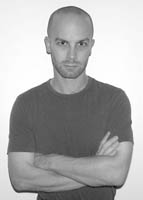 the plot is original and ingeniously woven and Sigler is one hell of a story teller. his palpable enthusiasm for his story, the Earthcore project and the new world of podcasting is infectious. just as in the best blogs, Earthcore seems to get an extra jolt from sigler’s willingness to put himself and his ideas on the line. his personality comes shining through; getting to know him and liking his attitude becomes an important part of the experience. with over 10,000 listeners by now, you would think that more than one major publisher would have come begging to buy the rights to a book with a significant proven audience. however, as if more proof of the moribund nature of big publishing were needed, to date not one publisher has approached Sigler. he’s on the verge of signing a deal with a small Canadian publisher, Dragon Moon Press. Congratulations to them for going with the opportunity.
the meaning of life? can you find an answer on the web?
On October 10, 2004, I was sitting with my laptop at a cafe in New York City trying to avoid writing a paper for my first-year humanities class. In a moment of despair, I typed “what is the meaning of life?” into an online forum. Fifty thousand hits and two thousand answers later…
That’s the cover copy for David Seaman’s first book “The Real Meaning of Life.,” due out this September. The book is a print version of the impromptu networked book, generated online in response to his question. Aphorisms like “be grease not glue,” and “there is not point to life, and that is exactly what makes it so special,” came from Buddhists, born-again Christians, atheists, waitresses, students, and recovering heart attack patients.
The public platform that the web offers ordinary people, introduces a new way to contemplate this perennial question. Typing “what is the meaning of life?” into wikipedia. yields an extensive post with over 500 edits and a lively discussion page. Here is an excerpt:
The person who asks “What is the meaning of life?” is pondering life’s purpose, in the context “Why are we here?”, or is searching for a justification or goal as in “What should I do with my life”? Thus, we’ve separated the main query into two different questions: one about the objective purpose of life (“Why are we here?”, and the other about subjective purpose in life (“What should I do with my life?”). Many claim that life has an objective purpose, though they differ as to what this purpose is, or where it comes from. Others deny that an objective purpose of anything is possible. Purposes, they argue, are by their very nature purely subjective. Subjective purpose of course varies from person to person. In some ways the quandary is a circular argument, the enquirer is in the midst of life seeking to validate life, or be it the meaning of it.
Books have, traditionally, been vehicles for the contemplation of this circular question. Scripture, scholarly texts, poetry, novels, self-help books, how-to books, grapple with the issue–“why are we here? And what should I do with my life?”–in various ways. It is interesting to see how the question plays out in the interactive space of the web.
Type “what is the meaning of life?” into the Google search engine and it yields 62,300 responses. Including an “Ask Yahoo” page from 1998 in which Juan asks the Yahoo search team to find the meaning of life for him. The letter he gets back reccommends a visit to the Yahoo meaning of life page. It also offers this advice:
Now, if you’re looking for the meaning of your life in particular, then we’re afraid we have to fall back on the somewhat predictable response: “It’s up to you.” Many people try to give lasting meaning to their lives by making the world a better place than when they entered it, either through scientific, philosophical, or artistic contributions. Others try by raising children that can themselves make contributions and preserve important societal and religious values for future generations.
There are also quite a few personal web pages that address the question. One particularly poignent example is JaredStory.com a site by and about Jared High, a young boy who took his own life shortly after a violent beating by a school bully. This heartbreaking site is filled with biblical quotations, audio and video of Jared, information about suicide, bullying, and a transciption of the lawsuit filed by his grieving parents.
Taken together these online “answers” create a wonderful mosaic of humanity striving to know itself and to connect with the universe. The web gives us an opportunity to read this interlinked accumulation of wisdom on a scale never before possible.
blogs and mainstream media: comparing influence
The fifth installment of Technorati‘s “state of the blogosphere” round-up studies the impact of blogs on mainstream media. Data shows that the most influential sites are still the mass media heavyweights: NY Times, Washington Post, BBC etc. But the most popular blogs are not far behind. In looking at the graph below, it’s important to bear in mind that what’s being measured is number of links, not page hits. Technorati gauges the influence of a site by the number of other sites that reference it.

the networked graphic novel
Media artist Andy Deck’s “Panel Junction” is a digital graphic novel that uses collaborative software to transform the authoring process. “Panel Junction” is one of the first open source networked books to visit the graphic novel genre, but judging from the response Deck is getting, it is probably not the last.
the open source curriculum: MIT’s opencourseware
Jimmy Wales of Wikipedia dreams of a free curriculum – open, high quality course materials built by a grassroots movement of volunteers (much like the one that is building the web’s largest encyclopedia). But Wales is not alone in his dreaming. The Massachusetts Institute of Technology also wants to spread the wealth – but not through a groundswell.
OpenCourseWare is all about the heights. OCW publishes syllabi, course calendars, readings, exams and other study materials from over 1,100 MIT classes – “a free and open educational resource for faculty, students, and self-learners around the world.” Sounds good. And it is pretty good, but it’s important to know one crucial fact: at this stage, many, if not most, course readings are only listed for reference. Anything in the public domain is available for download (or is linked to a free resource like Project Gutenberg), but most of the courseware is not, in effect, open.
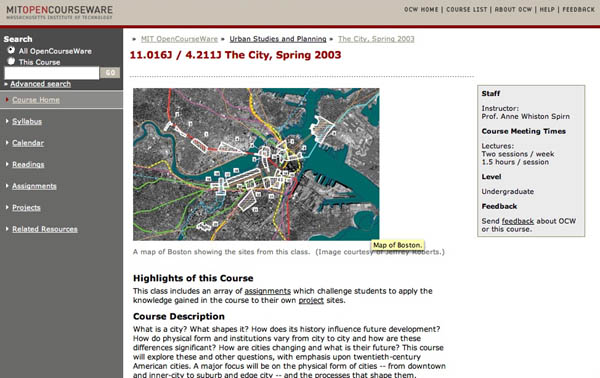
OpenCourseWare is most powerful as an idea, the same idea trumpeted by Wales, though they are pushing from opposite sides. MIT dispenses manna from the ivory tower while Wiki Books rallies instructors from middle and lower-tier American universites and developing countries. Both movements are in their infancy – largely untested.
There is some evidence that the OCW model is beginning to spread. Tufts University has launched its own OpenCourseWare project, as has The Johns Hopkins Bloomberg School of Public Health, and several universities in Japan (see OCW Japan portal). But to say that MIT has more institutional heft than the Wikimedia Foundation would be a serious understatement. It’s relatively easy for them to launch a project like this, with the MIT stamp, and to quickly generate a favorable buzz. But in the end, how valuable will OCW be if you can’t get your hands on the bulk of the materials? As more content becomes freely available through public-spirited ventures like Wiki Books and Creative Commons, as well as a myriad of independent online textbooks, OCW might need to populate its courses with such materials in order to stay relevant and useful.
But will an elite institution like MIT be willing in the end to incorporate texts and materials forged in the far-flung suburbs of the academy? MIT syllabi are stocked with quality scholarship – expensive, well-bred stuff. It’s difficult to imagine Wiki Books taking a seat among such high class company. And so it’s equally difficult to tell, for an institution like MIT, whether OCW is a sign of healthy adaptation or inevitable erosion. Questions like these point to the profound changes that will rock the modern university as the web levels and obsolesces the old hierarchies – as profound as the upheavals in Europe around the dawn of moveable type.
we teach success.
 That’s the motto of The Donald’s latest business venture, Trump University. Yes, you heard me right, Donald Trump has started an online University, complete with lectures, seminars, blogs, chat kiosks, esteemed faculty, and of course, distinguished Chairman of the University, Trump himself.
Like the University of Phoenix, Trump has built his online learning initiative on a firm business model. The mission of this so-called university is “success,” in a trade-school kind of way. The ambition is to teach skills and “trade-secrets” that are designed to turn a quick profit in the marketplace. The site is replete with self-help euphemisms like: “what’s the altitude of your attitude,” “bloom where you are planted,” and “your mind can build castles, just make sure the foundations are in place first.”
Self-help schlock notwithstanding, I was tempted by some of the offerings. For a mere twenty-nine dollars, I could get a “Career Assessment Profile.” A 76-question online test that measures key dimensions of my personality and can predict job performance. According to the site, the test can “tap into your hidden abilities and find the job that best matches your personality.” Twenty-nine dollars seemed like a small price to pay to tap my hidden potential. What if low-paying scholarly work really isn’t my thing? Maybe the assessment will reveal that I’m better suited to wheeling and dealing at the top of the corporate ladder. The only thing that stopped me from signing on was the memory of a similar test I took in high school which revealed that my true calling is police work (a noble profession, but, if you knew me, you would roll your eyes at the thought of kim white, the enforcer).
I also had to restrain myself from using the institute credit card to sign up for Trump’s intriguing “Women-Centric Studies program”
Trump University is developing a new “women-centric” curriculum, starting with Prof. Karen Kahn Wilson’s live course, Success Strategies for Women. This four-session course, scheduled for September and October, will be delivered over the Web. It will focus on the distinct strengths that women bring to the workplace and how they’re related to findings in the latest research on female neurology. It has always been “common knowledge” that men and women think and behave differently–in the workplace and elsewhere–but these differences can now be explained through hard science.
Could it be? Is the business community finally realizing the unique contributions women have to offer? Are courses like this designed to change the business environment so that cognitive skills native to the female become highly respected and sought after? Or does Trump University offer this course because they know that this is what I wish for, and what I might pay for?

From the “Trump University Winner Wear” collection
academic commons
 I’m excited to announce Academic Commons, a new online journal-cum-workshop space devoted to “investigating and defining the role that technology can play in liberal arts education.” The August issue brings together an impressive array of articles – including essays by Richard Lanham and hypertext fiction writer Michael Joyce – and profiles several noteworthy projects.
Academic Commons aims to share knowledge, develop collaborations, and evaluate and disseminate digital tools and innovative practices for teaching and learning with technology. We want this site to advance opportunities for collaborative design, open development, and rigorous peer critique of such resources.
Sponsored by the Center of Inquiry in the Liberal Arts at Wabash College, Academic Commons provides groups and forums for catalyzing and developing collaborative projects, and is linked to LOLA, a learning object repository hosted at Wesleyan. Educators can come here to find incisive critical thinking on the meaningful use of technology in schools, and also can obtain concrete resources and contacts for use in their teaching. From the looks of the inaugural issue, it seems Academic Commons is set to become an important player.
fictional pop star gets buried on wikipedia
Jamie Kane, fictional heartthrob and pop star, is the subject of a new BBC online game where players must solve the mystery of the singer’s death (story). Last Friday, a Jamie Kane article appeared on Wikipedia (original, current) that made no acknowledgement of the boy band singer’s fictional status. Encylopedians soon sniffed out the viral marketing ploy and edited the page, making it a likely candidate for deletion. Today, the BBC admitted that the page had been set up by an employee, but not as part of an official marketing campaign.
Should we be worried about the veracity of information on the web? Of course. On Wikipedia? Definitely. But not because of episodes like this. If anything, this demonstrates how Wikipedia can work quite well for pop culture, and how the community can respond swiftly to so-called vandalism. I say, let Jamie Kane have his page, just not under false pretenses. Let the page incorporate the history of this tiny scandal. That’s one of the things I find most fascinating about Wikipedia – that it can handle that kind of self-awareness.
electronic textbook program gets real (slightly)
So, the pilot e-textbook program (see post) on trial this fall at Princeton, the University of Utah and nearly a dozen other universities, is modifying inititial plans to make digital textbooks expire after five months, extending terms to at least a year, and, in some cases, scrapping the limit altogether. Congratulations to publishers for bravely pushing their program to the bare minimum.
See “Publishers loosen rules on e-textbooks” in CNET.
the open source curriculum: wikimania

A little over a week ago, at the first international Wikimedia conference (Wikimania) in Frankfurt, Wikipedia founder Jimmy “Jimbo” Wales presented a free culture manifesto comprising ten problems, or, “ten things that will be free” over the course of the next generation. Invoking the famous “23 problems” presented by mathematician David Hilbert to the world mathematics community in Paris in 1900, Wales laid out the ten forms of information that he believes have a solid chance of actually becoming free, provided that his burgeoning Wikimedia empire, and other similar ventures, continue to gain influence.
The list:
1. free the encyclopedia
2. free the dictionary
3. free the curriculum
4. free the music
5. free the art
6. free the file formats
7. free the maps
8. free the product identifiers (e.g. ISBN etc.)
9. free the TV listings
10. free the communities (e.g. web forums, wiki hosting sites etc.)
Recently a guest writer on the Lessig blog, Wales had the opportunity to expand on some of the ten items. I found the “free the curriculum” entry particularly suggestive, especially considering recent feeble efforts from textbook publishers to adopt an electronic model (see “tired of feeling so used, textbook publishers go digital”). Wales predicts that “a complete curriculum in English and a number of major languages will exist by 2040, and translation to minor languages will likely follow soon after.”
In the long run, it will be very difficult for proprietary textbook publishers to compete with freely licensed alternatives. An open project with dozens of professors adapting and refining a textbook on a particular subject will be a very difficult thing for a proprietary publisher to compete with. The point is: there are a huge number of people who are qualified to write these books, and the tools are being created to leave them to do that.
Wales dreams that Wiki Books – a clearinghouse of free, open content textbook modules – will lay the groundwork for this new era of openness. There’s not a whole lot there yet, certainly nothing to match the 22 million articles that in half a decade have filled the pages of Wikipedia. But let’s wait and see.
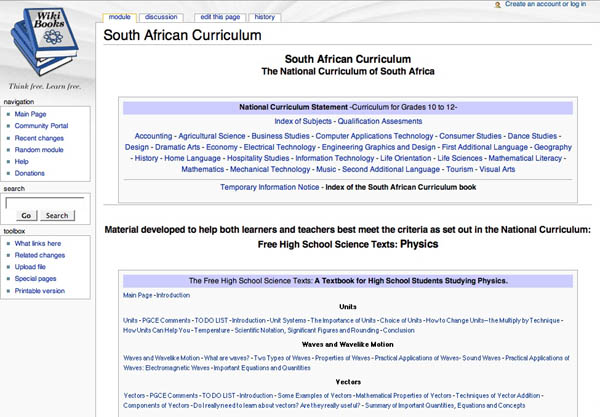
I would guess that it won’t be Americans or Europeans who will make the first big move into open source curricula. The West may be a great source of ideas, but it is also a stronghold for the entrenched interests of publishers and software companies. In so-called developing nations, there is much less to lose and probably much more to gain from experimenting with something like Wiki Books. Take a look: someone has even “wiki-fied” the entire National Curriculum of South Africa as a skeleton for the kind of public domain curriculum Wales has forecast. Right now, free software is spreading rapidly through the developing world, especially in educational initiatives. Freeing the curriculum would be a logical next step. If or when these changes take root, we’ll find ourselves living in a very different world.
Over the next few days, I’ll be discussing some other open curriculum initiatives. Stay tuned.
new post now up: MIT’s OpenCourseWare