
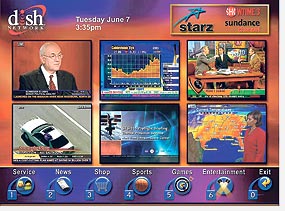
Several new “interactive television” services are soon to arrive that offer “mosaic” views of multiple channels, drawing TV ever nearer to full adoption of the browser, windows, and aggregator paradigms of the web (more in WSJ). It seems that once television is sufficiently like the web, it will simply be the web, or one province thereof.
the virtual library: lending audio books online
This past year, most of my reading (for better or for worse) has been done online. When I visit my local library it is to check out DVDs, or to take my son to story hour, or to use the library’s free wireless. When I am there, I notice that many of the other patrons are there for the same reason. There’s always a waiting list for the computers and a line of patrons with arms full of DVDs waiting to check out.
It’s no surprise that libraries are looking for ways to extend these popular digital offerings in order to better serve their patrons and to stay relevant in the digital age. A recent article in Technology Review by Michael Hill reports that libraries have, “considered the needs of younger readers and those too busy to visit,” and are beginning to offer downloadable digital audio books. “This is a way for us to have library access 24/7,” says Barbara Nichols Randall, director of the Guilderland Public Library in suburban Albany. As an added bonus, you never have to worry about late fees. Here’s how it works:
A patron with a valid library card visits a library Web site to borrow a title for, say, three weeks. When the audiobook is due, the patron must renew it or find it automatically “returned” in a virtual sense: The file still sits on the patron’s computer, but encryption makes it unplayable beyond the borrowing period.
“The patron doesn’t have to do anything after the lending period,” said Steve Potash, chief executive of OverDrive. “The file expires. It checks itself back into the collection. There’s no parts to lose. It’s never damaged. It can never be late.”
new york times on “godcasting”
An article in today’s Times describes the rise in Christian religious podcasting – sermons on demand, exegesis by RSS – known by some, inevitably, as “godcasting.” Worth a look.
convergence sighting: bbc tv channels to be put on net
Recent announcements at the BBC suggest further convergence of television and the web, reading in multimedia, cellphone as broadcast receiver etc. From Director General Mark Thompson:
We believe that on-demand changes the terms of the debate, indeed that it will change what we mean by the word ‘broadcasting.’
Read article.
there goes the neighborhood
Playboy Magazine is going digital. On September 13th, readers will be able to recieve the digital edition instantly, on their computers. According to the website, this new format will allow you to “zoom in to see every detail and archive your issues so you can access them anytime, anywhere.” Ah, progress…
penguin classics, the complete collection…if only


I was listening to a story on NPR called “Loading Up on Penguin Classics”. My son was running around the living room screaming, so I didn’t hear most of the broadcast. In my digital thoughtspace, I assumed “loading up” referred to software. Imagining an entire library, 1,082 classic titles, as electronic objects, stored neatly on my hard drive, is enormously appealing to my minimalist aesthetic and my nomadic digital worklife. However, as it turns out, the Penguin Classics Library Complete Collection is being offered as a 700 lb. load of paperback books (delivered free to anyone who can afford the shelf space and the $7,989.50 price tag). If only Penguin could catch a vision of THIS century and start making digital versions of the classics. I need screen-based books, audio books, lower pricetags, and I don’t think I’m alone. Penguin, are you listening? I’m clearing out virtual shelf space now, make me some ebooks!
one device to rule them all
Wired profiles Amp’d Mobile, a new service launching this fall that will offer subscribers a wide array of “mobile entertainment” options on a specialized handheld device. Amp’d has marshalled a vast amount of venture capital to bring the cellphone to its full potential as a catch-all media device – video console, gaming handset, ebook reader, web browser, and, if your brain hasn’t been totally fricasseed by that point, still a good old-fashioned telephone.
Amp’d targets consumers in their mid-20s to mid-30s – the bracket that is the most gadget-crazed, the most entertainment-hungry, as well as the most mobile, or so the reasoning goes. At the very least, Amp’d might serve as a catalyst for Verizon, Sprint and the other big mobile service providers to move into this sweet spot of media convergence. It certainly seems that things are going that way.
play station portable as online reading device
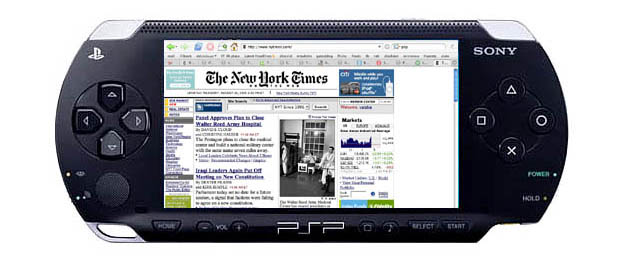
The new updated Sony PSP portable gaming device will include a web browser. That gives it games, film, photo and web – the most comprehensive pocket instrument out there. But for the time being, it’s read-only. Without a stylus, or virtual keyboard, many of the web’s more interactive elements will be unavailable.
amazon shorts: short literary works delivered digitally
Amazon Shorts offers 49¢ downloads of short fiction and nonfiction in .pdf, html and text-only email, seemingly without copy or printing restrictions. Amazon a publisher? The chapbook reborn? Not quite. Amazon Shorts is primarily a marketing program, available only to established authors who have other titles to sell – a sort of appetizer course to encourage larger book purchases. But it’s probably suggestive of where advertising in general is headed.
Television entertainment was originally conceived as a way to create a captive audience for advertising. Now, consumers have greater and greater ability to tune out the ads and focus on the entertainment – fast-forwarding on Tivo, or, on the web, clicking through, or closing the pop-up window. As a result, marketers are trying to figure out how to make the ads destinations in themselves – to develop a format where the ad and the entertainment are inseparable, even indistinguishable. Recall the Superbowl, where high-budget, elaborately produced ads are as much an attraction as the game itself (some would say more). Or BMW Films, creator of “The Hire” – a series of short films by major international directors, starring Clive Owen and, of course, a sexy Z4 Roadster.
Expect more of this short form blend of advertising and entertainment in film, certainly, and even (if the “Shorts” series is any indication) in books.
copyright 101
Richard Lanham, the godfather of electronic text, has written a wonderful piece in Academic Commons calling for a course in copyright for all undergraduates. Lanham, a UCLA English professor who has had a significant second career as an expert witness in copyright cases, gives one of the more cogent summaries of the copyright morass we find ourselves in as the digital tide overwhelms previous notions of property and ownership.