fertile pages

ifbook organic.jpg
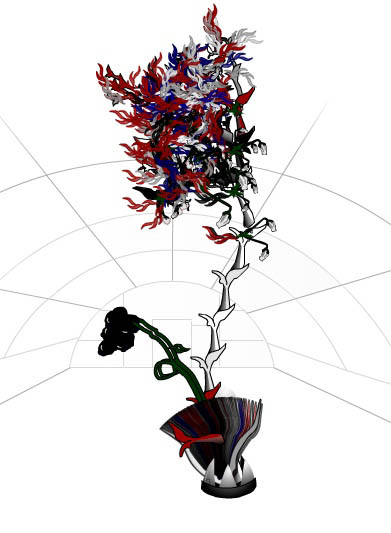
Organic HTML is a wonderful little applet I came across that turns websites into bizarre-looking plants. information aesthetics speculates on how it might work:

the emerging plant appears to use the colors similar to those found in the website HTML, CSS or images, while its size & branches depend on the site structure, content or number of pages. without any readily provided explanation or legend, one keeps trying to feed it URLs to derive the most beautiful flower (while avoiding the sometimes appearing flies)

Plug in a URL and try it out (be warned: it might crash your browser). if:book is apparently an inky species of blog (see above). I’ll add this to our garden. I wonder why there aren’t more sprouts of orange? The New York Times comes out more floral.

ny times organic.jpg

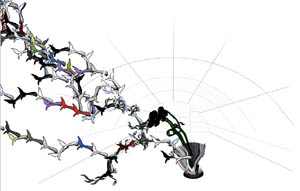
Something interesting I found, take a look at these two plants. One is Google, the other Yahoo! Can you guess which is which? (The larger plant has been scaled down.)
yahoo organic.jpg google organic.jpg

convergence sighting: ipod phone

rokr160.jpg The Motorola ROKR, a new iTunes-compatible cellphone developed for Apple, hits the stores today for Cingular subscribers. The phone will run for $249.99 and can load up to 100 songs from a computer through a USB wire. Sounds like a rip-off to me, but indicative of things to come. It also comes equipped with a camera. The cellphone is steadily swallowing up all personal media.
Apple also unveiled its newest iPod, the “nano,” which uses solid flash memory (like in little USB memory sticks) rather than a hard drive with moving parts. It’s roughly the size of a half dozen business cards stacked together, and can hold up to 1,000 songs.

katrina and the interactive atlas

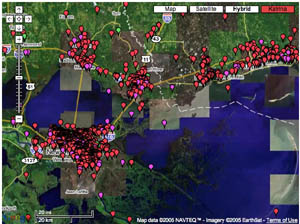
Interactive maps help those of us not in the region to grasp the terrain of devastation wrought by Hurricane Katrina. These maps are suggestive of a new paradigm for the digital page – an interactive canvas, or territory, through which the reader can zoom through orders of magnitude.
katrina map wiki 4.jpg katrina map wiki 5.jpg
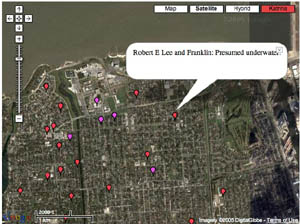
Most talked about is the “visual wiki” at scipionus.com – a re-tooling of Google maps that invites users to post tabs with information pertaining to specific locales (as fine-grained as streetcorners). Tabs are editable and are supposed to be used only for concrete reports, though many have posted pleas for news of specific missing persons or of the condition of certain blocks. Some samples:

“Saw news video 9/2/05 of corner street sign at 10th St. & Pontchartrain Blvd. Water level was about 6 in. below. green street signs.”
“the Ashley’s are in Prattville AL”
“4400 Calumet — dry on Weds?”
“as of 5:00 pm.. the streets from wilson canal to transcontinental are COMPLETELY DRY! source from somebody who stayed and called to tell us the info.”
“Dylan Nash anyone?? call 919-7307018”

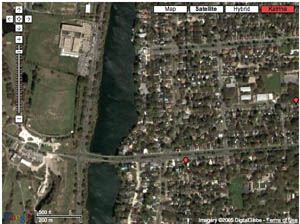
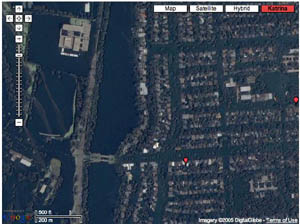
The maps include post-Katrina satellite imagery, which reveals, upon zooming in, horrifying grids of inundated streets, stadiums filled up like soup tureens, city parks transformed into swamps. Wired recently ran a piece about sciponius.
Before & After:
katrina map wiki before.jpgkatrina map wiki after.jpg
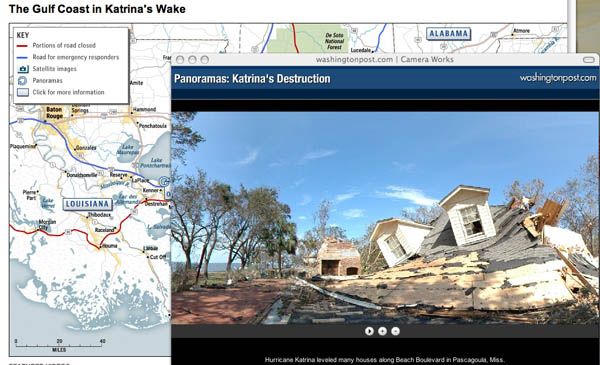
I was also impressed by the interactive maps on washingtonpost.com.
wash post katrina map.jpg
Click on spinning wheels at various points along the coastline and windows pop up with scrolling panoramic shots. Quite stunning. You can click the screen and drag the scroll in either direction, stop it, speed it up, and even pull it up and down to reveal glimpses of the sky or ground. Photojournalism is given new room to play on online newspapers.
(No Need to Click Here – I’m just claiming my feed at Feedster feedster:d50fedfc363272797584521a06a79da5)

fingerprinting text in the age of cut-and-paste

Lexis Nexis has installed new software for detecting plagiarism. As described on their site:

LexisNexis CopyGuard uses pattern-matching technology to identify suspect passages in submitted documents. An easy-to-read report underlines and color codes questionable sentences, with links to the original sources.

This could be an important tool for assuring integrity not only in professional journalism, but also in the emerging class of amateur reporters. But apply it to blogs and CopyGuard might overload and shut down. Bloggers are constantly recycling text, often without clear attribution, or obvious demarcation between quote and original commentary. The bounds of plagiarism seem a bit less clear when you consider that cutting and pasting is one of the main ways we converse online.
(NY Times has story)

the selected, annotated outbox of dave eggers

Email killed the practice of letter-writing so suddenly that we haven’t a chance to think about the consequences. The Times Book Review ran an essay this weekend on the problem this poses for literary historians, biographers and archivists, who long have relied on collected letters and papers to fill in the gaps between a writer’s published work. In the same review, the Times covers a new biography of the legendary critic Edmund Wilson largely based on his correspondences, and last week covered a new collection of the letters of poet James Wright. Letters are often treated as literature in themselves.
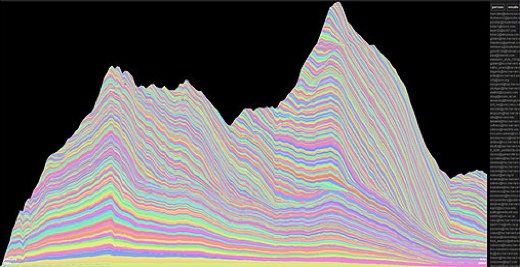
email mountain.jpg But a crop of writers is working now whose papers are not in order. The email is rotting away on the network, unorganized, not backed-up, and, to a great extent, simply being lost for good. I actually mused about this in a post last month about an email archive visualization tool by Fernanda Viégas at M.I.T.’s Sociable Media Group that shows years of electronic correspondence as sedimentary levels in a mountain-like mass. And a mountain it is. One novelist I know in Washington has her office stacked high with milk crates containing printouts of each and every email she sends and receives, no matter how trivial. There has to be a better way.
There isn’t necessarily anything less rich about email correspondence. It excels at capturing a vibrant volley of words with great immediacy, whereas paper letters permit deeper communiques, fewer and father between. But in some cases, these characterizations do not hold up. With reliable postal service, letters can fly back and forth quite rapidly. And just because an email suddenly appears in your box does not mean that it will be immediately read, let alone replied to. Sometimes we write long email letters, expecting that the receiver is busy and will take time to reply. These differences, true and false, are worth evaluating.
But if collected emails are to become a literary tool, there is no question that we will need more reliable ways of archiving and preserving digital correspondence. We will also need new editorial approaches for collecting and publishing them. A printed volume, or series of volumes, might be insufficient for presenting a massive 4 gigabyte email archive by Dave Eggers (No one wants to read the phone book from cover to cover). And according to the Times piece, Eggers’ agent Andrew Wylie is mulling over such a project. What would make more sense is an electronic edition that is essentially a selected or complete annotated Eggers Outbox, with folders and tags provided for categorization, a powerful search function, and the ability to organize according to your own interests. There would also be browsing and skimming tools that would allow a reader to move rapidly across vast tracts of correspondence and still find what they are looking for. And maybe, a way to email the author yourself and become a part of the living archive.

using the web to teach tolerance

eye.jpg
Teachers brave enough to tackle incredibly complex and sensitive issues, like the Arab-Israli conflict, may find some useful material on Eye to Eye. The site describes the conditions in refugee camps through the eyes of Palestinian children. The project was carried out by “Save the Children UK,” which conducts photo workshops for children in the camps and publishes the resulting photographs on the Eye to Eye site. While the site does not offer a comprehensive history of the situation, it does provide a perspective often missing from mainstream media coverage. The site goes to great pains to avoid bias. On the “Palestinian History” page, it provides this disclaimer, apologizing in advance for any offence their description may cause.

Save the Children UK recognises the political issues and sensitivities surrounding the current crisis in the Middle East and does not take a partisan view on these issues. Our sole concern is to protect the rights and lives of all children wherever they live and we believe that the Eye to Eye project can play an important role in building understanding and respect of this need during the current conflict.
For the benefit of the teachers and children using the Eye to Eye website, we have attempted in the following chronology to describe as objectively as we can, the historical context of the current situation of children in the Occupied Palestinian Territories. However this chronology does not claim to be comprehensive, and we apologise in advance if we inadvertently cause offence by the way we have described historical events.

Though the site does not entirely succeed at remaining impartial, the project seems worthy of attention, perhaps for that reason alone. The problem of how to teach these very emotional and inflammatory topics remains. Can one be impartial in this conflict? How do you sort through history and contemporary politics without taking a side? Is there a way to get past our emotional biases and political loyalties in order to find an objective “truth”? Is there an objective truth? These are the kinds of questions students should be confronted with; Eye to Eye offers one pathway into this contentious issue.

blogging the hurricane

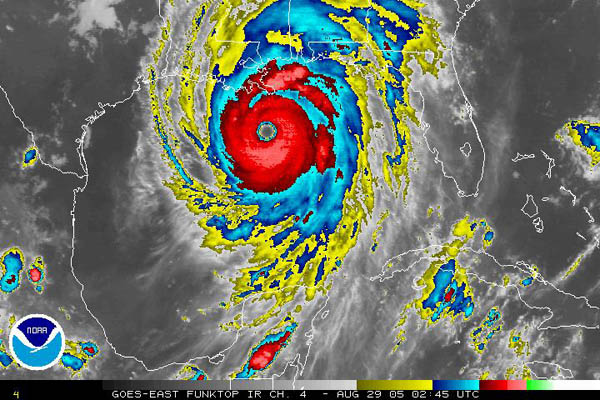
katrina satellite.jpg
As Katrina has blasted the Gulf Coast beyond recognition, a number of blogs have maintained a steady stream of reportage and personal testimony, in some cases serving as bulletin boards for the names of the missing. Given the extent of the destruction to communications infrastructure, it’s not surprising that it has primarily been the media blogs that have managed to stay active.
Here are a few I’ve come across (Poynter Online has been an invaluable resource for exploring the online response to Katrina):
Eyes on Katrina: A South Mississippi hurricane journal (from The Sun Herald) – a combination of brief news updates, community bulletin board, and advance runs of Sun Herald stories on Katrina.
Tuesday, 2:23 pm:

This from staff writer Geoff Pender, who is calling in reports from Hattiesburg. If you are thinking about getting in the car and coming back to South Mississippi, don’t. The Mississippi Emergency Management Agency is telling people who have evacuated to stay away until the roads have been cleared and the National Guard is in place. If we get word when that happens, we’ll pass it along.
On a different note, we have a report that portions of U.S. 90 are under seven feet of water.

NOLA View: a weblog by Jon Donley – for nola.com, a news and culture portal from The New Orleans Times-Picayune. Posting survival stories from readers.
From reader Lynne Bernard (today), on trying to survive in Talahassee, FL:

Story: We are stranded in Tallahassee. There is absolutely no compassion here whatsoever. The Hampton Inn in Tallahasse is pretty much throwing us out because of a football game. We are running out of money with no way of getting more out of the bank. We cannot use debit cards and our credit cards are maxed out. I thought I would encounter a little compassion and understanding here in Florida seeing they have been through similar situations. There is none. People here and the manager of this motel are very cold and uncaring. If anyone out there has any suggestions please email me asap. I cannot get in touch with red cross or fema. Cell phones don’t work. Can’t get hold of any family member for help. Please help!!!!

CNN: Miles O’Brien’s Hurricane Blog – direct from Louisiana.
Monday, 6:54 am:

Louisiana State University Hurricane Center’s Ivor van Heerden just said a real concern is coffins that would be swept away by the floodwaters — which themselves will be laced with a witches’ brew of industrial chemicals. Horrifying image.

Metroblogging New Orleans – group blog with frequent, first-hand reports.
12:54 pm today, from Craig Giesecke:

Being refugees has forced us to confront new realities and possibilities, particularly since it might be a while before we’ll actually be able to return to stay. I’m self-employed in a food business that was just beginning to take off and fly a bit on its own when this storm struck. To wit…
1) when we actually go home, what shape will my production facility be in? Since it’s in Mid-City, I’m assuming it’s already full of water.
2) Even if I can get the equipment operating again someplace else, 75 percent of my business is done in metro New Orleans. Lord knows how long it might be (2006?) before any local clients will be able to start placing orders again.
3) So far, our house seems to be dry. But when we get back in, how long will it be before anything else is around us? The neighbors will return, but how long before any of us can start earning a paycheck again? I mean — earning a paycheck ANYwhere?

Storm Central from al.com (“everything alabama”) – news updates and reader email.
Paula Baker from Houston, TX:

I am trying to find out about my brother. Stayed in Pascagoula. House on Sunfish Dr. 5 Blocks from beach

This is just a selection – by no means comprehensive. Let us know if you find anything else of interest.


hive mind

escher.gif I spend a lot of time looking for specific resources on the web. That means sifting through Google search results and following links that seem promising. A semi-interesting link may take me to an article with another semi-interesting link; that link takes me to another, and so on. As I progress, the articles become more thinly related to the topic, but I pursue them anyway, hoping they will lead me on a trajectory I hadn’t thought of, to a great idea that I couldn’t have anticipated.
During the whole process, however, I can’t shake the unpleasant sensation that I am not the master of my own destiny. I come out of a Google session with a wrung-out feeling, like I’ve just been lead along a path that was not entirely of my own choosing, marching behind an army of web searchers carving networked pathways into the information landscape, but not necessarily finding that unique morsel that will knit my ideas together. Lee Bryant explains this phenomenon as entaglement in the complex systems addressed by complexity theory. “Complexity theory,” says Bryant, “shows us that from the seeds of such small inter-connected actions, large trees of system behaviour can grow. These physical phenomena are reflected online as well, where the emergence of the Wiki movement and the growing cult of Google both display a simple form of collective intelligence.” He gives us this metaphor to consider:

The classic pop-science example that illustrates the point is the way in which ants forage for food. Ants display a kind of collective intelligence (described by some as a “hive mind” ) that is based on apparently dumb rules, repetitively followed by thousands of individual insects. Each ant forages for food in an apparently random manner, but when it finds food it marks a pheromone trail back to its colony. Trails fade over time, but positive feedback means that well-travelled paths will attract more and more ants until the particular food source is exhausted. The system works because there are enough ants each following the same rules to ensure comprehensive coverage of any given area.

The fact that my participation in the web, even at the browsing level, means that I will be drawn, unavoidably, into the group effort evokes a mixed response. My independent artistic sensibility hates anything that erases the individual voice and immerses me in a placid groupthink. But my social human sensibility sincerely wants to know what everyone else is doing; it makes me want to dive in, pitch in, follow along, and celebrate the complex social web we are weaving.

treasuremytext: a networked SMS book

treasuremytext is a free British service that allows you to save text messages from your phone to the web on an anonymous, communal log, or “slog.” Recent messages appear in a column on the main site where they can be read by all and sundry, subscribed to by feed, and even loaded onto an iPod as plain text files. jill/txt has a transcript from about two weeks back:

trying to convince myself that there was nothing there but i still find myself thinking about you
night nimet . . . . i miss you
How about sorting that taxi out for next week? For real?
Ok smart arse when you are there then! And then i will fix your issues for you, all of them!
U have beautifull eyes
Dont ring ill b down bout halfpast babes
Me to hes just arrived txt u l8r baby
Nite nite xxx
Nite nite fat sexy bum.Txt u tomoz nite nite xxxx

Not exactly prize-winning stuff, but has a nice dreamy flow of chatter plucked out of the air. Reminds me a bit of a game I played in elementary school where you go around a circle and improvise a story in broken-off pieces. Reading the site today, the entries seem to have taken on a smuttier tone. And a good number aren’t in English. But an intriguing experiment nonetheless.
But it would be more interesting if the logs had some focus. Something like the City Chromosomes project, which is building a networked chronicle of the city of Antwerp, all by SMS.