
High-definition TV pioneer and Dallas Mavericks owner Mark Cuban talks about what’s at stake in the upcoming Supreme Court case MGM vs. Grokster in an article drawn from a recent post on his blog.  Skip down to the section titled “Taking a Wrong Turn.” There, Cuban describes what could be lost if entertainment industry giants are able to convince the court that peer-to-peer file sharing is first and foremost a tool for theft.
“In the MGM v. Grokster case, the fewer than 50 companies who control less than 1 percent of all digital information are trying to take control of innovation in the technology industry and pry it away from the rest of us. Everything our imagination creates and touches that can be made digital is at risk if Grokster loses.
“What innovations will be condemned by law before they have a chance to come to market, because they could have an impact on Hollywood and the music industry? We have no idea, and that is a very scary prospect.”
Author Archives: ben vershbow
incredible shrinking book
 A couple morsels today on textually.org lending credence to our theory that cellphones/PDAs are the incubation niche for the eventual widespread adoption of ebooks. One on fashionable new casings Nokia is bringing out for mobile devices (re Kim’s leather-bound fantasy ebook). Another on plans by Chinese tech giant Lenovo to embed “mobile book software technology” into phones, allowing users to read fully illustrated books, as well as watch movies, listen to audio, play video games, and browse periodicals. Mobile phones are emerging, at least in China, as the ultimate mass-consumer media processor – affordable and eminently portable. And each year, notebook computers become lighter, sleeker, and easier to tote around. Are they just shrinking into palm pilots? How much serious work can you get done on a palm pilot?
“finally, I have a Memex!”
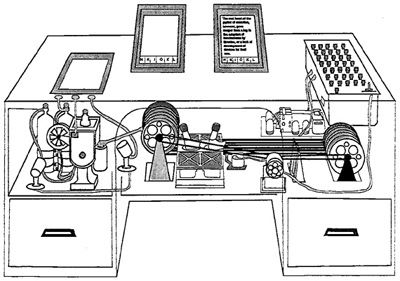
There’s an essay worth reading in the ny times book review this past sunday by Steven Johnson about a powerful semantic desktop management and search tool recently released for Macs.  The software (called DEVONthink) not only helps organize and briskly sift through readings, clippings, quotes, and one’s own past writings, but assists in the mysterious mental processes that are at the heart of writing – associative trains, useful non sequiturs, serendipitous stumbles. In effect, we now have a tool resembling the Memex device described in the seminal 1945 essay, As We May Think by visionary engineer Vannevar Bush. Working with the cutting edge technologies of his day – microfilm, thermionic tubes, and punch, or “Hollerith,” cards – Bush pondered how technology might help humanity to manage and make use of its vast systems of information. His recognition of the basic problem is no less relevant today: “Our ineptitude in getting at the record is largely caused by the artificiality of systems of indexing.” Fast forward to 2005. Now, the holy grail of search is the Semantic Web – moving beyond the artificiality of crude content-based queries and bringing meaning, relevance, and associations into the mix.
“Consider a future device for individual use, which is a sort of mechanized private file and library. It needs a name, and to coin one at random, “memex” will do. A memex is a device in which an individual stores all his books, records, and communications, and which is mechanized so that it may be consulted with exceeding speed and flexibility. It is an enlarged intimate supplement to his memory.” – Vannevar Bush
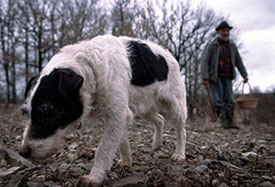
It’s quite suggestive that DEVONthink’s semantic search function can to an extent be trained, taking the obnoxious little puppy on Windows search toward its full potential – a sleek, truffle-tuned hound. When Johnson loads his body of work onto the computer, the hound picks up the distinctive scent of his writing, which in turn suggests affinities, similarities, and connections to other materials – truffles – that will find their way into later works.
 Says Johnson on his latest blog post, which goes into much greater detail than the Times piece:
“I have pre-filtered the results by selecting quotes that interest me, and by archiving my own prose. The signal-to-noise ratio is so high because I’ve eliminated 99% of the noise on my own.”
But it is significant that DEVONthink is not useful for searching entire books (the author’s own manuscripts notwithstanding). Currently, the tool is ideal for locating chunks of text that fall within the “sweet spot” of 50-500 words. If your archives include entire book-length texts, then the honing power is diminished. DEVONthink is optimal as a clip searcher. File searching remains a frustrating enterprise.
Johnson makes note of this:
“So the proper unit for this kind of exploratory, semantic search is not the file, but rather something else, something I don’t quite have a word for: a chunk or cluster of text, something close to those little quotes that I’ve assembled in DevonThink. If I have an eBook of Manual DeLanda’s on my hard drive, and I search for “urban ecosystem” I don’t want the software to tell me that an entire book is related to my query. I want the software to tell me that these five separate paragraphs from this book are relevant. Until the tools can break out those smaller units on their own, I’ll still be assembling my research library by hand in DevonThink.”
Another point (from the Times piece) worth highlighting here, which relates to our discussion of the networked book:
“If these tools do get adopted, will they affect the kinds of books and essays people write? I suspect they might, because they are not as helpful to narratives or linear arguments; they’re associative tools ultimately. They don’t do cause-and-effect as well as they do ‘x reminds me of y.’ So they’re ideally suited for books organized around ideas rather than single narrative threads: more ‘Lives of a Cell’ and ‘The Tipping Point’ than ‘Seabiscuit.'”
 And what about other forms of information – images, video, sound etc.? These media will come to play a larger role in the writing process, given the ease of processing them in a PC/web context. Images and music trump language in their associative power (a controversial assertion, please debate it!), and present us with layers of meaning that are harder to dissect, certainly by machine. It is an inchoate hound to be sure.
sticking it to the gatekeepers
 Stranded in copyright limbo, the landmark civil rights documentary Eyes on the Prize cannot currently be released on DVD or broadcast on television. But music activism group Downhill Battle has recently taken matters into its own hands by digitizing the 14-part series and making it available for peer-to-peer distribution. In addition, they’ve launched the Eyes on the Screen initiative to help communities coordinate local screenings of the film in time for Black History Month.
This could go down in history as an important skirmish in the copyright wars – when the public began to act in blatant defiance of the copyright gatekeepers. Rarely have the absurdities of the modern intellectual property system been cast in such stark relief.
But the brave souls at Downhill Battle are wrong to call this act of civil disobedience “fair use” (see Wired article). Few would argue that taking a 14-part film, not in the public domain, and slapping it on public access television is fair use. The big battles over what is and isn’t fair use are yet to come, and they will be crucial in defining the parameters of scholarly and artistic production in the digital era. Let’s not give ammunition to those who would further tighten the screws by blurring the distinction between acts of protest and legitemate fair use. The Eyes on the Prize case is about the public interest plain and simple. About protesting a system that allows public treasures to languish in forced obscurity.
no fortune in fishwrap
 This link to a New York Times article about maddening service disruptions on the New York City subway will self-destruct in 30 days. All right, so that’s not literally true, but click in a month’s time and you’ll be whisked to a virtual tollbooth – a pay-per-item archive service that no one under any normal circumstances would use. It’s just one of those nuisances of the web, a hyperlink hiccup slamming you into a brick wall. You wince slightly and move on.
This is by and large the experience of searching for all but newly minted news on the web. The older stuff, the stuff that goes in the recycling bin in real life, is slapped with a price tag. Most of us don’t stop to wonder at this strange inversion of value. We’ve grown accustomed to the way things are, that newspapers are pre-digital dinosaurs – vital, but very cranky and paranoid when it comes to the web. They have set up citadels where most have built cycloramas.
Cory Doctorow remarks to this effect on Boing Boing:
“Papers like the New York Times have decided that their archives — which were previously viewed as fishwrap, as in “today it’s news, tomorrow it’s fishwrap” — are their premium product, the thing that you have to pay to access; while their current articles from the past thirty days are free.”
He links to a fascinating and important piece on Dan Gillmor’s blog, Newspapers: Open Up Your Archives. Gillmor wonders how newspapers will stay relevant if they don’t unclench – move with the web rather than against it. He writes:
“One of these days, a newspaper currently charging a premium for access to its article archives will do something bold: It will open the archives to the public — free of charge but with keyword-based advertising at the margins.
“I predict that the result will pleasantly surprise the bean-counters. There’ll be a huge increase in traffic at first, once people realize they can read their local history without paying a fee. Eventually, though not instantly, the revenues will greatly exceed what the paper had been earning under the old system. Meanwhile, the expenses to run it will drop.
“And, perhaps most important, the newspaper will have boosted its long-term place in the community. It will be seen, more than ever, as the authoritative place to go for some kinds of news and information — because it will have become an information bedrock in this too-transient culture.”
It’s really worth reading this post, and following Gillmor’s blog in general. What is the future of the news if newspapers don’t learn the language of hyperlinking?
In that spirit, I refer you to another worthwhile rumination on this subject, The Importance of Being Permanent by Simon Waldman, Director of Digital Publishing at The Guardian (one of those few newspapers that seems to “get” the web), also linked on Gillmor’s post. From Waldman:
“It is the current policy of most American newspapers to be anti-Web in the key matters of linking out and permitting deep-linked content through stable and reliable url’s. This policy is, in my view, wrong-headed. It was done to get revenues from the archive. There was a business reason. No one was trying to be anti-Web. They just ended up that way by trying to collect revenues from a “closed” archive.
“But being closed cannot be the way forward for journalists, and so they have to involve themselves in the business of linking.”
I’ll rest there for now, though it would be interesting to discuss this further. Newspapers, all news media, are already in the grip of crisis – both a general crisis of confidence, and crisis arising from the extreme pressure exerted by new technologies. Over the next decade or so we’ll see how this plays out. But no matter how upset I am right now with the state of the mainstream media, I would be still more distraught if it were to disintegrate. Blogs and the rise of grassroots journalism are necessary revolutions, but they function best as counterpoint/collaborator/corrective to the the professional fourth estate. A kind of fifth estate?
I’ll end with a few links (perpetual, I hope) to some recent news about the indelible expansion of Google, to whose every footfall newspapers should pay heed. Google:
has recently absorbed Mozilla
may soon be on your cell phone
is dabbling in video search
wheels of (in)justice

 A blizzard of court papers blew out of the entertainment industry yesterday in anticipation of peer-to-peer file sharing’s big day in court. Shouts of “piracy!” and “stop thief!” were common themes in this choir of outrage, whose ranks ranged across the legal, political and entertainment worlds, from Kenneth Starr to Orrin Hatch to Avril Lavigne. The Supreme Court is set to begin hearing oral arguments on March 29 in the case that pits Grokster and StreamCast against such industry heavyweights as the RIAA and MPAA.
What’s needed at such a critical junture is an extended, nuanced discussion on the nature of intellectual property in the digital age, and on how these powerful new sharing technologies can be reasonably tempered to ensure that artists receive compensation for their work while preserving the dynamic modes of exchange. But what seems more likely is a big judicial slugfest.. brace yourself for a bloody spring.
our little community
 The blogosphere population has topped 8 million!
see PubSub tracking
tools for collaborative writing
 SubEthaEdit is an elegant collaborative writing and editing tool, originally designed for coders, but increasingly popular among educators, especially writing teachers. And if you’re using it for non-commercial purposes, it’s free! Here’s a fun piece written during the blizzard by a 3-person group using the software, courtesy of Slashdot. It’s a piece of collaborative writing about collaborative writing. Very meta. Reading it through once, I couldn’t really pick out individual voices.
email mystery novel and remix reading
Just back from the wonderful Decade of Web Design conference in Amsterdam – more to come on that soon. Catching up now on reading and turned up two interesting links on Boing Boing… First is a mystery novel that you read in email installments over a 3-week period. It’s not free – costs $7.49 – but I figured I’d give it a try. I should receive the first part tomorrow.
The other thing is an exciting collaborative writing project in Reading, UK. From their site:
“Remix Reading is an artistic project based in Reading, UK. It’s aim is to get artists (working with music, video, images and text) to come together and share their work, be inspired by each others’ work, and ultimately to create “remixes”. All material on the web site is released under a Creative Commons license, which allows you to customise your copyright so others can use, copy, and share your work as you choose.”
the untold (until now) history of the russian web
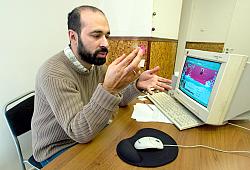 Great piece in this week’s Context, the weekly arts and ideas section of The Moscow Times, about the first history yet written about the Russian web. Feeling the Elephant (Oshchupyvaya Slona), by writer, journalist, and core member of Russia’s online literati Sergei Kuznetsov, was published late last year and has already engendered a small storm of controversy for alleged omissions, mischaracterizations and the like. But Kuznetsov says he never set out to write a “proper” history, simply an insider’s account – bias, warp and all – of the literary web he played a central role in creating. This lack of propriety is not altogether unfitting since there’s much in Russia’s neck of the web that, according to our stricter standards, isn’t at all proper, and this goes beyond mail order brides.. Intellectual property is only a fledgling idea there, and you can easily find practically any text online, from Pushkin to Pelevin, including fresh-off-the-press, protected material. The most popular of these literary indexes is Maxim Moshkov’s Lib.ru.
This loose, free-wheeling web culture has been both a boon and a curse to Russia’s writers and readers. On the one hand, it is easy and free to publish, and likewise easy and free to read. But with the exception of the most popular authors – the churners out of mysteries and bodice rippers – it’s damn hard to make a living writing in Russia (much harder than in the West, which is tough enough), and all this free literary trafficking, while rousing and diverse, bitterly emphasizes the underlying poverty. This begs the question, just as relevant here as anywhere else.. how can writers continue to make the web richer without becoming impoverished themselves?
(photo: Vladimir Filonov / Moscow Times)