
 Sci fi writer Benjamin Rosenbaum announced today that he has placed his short story Start the Clock under a Creative Commons Attribution-Noncommercial-Sharealike license, inviting readers and writers not only to share and reproduce (non-commercially) his work, but also to alter, rewrite, or remix it as they like.
This is not the first story Rosenbaum has made available under a CC license, but it is the first time he has explicitly welcomed derivative works and alteration of his material. Start the Clock began as part of Frank Wu’s Exquisite Corpuscule project, a riff on the classic parlor game the Exquisite Corpse, in which phrases, even stories, are woven from the free associations of the players. Supposedly, the first phrase ever yielded by this method was “the exquisite corpse will drink the young wine,” hence the name. So “unfreezing” this story is, in a way, only the most recent step in an ongoing experiment.
It is also marks the latest stage of a writer’s hard but fruitful struggle with the notions of sharing, permission, and piracy in a digital world. Writing on his blog last July, he ruminated on the evolvution of his ideas vis a vis copyright:
“So I kept intending to write the piratical bloggers nice letters, full of appreciation, expressing how honored I was, while gently educating them on copyright law. And then magnanimously assigning them noncommercial reprint rights ex post facto, in return for a link to my site.
“It was never that inspiring a project though, and I never did it. Something felt weird about it. Like I was greeting a spontaneous expression of love with rules-lawyering. It would be a different matter if I firmly believed pirates were a scourge of artists, like Madonna and Harlan Ellison do. But I don’t. I think there will be some ugly growing pains as antiquated business and revenue models adjust to cheap pervasive networking power and digitalization, but that ultimately freeloaders are useful. So it was like I’d be sending these letters on some kind of pedantic principle.”
Author Archives: ben vershbow
german library obtains “license to copy”


 Germany’s national library, Deutsche Bibliothek, has been made exempt from key provisions of the European Union Copright Directive, giving it the exclusive right “to crack and duplicate DRM-protected e-books and other digital media such as CD-Audio and CD-Roms” (check out post on mobileread).
Further in mobileread: “The Deutsche Bibliothek achieved an agreement with the German Federation of the Phonographic Industry and the German Booksellers and Publishers Association after it became obvious that copy protections would not only annoy teenage school boys, but also prohibit the library from fulfilling its legal mandate to collect, process and bibliographic index important German and German-language based works.”
Heartening to see a top-down hack like this.
see also threads on BoingBoing (German libraries can circumvent DRM) and Slashdot
moleskinerie – the steadfast fetish
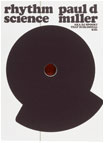 Last month, I had the good fortune to speak briefly with Peter Lunenfeld at the Scholarship in the Digital Age conference at USC. I was surprised to learn that this famous digital media theorist is currently obsessed with a print-based initiative. His new Mediaworks Pamphlets are “theoretical fetish objects for the 21st century” – elegantly produced collaborations between designer and writer, intended to break serious media theory out of “the hermetically sealed spheres of academia and the techno-culture” and into the public discourse, much like the famous collaboration between Marshall McLuhan and Quentin Fiore, “The Medium is the Massage.” By shifting reading, writing and design practices to the screen, Lunenfeld argues, digital media have effectively “taken the weight off” of the print codex, enabling its tactile qualities to flower anew.
  There is room now to play and invent in the realm of paper, and a resulting emphasis on the pursuit of pleasure and grace in the experience of book objects. As evidence of the resurgent fetish book, Lunenfeld points to the immaculate productions of McSweeney’s, which has made its mark by coupling serious literary output with elegant design at relatively low cost to the reader.
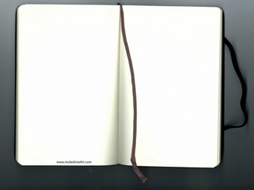
Another sign of this resurgence is the Moleskine phenomenon – those indelible oilskin-bound notebooks reissued in 1998 from the classic French design, famously employed by Chatwin in his travels, and, if the packaging is to be believed, by Hemingway, Van Gogh and Picasso as well. 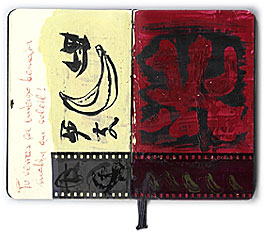 Nowadays, Moleskines are favored by aesthetes and design sophisticates with a propensity for jotting things down, and is especially beloved by the blogging and techie communities, further evidence that this renewed fetish interest is intimately linked to the experience of networked, digital culture. In fact, Moleskine culture is a flourishing niche on the web, with blogs, art sites, and a full Wikipedia entry devoted solely to the flights of invention (Moleskine hacks etc.) and cult of personal record-keeping arising from this little black book.
Returning to Lunenfeld’s fetish theory with McSweeney’s as exemplar, it’s almost too perfect that McSweeney’s founder Dave Eggers’ new book of short stories, How We Are Hungry, should be bound exactly like a Moleskine, complete with elastic fastening band. But whereas my notebooks have held up admirably through miles of travel and years of abuse, the elastic strap of my copy of the Eggers book broke after a single day’s jostling in my bag. Take note, McSweeney’s…
powers of 10
 The Pew Internet & American Life project’s recent report, The Future of the Internet, surveys the opinions of a broad assortment of scholars, web pioneers and technophiles on where they think the Internet is headed over the coming decade. Partnering with the Pew project, Elon University is running a related initiative, Imagining the Internet, which “examines the potential future of the Internet while simultaneously providing a peek back into its history.” The centerpiece of this project is a “Predictions Database,” pooling the prognostications of web luminaries and average joes alike. A great resource.
Pew and Elon aren’t the only ones talking about that slender ten-year slice known as the history of the Internet. A conference next week in Amsterdam at The Institute of Network Cultures will be spending two days discussing “a decade of web design.” Future of the Book will be coming to you live from the conference.
Pew participants more or less agreed on a few broad projections: that publishing and the news will undergo further dramatic change as blogs and other web phenomena continue to break apart and redefine the mass media structures of the past century (see also the Pew report on blogging); that “the Internet will be more deeply integrated in our physical environments and high-speed connections will proliferate – with mixed results”; and that network infrastructure will likely suffer a major attack.
 This last point is echoed in another recent speculative work, in this case, a work of fiction by former white house counter-terrorism chief Richard Clarke in the latest issue of The Atlantic Monthly (which annoyingly isn’t readable on the web without subscription). The story, titled Ten Years Later, is a concocted transcript of the Tenth Anniversary 9/11 Lecture given at the Kennedy School of Government in Cambridge. If you like having nightmares, go read this piece. At this imaginary lectern, Clarke delivers a hellish litany of terrorist attacks and domestic security crackdowns, painting an America even more paranoid and locked-down than the one we live in now. Among his grim predictions is “virtual war” in 2008 in the form of a “Zero Day worm” launched by Iran in cooperation with al-Qaeda which effectively shuts down the US economy.
Scary stuff, but probably important to keep in the back of one’s mind as we try to imagine the future of books and communication in the digital era. Technology does not develop in a vacuum, nor does culture. Think of the massive creative response to the wars that ravaged the earth in the twentieth century. How will artists and culture as a whole respond to the ravaging of a virtual world that is increasingly as real as the material one?
hyperlinking the eye of the beholder
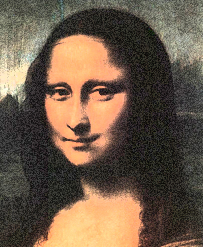 What if instead of just taking dorky pictures of your friends you could use your camera phone as an image swab, culling visual samples of the world around you and plugging them into a global database? Every transmitted picture would then be cross referenced with the global image bank and come back with information about what you just shot. A kind of “visual Google.”
This may not be so far away. Take a look at this interview in TheFeature with computer vision researcher Hartmut Neven. Neven talks about “hyperlinking the world” through image-recognition software he has developed for handheld devices such as camera phones. If it were to actually expand to the scale Neven envisions (we’re talking billions of images), could it really work? Hard to say, but it’s quite a thought – sort of a global brain of Babel. Think of the brain as a library where information is accessed by sense (in this case vision) queries. Then make it earth-sized.
Here, in Neven’s words, is how it would work:
“You take a picture of something, send it to our servers, and we either provide you with more information or link you to the place that will. Let’s say you’re standing in front of the Mona Lisa in the Louvre. You take a snapshot with your cameraphone and instantly receive an audio-visual narrative about the painting. Then you step out of the Louvre and see a cafe. Should you go in? Take a shot from the other side of the street and a restaurant guide will appear on your phone. You sit down inside, but perhaps your French is a little rusty. You take a picture of the menu and a dictionary comes up to translate. There is a huge variety of people in these kinds of situations, from stamp collectors, to people who want to check their skin melanoma, to police officers who need to identify the person in front of them.”
But the technology has some very frightening implications as well, chief among them its potential for biometric human identification through “iris scanning and skin texture analysis.” This could have some fairly sensible uses, like an added security layer for banking and credit, but we’re dreaming if we think that will be the extent of it. Already, the Los Angeles Police Department is testing facial recognition programs based on Neven’s work – a library of “digital mugshots” that can be cross referenced with newly captured images from the street. Add this to a second Patriot Act and you’ve got a pretty nasty cocktail.
top selling ebooks of 2004 announced
 Though still tiny, the ebook industry has been growing steadily since everyone pronounced its stillbirth a few years back. But right now it pretty much tracks the print figures – a faint, crackling aura around the print goliath. Pretty predictable stuff. I say it’s time for something new, for something born digital, to occur…
The Open eBook Forum (OeBF) announced the bestselling electronic titles of 2004 (press release) and reported double digit growth for the fledgling industry. Sci-fi, reference books, and the work of Dan Brown (who holds places 1 through 4) figure prominently on the top 30 list, along with a smattering of other print bestsellers. (yawn)
the ideal device
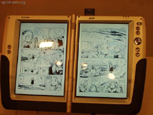
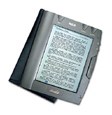
Bob wrote a couple of days ago about the new French Cybook – a sleek, but heavy, new ebook reader. Everyone interested in serious electronic books is waiting for the ideal device to come along, so that screen-based reading will be as comfortable paper-based. The benchmark for most is: “can I take it into bed with me?” 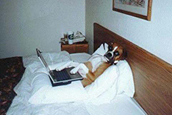 This is a very serious question (people who sleep with their laptops notwithstanding). But my hunch is that these successive generations of reading devices are missing the point. Who wants a device that is just for reading books? I don’t have a bag devoted exclusively to toting paper books. I carry many things together – books, pens, magazines, cds, maps, pictures, food etc. People are already using their cell phones for just about everything.
I think what we’re waiting for will be descended from laptops. They will likely resemble tablets, or even scrolls. It’s hard to predict. But take a look at this nice post at Word Munger from last year. I think this is on the right track.
Would love to hear some ideas….
e-culture report from the netherlands
Recently translated into english, From ICT to E-culture is an “advisory report on the digitalisation of culture and the implications for cultural policy” submitted by the Netherlands Council for Culture in 2003. Survey of the changing landscape..
what’s a library?
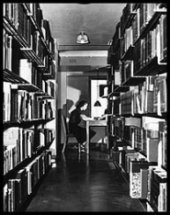 In a recent discussion in these pages, Gary Frost has suggested that the Google library model would be premised on an inter-library loan system, “extending” the preeminence of print. Sure, enabling “inside the book” browsing of library collections will allow people to engage remotely with print volumes on distant shelves, and will help them track down physical copies if they so desire. But do we really expect this to be the primary function of such a powerful resource?
We have to ask what this Google library intitiative is really aiming to do. What is the point? Is it simply a search tool for accessing physical collections, or is it truly a library in its own right? A library encompasses architecture, other people, temptations, distractions, whispers, touch. If the Google library is nothing more than a dynamic book locator, then it will have fallen terribly short of its immense potential to bring these afore-mentioned qualities into virtual space. Inside-the-book browsing is a sad echo of actual tactile browsing in a brick-and-mortar library. It’s a tease, or more likely, a sales hook. I think that’s far more likely to be the way people would use Google to track down print copies – consistent with Google’s current ad-based revenue structure.
But a library is not a retail space – it is an open door to knowledge, a highway with no tolls. How can we reinvent this in networked digital space?
more thoughts on salinas
Instead of becoming obsolete or extinct, local libraries should become portals to the global catalogue – a place where every conceivable text is directly obtainable. Instead of a library card, I might have a portable PC tablet that I use for all my e-texts, and I could plug into the stacks to download or search material. In this way, each library is every library.
But community libraries shouldn’t simply be a node on the larger network. They should cultivate their unique geographical and cultural situation and build themselves into repositories of local knowledge. By being freed, literally, of the weight of general print collections, local branches could really focus on cultivating rich, site-specific resources and multimedia archives of the surrounding environment.
 In Salinas, for example, there are two bookshelves of Chicano literature at the Cesar Chavez Library – a precious, unique resource that will soon be inaccessible as libraries close to solve the city’s budget crisis. With all library collections digitized, you wouldn’t have to physically be in Salinas to access the Chicano shelves, but Salinas would remain the place where the major archival work is conducted, and where the storehouse of material artifacts is located.
It would be a shame for libraries to lose their local character, or for knowledge to become standardized because of big equalizers like Google. But when federal and municipal money is so tight that libraries are actually closing down, can we really expect the digitization of libraries to be achieved by anyone but the big commercial entities (like Google)? And if they’re the ones in charge, can we really count on getting the kind of access to books that libraries once provided? (image: Cesar Chavez Library, Salinas)