
With MGM vs. Grokster fast approaching (initial hearings have been set for March 29), several amicus briefs have recently been filed with the Supreme Court in impassioned and eloquent defense of peer-to-peer file sharing. Notable among them are a brief filed Tuesday by a group of 17 computer scientists, and another filed today by 22 media studies scholars. Each accuses both the court and the petitioners (MGM) of “fundamental misunderstanding.” Of technology, in the view of the scientists. And in the view of the scholars, of “fair use” and the importance of p2p in the academy and in the construction of collective memory. To drive home this last point, the scholars direct our attention to the landmark 1984 Sony vs. Universal case in which the legality of VCRs (VTRs at the time) was challenged and ultimately upheld. There’s no doubt that MGM vs. Grokster is the Sony vs. Universal for this generation.
From the media scholars:
“…the unambiguous declaration by the Ninth Circuit Court of Appeals inGrokster — that the standards this Court set forth in Sony are alive and appropriate for this digital age — does grant educators comfort and confidence. Nor do certain “compromise” positions outlined in briefs submitted in support of neither party in this case protect the interests of educators and researchers. Ultimately, we wish to encourage the Court to consider that Sony did more than legalize home taping and “time shifting.” It democratized participation in the project of recording the collective memory of this dynamic nation. Sony went beyond the traditional parameters of fair use and showed the potential for an emerging set of clearly articulated “users’ rights.” Teachers, scholars, critics, journalists, fans, and hobbyists would all benefit greatly under a regime that offered them clarity and confidence about how they interact with works and the copyright system that governs them.”
Author Archives: ben vershbow
non, merci
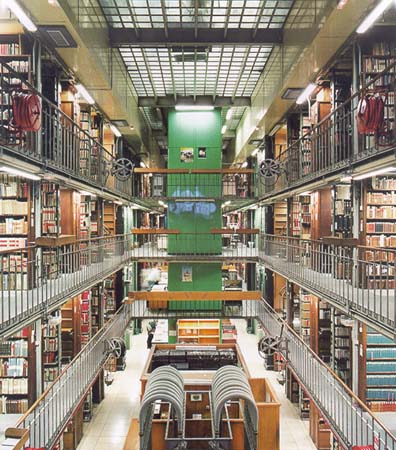
Jean-Noel Jeanneney, the head of France’s national library (BNF), has raised a “battle cry” (Le Figaro) against the cultural and linguistic imperialism of America. But this time, it’s not about Big Macs and slang coming to massacre the French langauge. It’s about Google and its plans to digitize libraries, which, Jeanneney says, will put a distinctly anglo stamp on the greater part of the world’s knowledge (Reuters). Encouraging Europe to take part in this massive project seems like a good idea – for the sake of diversity, but more important, to offer a possible alternative to Google’s approach, which was devised in the absence of any real competition. Google Print‘s interface is limited to a snapshot tour of a book, with minimal search capabilities. They’re essentially doing for books what A9 is doing for streets, with souped-up scanners instead of trucks with camera mounts. It’s a browsing tool and not much more.
Google’s stock is soaring not only because it is a great engine, but also because it has pioneered a new kind of search-based advertising. There’s been a lot of high-minded conjecture (e.g.) as to what Google Print might mean for humanity – rhapsodic allusions to Borges and the library of Alexandria. But the great global library of our dreams probably won’t be created by Google. You could say that we are all creating it, that the web is that library. But without getting too breathless, think of the fact that with each passing year we move further and further into a paperless world. We will need well-designed electronic books in a well-designed electronic library, or matrix of libraries. So it’s heartening that a serious institution like BNF wants to get in on the game. Maybe they can do better. A good indication that they could is their recently announced project (sorry, only French link) to build a free online archive of 130 years of French newspapers and periodicals – 29 publications in total, running from 1814 to 1944. But then again, perhaps they simply want to secure a place in Google’s illustrious coalition of the willing: Harvard, Oxford, U. of Michigan, Stanford, and the New York Public Library.
paperback ebook
 Booktopia, a Korean ebook developer, is introducing a 29-title series for mobile users based on popular movie scenarios (article), including the recent Cannes hit Old Boy (thanks, textually.org). The books act as supplements to the films, with omitted material and glimpses behind-the-scenes, sort of like special features on a DVD (though it appears that they will be text-only). They also seem to riff on that weird tie-in genre of books adapted from the screen (I’ve always wondered who reads those books..).
So are phones the electronic book in embryo? If you are looking for innovation in form, what’s happening on cell phones and mobile devices is far more interesting than what you’ll find in the area of conventional “ebooks,” which generally are the kind of pdf nightmare Dan decribes in his post yesterday. But so far, these kinds of mobile books, or mbooks, are to literature what ring tones are to music. The cell phone has become a kind of cud for the distracted brain to chew – I can’t count how many people I see on the subway or waiting in lines simply fiddling with their phone settings. What seems to be developing on cell phones is a new kind of ephemera descended from the pamphlet, flyer, or broadsheet, which will be tightly interwoven with advertising (these Korean movie tie-ins do leg work for the actual films, just as the new 24 spinoff offered on Verizon plugs the Fox television series). But what about actual books? Serious reading to counterbalance all the fluff. Portable devices like phones and palm pilots lend themselves to the serial model. Their diminutive size makes them better suited to smaller chunks of material, and their access to networks allows them to constantly grab new chunks. But I don’t see why quality has to be sacrificed. Perhaps, with time, the tradition of serialized narrative will be reinvented in meaningful ways. Many of Dickens’s novels were published and written serially, and he was able to modulate the course of his writing according to reader response and sales. Digital content delivery over cell phones and the web could employ the same fluidity, delivering the book as it is becoming, and creating whole communities of readers on the web (see earlier post elegant map hack). An interesting prospect for writers as well as readers.
 These literary experiments on the tiny screen are probably not trivial, even though the content may be. They seem to be saying “hurry up” to our more sophisticated but unwieldy reading devices like laptops and tablets. We need a kind of paperback ebook, in between a laptop and a smartphone – cheap and easy to tote. If I can comfortably read on this device in a crowded subway, then we might finally have something as handy as a paper book, conducive to any kind of content, with all the affordances of computers and the web. And ideally… I can write on it with a stylus, or on a keyboard that it projects on a tabletop, and I can dock it at a more powerful workstation in my office. I can plug in headphones or speakers and explore my music library, or surf satellite radio. I can watch a film that I made, or one that I downloaded, or I can flip through my photo album. If I’m lost, I can get a map with pictures of the place I’m trying to find. And at night, I can curl up with it in bed, reading by the light of its built-in candle. I may even have glasses I can plug in and read the book without hands, or look at images in 3-D like on a stereopticon. (Kim, I think I may have my fantasy ebook) Nothing could ever truly replace paper books for me, but a pan-media tablet – an everything device – might just become my everyday companion.
big plans for the tiny screen
Late last week, Random House announced it was making the microlit plunge, acquiring a “significant minority stake” in wireless applications developer VOCEL (AP wire story).
Says Random House Ventures president Richard Sarnoff: “You have a whole generation of consumers, perhaps more than a generation, who are never more than 10 feet from their cell phones, including when they shower. Increasingly, cell phones are becoming an appliance for entertainment and education.”
But, despite the success of cell phone novels and serials in Japan, South Korea and Germany, Sarnoff insists that tiny screens have a potential for information, but not for narrative. “The screens are inappropriate for that kind of sustained reading. That’s a `maybe, someday’ discussion. We’ll keep an eye on that area, and if something happens … we’ll certainly respond.”
So for the time being, Random House will be testing mobile phones for language instruction, test prep, and other informational services.
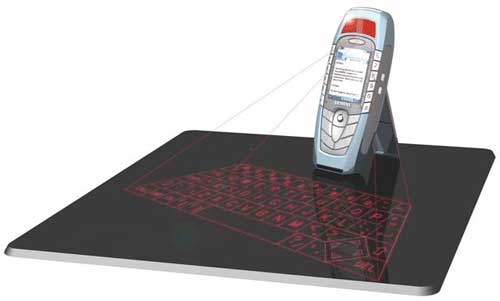
In a related vein, textually.org, an invaluable resource for the microlit observer, recently posted about Radio Shack‘s plans to sell stand-alone virtual keyboard units the size of a “small fist.” Virtual keyboards project a regular-sized typing area on a flat surface, registering keystrokes via Bluetooth onto a smartphone or personal digital assistant (PDA). VKB, the developer of the technology, recently announced its goal of making the virtual keyboard an embedded feature in mobile devices by next year. Further suggestion that cell phones and laptops are evolving into one another.
it’s mobisodic
 Teaming up with Verizon V Cast, a new spinoff of the popular Fox series 24 is beginning a high profile push into the fledgeling market of serialized mobile video. The show, 24 Conspiracy, will be available to subscribers in 24 sixty-second “mobisodes.” This means the entire program is 24 minutes long – not much more than an extended commercial for Fox, and a gimmick for selling more expensive phones. But perhaps this could open the floodgates for longer, more varied programming for mobile users. If HBO wants to stay on the cutting edge, they should probably open up a mobile programming division. How long before John Grisham or Dan Brown writes the first big serial blockbuster for cell phones?
Also, story in today’s NY Times..
the web in the world
In ten years, the world wide web has become an indispensable fact of life. Where do we take it next? At the conference’s closing plenary session, Peter Lunenfeld asked a similar question: “What is the next big dream that will keep us going? Are we out of ideas?” He then offered something called “urban computing” as a possible answer.
Here is my attempt (rather long, I apologize) to jump on that dream…
I live in New York, and in the past few years I’ve observed a transformation. My neighborhood coffee shop looks like an advertisement for Apple. At any given time, no less than two thirds of the customers are glued to their laptops, with mugs of coffee steaming in perilous proximity. 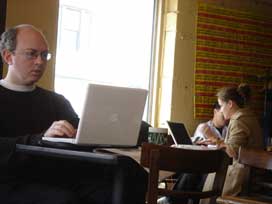 Power cords snake among the tables and plug into strips deployed around the cafe floor. Go to the counter and they’ll be happy to give you a dog-eared business card bearing the password to their wireless network. Of course, people have been toting around notebook computers since they first became available in the mid-80s, and they’ve certainly been no stranger to coffee shops. But with the introduction of Wi-Fi people are flocking in droves. Some kind of exodus has begun.
It’s a familiar sight throughout the more cosmopolitan neighborhoods of the city. Go to any Starbucks on the Upper West Side and you’re competing with half a dozen other customers for a space on their too-few powerstrips. And their Wi-Fi service isn’t even free. And come spring, I predict the same will occur in the city’s parks, especially those downtown, which are rapidly being integrated into a massive wireless infrastructure. No single entity is responsible for this, rather a lattice of different initiatives working toward a common goal: free high speed Wi-Fi coverage across Manhattan.
Mobile web and messaging technologies have already created a new breed of roving web users. Cell phones, PDAs, text messaging, Blue Tooth, RSS, podcasting (the list goes on..) have swept into our daily life like a tidal wave. More and more, we’re able to read, search, capture, edit, and send on the go, and with satellite-fed positioning technologies, we can pinpoint our location at any given time. What we have is the beginnings of a kind of “augmented reality” where information relates intimately to place, and vice versa. The world itself can now be as searchable, linkable, and informative as the web – a synthesis, or overlay, of real and virtual realities.
So the next big dream could be the evolution of the web into something more than a desktop system – into something that we can use while moving, and interact with anywhere.
laptops for the masses
MIT Media Lab founder Nicholas Negroponte is developing a line of laptop computers that will sell for less than $100 a piece. The textbook of the future?….
>>BBC article
little red book
Very interesting review of McKenzie Wark‘s A Hacker Manifesto, recently published by Harvard University Press. In the manifesto (shorter version), Wark outlines a class struggle over “vectors” – the information channels of a society. In his words:
 “With the commodification of information comes its vectoralisation. Extracting a surplus from information requires technologies capable of transporting information through space, but also through time. The archive is a vector through time just as communication is a vector that crosses space. The vectoral class comes into its own once it is in possession of powerful technologies for vectoralising information.–The vectoral class may commodify information stocks, flows, or vectors themselves. A stock of information is an archive, a body of information maintained through time that has enduring value. A flow of information is the capacity to extract information of temporary value out of events and to distribute it widely and quickly. A vector is the means of achieving either the temporal distribution of a stock, or the spatial distribution of a flow of information. Vectoral power is generally sought through the ownership of all three aspects.”
the tomorrow book
 “The Jan van Eyck Academie and the Charles Nypels Foundation invite designers, book critics, book theoreticians and book makers to submit project proposals in the context of the research project ‘The tomorrow book. Navigating to, within and beyond the book’. ‘The tomorrow book’ intends to query the future of the book from a multi-disciplinary standpoint. In doing so, the following aspects will be treated: editing, typography, book design, publishing and distribution. The umbrella theme of the project is navigation towards, inside and outside of the book. Research candidates can submit project proposals for ‘The tomorrow book’ up to 15 April 2005.”
More information on “the tomorrow book” research…
from aspen to A9
Amazon’s search engine A9 has recently unveiled a new service: yellow pages “like you’ve never seen before.”
“Using trucks equipped with digital cameras, global positioning system (GPS) receivers, and proprietary software and hardware, A9.com drove tens of thousands of miles capturing images and matching them with businesses and the way they look from the street.”
 All in all, more than 20 million photos were captured in ten major cities across the US. Run a search in one of these zip codes and you’re likely to find a picture next to some of the results. Click on the item and you’re taken to a “block view” screen, allowing you to virtually stroll down the street in question (watch this video to see how it works). You’re also allowed, with an Amazon login, to upload your own photos of products available at listed stores. At the moment, however, it doesn’t appear that you can contribute your own streetscapes. But that may be the next step.
I can imagine online services like Mapquest getting into, or wanting to get into, this kind of image-banking. But I wouldn’t expect trucks with camera mounts to become a common sight on city streets. More likely, A9 is building up a first-run image bank to demonstrate what is possible. As people catch on, it would seem only natural that they would start accepting user contributions. 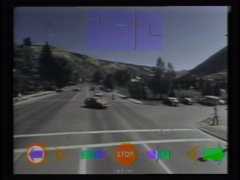 Cataloging every square foot of the biosphere is an impossible project, unless literally everyone plays a part (see Hyperlinking the Eye of the Beholder on this blog). They might even start paying – tiny cuts, proportional to the value of the contribution. Everyone’s a stringer for A9, or Mapquest, or for their own, idiosyncratic geo-caching service.
A9’s new service does have a predecessor though, and it’s nearly 30 years old. In the late 70s, the Architecture Machine Group, which later morphed into the MIT Media Lab, developed some of the first prototypes of “interactive media.” Among them was the Aspen Movie Map, developed in 1978-79 by Andrew Lippman – a program that allowed the user to navigate the entirety of this small Colorado city, in whatever order they chose, in winter, spring, summer or fall, and even permitting them to enter many of the buildings. The Movie Map is generally viewed as the first truly interactive computer program. Now, with the explosion of digital photography, wireless networked devices, and image-caching across social networks, we might at last be nearing its realization on a grand scale.