
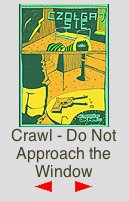
 The Digital Museum of Modern Art, a virtual exhibition space, is featuring “Czolgaj Sie” (“Crawl”), verses by Polish poet Marcin Swietlicki, illustrated by fellow countryman Cezary Ostrowski. The poem is exhibited on the museum’s website, and has also been optimized for reading on a mobile phone.
I’m not crazy about the poem, but it’s an intriguing experiment. Is there a Flash plugin for phones so one can view dynamic text (like this)?
(via textually)
Author Archives: ben vershbow
franco-googlian wars continue…
“…news agency Agence France Press (AFP) is claiming damages of at least $17.5 million and a court order barring Google News from displaying AFP photographs, news headlines or story leads…” (story)
This recalls Virginia’s post a couple months back on “the future of the news.” Will news aggregators and headline-scouring robots be accused of copyright infringement? Will other news providers follow AFP’s lead?
(via Searchblog)
novels on your phone

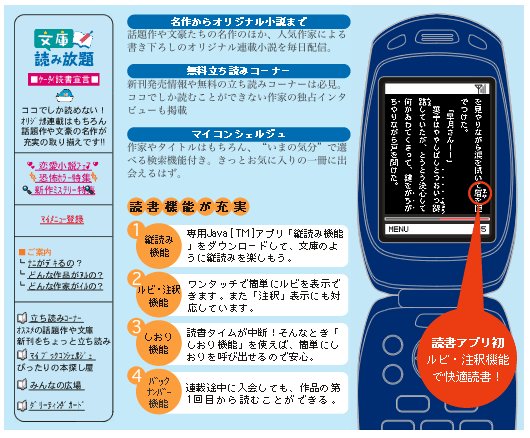
There was a great AP article yesterday on the recent boom in cell phone novels and serials in Japan. The top and bottom images here are pulled from “Bunko Yomihodai,” or “All You Can Read Paperbacks” – a popular microlit site with over 50,000 subscribers, offering 150 titles written or adapted specially for reading on phones.
“In the latest versions, cell-phone novels are downloaded in short installments and run on handsets as Java-based applications. You’re free to browse as though you’re in a bookstore, whether you’re at home, in your office or on a commuter train. A whole library can be tucked away in your cell phone — a gadget you carry around anyway.”
True. Right now, the cell phone is the ultimate indispensable gadget. It’s with us practically all the time. No wonder it’s the first place that electronic books are gaining a foothold.
And the content is varied…
“Surprisingly, people are using cell-phone books to catch up on classics they never finished reading. And people are perusing sex manuals and other books they’re too embarrassed to be caught reading or buying. More common is keeping an electronic dictionary in your phone in case a need arises.”
Microlit hasn’t really taken off here in the States, though there are a few signs that suggest a gradual movement in this direction. There was a bit of buzz about a month ago when Random House acquired a significant minority stake in wireless applications developer VOCEL. And more people seem to be using their phones and PDAs for reading – everything from websurfing, to RSS feeds, to downloaded books (or even raw text files of public domain literature – I tried this on my iPod with this fun hack). But we have yet to see any kind of full-blown lit phenomenon.
 The breakthrough work in Japan was a serial called “Deep Love,” the story of a teenage prostitute in Tokyo. It became so popular that it was published as an actual book, and spun off into a TV series, a manga (comics), and a movie. Now the author, named simply Yoshi, is trying his hand at thrillers. From the article:
“Another work by Yoshi, a horror mystery, has a cell-phone Web link that readers click. One pulls up a video clip of a bleeding face; another shows a letter that tells people to go on living.
“Yoshi, a former prep-school instructor who sees his readers as “a community,” reads the dozens of e-mail messages teenage fans send him daily and uses their material for story ideas.
“He also knows immediately when readers are getting bored and changes the plot when access tallies start dipping for his stories.
“‘It’s like playing live music at a club,'” he said. ‘You know right away if the audience isn’t responding, and you can change what you’re doing right then and there.'”
Remember that Dickens often wrote in this way. Perhaps we are witnessing the return of serialized novels.
50 people see… a networked picture book
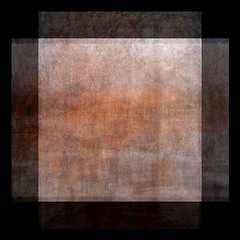 This image was created by blending 50 photos in Flickr all tagged with “the gates” (the program was devised by brevity). You can see the complete set of images here. Try guessing the tag for each image – I found that, even though they are quite abstract, there are ghostly traces of shape and line that quietly announce themselves. It sort of whispers to you.
There is often a kind of ethereal beauty in network maps. They resemble something living, fibrous, arterial. Brevity’s program achieves something rather different. It takes pictures – fragments of experience – and mixes them like a painter mixes pigments. The resulting colors and textures are reminiscent of deep, subconscious urges, like the color field paintings of Rothko, or Ad Reinhardt (thanks Alex). It portrays a kind of experiential network.
This was posted yesterday on the Gates Memory Blog, the discussion forum for our project (in collaboration with Flickr), “The Gates: An Experiment in Collective Memory.”
chirac vs. google
 French President Jacques Chirac has instructed the Bibliothè que Nationale de France to “draw up a plan” for a comprehensive online library of European literature to counter what is seen as the inevitably Anglo-Saxon bias of Google Print (see “non, merci”).
Reuters story: Chirac Rivals Google with French Online Book Plan
a book by Lawrence Lessig and you
Lawrence Lessig is inviting everyone to help revise and update his landmark 1999 book Code and Other Laws of Cyberspace on a public wiki, as a way of drawing “upon the creativity and knowledge of the community.” (story in Mercury News)
From the site: “This is an online, collaborative book update; a first of its kind. Once the the project nears completion, Professor Lessig will take the contents of this wiki and ready it for publication. The
resulting book, Code v.2, will be published in late 2005 by Basic Books. All royalties, including the book advance, will be donated to Creative Commons.”
As an experiment with networked books, this has a couple of big things going for it. For one, it is a pre-existent work with a large reader community. Like a stone tossed in the water, it creates ripples. Version 2 might benefit by incorporating these ripples. Secondly, Lessig will retain ultimate editorial authority, so we can be pretty sure that the final revision will be focused and well-shaped. And lastly, Lessig’s subject is so vast, so multi-dimensional, that the book will almost certainly benefit from broad reader/writer input. And for someone like Lessig, who is as much an activist as a scholar, constantly running around the world spreading his ideas, it is a nice way of asking for assistance in the time-consuming process of updating of a book that the world needs sooner rather than later.
Incidentally, Lessig will be appearing on April 7 at the New York Public Library with Wilco frontman Jeff Tweedy to discuss the question, “Who Owns Culture?” moderated by Steven Johnson. (thanks, NEWSgrist)
Tweedy says: “A piece of art is not a loaf of bread. When someone steals a loaf of bread from the store, that’s it. The loaf of bread is gone. When someone downloads a piece of music, it’s just data until the listener puts that music back together with their own ears, their mind, their subjective
experience.”
illuminated letters
Boing Boing links to a fun new toy called Web of Letters – a kind of automatic ransom note generator, pulling letters from Yahoo’s image search to compose the word(s) of your choice. Also take a look at this Flickr version (simply replace the “omegg” part of the URL with your desired word).

I tried both versions with “omEGG” – the title of a work in progress by the institute’s artist-in-residence Alex Itin. I found it resonated nicely with Alex’s work, which pulls on image fragments and cultural detritus, remixing and juxtaposing in fascinating ways. Both versions work quite well, but I found that on Web of Letters (first image) I had to click through several searches to find a mix that was pleasantly legible and didn’t use repeat sources. The Flickr hack (below) is nice in that you can change individual letters until you get it just the way you want it.

It’s a fun game that suggests how the web can be mined to illuminate content in playful ways (and to write ransom notes in a hurry).
generation M and the mediated mind
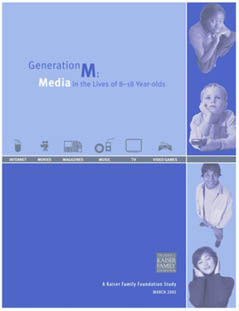 A major study of media consumption habits among American youth (ages 8-18) was released yesterday by the Kaiser Family Foundation. A “representative sample” of over 2,000 3rd through 12th graders were surveyed, including 700 who volunteered to maintain seven-day “media diaries,” charting media consumption in half hour chunks, noting location, company they had, and any simultaneous activities. Findings were announced at a high-profile release in Washington attended by Hillary Clinton and other luminaries.
The study finds that kids are often multitasking – absorbing several media simultaneously, often at consoles set up in their bedrooms. Average daily exposure is a full third of the day (8.33 hours), which, when combined with approximately a third of the day at school and a third of the day asleep (although most kids are probably not sleeping that much), amounts to nearly every waking, extra-curricular hour spent tuned in, logged on, glued to, etc…
The evidence of multitasking paints a picture of a generation skilled at combining passive and interactive media – the TV is on, but you’re also instant messaging with friends, and doing a bit of quick research on Google for that homework assignment. Constant skimming and constant scattering. Are these fractured minds in the making?
another great brief in the fight for p2p
There’s a growing body of legal literature defending peer-to-peer file sharing in the lead-up to the Supreme Court showdown, MGM vs. Grokster. Here’s one of the latest additions, an amicus brief filed today by the Free Software Foundation and New Yorkers For Fair Use. The following excerpt nicely skewers the petioners (thanks again, Boing Boing):
“At the heart of Petitioners’ argument is an arrogant and unreasonable claim–even if made to the legislature empowered to determine such a general issue of social policy–that the Internet must be designed for the convenience of their business model, and to the extent that its design reflects other concerns, the Internet should be illegal.
Petitioners’ view of what constitutes the foundation of copyright law in the digital age is as notable for its carefully-assumed air of technical naivete as for the audacity with which it identifies their financial interest with the purpose of the entire legal regime.
Despite petitioners’ apocalyptic rhetoric, this case follows a familiar pattern in the history of copyright: incumbent rights-holders have often objected to new technologies of distribution that force innovation on the understandably reluctant monopolist.”
(see MGM vs. Grokster: Brief Update)
l.i. library lends ipods
Boing Boing points to a library in Long Island that has recently started lending mp3 audio books on iPod shuffles, even throwing in casette adapters and FM transmitters for listening in the car. The library claims that they are saving a lot of money in the long run, since mp3 audio books cost significantly less than books on cd.
>>Wired story