
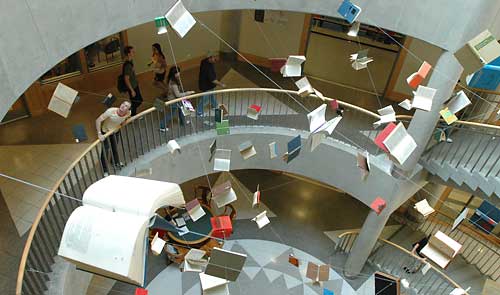
A new installation by J. Ignacio Diaz de Rabago in the atrium staircase of the Gardner stacks at Berkeley’s Doe Library (photograph from UC Berkeley News). Other works by Diaz de Rabago can be viewed here, including his multi-part “Babel” series, to which his latest presumably belongs.
(via Conversational Reading)
Author Archives: ben vershbow
out of print is out of date
Amazon.com has recently acquired BookSurge, the self-described “global leader in inventory-free book publishing, printing, fulfillment and distribution.” This adds cutting edge print-on-demand technology to Amazon’s online retailing recipe – big news for self-published authors, but even bigger news for readers. Amazon’s move suggests that print-on-demand might finally be maturing out of the terrible twos of the vanity press into a technology that redefines publishing in space and time. Imagine rare books suddenly coming back into print, and newer books staying in print longer, or indefinitely. Every book, no matter how old or obscure, could theoretically be in print, in perpetuity. Amazon already sells out-of-print or hard-to-obtain titles produced on demand by BookSurge, but their absorbing the company signals a definitive step futher into long tail bookselling. (article)
The backbone of any serious publishing house used to be its backlist – the large catalogue of older titles that sell reliably over time and are therefore kept in print. A backlist might include classics by the country’s most important authors, or books with more modest readership that still sell consistently over the years. It’s like the publisher’s DNA – a map of who they really are. On occasion, you have a runaway bestseller, and you rejoice, but it’s not something you count on. It’s the sturdy, distinguished backlist that keeps a publisher grounded. Today we have the opposite. Most publishing houses have merged under large media conglomerates, backlists have dwindled, and publishers are ever more obsessed with finding their next blockbuster hit – a Dan Brown or Sue Grafton. Books quickly go out of print, and many more – books that might have found a smaller, more select readership – probably never see the light of day since publishers aren’t willing to take on the cost and risk of a smaller print run.
But as Greg Geeley, Amazon.com media products vice president, puts it:
“Print-on-demand has changed the economics of small-quantity printing, making it possible for books with low and uncertain demand to be profitably produced… Thanks to print-on-demand, ‘out of print’ is out of date.”
People have been talking for some time about the internet’s potential to sweep away the stagnation of mainstream publishing. Amazon has already changed the way we browse, buy and discuss books. Now, with machines that can turn out a single book at a time, indistinguishable in appearance and quality from a regular trade paperback or even hardcover, no title need ever go out of print, and publishers might finally be able to direct their attention away from quantity and back to quality.
For further reading…
wireless fairy tales
Kids in Denmark may soon be reading Hans Christian Anderson on their cell phones. To celebrate the writer’s bicentennial, a Danish company is releasing an interactive comic book series designed specially for the tiny screen.
(via textually.org)
simple answers to simple questions
Looking for simple facts on the web can be a frustrating business. Over time, we bookmark sites that reliably deliver the goods – things like basic geographical data, conversion scales for measurements, biographical summaries, or anything else that we need to quickly grab, plug in, and move on. But it all takes much longer than it should, and in looking for such things, we’re plagued as much by the nuance of internet search as by its imprecision. It’s all part of learning how to deal with this massive web we’ve created, and the state of blindness to which it reduces us. Search engines are really the only tool we have for groping through a pitch black sea of information, where the ineluctable modality is meaning, not the visible (for more on this, read Steven Pemberton’s talk from the Decade of Web Design conference, which if:book attended this January in Amsterdam).
Well Google has helped us to see, just a little bit better, the little nuggets and factual crystals that we so often sift for in our blindness – by unveiling a new Q&A feature for basic web search (article via Bibliotheke). Plug in a search like “earth distance sun,” or “copernicus date of death,” and you get exactly what you’re looking for right above the stack of general results:

or

It’s the kind of small, thoughtful innovation that makes you appreciate Google’s attention to detail and sensitivity to the problem of blindness. Other search engines like Ask Jeeves offer a similar feature, but Google includes the information’s source (a source they’ve vetted and deemed reliable) and a link to that page. For example, in the case of basic geography and demographics, the link might be to the CIA’s World Factbook. Even if you just grab the fact and run, it’s comforting to have seen a trustworthy citation, though some might grumble about the CIA.
It would be fantastic if this kind of quick fact extraction could be tailored to different search needs. Imagine a “writer’s search toolbox” combining every conceivable reference resource that an author might need. Enter “synonym for think” and right at the top you get an entire thesaurus search result: “analyze, appraise, appreciate, brood, cerebrate, chew, cogitate, comprehend, conceive….” Enter “idiom with humble” and you get “eat humble pie,” “Be it ever so humble, there’s no place like home,” etc. Or search for rhymes, poetic forms, grammar guidelines, literary terms, writer bios, quotes, etymologies – anything. It’s good news that search is being refined in this way, and competition among giants seems, in the end, to be good for the average web browser. Whatever helps us spend less time scouring and more time on the things that are important to us.
sony patents prophetic invention
Sony has secured a patent for a theoretical device that creates “sensory experiences” in the brain by sending ultrasonic pulses directly to the neural cortex – a non-invasive (that is, non-surgical) procedure, with the potential to give sight to the blind, or sound to the deaf. Gives a glimpse at what these tech giants are imagining for human entertainment further down the road.
From New Scientist – “Sony patent takes first step towards real-life Matrix”:
Elizabeth Boukis, spokeswoman for Sony Electronics, says the work is speculative. “There were not any experiments done,” she says. “This particular patent was a prophetic invention. It was based on an inspiration that this may someday be the direction that technology will take us.”
Link to patent.
(via Boing Boing)
food for thought

(photograph by Gregory Vershbow)
mapping memory
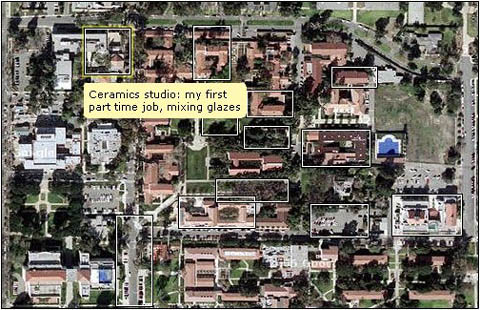
Flickr has a wonderful annotation feature that allows you to attach notes to boxes drawn around sections of an image. Someone had the great idea of using Google satellite images of their hometown, or other significant locales in their life history, to make “memory maps.”
We’ve been thinking a lot about using film or music as a time-based “spine” for an electronic book. This experiment suggests the narrative possibilities of maps and images – not simply as reference points or illustrations on a page, but as dynamic agents. The folks at Grand Text Auto appear to be thinking along similar lines.
This also relates to the institute’s current Born Digital Competition, which deals with reinventing the page illustration in digital space. Memory mappers take notice!
viral video lit
Faced with declining coverage of books in newspapers and magazines, writers are constantly looking for new ways to promote their work on the web. Literary blogs have done a lot to fill in the gaps left by print, covering lesser-known authors and titles translated from foreign languages, and even revisiting older works. And since many lit bloggers are writers themselves, the blogs serve as a virtual salon where writers and intellectuals come to spar about literature, recommend books, and share their own work. Cory Doctorow offers free, cc-licensed downloads of his novels, attracting readers, generating buzz, and bolstering sales of his books in print. Others are sneakier, deploying anonymous 5-star reviews under their own titles to boost sales on Amazon.
The latest, and probably most expensive, trick is video lit, or book shorts – brief little films (like movie trailers or music videos, but for books) designed to be spread virally through email, blog shout outs, and links, just like the digital tidbits – video clips, images, sites, articles – we stumble upon and circulate daily among friends and family. If people like what they see, they can buy the book (a convenient link to Amazon or Barnes & Noble is provided).
 It sounds a bit cock-eyed to advertise books as though they were movies, but proponents of the form say it can get results. There’s a piece in Wired that profiles some of the writers who have experimented with the form, and the little production houses that help them do it. The most frequently cited example is a Flash-animated encapsulation of “Yiddish With Dick and Jane,” a borscht-belt-infused pastiche of the iconic 1950s children’s reading primers. Not too long ago, the 2:45-minute film, produced by a company called Vidlit, was getting passed around incessantly on the web, while at the same time, the physical book flew like hot cakes off the shelves, going on to sell over 150,000 copies. Whether the two are related is hard to say. The book was pretty heavily promoted in stores as a no-brain-required gift item. But Vidlit touts this as a coup of viral advertising.
BookShorts, a Canadian company, produces full live action films for its titles. I watched the book short for Susan Swan’s novel “What Casanova Told Me” and was not terribly impressed. It comes off like a preview for a TV movie adaption of a trashy book. But the Dick and Jane example, silly as it is, suggests how clever design and a quick one-two punch can get you a lot of mileage on the web. If people like the idea (and clearly they did), and if the film possesses a kind of must-see quality (the visual equivalent of a good one-liner, a zinger), then people might feel compelled to shuffle it voluntarily through the web. I could see this perhaps working for a political tract or manifesto, or for a religious text – something that is compulsive and seems to contain the seeds of larger truths or revelations. Imagine if this piece were connected to a book (click “Knife Party,” then again in new window, then watch “What Barry Says” by hitting “click here” at the bottom). Breathtaking visuals and a compelling political premise combine to whet the appetite for further reading.
britannica storms wikipedia – networked accumulatio
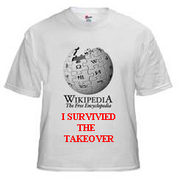
 Beginning on as an april fool’s prank, Britannica’s hostile takeover of Wikipedia has snowballed over the past few days into a sprawling collaborative goof-off on a nerdy conspiracy theory. The article is currently being considered for deletion, or consignment to Wikipedia’s Bad Jokes and Other Deleted Nonsense archive. A funny specimen of web accumulatio (thanks, Infocult).
a new kind of newspaper
 Dan Gillmor points to what might be the beginning of something big, exciting and a little scary: user-generated newspapers. Bluffton Today, a free daily serving the small, but rapidly growing, South Carolina town of Bluffton (10,000 households, expected to double in the next five years), hits the racks this morning, filled with news, local events listings, and classifieds, culled in large part from reader contributions on the paper’s website. Bluffton Today.com is “a new kind of community website that joins with the Bluffton Today newspaper in a mission of helping Bluffton come together as a community.” Run in Drupal, a popular open source “community plumbing” platform, Bluffton Today weaves together blogs, photo-sharing, discussion forums, and classified ads into the living picture of a community. Everyday, the editors will assemble the print edition from content generated on the website, proving they mean what they say in the paper’s slogan, “It’s what people are talking about!” Browsing through, I found photo galleries ranging across topics like the recent passing of Pope John Paul, graduating Marines on Parris Island, the local SWAT team in training, a bar mitzvah, and life guards. Bluffton blogs (this is where you go when you click “news”) were discussing the Pope’s death, local sports events, surveys of the night’s television offerings, a golf story, and a plug for the Beaufort Humane Association.
Bluffton Today certainly seems like a powerful model for community reporting, but is there any potential here for serious journalism? So far, blogs have proven most effective as watchdogs for the mainstream media – calling out the bullshitters, filling in the gaps, refusing to let certain stories be buried or spun, and occasionally pulling off the dazzling revelation or exposé. They also paint an organic picture of how events ripple through society, registering, like a seismograph, the intensity, direction, and duration of a story. Recall the case of the tsunami, in which the million human voices crying out in the blogosphere balanced the monolithc coverage of the press. But this is not the same thing as providing consistent, exhaustive coverage of events. How could we get any reliable information without a professional class of journalists with the resources and training to extract truth from complex, hectic, or even dangerous circumstances? The blogs would largely dry up if they didn’t have the professional news to feed off of. This is not to say the news is complete, fair, or immune to corruption. But without it, web-based discussions would become incoherent.
There was a time when the only way to publicly comment or complain about a newspaper was in the paper’s own “letters to the editor” page. But we have entered an age in which readers have unprecedented opportunities to comment and even contribute to the news. Small communities like Bluffton might become entirely self-sufficient in the management of their information, while larger news outlets will probably have to evolve to incorporate grassroots journalism. Who knows? The New York Times might eventually establish a massive community portal on the Bluffton model to supplement its professionally generated news with contributions from community “stringers,” redefining what is meant by a story’s “source.”
But amidst all this change, the ingredient that must not be lost is editors. Bluffton Today reserves editorial authority, and this is precisely what makes them so interesting. They are betting that their content will be more colorful, nuanced, and (hold your breath) accurate, if they open up the news gathering process to the community. But they also seem to understand that this makes the role of editors all the more crucial. It’s an experiment worth watching.
Another recently launched initiative worth keeping an eye on (and participating in) is Our Media, a community-generated, community-maintained “home-brew” media warehouse, hosted by the Internet Archive. They are experimenting with guest editors for assembling the archive’s homepage, and with volunteer moderators for their various discussion forums. From the site:
“Ourmedia’s goal is to expose, advance and preserve digital creativity at the grassroots level. The site serves as a central gathering spot where professionals and amateurs come together to share works, offer tips and tutorials, and interact in a combination community space and virtual library that will preserve these works for future generations. We want to enable people anywhere in the world to tap into this rich repository of media and create image albums, movie and music jukeboxes and more.”