Author Archives: ben vershbow

wikipedia keeps apace

Barely 24 hours after being selected as the 265th Pope, Cardinal Joseph Ratzinger, now Benedict XVI, has his own Wikipedia article. Actually, Ratzinger did previously have his own page, but it was moved yesterday to the new Benedict XVI address and has since undergone a massive overhaul. 180px-Ratzinger_soldierjpg.jpg The revision history, already quite long, captures in miniature the stormy debate that has raged across the world since the news broke. Early on in the history, you see the tireless Wikipedians wrestling over passages dealing with the pontiff’s early years in Germany, where he was a member of the Hitler Youth (membership was compulsory). One finds evidence of a virtual tug-of-war waged over a photograph of Ratzinger as a boy, wearing what appears to be the crisp uniform and official pin of the Hitlerjugend. The photo was eventually scrapped amid doubts about its veracity and copyright status.

Scanning across the revision history, it’s hard not be to impressed by the vigilance, passion and sheer fussiness that go into the building of a Wikipedia article. Like referees, the writers are constantly throwing down flags for excessive “editorializing” or “POV,” challenging each other on accuracy, grammar, and structure. There are also frequent acts of vandalism to deal with (all the more so, I imagine, with an article like this). Earlier today, for instance, some teenager replaced the Pope’s headshot with a picture of himself. But within a minute, it was changed back. The strength of the Wikipedia is the size of its community – illustrating the “group-forming networks law” that Kim discusses in the previous post, “the web is like high school.”
Not long ago, I posted about a new visualization tool that depicts Wikipedia revision histories over time, showing the shape of an article as it grows and the various users that impact it. For articles on controversial subjects – like popes – it would be fascinating to see these histories depicted as conversations, for that is, in essence, what they are. Any conversation that involves more than two parties cannot be accurately portrayed by a linear stream. There are multiple forks, circles, revolutions, and returns that cannot be captured by a straight line. Often, we are responding to something further up (or down) in the stream, but everything appears sequentially according to the time it was posted. We are still struggling on the web to find a better way to visualize conversations.
It’s also strange to think of an encyclopedia article as news. But that’s definitely what’s happening here, and that’s why Dan Gillmor calls attention to the article on his blog (“How the Community Can Work, Fast”). If newspapers are the “rough draft of history” and encyclopedias are the stable, authoritative version, it seems Wikipedia is somewhere in the middle.
This image sums it up well. It appears at the top of the Benedict XVI page, or above any other article that is similarly au courant.


wikiupdate.jpg

as u like it – a networked bibliography

This past weekend I attended some of the keynote lectures at the Interactive Multimedia Culture Expo at the Chelsea Art Museum in New York. Among the speakers was Clay Shirky, who gave a quick, energetic talk on “folksonomies” – user-generated taxonomies (i.e. tags) – and how they are changing, from the bottom up, the way we organize information. Folksonomies are still in an infant stage of development, and it remains to be seen how they will develop and refine themselves. Already, it is getting to be a bit confusing and overwhelming. We are in the process of building, collectively, one tag at a time, a massive library. Clearly, we need tools that will help us navigate it.
citesulike.jpg Something to watch is how folksonomies are converging with social software platforms like Flickr. What’s interesting is how communities form around specific interests – photos, for instance – and develop shared vocabularies. You also have the bookmarking model pioneered by del.icio.us, which essentially empowers each individual web user as a curator of links. People can link to your page, or subscribe with a feed reader. Eventually, word might spread of particular “editors” with particularly valuable content, organized particularly well. New forms of authority are thereby engendered.
Shirky mentioned an interesting site that is sort of a cross between these two models. CiteULike takes the tag-based bookmark classification system of del.icio.us and applies it exclusively to papers in academic journals, thereby carving out a defined community of interest, like Flickr.
“CiteULike is a free service to help academics to share, store, and organise the academic papers they are reading. When you see a paper on the web that interests you, you can click one button and have it added to your personal library. CiteULike automatically extracts the citation details, so there’s no need to type them in yourself. It all works from within your web browser. There’s no need to install any special software.”
Essentially, CiteULike is an enormous networked bibliography. On the first page, recently posted papers are listed under the header, “everyone’s library.” To the right is an array of the most popular tags, varying in size according to popularity (like in Flickr). Each tag page has an RSS feed that you can syndicate. You can also form or join groups around a specific subject area. As of this writing, there are articles bookmarked from 6,498 journals, primarily in biology in medicine, “but there is no reason why, say, history or philosophy bibliographies should not be equally prevalent.” So says Richard Cameron, who wrote the site this past November and is its sole operator. Citations are automatically extracted for bookmarked articles, but only if they come from a source that CiteULike supports (list here, scroll down). You can enter metadata manually if you are are not submitting from a vetted source, but your link will appear only on your personal bookmarks page, not on the homepage or in tag searches. This is to maintain a peer review standard for all submitted links, and to guard against “lunatics.” CiteULike says it is looking to steadily expand its pool of supported sources.
CiteULike might eventually fizzle out. Or it might mushroom into something massively popular (it’s already running in five additional languages). Perhaps it will merge with other social software platforms into a more comprehensive folksonomic universe. Perhaps Google will buy it up. It’s impossible to predict. But CiteULike is a valuable experiment in harnessing the power of focused communities, and in creating the tools for navigating our nascent library. It might also solve some of the problems put forth in Kim’s post, “weaving textbooks into the web.” Worth keeping an eye on.

five million words of public domain restored!

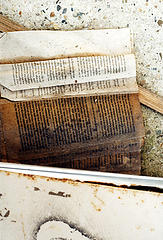
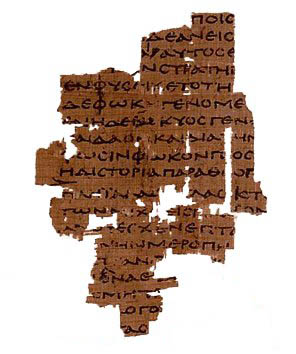
papyrus.jpg “Once it had walls three miles round, with five or more gates; colonnaded streets, each a mile long, crossing in a central square; a theatre with seating for eleven thousand people; a grand temple of Serapis. On the east were quays; on the west, the road led up to the desert and the camel-routes to the Oases and to Libya. All around lay small farms and orchards, irrigated by the annual flood — and between country and town, a circle of dumps where the rubbish piled up.” (from Waste Paper City by P.J. Parsons)

It was in this garbage dump, outside the ancient city of Oxyrhynchus in modern-day Egypt, vanished except for a single column, that 400,000 classical manuscript fragments were unearthed by British archaeologists in the late 19th century. It has long been thought that the texts, which reside at Oxford’s Sackler Library, represent a vast number of missing pieces from the known classical canon, in addition to thousands of humdrum documents – petitions, land deeds, wage receipts, orders for arrest, registration of slaves and goats etc. – shedding light on daily life in the Greco-Roman world. The problem is that they are largely unreadable, crushed and mashed together, blackened by years of decay, nibbled by worms. Here and there over the years, individual texts have been deciphered, making waves through the academic world. But now, the Oxyrhynchus Papyri can at last be decoded en masse through the use of multi-spectral imaging, a technique developed in satellite photography, which teases texts to the surface with infra-red light. Hailing it as the “holy grail” of antiquarian discoveries, classicists are predicting a major wave of restoration to the received literary canon, including lost plays of Sophocles and Euripides, a post-Homeric epic by Archilochos, and even missing gospels of the New Testament.
Read article in the Independent, via Grand Text Auto.

abandon all hope, ye who enter here

Silly-sounding business jargon and corporate pep talk abounded at the eBooks in Education Conference at McGraw-Hill in New York. The kind of stuff that makes the eyes and mind glaze over. “Fluidity of work flow.” “Content creation.” “Course-centric versus learner-centric.” The “three-legged stool,” of digital publishing… Books are “learning objects.” A teacher is just a “sage on the stage,” as though teaching were an antiquated idea. Youth is a marketing problem to be solved, the latest batch of young professionals in the making, rolling along the conveyor belt. Tim Magner, a stuffed shirt from our dear own Department of Ed., talked about priming kids for the new global economy (he also took the opportunity to mention that we’re doing the same for Iraq). But nothing about the issues at the heart of education. Nothing about a civil society, an educated citizenry, etc. About nurturing critical faculties in an age of information blitz. About advancing the light against darkness. I don’t doubt the good intentions of many of the speakers and attendees (though I do doubt some) but to someone outside the industry, the conference was plainly nothing more than a congregation of hucksters and homogenizers. Only the accessibility folks (the ones concerned with opening up digital media to people with disabilities), and one soft-spoken tech development manager from the University of Nebraska-Lincoln, seemed to exhibit any kind of public spiritedness, or a belief that technology should be made to serve human beings and not companies.
Then there were the numbing waves of PowerPoint, PowerPoint, PowerPoint! Nothing more perfectly exemplifies the muddled thinking, ignorance of design, and all-around mediocrity of the so-called “ebook industry.” Each presenter – with the exception of George Kerscher of the Daisy Consortium (who is blind) – supplemented their talk with the obligatory PowerPoint presentation, which, after a while, becomes a kind of torture. The slides flip one after the other after the other, the bullet points rattle like hail. Incomprehensible charts and graphs slouch across backgrounds of pastel or mock-marble. There’s a lot of teal. A lot of magenta. The slick veneer of the corporate board room washes over you like microwaved cheese, but the occasional tell-tale typo betrays the obvious haste and lack of consideration with which the things are made. In most cases the presenter abdicates entirely and plays human accompaniment to the PowerPoint show, lamely reading aloud as the panels slide past, sort of like the airline stewardess doing her bit with the oxygen mask while the safety film plays behind. After sitting through a few of these, your brain feels like it’s been flattened out with a rolling pin. I kept thinking of Hart Crane’s lines:
“The mind has shown itself at times
Too much the baked and labeled dough
Divided by accepted multitudes.”

I also thought of Edward Tufte‘s wonderful monograph, “The Cognitive Style of PowerPoint” (encapsulated here), a shrewd critique of sandblasted thinking in Microsoft-era America. It’s a little frightening to hear adults talk about the future of education in the scrubbed, frictionless language of the corporate slideshow. If they are teaching by example, then it is a sorry example indeed.
From Tufte:
“Particularly disturbing is the adoption of the PowerPoint cognitive style in our schools. Rather than learning to write a report using sentences, children are being taught how to formulate client pitches and infomercials. Elementary school PowerPoint exercises (as seen in teacher guides and in student work posted on the Internet) typically consist of 10 to 20 words and a piece of clip art on each slide in a presentation of three to six slides -a total of perhaps 80 words (15 seconds of silent reading) for a week of work. Students would be better off if the schools simply closed down on those days and everyone went to the Exploratorium or wrote an illustrated essay explaining something.”
I couldn’t resist including the cover illustration of Tufte’s piece. which gloriously sends up the totalitarianism of PowerPoint..
tufteppoint.jpg

find it rip it mix it share it

That’s the slogan for the just-launched Creative Archive License Group – a DRM-free audio/video/still image repository maintained by the BBC to provide “fuel for the creative nation.” Other members include Channel 4, Open University, and the British Film Institute (bfi). Imagine if the big three US networks, PBS, NPR and the MOMA film archive were to do such a thing…

ebooks in education

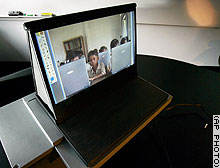
story.100.dollar.laptop.ap.jpg if:book will be spending the day at the Open eBook Forum‘s eBooks in Education Conference at the McGraw-Hill Auditorium in New York.
In the spirit of the conference, here’s an AP article from last week that gives a good overview of Nicholas Negroponte‘s $100 laptop project for developing countries.
“Details are still being worked out, but here’s the MIT team’s current recipe: Put the laptop on a software diet; use the freely distributed Linux operating system; design a battery capable of being recharged with a hand crank; and use newly developed ‘electronic ink’ or a novel rear-projected image display with a 12-inch screen. Then, give it Wi-Fi access, and add USB ports to hook up peripheral devices. Most importantly, take profits, sales costs and marketing expenses out of the picture.”

one tree in a forest of information

ifbooktree3.jpg This tree is made of all the pages, links and data on our site – built with a cool processing applet on texone.org (via reBlog ).
“tree accesses the source code of a web domain through it’s url and transforms the syntactic structure of the web site into a tree structure represented by an image. this image illustrates a tree with trunk, branches and ramifications. first each tree is initialized, than all html links are detected, chronologically saved and finally displayed.”
It also builds separate trees for external links, creating entire forests of information. For some reason, our one external tree was a stubby, brown little runt for worldbook.com/info, which I’m pretty sure we do not link to, so I’ve left it off. I’m not sure why it didn’t pick up on our real external links. I’m also not sure exactly how to read the tree, but I guess I can see the basic nature of if:book represented – i.e. a blog is pretty simple structurally but with a lot of content, hence our shaggy, dense foliage on a slender trunk. I also made trees for Google and the New York Times and they were much less woolly and not green like ours.
The texone guys have also recorded the sound of data forests growing. Apparently, every node on a tree – each trunk segment, branch, and leaf – emits a piece of MIDI data – a digital note, varying in pitch according to placement on the tree (high notes are toward the top). They recorded the output for different trees and filtered it through various sound palettes (different types or arrays of instruments). A couple of examples are posted on their site. I’ve put one of them below.

amazon: inching toward semantic

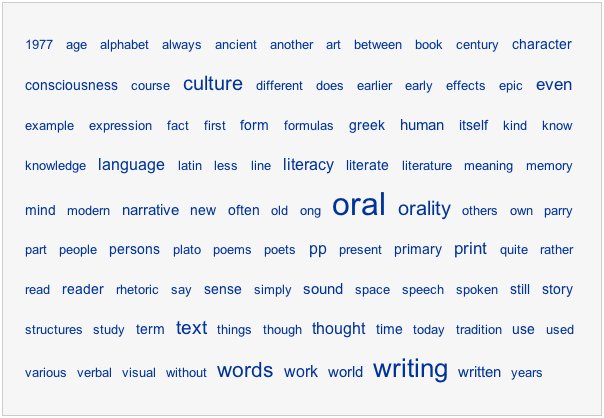
amazonconcordance.jpg
Sometime in the last few days, Amazon.com unveiled three new features for its Inside the Book search: “books on related topics,” a “100 most frequently used” concordance (above is the concordance for Orality and Literacy by Walter J. Ong), and “text stats.” The stats are pretty funny – in addition to page, word and character count, they measure a book’s “complexity” as well as its “readability” according to three established indexes, including the famous and amusingly named “Fog Index” (as though it rated the density of mental fog between a reader and a book). It also includes so-called “fun stats” like words per dollar and words per ounce.
Some of these features seem a little trivial, but there’s no denying that Amazon is moving surely and steadily toward a comprehensive semantic browsing system (other recent innovations are Statistically Improbable Phrases (SIPS) and Citations). Though still crude compared to what it might eventually become, you can begin to glimpse the pleasures and uses it will afford. Amazon can never replace the social and tactile pleasures of browsing a physical bookstore, but it’s doing a good job at making the virtual bookstore a more exciting place.

hub media

Another grassroots media experiment has sprung up in the hinterlands: YourHub.com, a cluster of community portals in the greater Denver metropolitan area that, like Bluffton Today, invites users to forge their own local news from submitted stories, images, ads and events listings. And like its South Carolina counterpart, YourHub is being launched by a larger media company, The Rocky Mountain News.
(via Dan Gillmor)