

 “Baghdad Burning” collects roughly a year’s worth of posts from the blogger known as Riverbend, the 25-year-old Iraqi woman who has been electrifying western readers with her regular reports from the tumultuous heart of the American occupation. But do blogs necessarily stack up as books? Conversational Reading points to a San Francisco Chronicle review that says they don’t, just as binding a stack of news articles does not make a coherent work of history: “‘Baghdad Burning’ fails because the characters and anecdotes are too varied to establish a compelling narrative.” Riverbend may very well have a good book to write, but “Baghdad Burning” just seems like slick packaging, reminding us that a book is much more than just a vessel. As a blog, Riverbend soars. As a book, it clatters around like nuts and bolts.
Author Archives: ben vershbow
all the news that’s fit to list
Google has patented a system that will rank news search results by quality and credibility, instead of simply by date and relevance to keywords. See article “Google searches for quality not quantity” in NewScientist. This recalls questions recently raised by Kim in “is the information any good?…don’t ask Google.”
People have a hard time agreeing on which news is credible, but I’m hesitant to believe that machines and algorithms can do better. I worry that smaller or alternative sources will get unfairly buried in the listings. Perhaps they should try ranking for neutrality…
Google talks to the librarians
Joy Weese Moll, a soon-to-be graduate of the School of Information Science and Learning Technologies at the University of Missouri, and author of the blog Wanderings of a Student Librarian, has written a useful overview of Google’s Print and Scholar initiatives – actually a session report from the Association of College & Research Libraries conference earlier this month. Summarized by Moll are suprisingly harmonious remarks by Adam Smith, product manager for Google’s library-related projects, and John Price Wilkin, a top librarian at the University of Michigan (and one of Google’s pilot partners).
“Smith made it very clear that this project is in its infancy. Google considers itself to be an international company and intends to participate in digitization projects in other countries and other languages. Smith acknowledged that Google cannot digitize everything. Rather, Google wants to be a catalyst for digitization efforts, not the only game in town. Google’s digitization project will help them build tools that will improve the searching of digital libraries created by universities, governments, and other organizations.”
Among other things, Wilkin points out that the mass digitization library collections “has already proven to be a factor in driving clarification of intellectual property rights, including the orphan copyright issue.”
Published in Cites and Insights. Link via Bibliotheke.
reading, without the book
David Bell, a history professor at Johns Hopkins, has written a smart, well-reasoned article for The New Republic entitled “The Bookless Future,” in which he ponders the changing nature of reading, writing and research in a digital world. Professor Bell and The New Republic have kindly allowed us to reproduce the article in TK3, an e-document reader. Our hope is that it will serve as a springboard for wider discussion, both of the article, and of what is needed to create the optimal electronic reading environment. The downloads are below, followed by some initial thoughts on Bell’s piece. We would love to hear people’s reactions..
First Download and Install the TK3 Reader
- TK3 Reader Installer WINDOWS
- TK3 Reader Installer MAC OSX (if using Internet Explorer, hold down the option-key when downloading for the Mac)
Then Download “The Bookless Future”
(when you’ve unzipped the book, you should be able to open it by double-clicking on its icon)
In Bell’s view, the big gains so far have been in the realm of research. “Today, a scholar in South Dakota, or Shanghai, or Albania–anywhere on earth with an Internet connection–has a research library at her fingertips.” A democratization has taken place, comparable only to the change unleashed by the printing press. The ease and speed of searching, comparing, and collating digital documents is similarly a great boon to scholars and students. The benefits afforded by new reading modes far outnumber the losses that opponents of the electronic book frequently lament – the tactile pleasures, the smell of musty bindings, the social environment of bookstores, the art of typography.
This will remain controversial territory for quite some time, but Bell manages to strike the right balance:
What really matters, particularly at this early stage, is not to damn or to praise the eclipse of the paper book or the digital complication of its future, but to ensure that it happens in the right way, and to minimize the risks.
Bell is also thinking what this means for writing. He recognizes the possibilities for new kinds of expression and argumentation that are only possible in the multimedia, not-exclusively-linear, environment of the computer. He cites a few examples in the Gutenberg-e series. But Bell’s enthusiasm is mixed with concern for how we are being affected as readers. First there is the way we absorb content, which has been entirely transformed by hypertext and search – the “browsing” ethos. Bell warns:
Reading in this strategic, targeted manner can feel empowering. Instead of surrendering to the organizing logic of the book you are reading, you can approach it with your own questions and glean precisely what you want from it. You are the master, not some dead author. And this is precisely where the greatest dangers lie, because when reading, you should not be the master. Information is not knowledge; searching is not reading; and surrendering to the organizing logic of a book is, after all, the way one learns.
Questions of form are no less important. Bell reminds us that the digital revolution, unlike the print revolution, is not just about the book. Moveable type may have transformed the means of production for books. But in form, they remained basically the same, and were no less “readable” than their hand-copied forebears. This is not the case with digital books. Until personal computers, and later, the web, it was never assumed that we would do any serious reading on screens. But as technology advanced, we learned that computers were more than just computational tools. A big lesson of the digital revolution is that since all media can be equalized as ones and zeros, then it follows that all media can converge and dance together in a single space. The digital revolution is about this convergence. Text is just one part of it, and so far computers have proven themselves better at handling rich media like graphics, film and sound than at providing satisfactory conditions for sustained reading. This boils down to a few, very simple reasons:
1. Screen display technology is poor – it hurts the eyes, requires large amounts of energy, and cannot be read in sunlight or other such ambient light settings. Progress is being made with the development of electronic ink and cholesteric displays, and Bell hopes that these improvements will deliver us from the headache of liquid crystal displays.
2. Most electronic documents are read in vertical scrolling fields. This is probably descended from the first computer terminal reading which consisted of long batches of code, best read in a scroll, or spit out on long rolls of paper. Horizontal paging keeps words and lines in a fixed position and makes for much easier reading. But you rarely find this today. A good example is the website of the International Herald Tribune. It seems like a no-brainer that screen-based documents should be laid out in this way.
3. And finally, the device is too awkward – heavy, fragile, expensive, and overheated.
Bell recognizes these points, but overemphasizes the need for a device that is tailored exclusively for screen-reading (though he does acknowledge that it would require web-browsing capabilities). One of the reasons book reading devices have consistently failed to catch on is that they are too specialized. In digital space, media can dance together, and there is no reason to corral them off into distinct zones. People are already reading books and other documents on their PDAs, and even their cell phones (check out thread, “the ideal device“). This is not because they offer an ideal reading environment, but because they are indispensable – gadgets that you always have with you. As a consequence, people feel compelled to cram in as many uses as possible. By this logic, the cell phone and the laptop seemed destined to combine. It may end up being something roughly the size of a trade paperback – hold it vertically to read a text, or flip it on its side to watch a widescreen film or play a video game. As with media, it seems inevitable that devices, too, will eventually converge.
what’s in a game?
Steven Johnson’s much-discussed book excerpt in the NY Times Magazine challenges the conventional wisdom that television rots the brain, arguing that TV today offers an incredibly rigorous cognitive workout. Multi-threaded narrative, a form first developed on television in soap operas, first found its way into more “serious” programming in the early 80s with Hill Street Blues, and has matured all the way up to the Sopranos, the West Wing and 24. Junk too, Johnson argues, has become more sophisticated. Reality shows like Survivor or the Apprentice explore well-worn territory like sex, money and ambition within a more complex, and at times intentionally confusing matrix, and raise the society of the spectacle to new heights. Much of this, it can be argued, is also influenced by video games, and a large part of Johnson’s book is apparently devoted to this.
On his blog, he brings attention to the question of gaming, and delivers a very funny satire on what would happen if it were actually books that were the new invention that had parents and educators in a frenzy, encroaching on the centuries-old civilization of the video game.
“Reading books chronically under-stimulates the senses. Unlike the longstanding tradition of gameplaying–which engages the child in a vivid, three-dimensional world filled with moving images and musical soundscapes, navigated and controlled with complex muscular movements–books are simply a barren string of words on the page. Only a small portion of the brain devoted to processing written language is activated during reading, while games engage the full range of the sensory and motor cortices.”
It goes on…
Also worth reading is a nice post on Cognitive Daily about the uses of video games in education. And this piece – “Much Fun, For Credit” – from the Sunday Times about the recently instated “Game Arts & Sciences” program at Rensselaer Polytechnic Institute.
more thoughts on the possible domestication of blogs
Juan Cole elaborates upon the differences between blogging and the mainstream media (MSM), underscoring the danger of a Murdoch move into that sphere (see just posted: “blog on a leash“).
“…we are independent actors, not part of a small set of multi-billion dollar corporations. The difference is that we are not under the constraints of making a 15% profit. The difference is that we are a distributed information system, whereas MSM is like a set of stand-alone mainframes. The difference is that we can say what we damn well please.”
and later..
“Blogs operate in a different political economy than does mainstream media. Bloggers’ “editors” are the readers and the Daily Kos and Eschaton commentators who use collective intelligence to improve them. Their motive is not the profit motive for the most part. Most bloggers are hobbyists.”
People sneer at blogs as amateur, as just the “demos” blowing off steam. But what’s a democracy without the demos? That “collective intelligence” is what one hopes for in a truly participatory democracy. Independent voices. In conversation. It seems inevitable that some blogs will become commercialized, or will leash themselves to mainstream media. The cover story in the latest issue of Business Week focuses on how “blogs will change your business.” But these moves will not be about the collective intelligence Juan Cole is talking about.
I’ve also been thinking lately about blogs as a learning tool. Writing for an audience, whether in the dozens or in the thousands, helps hone writing and thinking. Let’s discuss this further..
blog on a leash
How much longer will print newspapers be around? Earlier this month, in a speech to the American Society of Newspaper Editors, Rupert Murdoch gave a shockingly clear-eyed appraisal of print journalism in the digital age, calling for an end to complacency in the face of “a revolution in the way young people are accessing news.”
“They don’t want to rely on the morning paper for their up-to-date information. They don’t want to rely on a god-like figure from above to tell them what’s important. And to carry the religion analogy a bit further, they certainly don’t want news presented as gospel. Instead, they want their news on demand, when it works for them. They want control over their media, instead of being controlled by it.”
Murdoch clearly understands the forces at work and is keen to adapt in times of change. Print is still important, he says, but less so by the day. We should not take for granted that the traditional broadsheet will still be in use even one generation from now. We must focus on improving the way news is presented on the web. He talks about the inevitable shift to web advertising, hybrid forms for web content combining text and video (simply a merging of two of his empires), and bringing blogs into the news apparatus.
It is this last point about blogs that made me wary… especially in terms of the “control over the media” that he articulates in the quote above. The founder of Fox News understands that control can go two ways… Control can be construed simply as more choice for the viewer – more formats, more frequency, but also the power to choose the kind of spin, or presumed shared values that come with your news. This has been the success of Fox, with its trademark blend of hard news and hyper-politicized slant. But Fox is billed as serious news and is relied on by millions as a primary source of information. How much are they thinking about that as a choice? Here we get into control of a different kind. It’s not hard to imagine a few key blogs getting hitched up to a newspaper as a sort of web-based O’Reilly Factor or Hannity and Colmes. Many newspapers are already experimenting with bringing blogs into the fold, but there’s still a fairly clear line between news and commentary. What if blogs, or something descended from blogs, became the news?
Everyone is wondering where the blog phenomenon might lead. Is it a transitional medium that will eventually lose steam? Or will blogs get co-opted by big media and join the spectacle of punditry that so dominates television and radio? Say what you will about bloggers today – that they are hacks, windbags, amateurs – but it’s hard to argue that they aren’t independent, that they don’t function in their own sphere. What’s been so impressive is how they’ve expanded the domain of the op-ed and letters-to-the-editor pages, actually emphasizing the line between opinion and news. Blogs can break stories too, and often act as a corrective to the mainstream media. But take away professional reporting altogether and you remove the foil that defines their existence. There’s a new kind of media diversity coming into being on the web: new kinds of journalism, the evolution of an in-between class of citizen journalists, and of course, blogs. How does one weave it all together to form a view of the world? Murdoch seems to have some ideas. What’s scary is that he might be dreaming of a world in which all news comes in a sort of bloggish wrapping – the Foxification of web news.
Other useful reading on the uncertain future of newspapers:
– “Abandoning the News” – report from the Carnegie Corporation about news-reading habits of 18 to 34-year-olds
– good comment on the Carnegie report
– good post on PressThink: “Laying the Newspaper Gently Down to Die”
– from the Economist: “Yesterday’s Papers”
– from American Journalism Review: “Reversing the Slide” – on the Washington Post’s efforts to counter a recent sharp decline in circulation
stacking up HyperCard
 Nick Montfort (over at Grand Text Auto) aims to compile a comprehensive directory of works built in the now-legendary HyperCard – the graphical, card-based application that popularized hypermedia and jumpstarted the first big wave of popular electronic authoring. The HyperCard Bibliography is far from complete, but Nick has placed it in the public domain, inviting everyone to make additions. Among the “noted omissions” are the Expanded Book Series and CD-ROMs from the Voyager Company (pictured here is a card from Robert Winter’s Beethoven’s Symphony No. 9 CD Companion). A selection of these titles can be viewed on the institute’s exhibitions page. Thanks, Nick!
For more background on this period, visit Smackeral’s “When Multimedia Was Black & White.”
web 3.0 – all consuming
Dan Gillmor has written a nice, accessible overview of the evolution of the web in his periodic column for the Financial Times. As he sketches it, vesion 1.0 was a “fairly static,” “read-only” affair – sites were relatively basic and we checked them for new content or downloads. Online retail and search engines sprang up, essentially to help us find things to read, while things like GeoCities made it possible for anyone to have their own site. With 2.0 it became a two-way street – a “read-write” web, with its poster child the blog. Now, we are learning how to weave all the pieces together and to recombine them in innovative ways – this is version 3.0.
The emerging web is one in which the machines talk as much to each other as humans talk to machines or other humans. As the net is the rough equivalent of a computer operating system, we’re learning how to program the web itself.
A big part of 3.0 are the “web services” that can be built with a site’s “applications programming interface,” or API. An API is essentially a window into a site’s code that programmers can use to build derivative applications. Google, Yahoo, Amazon, and Flickr all have APIs. Gillmor points to a wonderful site – ALL consuming – that uses the Amazon API to build communities around the media – books, music, film – that people are consuming. You simply post the latest entree in your media diet – anything that can be found on Amazon – and then add tags and comments. People inevitably find each other through what they are reading and discussions can ensue. This is an interesting step toward the real-time reading communities that will be possible when we have dynamic electronic books that can plug into the network.
“the only group that can organize everything is everybody”
Some more thoughts on Clay Shirky‘s keynote lecture on “folksonomies” at the Interactive Multimedia Culture Expo this past weekend in New York (see earlier post, “as u like it – a networked bibliography“).
Shirky talks about the classification systems of libraries – think card catalogues. Each card provides taxonomical directions for locating a book on a library’s shelves. And like shelves, the taxonomies are rigid, hierarchical – “cleaving nature at the joints,” in his words. The rigidity of the shelf tends to fossilize cultural biases, and makes it difficult to adjust to changing political realities. The Library of Congress, for instance, devotes the same taxonomic space to the history of Switzerland and the Balkan Peninsula as it does to the history of all Africa and Asia. See the table below (source: Wikipedia).
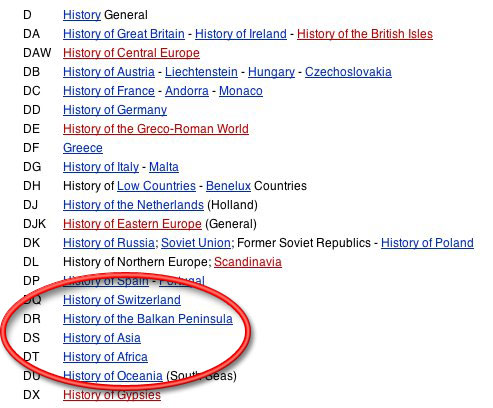
Or take the end of the Cold War.. When the Soviet Union disintegrated, the world re-arranged itself. An old order was smashed. Dozens of political and cultural identities poured out of stasis. Imagine the re-shelving effort that was required! Librarians shuddered, knowing this was a task that far exceeded their physical and temporal resources. And so they opted to keep the books where they were, changing the section’s header to “the former Soviet Union.” Problem solved. Well, sort of.
When communication and transportation were slower, libraries had a chance of keeping up with the world. But the management of humanity’s paper memory has become too cumbersome and complex – too heavy – to register every nuance, shock, and twist of history and human thought. Now, with the web becoming our library, there is, quoting Shirky again, “no shelf,” and it’s possible to have more fluid, more flexible ways of classifying knowledge. But the web has been slow to realize this. Look at Yahoo!, which, since first appearing on the scene, has organized its content under dozens of categories, imposing the old shelf-based model. As a result, their home page is the very picture of information overload. Google, on the other hand, decided not to impose these hierarchies, hence their famously spartan portal. Given the speed and frequency with which we can document every moment of our lives in every corner of the world, in every conceivable media – and considering that this will only continue to increase – there is no way that the job of organizing it all can be left solely to professional classifiers. Shirky puts it succinctly: “the only group that can organize everything is everybody.”
That’s where folksonomy comes in – user-generated taxonomy built with metadata, such as tags. Everybody can apply tags that reflect their sense of how things should be organized – their own personal Dewey Decimal System. There is no “top level.” There are no folders. There is no shelf. Categories can overlap endlessly, like a sea of Venn diagrams. The question is, how do we prevent things from becoming incoherent? If there are as many classifications as there are footsteps through the world, then knowledge ceases to be a tool we can use. And though folksonomy frees us from the rigid, top-down hierarchies of the shelf, it subjects us to the brutal hierarchy of the web, which is time.
The web tends to privilege content that is new or recently updated. And tagging systems, in their present stage of development, are no different. Like blogs, tag searches place new content at the top, while the old stuff gets swiftly buried. As of this writing, there are nearly 24,000 photos on Flickr tagged with “China” (and this with Flickr barely a year old). You get the recent uploads first and must dig for anything older. Sure, you can run advanced searches on multiple tags to narrow the field, but how can you be sure you’ve entered the right tags to find everything that you’re looking for? With Flickr, it is by and large the photographers themselves that apply the tags, so we have to be mind readers to guess the more nuanced classifications. Clearly, we’ll need better tools if this is all going to work. Far from becoming obsolete, librarians may in fact become the most important people of all. It’s not difficult to imagine their role shifting from the management of paper archives to the management of tags. They are, after all, the original masters of metadata. Different schools of tagging could emerge and we would subscribe to the ones we most trust, or that mesh best with our own view of things. Librarians could become the sages of the web.
It’s easy to get preoccupied with the volume of information we’re dealing with today. But the issue of time, which I raised earlier, should also be foremost in our minds. If libraries were to shake as violently and often as the world, they would crumble. They are not newsrooms. They are not bazaars. Like writing, libraries create stable, legible forms out of swirling passions. They provide refuge. Their cool, peaceful depths enable analysis and abstraction. They provide an environment in which the world can appear at a distance, spread out on literate strands that may be read in calm and quiet. As a library, the web feels more like the real world – sometimes too much so. It throbs with life, with momentary desires, with sudden outbursts. It is hypersensitive to change. But things pile up, or vanish altogether. I may have the smartest, most intuitive tags in the world, but in a year they might become nothing more than headstones for dead links. It is ironic that with greater access to more knowledge than ever before, we tend to live in a perpetual present. If folksonomies are truly where we’re headed, then we must find ways to overcome the awful forgetfulness of the web. Otherwise, we may regret leaving the old, stubborn, but dependable shelf behind.