



It’s really happening. Next Monday, The New York Times will inaugurate its “Times Select” subscription service. NYTimes.com will remain free, with much of the usual content still available (including multimedia), but op-eds and columnists will be pay-only. Oh well, the Washington Post opinion page is better anyway. The 100-article-per-month archive access is slightly tempting though.
The Times is betting that significant numbers of readers will shell out, just like they do for a premium channel on cable. Can the Times be the HBO of web news? Casual reader poll: who’s thinking of paying?
(link: Letter From the Editor explaining the new service to readers)
Author Archives: ben vershbow
reed elsevier and the arms trade
 They say that sunlight is the best disinfectant. And so I’m pointing to this upsetting story about educational publishing giant Reed Elsevier’s complicity in international violence through a subsidiary (Spearhead Exhibitions) that runs one of the world’s largest arms fairs. There are the beginnings of a movement for academics and others to demand that R.E. drop this sordid business.
(via Crooked Timber)
yahoo! experiments with multimedia journalism
Yahoo! has enlisted tele-journalist and blogger Kevin Sites to produce a one-year web program chronicling the world’s conflict zones in multimedia format.

Sites has become known for his jaunts as a “solo journalist,” trundling from hot spot to hot spot with a backpack full of gadgetry, beaming reports from his one-man broadcast station. It’s a formula that is tailor-made for the web. Clearly, Yahoo! was paying attention. The NY Times reports on “Kevin Sites In the Hot Zone”:
As he travels to these places, Mr. Sites will write a 600- to 800-word dispatch each day and produce a slide show of 5 to 10 digital photographs. He will also narrate audio travelogues. There will be several forms of video – relatively unedited footage posted several times a week, and once a week, a more traditional video report, edited in the style of a network news broadcast.
Mr. Sites will also be the host of regular online chats with Yahoo users who will be able to post comments on message boards. And he will post quick text messages on the site updating his activities throughout the day.
Counting on war and carnage as a surefire crowd draw, Yahoo! makes a rather tawdry entrance into independent journalism. But this is a very significant move nonetheless, evidence that Yahoo! is evolving into a full-fledged media company, and suggesting that the one-man-band approach to journalism and webcast might become a regular thing. If the Sites show finds an audience, they should try out serious investigative reporting or medium-length documentary.
thoughtful intertextuality
New Orleans DoubleQuotes by Charles Cameron plays with juxtaposition, cleverly pairing bits of text in ways that illuminate Katrina and all that flows from it:
Think of these paired quotes as twin thoughts dropped into the mind-pond — not so much for their own sakes as for the sake of the ripples and resonances between them. I invite you to read these DoubleQuotes one pair at a time, slowly, slowly, so that the multiples ironies and quiet nuances that have come together in the weaving of this tragedy have room to breathe.
(thanks, Bryan Alexander of Infocult)
craigslist new orleans – web 2.0 in action
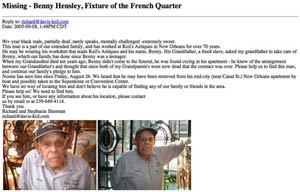

You can find just about anything on craigslist. Bikes, mattresses, futons, stereos, landscapers, moving vans, graphic designers, jobs. You can even find missing persons, or a safe haven thousands of miles from what was once your home. How a public classifieds section transformed itself overnight into a dynamic networked survival book – a central node in the effort to locate the missing and provide shelter to the uprooted – captures the significance of what has happened over the past two weeks in Katrina’s wake. The web has been pushed to its full potential, capturing both the enormity of the disaster (in a way that the professional media, working alone, would have been unable to), and the details – the individual lives, the specific intersections of streets – that got swept up in the flood. This give-and-take between global and “hyperlocal” is what Web 2.0 is all about. Danah Boyd recently described this as “glocalization” – “a dance between the individual and the collective”:
In business, glocalization usually refers to a sort of internationalization where a global product is adapted to fit the local norms of a particular region. Yet, in the social sciences, the term is often used to describe an active process where there’s an ongoing negotiation between the local and the global (not simply a directed settling point). In other words, there is a global influence that is altered by local culture and re-inserted into the global in a constant cycle. Think of it as a complex tango with information constantly flowing between the global and the local, altered at each junction.
The diverse, simultaneous efforts on the web to bear witness and bring relief to the ravaged Gulf Coast – a Knight Ridder newspaper running hyperlocal blogs out of a hurricane bunker (nola.com); a frantic text message sent from a phone in a rapidly flooding attic to relatives in Idaho who, in turn, post precise coordinates for rescue on a missing persons forum (anecdote from Craig Newmark of craigslist); an apartment rental registry turned into a disaster relief housing index; images from consumer digital cameras leading the network news; scipionus.com, the interactive map wiki where users can post specific, geographically situated information about missing persons and flood levels – that is the dance. The case of the scrappy craigslist, or rather its users, rising to the occasion is particularly moving.
recommended podcast: “information as news”
Katrina blew through the news business just as furiously as it tore through the Gulf Coast. For a good discussion of this, I highly recommend last night’s podcast of Open Source, a great new program on public radio that is of, by and through the web, generating story ideas and discussion on its blog. The show operates in an exciting border zone, dealing with general interest stories while always keeping an eye on the changing communication practices that are affecting/chanelling them. Last night’s show – “Craigslist and Nola.com: Information as News” – deals with citizen coverage of Katrina and the big changes underfoot for professional journalism.
Host Christopher Lydon speaks, with the breathless excitement of a man watching his profession change before his eyes, about “changing terms of authority in the news business” after Hurricane Katrina. He has on as guests Craig Newmark of craigslist (New Orleans site), nola.com editor Jon Donley, and media critic/blogger/citizen journalism guru Jeff Jarvis. From the intro:
The best reporting in the world — no hyperbole, the best reporting in the world — this week came from the web division of the New Orleans Times Picayune, nola.com. Information — missing person reports, safe and alive person reports — became news. And it became a source, even, for rescue teams, more accurate than anything else they had to go on.
Craigslist, after Katrina, became a forum for finding the missing and housing the saved, and what you find on Craigslist are stories as compelling as anything on CNN. Maybe what communities want in a time of crisis is good information, and maybe detailed, accurate information makes the best story. Craig and Jeff helped invent two new ways of collecting and distributing information; Jon is perfecting it right now in the Crescent City.
fertile pages

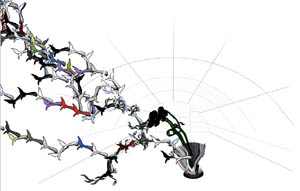
Organic HTML is a wonderful little applet I came across that turns websites into bizarre-looking plants. information aesthetics speculates on how it might work:
the emerging plant appears to use the colors similar to those found in the website HTML, CSS or images, while its size & branches depend on the site structure, content or number of pages. without any readily provided explanation or legend, one keeps trying to feed it URLs to derive the most beautiful flower (while avoiding the sometimes appearing flies)
Plug in a URL and try it out (be warned: it might crash your browser). if:book is apparently an inky species of blog (see above). I’ll add this to our garden. I wonder why there aren’t more sprouts of orange? The New York Times comes out more floral.
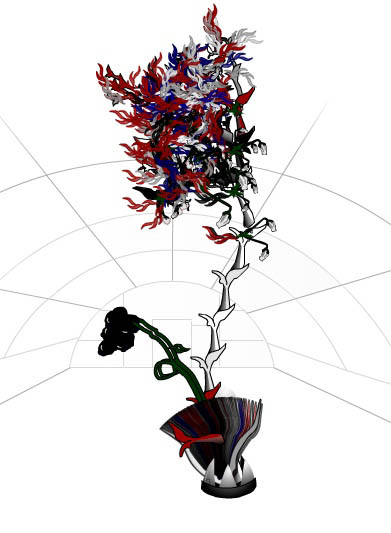
Something interesting I found, take a look at these two plants. One is Google, the other Yahoo! Can you guess which is which? (The larger plant has been scaled down.)

convergence sighting: ipod phone
 The Motorola ROKR, a new iTunes-compatible cellphone developed for Apple, hits the stores today for Cingular subscribers. The phone will run for $249.99 and can load up to 100 songs from a computer through a USB wire. Sounds like a rip-off to me, but indicative of things to come. It also comes equipped with a camera. The cellphone is steadily swallowing up all personal media.
Apple also unveiled its newest iPod, the “nano,” which uses solid flash memory (like in little USB memory sticks) rather than a hard drive with moving parts. It’s roughly the size of a half dozen business cards stacked together, and can hold up to 1,000 songs.
katrina and the interactive atlas
Interactive maps help those of us not in the region to grasp the terrain of devastation wrought by Hurricane Katrina. These maps are suggestive of a new paradigm for the digital page – an interactive canvas, or territory, through which the reader can zoom through orders of magnitude.
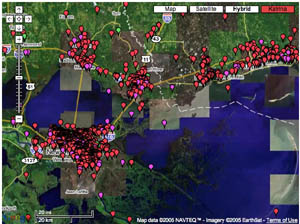
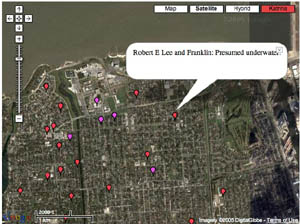
Most talked about is the “visual wiki” at scipionus.com – a re-tooling of Google maps that invites users to post tabs with information pertaining to specific locales (as fine-grained as streetcorners). Tabs are editable and are supposed to be used only for concrete reports, though many have posted pleas for news of specific missing persons or of the condition of certain blocks. Some samples:
“Saw news video 9/2/05 of corner street sign at 10th St. & Pontchartrain Blvd. Water level was about 6 in. below. green street signs.”
“the Ashley’s are in Prattville AL”
“4400 Calumet — dry on Weds?”
“as of 5:00 pm.. the streets from wilson canal to transcontinental are COMPLETELY DRY! source from somebody who stayed and called to tell us the info.”
“Dylan Nash anyone?? call 919-7307018”
The maps include post-Katrina satellite imagery, which reveals, upon zooming in, horrifying grids of inundated streets, stadiums filled up like soup tureens, city parks transformed into swamps. Wired recently ran a piece about sciponius.
Before & After:
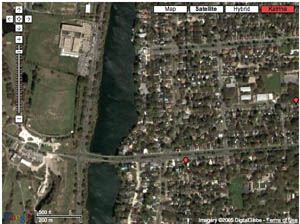
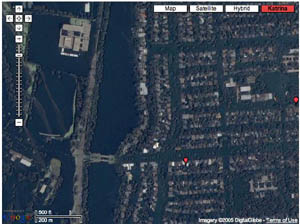
I was also impressed by the interactive maps on washingtonpost.com.
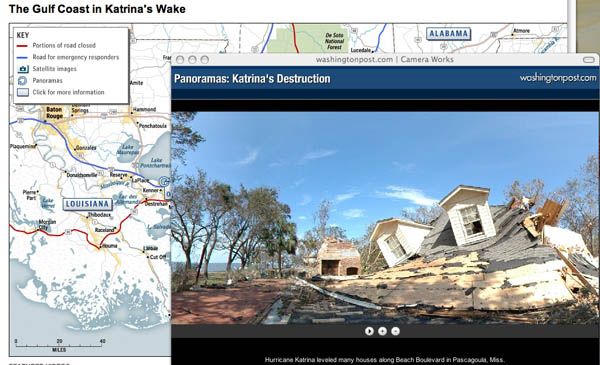
Click on spinning wheels at various points along the coastline and windows pop up with scrolling panoramic shots. Quite stunning. You can click the screen and drag the scroll in either direction, stop it, speed it up, and even pull it up and down to reveal glimpses of the sky or ground. Photojournalism is given new room to play on online newspapers.
(No Need to Click Here – I’m just claiming my feed at Feedster feedster:d50fedfc363272797584521a06a79da5)
fingerprinting text in the age of cut-and-paste
Lexis Nexis has installed new software for detecting plagiarism. As described on their site:
LexisNexis CopyGuard uses pattern-matching technology to identify suspect passages in submitted documents. An easy-to-read report underlines and color codes questionable sentences, with links to the original sources.
This could be an important tool for assuring integrity not only in professional journalism, but also in the emerging class of amateur reporters. But apply it to blogs and CopyGuard might overload and shut down. Bloggers are constantly recycling text, often without clear attribution, or obvious demarcation between quote and original commentary. The bounds of plagiarism seem a bit less clear when you consider that cutting and pasting is one of the main ways we converse online.
(NY Times has story)