
Email killed the practice of letter-writing so suddenly that we haven’t a chance to think about the consequences. The Times Book Review ran an essay this weekend on the problem this poses for literary historians, biographers and archivists, who long have relied on collected letters and papers to fill in the gaps between a writer’s published work. In the same review, the Times covers a new biography of the legendary critic Edmund Wilson largely based on his correspondences, and last week covered a new collection of the letters of poet James Wright. Letters are often treated as literature in themselves.
 But a crop of writers is working now whose papers are not in order. The email is rotting away on the network, unorganized, not backed-up, and, to a great extent, simply being lost for good. I actually mused about this in a post last month about an email archive visualization tool by Fernanda Viégas at M.I.T.’s Sociable Media Group that shows years of electronic correspondence as sedimentary levels in a mountain-like mass. And a mountain it is. One novelist I know in Washington has her office stacked high with milk crates containing printouts of each and every email she sends and receives, no matter how trivial. There has to be a better way.
There isn’t necessarily anything less rich about email correspondence. It excels at capturing a vibrant volley of words with great immediacy, whereas paper letters permit deeper communiques, fewer and father between. But in some cases, these characterizations do not hold up. With reliable postal service, letters can fly back and forth quite rapidly. And just because an email suddenly appears in your box does not mean that it will be immediately read, let alone replied to. Sometimes we write long email letters, expecting that the receiver is busy and will take time to reply. These differences, true and false, are worth evaluating.
But if collected emails are to become a literary tool, there is no question that we will need more reliable ways of archiving and preserving digital correspondence. We will also need new editorial approaches for collecting and publishing them. A printed volume, or series of volumes, might be insufficient for presenting a massive 4 gigabyte email archive by Dave Eggers (No one wants to read the phone book from cover to cover). And according to the Times piece, Eggers’ agent Andrew Wylie is mulling over such a project. What would make more sense is an electronic edition that is essentially a selected or complete annotated Eggers Outbox, with folders and tags provided for categorization, a powerful search function, and the ability to organize according to your own interests. There would also be browsing and skimming tools that would allow a reader to move rapidly across vast tracts of correspondence and still find what they are looking for. And maybe, a way to email the author yourself and become a part of the living archive.
Author Archives: ben vershbow
if:book one of five blogs for blogday
Writing and the Digital Life, a brand new weblog with interests very similar to ours, just went live today and has kindly named us among five blogs for “blogday.” I look forward to reading their site.
blogging the hurricane
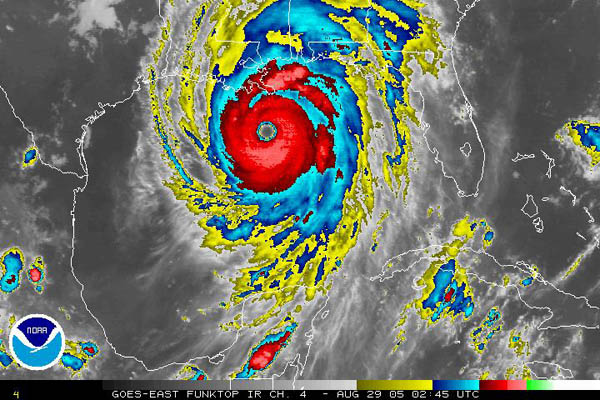
As Katrina has blasted the Gulf Coast beyond recognition, a number of blogs have maintained a steady stream of reportage and personal testimony, in some cases serving as bulletin boards for the names of the missing. Given the extent of the destruction to communications infrastructure, it’s not surprising that it has primarily been the media blogs that have managed to stay active.
Here are a few I’ve come across (Poynter Online has been an invaluable resource for exploring the online response to Katrina):
Eyes on Katrina: A South Mississippi hurricane journal (from The Sun Herald) – a combination of brief news updates, community bulletin board, and advance runs of Sun Herald stories on Katrina.
Tuesday, 2:23 pm:
This from staff writer Geoff Pender, who is calling in reports from Hattiesburg. If you are thinking about getting in the car and coming back to South Mississippi, don’t. The Mississippi Emergency Management Agency is telling people who have evacuated to stay away until the roads have been cleared and the National Guard is in place. If we get word when that happens, we’ll pass it along.
On a different note, we have a report that portions of U.S. 90 are under seven feet of water.
NOLA View: a weblog by Jon Donley – for nola.com, a news and culture portal from The New Orleans Times-Picayune. Posting survival stories from readers.
From reader Lynne Bernard (today), on trying to survive in Talahassee, FL:
Story: We are stranded in Tallahassee. There is absolutely no compassion here whatsoever. The Hampton Inn in Tallahasse is pretty much throwing us out because of a football game. We are running out of money with no way of getting more out of the bank. We cannot use debit cards and our credit cards are maxed out. I thought I would encounter a little compassion and understanding here in Florida seeing they have been through similar situations. There is none. People here and the manager of this motel are very cold and uncaring. If anyone out there has any suggestions please email me asap. I cannot get in touch with red cross or fema. Cell phones don’t work. Can’t get hold of any family member for help. Please help!!!!
CNN: Miles O’Brien’s Hurricane Blog – direct from Louisiana.
Monday, 6:54 am:
Louisiana State University Hurricane Center’s Ivor van Heerden just said a real concern is coffins that would be swept away by the floodwaters — which themselves will be laced with a witches’ brew of industrial chemicals. Horrifying image.
Metroblogging New Orleans – group blog with frequent, first-hand reports.
12:54 pm today, from Craig Giesecke:
Being refugees has forced us to confront new realities and possibilities, particularly since it might be a while before we’ll actually be able to return to stay. I’m self-employed in a food business that was just beginning to take off and fly a bit on its own when this storm struck. To wit…
1) when we actually go home, what shape will my production facility be in? Since it’s in Mid-City, I’m assuming it’s already full of water.
2) Even if I can get the equipment operating again someplace else, 75 percent of my business is done in metro New Orleans. Lord knows how long it might be (2006?) before any local clients will be able to start placing orders again.
3) So far, our house seems to be dry. But when we get back in, how long will it be before anything else is around us? The neighbors will return, but how long before any of us can start earning a paycheck again? I mean — earning a paycheck ANYwhere?
Storm Central from al.com (“everything alabama”) – news updates and reader email.
Paula Baker from Houston, TX:
I am trying to find out about my brother. Stayed in Pascagoula. House on Sunfish Dr. 5 Blocks from beach
This is just a selection – by no means comprehensive. Let us know if you find anything else of interest.
treasuremytext: a networked SMS book
treasuremytext is a free British service that allows you to save text messages from your phone to the web on an anonymous, communal log, or “slog.” Recent messages appear in a column on the main site where they can be read by all and sundry, subscribed to by feed, and even loaded onto an iPod as plain text files. jill/txt has a transcript from about two weeks back:
trying to convince myself that there was nothing there but i still find myself thinking about you
night nimet . . . . i miss you
How about sorting that taxi out for next week? For real?
Ok smart arse when you are there then! And then i will fix your issues for you, all of them!
U have beautifull eyes
Dont ring ill b down bout halfpast babes
Me to hes just arrived txt u l8r baby
Nite nite xxx
Nite nite fat sexy bum.Txt u tomoz nite nite xxxx
Not exactly prize-winning stuff, but has a nice dreamy flow of chatter plucked out of the air. Reminds me a bit of a game I played in elementary school where you go around a circle and improvise a story in broken-off pieces. Reading the site today, the entries seem to have taken on a smuttier tone. And a good number aren’t in English. But an intriguing experiment nonetheless.
But it would be more interesting if the logs had some focus. Something like the City Chromosomes project, which is building a networked chronicle of the city of Antwerp, all by SMS.
convergence sighting: the multi-channel tv screen
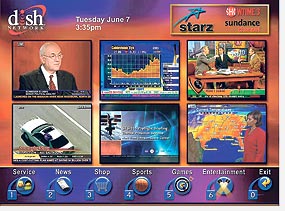
Several new “interactive television” services are soon to arrive that offer “mosaic” views of multiple channels, drawing TV ever nearer to full adoption of the browser, windows, and aggregator paradigms of the web (more in WSJ). It seems that once television is sufficiently like the web, it will simply be the web, or one province thereof.
new york times on “godcasting”
An article in today’s Times describes the rise in Christian religious podcasting – sermons on demand, exegesis by RSS – known by some, inevitably, as “godcasting.” Worth a look.
convergence sighting: bbc tv channels to be put on net
Recent announcements at the BBC suggest further convergence of television and the web, reading in multimedia, cellphone as broadcast receiver etc. From Director General Mark Thompson:
We believe that on-demand changes the terms of the debate, indeed that it will change what we mean by the word ‘broadcasting.’
Read article.
one device to rule them all
Wired profiles Amp’d Mobile, a new service launching this fall that will offer subscribers a wide array of “mobile entertainment” options on a specialized handheld device. Amp’d has marshalled a vast amount of venture capital to bring the cellphone to its full potential as a catch-all media device – video console, gaming handset, ebook reader, web browser, and, if your brain hasn’t been totally fricasseed by that point, still a good old-fashioned telephone.
Amp’d targets consumers in their mid-20s to mid-30s – the bracket that is the most gadget-crazed, the most entertainment-hungry, as well as the most mobile, or so the reasoning goes. At the very least, Amp’d might serve as a catalyst for Verizon, Sprint and the other big mobile service providers to move into this sweet spot of media convergence. It certainly seems that things are going that way.
play station portable as online reading device
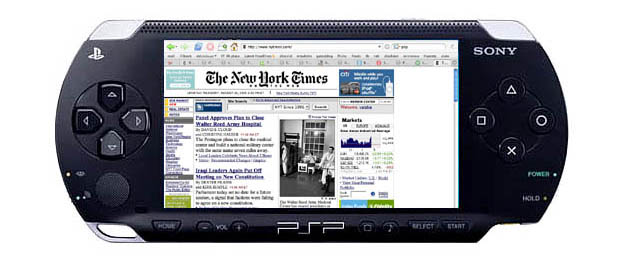
The new updated Sony PSP portable gaming device will include a web browser. That gives it games, film, photo and web – the most comprehensive pocket instrument out there. But for the time being, it’s read-only. Without a stylus, or virtual keyboard, many of the web’s more interactive elements will be unavailable.
amazon shorts: short literary works delivered digitally
Amazon Shorts offers 49¢ downloads of short fiction and nonfiction in .pdf, html and text-only email, seemingly without copy or printing restrictions. Amazon a publisher? The chapbook reborn? Not quite. Amazon Shorts is primarily a marketing program, available only to established authors who have other titles to sell – a sort of appetizer course to encourage larger book purchases. But it’s probably suggestive of where advertising in general is headed.
Television entertainment was originally conceived as a way to create a captive audience for advertising. Now, consumers have greater and greater ability to tune out the ads and focus on the entertainment – fast-forwarding on Tivo, or, on the web, clicking through, or closing the pop-up window. As a result, marketers are trying to figure out how to make the ads destinations in themselves – to develop a format where the ad and the entertainment are inseparable, even indistinguishable. Recall the Superbowl, where high-budget, elaborately produced ads are as much an attraction as the game itself (some would say more). Or BMW Films, creator of “The Hire” – a series of short films by major international directors, starring Clive Owen and, of course, a sexy Z4 Roadster.
Expect more of this short form blend of advertising and entertainment in film, certainly, and even (if the “Shorts” series is any indication) in books.