Author Archives: ben vershbow

new york times and several philly papers cutting staff

“Times Company Announces 500 Job Cuts”
“Philly Newspapers Announce 100 Job Cuts”
From an internal email sent by Bill Keller (NY Times Executive Editor) breaking the bad news (leaked to Gawker):

I won’t pretend that it will be painless. Between the buyouts earlier this summer and the demands placed on us by the IHT and the Website — not to mention the heroic commitment we’ve made to covering the aftermath of Katrina – we don’t have a lot of slack. Like the rest of you, I found the recent spate of retirement parties more saddening than celebratory, both for the obvious personal reasons and because they represented a sapping of our collective wisdom and experience. Throughout these lean years you have worked your hearts out to perform our daily miracle, and I wish I could tell you relief was in sight.

Bob Cauthorn comments on Rebuilding Media about newspapers on the precipice:

The pro-industry spin will talk about combining web-site and print readers, which is disingenuous in exactly 1,465 ways. For example, does someone from Islamabad dipping in for one story on your web site have equal value as a seven-day-a- week local print subscriber?…
…The notion of platform shift — people moving from print to web just, you know, because — is a comfort to the media establishment as it suggests people still really, really, really love their product, they’re just selecting a different distribution mechanism.
Nonsense. The platform shift doctrine is a dangerous — and for some media companies, ultimately fatal — illusion that blinds the industry to necessary changes in the core product. Platform shift is the argument for the status quo: We don’t have to do anything different.

Speaking of not doing anything different, the Wall Street Journal ran this story about magazines experimenting with “digital editions”: “electronic versions of their publications that replicate every page of the print edition down to the table of contents and the ads.”
Cauthorn goes on about possibly breathing new life into print:

If newspapers fix their print products circulation will grow — change format, revive local coverage, alter the hierarchical approach to the news, open the ears of the newsrooms and get reporters back on the street where they belong. If you want to get really daring, re-imagine print newspapers as a three-day a week product rather than as a seven-day a week product.
As a practical matter, print newspapers only make money three days a week anyway. Imagine the interplay between a seven day a week digital product and a densely focused (and wildly profitable) three-day a week print product. Each doing different things. Each serving readers and advertisers in different ways.

The Guardian has just totally revamped its print identity, abandoning the broadsheet for the more petite Berliner format and adopting a slicker style. It’ll be worth watching whether this catches on. New packaging might make newspapers cuter, but not necessarily better.

copyright lawyers remain richest professionals

Or so is the case in Korea, where the custodians of intellectual property law ranked first (apparently for the sixth straight year) in a recent personal income survey. An interesting nugget blown down the pipeline from Korean newspaper Chosun Ilbo, in an article barely longer than its headline. Though I am only able to explore the English-language edition, it seems to be a newspaper with no end of information, but little in the way of analysis. One has the feeling of reading oil, a lubricant for the economic wheels that have delivered a war-torn and psychologically divided nation into material prosperity. Korea is now a major regional power of the so-called global information economy.
The Chosun trifle nicely animates the highly abstract, but fascinating “A Hacker Manifesto” by McKenzie Wark, which I recently began reading. The manifesto is a Marxist tract for the information age, redefining the eternal class struggle in terms of intellectual property – the post-capital form of property – which is controlled by a new ruling class, the “vectoralists.” The vectoralists – Bill Gates, Rupert Murdoch, or the big pharmaceutical companies would be the most obvious examples – control the vectors, or channels, of communication, and seek to subjugate the “hackers,” who Wark defines as a newly coherent class of idea makers – programmers, inventors, artists and philosophers. It’s an important book, and convincingly argues why the intellectual property debate is central in the struggle for liberty.

That the vectoralist class has replaced capital as the dominant exploiting class can be seen in the form that the leading corporations take. These firms divest themselves of their productive capacity, as this is no longer a source of power. They rely on a competing mass of capitalist contractors for the manufacture of their products. Their power lies in monopolizing intellectual property — patents, copyrights and trademarks — and the means of reproducing their value — the vectors of communication. The privatization of information becomes the dominant, rather than a subsidiary, aspect of commodified life.

He goes on to quote from Naomi Klein:

“There is a certain logic to this progression: first, a select group of manufacturers transcend their connection to earthbound products, then, with marketing elevated as the pinnacle of their business, they attempt to alter marketing’s social status as a commercial interruption and replace it with seamless integration.”

“the minotaur project” featured at ELO

Kim’s hypermedia poem cluster, “The Minotaur Project,” is currently featured at the Electronic Literature Organization. Highly recommended.

introducing nexttext

The dawn of personal computing and the web has changed the way we learn, yet the tools of instruction have been sluggish to evolve. Nowhere is this more clear than with the printed textbook.
So the institute has launched nexttext, a project that seeks to accelerate the textbook’s evolution, onward from its current incarnation, the authoritative brick, toward something more fluid, more complete, and more alive – more fitting with this networked age.
Our aim is to encourage – through identifying existing experiments and facilitating new ones – the development of born-digital learning materials that will enhance, expand, and ultimately replace the printed textbook. To begin, we’ve set up a curated site showcasing the most significant digital learning experiments currently in the field. Our hunch is that by bringing these projects (and eventually, their creators) together in a single place, along with publishers and funders willing to take a risk, a concrete vision of the digital textbook for the near future might emerge. And actually happen.
So check out the site, comment, and by all means recommend other projects you think belong there. What’s up now is a seed group – things that have gotten our wheels turning so far – to be grown and expanded by the collective intelligence of the community.

making visible the invisible: george legrady installation at seattle central library

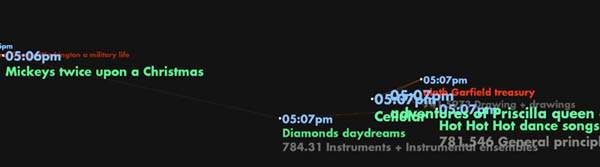
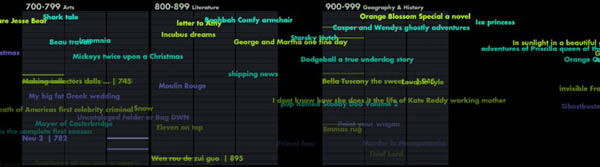
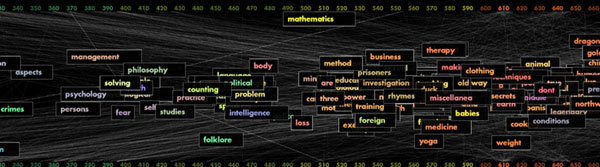
A nice companion piece to the “database of intentions” is George Legrady‘s new installation, “Making Visible the Invisible,” at the Rem Koolhaas-designed Seattle Central Library. Six large LED display panels suspended above the “mixing chamber” on the library’s fifth floor display a series of visualizations depicting the circulation of library books and other media across time and classification area, providing “a real-time living picture of what the community is thinking.”
KeyWord Map Attack
legrady visible2.jpg
Legrady described the project at the Transliteracies conference this past June in Santa Barbara. At that time, Bob blogged:

the pinpoint accuracy of computer-searches, leaves those of us lucky enough to have spent time in library stacks, nostalgic for the unexpected discovery of something we didn’t know we were looking for but which just happened, serendipitously, to be on a nearby shelf. George Legrady, artist and prof at UC Santa Barbara, just showed a project he is working on for the new public library in Seattle that gave the first glimpse of serendipity in online library searching which lets you see all the books that have recently been checked out on a particular subject. Beautiful and Exciting.

Vital Statistics
legrady visible3.jpg
Floating Titles
legrady visible4.jpg
Dot Matrix Rain
legrady visible5.jpg
Other observations:
“New piece for Central Library pushes art to the technical edge” in Seattle Post Intelligencer

Information Aesthetics profile

the database of intentions

Interesting edition of Open Source last week on “Google Sociology” with David Weinberger and John Battelle, author of the just-published “The Search: How Google and Its Rivals Rewrote the Rules of Business and Transformed Our Culture”. Listen here.
Weinberger has some interesting things to say about Google (and the other search engines) as “publishers.” I have some thoughts on that too. More to come later.
Battelle has done a great deal of thinking on search from a variety of angles: the technology of search, the economics of search, and the more esoteric dimensions of a “search” culture. He touches briefly on this last point, laying out a construct that is probably treated more extensively in his book: the “database of intentions.” By this he means the archive, or “artifact,” of the world’s search queries. A picture of the collective consciousness formed by the questions everyone is asking. Even now, when logged in to Google, a history of all your search query strings is kept – your own database of intentions. The potential value of this database is still being determined, but obvious uses are targeted advertising, and more relevant search results based on analysis of search histories.
As regards the collective database of intentions, Battelle speculates that future advances in artificial intelligence will likely draw on this enormous crop of information about how humans think and seek.

“bringing karaoke to literature”

china mini novel.jpg
Shanghai Daily reports on a Chinese “mini novel” contest where writers submit bite-sized narratives (350 words or less) by text message.

Commenting on the contest, well-known writer Yu Hua says: “To hold the competition is like bringing ‘karaoke’ to literature. Before the invention of karaoke, there were only few people who could or would sing in public. Thanks to karaoke, anyone and everyone can sing in public whenever they feel like it. Now, thanks to the mobile phone, the same is true with writing.

The karaoke analogy is apt, and a bit scary.
(via textually)

“In the dark woods, on the sodden ground, I found my way only by the white of his collar.”

Someone is blogging Kafka’s diaries, from 1910 to 1923. They’re still in the first year. Either it started recently, or lost steam early at some undetermined date (the editor has opted to remove datelines from posts). Any dates added by Kafka himself are of course retained. Archives are organized by year within the span of the diaries.
I subscribed to the feed to see if it keeps updating (they’re using a recent version of Movable Type – more recent than ours – so I bet things are active). It could be a nice way to read these.
There’s also a blog of the diary of Samuel Pepys, which seems to have been chugging along for about two years. A nice touch is that instead of comments they have “annotations.” A quick glance reveals that quite a number of people are participating in this reading.
update: Another good book blogging experiment worth checking out is Bryan Alexander‘s Dracula Blogged – “Bram Stoker’s vampire novel, published by its own calendar” – which will conclude sometime in November. A particularly clever choice, since Dracula is largely written in letters and journal entries.

google blog search – still a long way to go

Google’s new blog search engine reminds me of how far we still have to go with blog search. The engine works much the same way as Google’s general web search – with keywords and page ranking – only here it’s searching RSS feeds. Recent posts with keyword matches fill the column, and a few links to related blogs come up at the top. But there’s the rub. These so-called “related” blogs are only related by direct keyword matches in their title tagline. I just searched “poetry” and came up with only three related blogs. C’mon. A search for “gossip” turns up only one related blog – “Starbucks Gossip”. There has to be some kind of promotion going on here, though their “about” page mentions nothing of the kind.
A good engine would be capable of searching blogs by their subject, their preoccupation, their obsession. Many blogs could be considered “general,” but just as many have a special focus, and readers are often searching with a particular theme in mind. They don’t just want a list of transient posts, but whole sites that might potentially become regular destinations. Many blogs are valuable publications that prove themselves day after day. But blog search hasn’t yet grown beyond the trendy “what’s the latest chatter on the blogosphere” mode.
I do have to give credit to Technorati. Glitchy as it is, they’re trying to think of creative ways – tagging, author-determined keywords – to help readers find interesting blogs and authors their audience. Then again, my greatest finds have usually been from other blogs. Humans will always be the smartest aggregators.
People out there, what do you use?

flash memory: “the digital paper age”?

Heads are spinning in response to Samsung’s planned release of a 16 gigabyte flash drive – a string of eight 2GB flash memory cards. Flash memory is solid state data storage, as opposed to the conventional hard drive, which contains spinning mechanical parts. The implication is that the price of memory for computers will soon drop dramatically, as will the amount of energy used to power them. Moreover, you will be able to carry millions upon millions of pages on something the size of a keychain (people will probably start using smaller ones as business cards before too long). There’s definitely something reassuring about the solidity – to rely entirely on a single, rickety hard drive, or a network, to store documents is incredibly risky and unreliable. Plus, these cards are far more tolerant of shocks, bad weather and all around abuse.
Chosun Ilbo describes the remarks of Hwang Chang-gyu, Samsung’s chief executive, who said:

…the development signaled the opening of the “digital paper age.” “In the same way that civilization rapidly progressed after paper was invented 2,000 years ago, flash memory will serve as the ‘digital paper’ to store all kind of information from documents to photos and videos in the future. Mobile storage devices like CDs and hard disks will gradually disappear over the next two or three years, and flash memory will dominate the information age.”