Author Archives: ben vershbow

directory of open access journals

The Directory of Open Access Journals indexes free peer review research journals from any country in any discipline. The directory is funded by the Soros “Open Access Initiative” which seeks to make the fruits of academic research freely available on the internet.

We define open access journals as journals that use a funding model that does not charge readers or their institutions for access. From the BOAI, Budapest Open Access Initiative, definition of “open access” we take the right of “users to read, download, copy, distribute, print, search, or link to the full texts of these articles” as mandatory for a journal to be included in the directory. The journal should offer open access to their content without delay. Free user registration online is accepted.

(via librarian.net)

this laptop costs $100

928laptop550x413.jpg
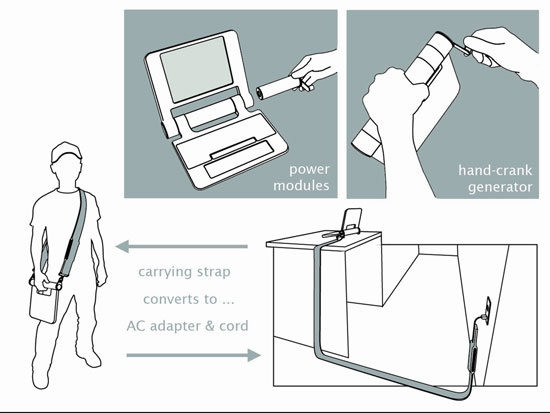
MIT has released some new images of its $100 laptop prototype, of which it hopes to have 5 to 15 million test units within the year. The laptops are much more durable than your average commercial machine, can be used as writing tablets or rotated 90 degrees as ebooks, and run on Linux – 100% free software. The idea is for the machines to provide a platform for an open source education movement throughout the South – a major hack of the current global order.
I love the hand cranks on the side, a backup charging option for remote or poorly provided areas where there is little or no electricity.
(“The $100 laptop moves closer to reality” in CNET)
928instructions550x413.jpg

podcast: discussing neil postman’s “building a bridge to the 18th century”

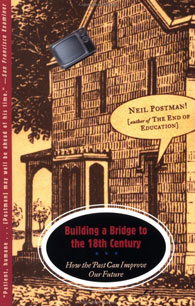
book_building_a_bridge.jpg (Annotated audio recordings of this discussion appear further down.)
On the dedication page of “Building a Bridge to the 18th Century,” Neil Postman quotes the poet Randall Jarrell:

Soon we shall know everything the 18th century didn’t know, and nothing it did, and it will be hard to live with us.

Though often failing to provide satisfying answers, Postman asks the kind of first-order questions one hears all too infrequently at a time when technology’s impact on our social, political and intellectual lives grows ever more profound. Postman has been accused of deep reactionism toward technology, and indeed, his hostility toward computers and telecommunications betrays an elitism that discredits some of his larger, and quite compelling observations.
In spite of this, Postman’s diagnosis is persuasive: that the idea of technological progress bequeathed by the Enlightenment has detached from reason and become a runaway train, that we are unquestioningly embracing new technologies that unleash massive change on our family and communal life, our democracy, and our capacity to think critically. We have stopped asking the single most important question that should be applied to all new technological innovations: does this technology solve a problem? If so, then at what cost? To whose benefit? And at whose expense?
Postman portrays the contemporary West as a culture without a narrative, littered with the shards of broken ideologies – depressed, unmotivated, and therefore uncritical of the new technologies that are foisted upon it by a rapacious capitalist system. The culprit, as he sees it, is postmodernism, which he lambasts (rather simplistically) as a corrosive intellectual trend, picking at the corpse of the Enlightenment, and instilling torpor and malaise at all levels of culture through its distrust of language and dogged refusal to accept one truth over another. This kind of thinking, Postman argues, is seductive, but it starves humans of their inspiration and sense of purpose.
To be saved, he goes on, and to build a better future, we would do well to look back to the philosophes of 18th century Europe, who, in the face of surging industrialization, defined a new idea of universal rational humanism – one that allowed for various interpretations within its fold, was rigorously suspicious of religious or any other kind of dogma, and yet gave the world a sense of moral uplift and progress. Postman does not suggest that we copy the 18th century, but rather give it careful study in order to draw inspiration for a new positive narrative, and for a reinvigoration of our critical outlook. This, Postman insists, offers us the best chance of surviving our future.
Postman’s note of alarm, if at times shrill, is nonetheless a refreshing antidote to the techno-optimism that pervades contemporary culture. And his recognition of our “crisis in narrative” – a formulation borrowed from Vaclav Havel – is dead on.
September 19: Bob, Dan, Kim, and Ben discuss Postman’s book at our new Brooklyn office (special prize if you pick out the sound of the ice cream truck passing by).
1. Bob’s preface – thoughts about how we do business at the institute (1:56) (download)

2. Ben’s first impressions – childhood under threat… Dan’s first impressions into discussion – a Clinton-era book, sets up a rather straw man caricature with the postmodernists, but society’s need for a narrative is compelling – why the Christian right has done so well… Postman seems to be assuming that progress is a law, that there is a directed narrative to history – problems with how he treats evolution. (6:43) (download)

3. Bob: Postman is much better at identifying problems than at coming up with solutions. Which is what makes him compelling. His stance is courageous. People assume with technology that just because something can be done it should be done. This is a tremendous problem – an affliction. If you could go back in time and be the inventor of the automobile, would you do it? People get angry at the responsibility this question imputes to them. How can we put these big questions at the center of our work? (13:34) (download)

4. Another big question… “An electronic community is only a simulation of a real community”? Flickr, Friendster, Howard Dean campaign? What is the vehicle for talking about this? What format is best for engaging these questions? Looking for new forms that illuminate or activate the questions. (15:43) (download)

5. Where/who are the public intellectuals today? [The ice cream truck passes by.] Strange bifurcation of the intellectual elite – many of the best-educated people most able to deal with abstraction make their living producing popular media that controls society. (10:07) (download)

6. Is capitalism the problem? Postman’s bias: written language will never be surpassed in its power to deal with abstract thought and cultivation of ideas. But we are arguably past the primacy of print. What is our attitude toward this? (9:39) (download)

7. What opportunities for reflection do different media afford? Films on DVD can be read and reread like a book – the viewer controls, rather than being controlled – a possibility for reflection not available in broadcast. What is the proper venue for discussing this? Capitalism is the 800 lb. gorilla in the room. How do we create, if not a mass agitation, then at least a mass discussion? Tie it to the larger pressing problems of the world and how they will be better addressed by certain forms of discourse and reflection. Averting ecological catastrophe as one possible narrative – an inspiring motivator that will get people moving. How do find our way back into history? (10:09) (download)

8. What should we read next as counterpoint/antidote to Postman? The Matrix – are we headed that way? (12:33) (download)

9. How do we organize new kinds of debates about technology and society? Other issues to be addressed – class, race and gender inequality. (11:26) (download)

yahoo! hires finance writers

Following Kevin Sites in the Hot Zone, Yahoo! takes another step in its transformation into original content provider (see Wall Street Journal – free). Though they say they have no intention of becoming a full-fledged news service.
Yahoo’s move suggests increased specialization and atomization of news media on the web, as full-fledged news services find it increasingly hard to stay afloat (as the recent wave of staff cuts at major papers suggests). As newspapers agonize over how to make more money from their websites (e.g. Times Select), companies with diverse revenue bases (like the big search portals) will find it a lot easier to deliver the news. But it will be a stripped down service, heavy on features. Can the news media as public trust survive this process of atomization? Or was the idea of a public trust always a fairy tale?

excellent analysis of times select

You can’t fault the Times for trying to find a new business model for the web, but they seem to be doing themselves more harm than good with Times Select. Jay Rosen has a terrific post on Press Think running through various reactions to the NY Times’ new subscription service that charges $49.99 per year for access to columnists, archives, and exclusive interactive features. Rosen rightly notes that the Times has gotten the idea of exclusivity all wrong:

The phrase “exclusive online accesss” advertises two different goods. The first good is the work of the Times columnists themselves. The proposition that some will pay for that is hard to prove until you try, but it’s simple to understand. The second good being advertised is exclusivity. You, the lucky TimesSelect subscriber, have access to these voices. Others do not. The value proposition there is muddled. If we prize up-to-date information about petroleum markets, we might value it more–and pay a premium–if the news is exclusively available to paying customers; but do we value Nicholas D. Kristof’s column more if he’s an “exclusive?”
We don’t. In fact, it’s probably the reverse. If everyone is reading a columnist, that makes the columnist more of a must have. If “everyone” isn’t, less of a must. “Exclusive online access” attacks the perception of ubiquity that is part and parcel of a great columnist’s power. In his prime Walter Lippmann was called “the name that opened every door.” Nick Kristof’s brand of human rights journalism, which depends on the mobilization of outrage, is simply less potent if it can’t reach widely around the world, and pass by every door.

The Wall Street Journal is an exclusive paper, so offering it over the web as a pay subscription service actually increases its cachet. The Times is a different sort of paper – it has a general audience and is read the world over. Its ubiquity, its availability over the web, is part of its identity.
Moroever, the Times is seriously overvaluing its columnists, or worse, de-valuing them by placing them behind a pay wall. If I were Tierney, or Kristof or Dowd, I would be furious. It makes them look like preened show dogs when everyone else is duking it out in the commons for all to read. Seems like a one-way ticket to irrelevance. Plus, soon they’re going to have to take part in all sorts of online chats and seminars with Select subscribers – I bet they’ll really start to chafe then.
The archive access is certainly tempting, though over-priced. Still, that seems a better starting point for a paperless subscription model, though it’s hard to imagine archives alone finding a mass paying audience.

more shrinking newsrooms: “the perennial gale of creative destruction”

“Mercury News plans to shrink newsroom by 52 jobs”:

The newspaper whose newsroom topped 400 people at the height of the dot-com economic boom in Silicon Valley could not avoid downsizing to reflect a local economy that never recovered. But the larger problem…is that the stock market offers no slack to news organizations in less profitable years….
…Two weeks ago, the publicly traded Knight Ridder, the nation’s second-largest newspaper chain, announced that earnings per share would fall 20%, which it attributed to higher paper costs and health insurance premiums.

Joseph A. Schumpeter, Capitalism, Socialism and Democracy:

The opening up of new markets, foreign or domestic, and the organizational development from the craft shop and factory to such concerns as U.S. Steel illustrate the same process of industrial mutation-if I may use that biological term-that incessantly revolutionizes the economic structure from within, incessantly destroying the old one, incessantly creating a new one. This process of Creative Destruction is the essential fact about capitalism. It is what capitalism consists in and what every capitalist concern has got to live in….
Every piece of business strategy acquires its true significance only against the background of that process and within the situation created by it. It must be seen in its role in the perennial gale of creative destruction; it cannot be understood irrespective of it or, in fact, on the hypothesis that there is a perennial lull….

ways of seeing, ways of writing – a conversation

The following discussion about a proposed exercise for a high school or college class began in an email exchange yesterday with Bob, Virginia Kuhn and Karl Stolley (Virginia and Karl are both teachers of rhetoric and composition and great intellectual partners of the institute). We thought it was getting interesting so we decided to slap it up here on the blog as a thought experiment. Please join in the discussion in the comment stream.
Bob Stein wrote:
karl and virginia:
this is an idea for an exercise for a high school or college class. i’m wondering if you think it would be interesting/valuable for both students and for those of us interested in understanding the relation of different media types.
*Ways of Seeing, Ways of Writing*
class is divided into four sections. one given pad and pencil. one given digital still camera. one given audio recorder. one given video camera*
the class is asked to “write” about a place (local historical site, downtown street corner, mall, supermarket, cemetary, etc. etc. )
or asked to “write” a response to a question, e.g. “was the response of the federal govt. to the rescue of New Orleans residents affected by the fact that the people needing rescue were mostly poor and black.”
each group “writes” their description of the place or answer to the question using the particular media assigned to their group.
the class reviews all responses, then each group is asked to make a synthesis piece using media captured by all groups.
*if resources aren’t a problem, it would be great if each of the groups with electronic capture devices has more than one.
Karl Stolley replies:
Hmmm…this assignment does offer interesting possibilities. But I guess I’d be interested in the rationale behind splitting the media-producing and -capturing activities between groups. On the one hand, from a teacherly point of view, it’s quite convenient. But viewed from the analogy of a cooking class, it would be like giving each group a set of ingredients plus a kitchen appliance, and then asking each group to take some of the results and make a dish out of it. I know that’s riddled with all kinds of logical holes, but I have to try and interrogate this somehow.
The thing that bothers me most about the assignment is that there is a serious disconnect between the artful choices required to both capture/produce AND compose/orchestrate, as though those activities can be discreet and separate (that disconnect is what tends to make a lot of multimedia assignments feel like the old Surrealist “exquisite corpse” drawing game; if that’s the rhetorical goal, then fine–but that’s limited to a particular kind of stance towards orchestration).
Instead, wouldn’t it be better to give students the question, and then consider which kind of media would be most effective to capture based on the rhetorical situation they’ve been confronted with, have the groups delegate that task amongst themselves? Beginning with the distribution of media before the question is putting the media/genre cart before the rhetorical horse, I think.
Bob replies:
karl,
thank you for your very thoughtful reply. before make specific comments, perhaps i should explain the origin of the idea.
ashton (girlfriend) and i try to spend as much time at her godmother’s place in sardinia as possible. one of the big draws is an island, actually a big hunk o’ dolomite – two miles long and 1500 feet high- that dominates the view from the shoreline. because tavolara’s rockface is mostly white and gray it changes color all day with the sun. (a few photos from recent vist here.) i literally can sit and watch it for hours. it’s been a dream to bring a group of artists to capture its beauty. this year i was thinking that it might be interesting to bring a writer (think someone like john mcphee), a painter, a photographer, a video artist or filmmaker, and an experimental interactive artist like mike naimark or josh portway and let them all have a go at it. my guess is that each would be inspired and the results while quite different would all get at some aspect of the beauty.
at the same time i was thinking about capturing tavolara in various media, i was thinking a lot about the increasingly nettlesome text vs. image (especially moving image) debate. i’m pretty sure the solution is not to give up words in favor of images, but rather begin to appreciate the value of all media and work toward new forms of _expression which call on different media types at different points or which merge them in useful new ways. i was also thinking about how the insitute might start to play a more active role.
thus the idea of coming up with a series of exercises that might be used in college and high school which helped students begin to understand the relative value and utility of different media types and also begin to experiment with how to use them together.
Specific comments:

Hmmm…this assignment does offer interesting possibilities. But I guess I’d be interested in the rationale behind splitting the media-producing and -capturing activities between groups. On the one hand, from a teacherly point of view, it’s quite convenient. But viewed from the analogy of a cooking class, it would be like giving each group a set of ingredients plus a kitchen appliance, and then asking each group to take some of the results and make a dish out of it. I know that’s riddled with all kinds of logical holes, but I have to try and interrogate this somehow.

i think a better kitchen analogy would be giving everyone the same ingredients (in the sense that tavolara or a question is the same ingredient) but ask one group to use a grill, one group to use a pan on a stove, one group to use only a cuisinart etc. but anyway, the pedagogical reason to get the students to use one media type is so that they can appreciate its properties on its own.

The thing that bothers me most about the assignment is that there is a serious disconnect between the artful choices required to both capture/produce AND compose/orchestrate, as though those activities can be discreet and separate (that disconnect is what tends to make a lot of multimedia assignments feel like the old Surrealist “exquisite corpse” drawing game; if that’s the rhetorical goal, then fine–but that’s limited to a particular kind of stance towards orchestration).

my instincts are that one of the problems with “multimedia” is that few of us really understand the components, that is we don’t really know what the different types can do on their own. i guess i don’t think we are so far advanced that we can conceive of a new media type which is multimedia. e.g. i don’t think people intuitively grasp how impt. sound is to a movie until it’s pointed out and they have an oppty to focus on it.

Instead, wouldn’t it be better to give students the question, and then consider which kind of media would be most effective to capture based on the rhetorical situation they’ve been confronted with, have the groups delegate that task amongst themselves? Beginning with the distribution of media before the question is putting the media/genre cart before the rhetorical horse, I think.

i’m not wedded to my schema, but it still seems like there would be some fantastic discussions in the classroom as students look at the different results and debate the advantages and disadvantages. it seems that experience would be helpful when they later start to create full multimedia projects.
and then of course there is the issue of interactivity which complicates everything exponentially.
b.
The conversation continues in the comment stream.


“imaginative keyword conversations” – playing flickr on public screens

playingflickr.jpg
A wonderful hack of public space in Amsterdam. And on the top floor of the PostCS building no less, with breathtaking panoramic views of the city. Kim and I had the pleasure of spending two days there this past January at “A Decade of Web Design.”

The diners in bar/restaurant/club 11 will be subjected to the wrath of fellow visitors SMSing whatever keyword they want to the installation that pulls photos from the online community flickr and projects them onto Restaurant 11’s huge panoramic screens.

(via Smart Mobs)

marketing books on mobile phones

Harper Collins Australia’s new MobileReader service beams information about new titles and authors, and even book excerpts, to a cellphone. They’re beginning with promotions of Dean Koontz, Paul Coelho and others.
(via textually)