
Yesterday’s post about MediaCommons has generated a number of questions about the whereabouts of “Sophie,” the new environment for digital writing and reading that the institute is working on. I’m delighted to report we are holding an introductory session in LA on august 14/15 for a group of professors that will be using Sophie on several campuses this fall. we’ll be putting up a website, specifically for Sophie in time for a soft public launch in September for anyone who wants to download and use it.
introducing MediaCommons
UPDATE: Avi Santo’s follow-up post, “Renewed Publics, Revised Pedagogies”, is now up.
I’ve got the somewhat daunting pleasure of introducing the readers of if:book to one of the Institute’s projects-in-progress, MediaCommons.
As has been mentioned several times here, the Institute for the Future of the Book has spent much of 2006 exploring the future of electronic scholarly publishing and its many implications, including the development of alternate modes of peer-review and the possibilities for networked interaction amongst authors and texts. Over the course of the spring, we brainstormed, wrote a bunch of manifestos, and planned a meeting at which a group of primarily humanities-based scholars discussed the possibilities for a new model of academic publishing. Since that meeting, we’ve been working on a draft proposal for what we’re now thinking of as a wide-ranging scholarly network — an ecosystem, if you can bear that metaphor — in which folks working in media studies can write, publish, review, and discuss, in forms ranging from the blog to the monograph, from the purely textual to the multi-mediated, with all manner of degrees inbetween.
We decided to focus our efforts on the field of media studies for a number of reasons, some intellectual and some structural. On the intellectual side, scholars in media studies explore the very tools that a network such as the one we’re proposing will use, thus allowing for a productive self-reflexivity, leaving the network itself open to continual analysis and critique. Moreover, publishing within such a network seems increasingly crucial to media scholars, who need the ability to quote from the multi-mediated materials they write about, and for whom form needs to be able to follow content, allowing not just for writing about mediation but writing in a mediated environment. This connects to one of the key structural reasons for our choice: we’re convinced that media studies scholars will need to lead the way in convincing tenure and promotion committees that new modes of publishing like this network are not simply valid but important. As media scholars can make the “form must follow content” argument convincingly, and as tenure qualifications in media studies often include work done in media other than print already, we hope that media studies will provide a key point of entry for a broader reshaping of publishing in the humanities.
Our shift from thinking about an “electronic press” to thinking about a “scholarly network” came about gradually; the more we thought about the purposes behind electronic scholarly publishing, the more we became focused on the need not simply to provide better access to discrete scholarly texts but rather to reinvigorate intellectual discourse, and thus connections, amongst peers (and, not incidentally, discourse between the academy and the wider intellectual public). This need has grown for any number of systemic reasons, including the substantive and often debilitating time-lags between the completion of a piece of scholarly writing and its publication, as well as the subsequent delays between publication of the primary text and publication of any reviews or responses to that text. These time-lags have been worsened by the increasing economic difficulties threatening many university presses and libraries, which each year face new administrative and financial obstacles to producing, distributing, and making available the full range of publishable texts and ideas in development in any given field. The combination of such structural problems in academic publishing has resulted in an increasing disconnection among scholars, whose work requires a give-and-take with peers, and yet is produced in greater and greater isolation.
Such isolation is highlighted, of course, in thinking about the relationship between the academy and the rest of contemporary society. The financial crisis in scholarly publishing is of course not unrelated to the failure of most academic writing to find any audience outside the academy. While we wouldn’t want to suggest that all scholarly production ought to be accessible to non-specialists — there’s certainly a need for the kinds of communication amongst peers that wouldn’t be of interest to most mainstream readers — we do nonetheless believe that the lack of communication between the academy and the wider reading public points to a need to rethink the role of the academic in public intellectual life.
Most universities provide fairly structured definitions of the academic’s role, both as part of the institution’s mission and as informing the criteria under which faculty are hired and reviewed: the academic’s function is to conduct and communicate the products of research through publication, to disseminate knowledge through teaching, and to perform various kinds of service to communities ranging from the institution to the professional society to the wider public. Traditional modes of scholarly life tend to make these goals appear discrete, and they often take place in three very different discursive registers. Despite often being defined as a public good, in fact, much academic discourse remains inaccessible and impenetrable to the publics it seeks to serve.
We believe, however, that the goals of scholarship, teaching, and service are deeply intertwined, and that a reimagining of the scholarly press through the affordances of contemporary network technologies will enable us not simply to build a better publishing process but also to forge better relationships among colleagues, and between the academy and the public. The move from the discrete, proprietary, market-driven press to an open access scholarly network became in our conversations both a logical way of meeting the multiple mandates that academics operate within and a necessary intervention for the academy, allowing it to forge a more inclusive community of scholars who challenge opaque forms of traditional scholarship by foregrounding process and emphasizing critical dialogue. Such dialogue will foster new scholarship that operates in modes that are collaborative, interactive, multimediated, networked, nonlinear, and multi-accented. In the process, an open access scholarly network will also build bridges with diverse non-academic communities, allowing the academy to regain its credibility with these constituencies who have come to equate scholarly critical discourse with ivory tower elitism.
With that as preamble, let me attempt to describe what we’re currently imagining. Much of what follows is speculative; no doubt we’ll get into the development process and discover that some of our desires can’t immediately be met. We’ll also no doubt be inspired to add new resources that we can’t currently imagine. This indeterminacy is not a drawback, however, but instead one of the most tangible benefits of working within a digitally networked environment, which allows for a malleability and growth that makes such evolution not just possible but desirable.
At the moment, we imagine MediaCommons as a wide-ranging network with a relatively static point of entry that brings the participant into the MediaCommons community and makes apparent the wealth of different resources at his or her disposal. On this front page will be different modules highlighting what’s happening in various nodes (“today in the blogs”; active forum topics; “just posted” texts from journals; featured projects). One module on this front page might be made customizable (“My MediaCommons”), such that participants can in some fashion design their own interfaces with the network, tracking the conversations and texts in which they are most interested.
The various nodes in this network will support the publication and discussion of a wide variety of forms of scholarly writing. Those nodes may include:
— electronic “monographs” (Mackenzie Wark’s GAM3R 7H30RY is a key model here), which will allow editors and authors to work together in the development of ideas that surface in blogs and other discussions, as well as in the design, production, publicizing, and review of individual and collaborative projects;
— electronic “casebooks,” which will bring together writing by many authors on a single subject — a single television program, for instance — along with pedagogical and other materials, allowing the casebooks to serve as continually evolving textbooks;
— electronic “journals,” in which editors bring together article-length texts on a range of subjects that are somehow interrelated;
— electronic reference works, in which a community collectively produces, in a mode analogous to current wiki projects, authoritative resources for research in the field;
— electronic forums, including both threaded discussions and a wealth of blogs, through which a wide range of media scholars, practitioners, policy makers, and users are able to discuss media events and texts can be discussed in real time. These nodes will promote ongoing discourse and interconnection among readers and writers, and will allow for the germination and exploration of the ideas and arguments of more sustained pieces of scholarly writing.
Many other such possibilities are imaginable. The key elements that they share, made possible by digital technologies, are their interconnections and their openness for discussion and revision. These potentials will help scholars energize their lives as writers, as teachers, and as public intellectuals.
Such openness and interconnection will also allow us to make the process of scholarly work just as visible and valuable as its product; readers will be able to follow the development of an idea from its germination in a blog, though its drafting as an article, to its revisions, and authors will be able to work in dialogue with those readers, generating discussion and obtaining feedback on work-in-progress at many different stages. Because such discussions will take place in the open, and because the enormous time lags of the current modes of academic publishing will be greatly lessened, this ongoing discourse among authors and readers will no doubt result in the generation of many new ideas, leading to more exciting new work.
Moreover, because participants in the network will come from many different perspectives — not just faculty, but also students, independent scholars, media makers, journalists, critics, activists, and interested members of the broader public — MediaCommons will promote the integration of research, teaching, and service. The network will contain nodes that are specifically designed for the development of pedagogical materials, and for the interactions of faculty and students; the network will also promote community engagement by inviting the participation of grass-roots media activists and by fostering dialogue among authors and readers from many different constituencies. We’ll be posting in more depth about these pedagogical and community-outreach functions very soon.
We’re of course still in the process of designing how MediaCommons will function on a day-to-day basis. MediaCommons will be a membership-driven network; membership will be open to anyone interested, including writers and readers both within and outside the academy, and that membership have a great deal of influence over the directions in which the network develops. At the moment, we imagine that the network’s operations will be led by an editorial board composed of two senior/coordinating editors, who will have oversight over the network as a whole, and a number of area editors, who will have oversight over different nodes on the network (such as long-form projects, community-building, design, etc), helping to shepherd discussion and develop projects. The editorial board will have the responsibility for setting and implementing network policy, but will do so in dialogue with the general membership.
In addition to the editorial board, MediaCommons will also recruit a range of on-the-ground editors, who will for relatively brief periods of time take charge of various aspects of or projects on the network, doing work such as copyediting and design, fostering conversation, and participating actively in the network’s many discussion spaces.
MediaCommons will also, crucially, serve as a profound intervention into the processes of scholarly peer review, processes which (as I’ve gone on at length about on other occasions) are of enormous importance to the warranting and credentialing needs of the contemporary academy but which are, we feel, of only marginal value to scholars themselves. Our plan is to develop and employ a process of “peer-to-peer review,” in which texts are discussed and, in some sense, “ranked” by a committed community of readers. This new process will shift the purpose of such review from a gatekeeping function, determining whether or not a manuscript should be published, to one that instead determines how a text should be received. Peer-to-peer review will also focus on the development of authors and the deepening of ideas, rather than simply an up-or-down vote on any particular text.
How exactly this peer-to-peer review process will work is open to some discussion, as yet. The editorial board will develop a set of guidelines for determining which readers will be designated “peers,” and within which nodes of MediaCommons; these “peers” will then have the ability to review the texts posted in their nodes. The authors of those texts undergoing review will be encouraged to respond to the comments and criticisms of their peers, transforming a one-way process of critique into a multi-dimensional conversation.
Because this process will take place in public, we feel that certain rules of engagement will be important, including that authors must take the first step in requesting review of their work, such that the fear of a potentially damaging critique being levied at a text-in-process can be ameliorated; that peers must comment publicly, and must take responsibility for their critiques by attaching their names to them, creating an atmosphere of honest, thoughtful debate; that authors should have the ability to request review from particular member constituencies whose readings may be of most help to them; that authors must have the ability to withdraw texts that have received negative reviews from the network, in order that they might revise and resubmit; and that authors and peers alike must commit themselves to regular participation in the processes of peer-to-peer review. Peers need not necessarily be authors, but authors should always be peers, invested in the discussion of the work of others on the network.
There’s obviously much more to be written about this project; we’ll no doubt be elaborating on many of the points briefly sketched out here in the days to come. We’d love some feedback on our thoughts thus far; in order for this network to take off, we’ll need broad buy-in right from the outset. Please let us know what you like here, what you don’t, what other features you’d like us to consider, and any other thoughts you might have about how we might really forge the scholarly discourse network of the future.
UPDATE: Avi Santo’s follow-up post, “Renewed Publics, Revised Pedagogies”, is now up.
wikipedia provides rss for articles
As noted in The Long Tail, RSS feeds have been added to Wikipedia articles. The feeds can be accessed by going to an article’s history page – links for RSS & Atom feeds are on the left side, under the “toolbox” heading.
They’ve done a good job with these: instead of sending you a new copy of the article every time changes are made, as is the case with most blogging software, the feed explains exactly what’s changed. Here’s a sample of what they look like. It’s not the most intuitive presentation if you’ve never edited Wikipedia, but it is useful once you learn to decode it:
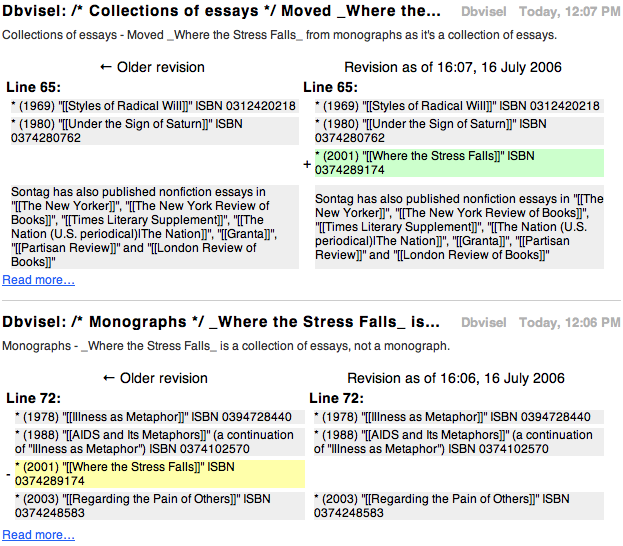
This is from the Wikipedia article on Susan Sontag; the feed is here, though the speed at which the Wikipedia changes suggests that you may no longer see these edits. This is actually two entries (the newest first) documenting a change that I made: I noticed that one of her books had been categorized incorrectly so I moved it to the correct category. In the bottom entry, I deleted Where the Stress Falls from the Monographs section: on the left side is the Monographs section before my deletion, on the right side in Monographs after my deletion. In the top entry, I added Where the Stress Falls to the Essays section. On the left is the section before my addition; on the right is the section after. The brackets, asterisks, and single quotes are the markup style used by Wikipedia. The yellow background is added to a new paragraph; green denotes a deleted paragraph. If you change existing text, changes are in red, much like MS Word’s track changes feature.
How useful is this? It might be too early to say: RSS is a useful building block, and once it exists, interesting uses tend to present themselves. I suspect it will prove most useful to casual Wikipedians, who update a small number of articles on a regular basis but don’t spend most of their time in the Wikipedia.
aggregator academica
Scott McLemee has made an interesting proposal for a scholarly aggregator site that would weave together material from academic blogs and university presses. Initially, this would resemble an enhanced academic blogroll, building on existing efforts such as those at Crooked Timber and Cliopatria, but McLemee envisions it eventually growing into a full-fledged discourse network, with book reviews, symposia, a specialized search engine, and a peer voting system á la Digg.
This all bears significant resemblance to some of the ideas that emerged from a small academic blogging symposium that the Institute held last November to brainstorm ways to leverage scholarly blogging, and to encourage more professors to step out of the confines of the academy into the role of public intellectual. Some of those ideas are set down here, on a blog we used for planning the meeting. Also take a look at John Holbo’s proposal for an academic blog collective, or co-op. Also note the various blog carnivals around the web, which practice a simple but effective form of community aggregation and review. One commenter on McLemee’s article points to a science blog aggregator site called Postgenomic, which offers a similar range of services, as well as providing useful meta-analysis of trends across the science blogosphere — i.e. what are the most discussed journal papers, news stories, and topics.
For any enterprise of this kind, where the goal is to pull together an enormous number of strands into a coherent whole, the role of the editor is crucial. Yet, at a time when self-publishing is the becoming the modus operandi for anyone who would seek to maintain a piece of intellectual turf in the network culture, the editor’s task is less to solicit or vet new work, and more to moderate the vast conversation that is already occurring — to listen to what the collective is saying, and also to draw connections that the collective, in their bloggers’ trenches, may have missed.
Since that November meeting, our thinking has broadened to include not just blogging, but all forms of academic publishing. On Monday, we’ll post an introduction to a project we’re cooking up for an online scholarly network in the field of media studies. Stay tuned.
rice university press reborn digital
After lying dormant for ten years, Rice University Press has relaunched, reconstituting itself as a fully digital operation centered around Connexions, an open-access repository of learning modules, course guides and authoring tools.  Connexions was started at Rice in 1999 by Richard Baraniuk, a professor of electrical and computer engineering, and has since grown into one of the leading sources of open educational content — also an early mover into the Creative Commons movement, building flexible licensing into its publishing platform and allowing teachers and students to produce derivative materials and customized textbooks from the array of resources available on the site.
The new ingredient in this mix is a print-on-demand option through a company called QOOP. Students can order paper or hard-bound copies of learning modules for a fraction of the cost of commercial textbooks, even used ones. There are also some inexpensive download options. Web access, however, is free to all. Moreover, Connexions authors can update and amend their modules at all times. The project is billed as “open source” but individual authorship is still the main paradigm. The print-on-demand and for-pay download schemes may even generate small royalties for some authors.
The Wall Street Journal reports. You can also read these two press releases from Rice:
“Rice University Press reborn as nation’s first fully digital academic press”
“Print deal makes Connexions leading open-source publisher”
UPDATE:
Kathleen Fitzpatrick makes the point I didn’t have time to make when I posted this:
Rice plans, however, to “solicit and edit manuscripts the old-fashioned way,” which strikes me as a very cautious maneuver, one that suggests that the change of venue involved in moving the press online may not be enough to really revolutionize academic publishing. After all, if Rice UP was crushed by its financial losses last time around, can the same basic structure–except with far shorter print runs–save it this time out?
I’m excited to see what Rice produces, and quite hopeful that other university presses will follow in their footsteps. I still believe, however, that it’s going to take a much riskier, much more radical revisioning of what scholarly publishing is all about in order to keep such presses alive in the years to come.
GAM3R 7H30RY gets (open) peer-reviewed
Steven Shaviro (of Wayne State University) has written a terrific review of GAM3R 7H30RY on his blog, The Pinnochio Theory, enacting what can only be described as spontaneous, open peer review. This is the first major article to seriously engage with the ideas and arguments of the book itself, rather than the more general story of Wark’s experiment with open, collaborative publishing (for example, see here and here). Anyone looking for a good encapsulation of McKenzie’s ideas would do well to read this. Here, as a taste, is Shaviro’s explanation of “a world…made over as an imperfect copy of the game“:
Computer games clarify the inner logic of social control at work in the world. Games give an outline of what actually happens in much messier and less totalized ways. Thereby, however, games point up the ways in which social control is precisely directed towards creating game-like clarities and firm outlines, at the expense of our freedoms.
Now, I think it’s worth pointing out the one gap in this otherwise exceptional piece. That is that, while exhibiting acute insight into the book’s theoretical dimensions, Shaviro does not discuss the form in which these theories are delivered, apart from brief mention of the numbered paragraph scheme and the alphabetically ordered chapter titles. Though he does link to the website, at no point does he mention the open web format and the reader discussion areas, nor the fact that he read the book online, with the comments of readers sitting plainly in the margins. If you were to read only this review, you would assume Shaviro was referring to a vetted, published book from a university press, when actually he is discussing a networked book that is 1.1 — a.k.a. still in development. Shaviro treats the text as though it is fully cooked (naturally, this is how we are used to dealing with scholarly works). But what happens when there’s a GAM3R 7H30RY 1.2, or a 2.0? Will Shaviro’s review correspondingly update? Does an open-ended book require a more open-ended critique? This is not so much a criticism of Shaviro as an observation of a tricky problem yet to be solved.
Regardless, this a valuable contribution to the surrounding literature. It’s very exciting to see leading scholars building a discourse outside the conventional publishing channels: Wark, through his pre-publication with the Institute, and Shaviro with his unsolicited blog review. This is an excellent sign.
flickr as virtual museum

A local story. The Brooklyn Museum has been availing itself of various services at Flickr in conjunction with its new “Grafitti” exhibit, assembling photo sets and creating a group photo pool. In addition, the museum welcomes anyone to contribute photographs of grafitti from around Brooklyn to be incorporated into the main photo stream, along with images of a growing public grafitti mural on-site at the museum where visitors can pick up a colored pencil and start scribbling away. Here’s a picture from the first week of the mural:

This is an interesting case of a major cultural institution nurturing an outer curatorial ring to complement, and even inform, a central exhibit (the Institute conducted a similar experiment around Christo’s Gates installation in Central Park, 2005). It’s especially well suited to a show about grafitti, which is already a popular subject of amateur street photography. The museum has cleverly enlisted the collective eyes of the community to cover a terrain (a good chunk of the total surface area of Brooklyn) far too vast for any single organization to fully survey. (The quip has no doubt already been made that users be sure not forget to tag their photos.)
Thanks, Alex, for pointing this out.
the myth of universal knowledge 2: hyper-nodes and one-way flows
 My post a couple of weeks ago about Jean-Noël Jeanneney’s soon-to-be-released anti-Google polemic sparked a discussion here about the cultural trade deficit and the linguistic diversity (or lack thereof) of digital collections. Around that time, Rüdiger Wischenbart, a German journalist/consultant, made some insightful observations on precisely this issue in an inaugural address to the 2006 International Conference on the Digitisation of Cultural Heritage in Salzburg. His discussion is framed provocatively in terms of information flow, painting a picture of a kind of fluid dynamics of global culture, in which volume and directionality are the key indicators of power.
First, he takes us on a quick tour of the print book trade, pointing out the various roadblocks and one-way streets that skew the global mind map. A cursory analysis reveals, not surprisingly, that the international publishing industry is locked in a one-way flow maximally favoring the West, and, moreover, that present digitization efforts, far from ushering in a utopia of cultural equality, are on track to replicate this.
…the market for knowledge is substantially controlled by the G7 nations, that is to say, the large economic powers (the USA, Canada, the larger European nations and Japan), while the rest of the world plays a subordinate role as purchaser.
Foreign language translation is the most obvious arena in which to observe the imbalance. We find that the translation of literature flows disproportionately downhill from Anglophone heights — the further from the peak, the harder it is for knowledge to climb out of its local niche. Wischenbart:
An already somewhat obsolete UNESCO statistic, one drawn from its World Culture Report of 2002, reckons that around one half of all translated books worldwide are based on English-language originals. And a recent assessment for France, which covers the year 2005, shows that 58 percent of all translations are from English originals. Traditionally, German and French originals account for an additional one quarter of the total. Yet only 3 percent of all translations, conversely, are from other languages into English.
…When it comes to book publishing, in short, the transfer of cultural knowledge consists of a network of one-way streets, detours, and barred routes.
…The central problem in this context is not the purported Americanization of knowledge or culture, but instead the vertical cascade of knowledge flows and cultural exports, characterized by a clear power hierarchy dominated by larger units in relation to smaller subordinated ones, as well as a scarcity of lateral connections.
Turning his attention to the digital landscape, Wischenbart sees the potential for “new forms of knowledge power,” but quickly sobers us up with a look at the way decentralized networks often still tend toward consolidation:
Previously, of course, large numbers of books have been accessible in large libraries, with older books imposing their contexts on each new release. The network of contents encompassing book knowledge is as old as the book itself. But direct access to the enormous and constantly growing abundance of information and contents via the new information and communication technologies shapes new knowledge landscapes and even allows new forms of knowledge power to emerge.
Theorists of networks like Albert-Laszlo Barabasi have demonstrated impressively how nodes of information do not form a balanced, level field. The more strongly they are linked, the more they tend to constitute just a few outstandingly prominent nodes where a substantial portion of the total information flow is bundled together. The result is the radical antithesis of visions of an egalitarian cyberspace.
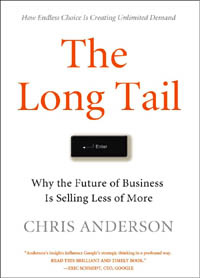 He then trains his sights on the “long tail,” that egalitarian business meme propogated by Chris Anderson’s new book, which posits that the new information economy will be as kind, if not kinder, to small niche markets as to big blockbusters. Wischenbart is not so sure:
…there exists a massive problem in both the structure and economics of cultural linkage and transfer, in the cultural networks existing beyond the powerful nodes, beyond the high peaks of the bestseller lists. To be sure, the diversity found below the elongated, flattened curve does constitute, in the aggregate, approximately one half of the total market. But despite this, individual authors, niche publishing houses, translators and intermediaries are barely compensated for their services. Of course, these multifarious works are produced, and they are sought out and consumed by their respective publics. But the “long tail” fails to gain a foothold in the economy of cultural markets, only to become – as in the 18th century – the province of the amateur. Such is the danger when our attention is drawn exclusively to dominant productions, and away from the less surveyable domains of cultural and knowledge associations.
John Cassidy states it more tidily in the latest New Yorker:
There’s another blind spot in Anderson’s analysis. The long tail has meant that online commerce is being dominated by just a few businesses — mega-sites that can house those long tails. Even as Anderson speaks of plentitude and proliferation, you’ll notice that he keeps returning for his examples to a handful of sites — iTunes, eBay, Amazon, Netflix, MySpace. The successful long-tail aggregators can pretty much be counted on the fingers of one hand.
Many have lamented the shift in publishing toward mega-conglomerates, homogenization and an unfortunate infatuation with blockbusters. Many among the lamenters look to the Internet, and hopeful paradigms like the long tail, to shake things back into diversity. But are the publishing conglomerates of the 20th century simply being replaced by the new Internet hyper-nodes of the 21st? Does Google open up more “lateral connections” than Bertelsmann, or does it simply re-aggregate and propogate the existing inequities? Wischenbart suspects the latter, and cautions those like Jeanneney who would seek to compete in the same mode:
If, when breaking into the digital knowledge society, European initiatives (for instance regarding the digitalization of books) develop positions designed to counteract the hegemonic status of a small number of monopolistic protagonists, then it cannot possibly suffice to set a corresponding European pendant alongside existing “hyper nodes” such as Amazon and Google. We have seen this already quite clearly with reference to the publishing market: the fact that so many globally leading houses are solidly based in Europe does nothing to correct the prevailing disequilibrium between cultures.
mining for emergent discourse
 Last spring, I was completely obsessed with the Brokeback Mountain trailer remixes. I found them to be part parody and part distillation of commentary on the hero archetype. The remixes produced an emergent discourse, without the intention of the creators.
Virginia Kuhn posed a very interesting thought in her comment to the post:
I wonder however, if the aggregate discourse created will be able to shed reliance on archetypes that don’t seem entirely natural but more cultural in nature. In other words, I wonder if the hero can be submerged in favor of something else… It seems to me that would be quite radical.
A great place to mine for these new types of emergent discourse is ytmnd.com, where a incredibly rich discourse is going on purely through multimedia texts. As with most viral media, I was first shown the site a few years ago at work, in this case, by a former colleague Brian.
ytmnd.com refers to a website sampling Sean Connery’s line “You’re the man now, dog!” from the film “Finding Forester.” The site contained with a tiled of image of Mr. Connery, a bit of text, and a sound loop. What was intended on being a one-off post lead to the creation of an entire site devoted to similar sampled remixes inspired by the original, which anyone can upload. What a “post” is difficult to describe and is almost a genre to itself. However, there are common features, including animated gifs, tiled images in a webpage background, limited text, techno-pop samples, Nintendo imagery and science fiction references. The lack of text, micro-length, and heavy use of pop culture is a reflection upon the evolving norms of our cultural language in the digital networked society.
The low production values has interesting effects on the site. Because the barrier of entry is lowered, the speed of production allows for responding to events or other posts in real time. The vibrant spontaneous “conversation” is seen with the immediate reactions to the ejection of French soccer player, Zinedine Zidane, in the 2006 World Cup championship match for head-butting a player on the Italian national team. By the end of the next day a series of posts had been watched tens of thousands of times, with the most popular entry currently having over 200,000 views. People have posted various commentaries on the incident, with the more amusing ones having theories behind Zidane’s action, involving missiles and candy.
However, as with any open and accessible forum, much of the work can be juvenile, crude, not appropriate for work, and plainly offensive. Many posts are not safe for work. The number of page views a far from perfect, but not terrible filter for quality. A community has emerged around the site, as has a media ecology, where one example inspires the creation of others. Often a popular post, will initiate others to riff off the post and create responses. For instance, Picard Song was the first post to be uploaded to the ytmnd.com site after it went live. As of July 11,2006, a search for Picard reveals 1,261 entries. Including, YOU’RE THE CAPTAIN PICARD NOW! (made four days after Picard Song) and of course Picard and Zidane. Picard IS the Empire has cultural nods to Star Trek, Star Wars, Saturday Night Live’s Night at the Roxbury skit, and Herbie the Love Bug in the memorizing display of pop cultural referential weirdness.
The Brokeback Mountain trailer spoofs rely on the archetype of the hero, while playing off the implied homoeroticism of male bonding in film for a specific outcome. Here, the discourse is much more chaotic and disparate. As Kuhn predicted, the archetype has been submerged. Something else is in its place, but I am not sure what that is. Although we are not seeing in general deep critical analysis, the bird’s eye view does show a new form of language more akin to leet or perhaps, the inside joke among a group friends, but on a much wider scale due to its accessibility on the Internet. ytmnd.com is a prime example of cultural production built on existing culture that Larry Lessig discribes in Free Culture. Further, Henry Jinkens has discussed how we as a culture are constantly bombarded with media, advertising and branding. We should not be surprised then that ytmnd.com takes for the form that it does, using existing content almost certainly under copyright protection. It is worth noting that some posts push against this reliance on popular culture by using historic references. However, the series of medieval themed posts including this one is most funny and successful when understood within the larger going conversation of ytmnd.com.
When I go to ytmnd.com, I may not understand everything being said or find it amusing, however I inevitably feel like something new and important is happening. These short bursts of communication are extremely popular and are a unique form of composition that can carry on a conversation within its own form. Although it will not replace standard forms of digital or analogue writing, ytmnd.com is a model of how emergent discourse can form through an open network and accessible tools.
world cup coverage in the blogosphere
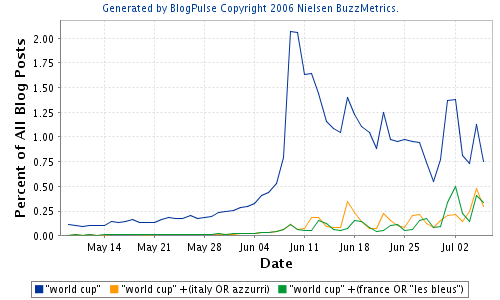
Like much of the rest of the world, I got swept up in the World Cup. Matthew Hurst from Nielsen Buzzmetrics has some great visualizations of the blogosphere’s coverage of the World Cup. He shows images of who the blogosphere expected to win (Italy,) the interest of bloggers rise and fall during the month long tournament, a proposal to estimate TV viewership from blogosphere size, and the increase of online discussion over time by country.
The discussion that occurred online is a reflection of an overall online international consciousness. The World Cup is a great opportunity to see what information can be teased out from the aggregate conversation. Overtime, domestic coverage is an interesting case, because the popularity of soccer in the US is growing but is still less than average on a global scale. What are the reasons behind the much greater interest this year, even though the team was eliminated in the first round? Perhaps, the success four years ago when they reached the quarterfinals lead to more viewers this year. What role did the time difference from the US to Germany versus 2002’s co-hosts Japan and South Korea, and therefore the ability to watch more games live, play? Does more coverage from traditional US media outlets explain the high volume of online World Cup discussions? I expect in the future, as we witness more events, be it political, economic or entertainment, we will able to use these aggregation tools and visualizations to gain insight on these kinds of questions.
Via Jeff Jarvis at Buzzmachine