amazon raises paperback prices

An interesting twist in the Kindle story reported at Dear Author:

Amazon’s pricing for mass market books has suddenly gone full retail, no discount since the release of the Kindle. When questioned in Newsweek about the low pricing, Bezos said “low-margin and high-volume sale – ?you just have to make sure the mix [between discounted and higher-priced items] works.” It looks like Bezos is hoping to make more money off the high volume of sales from those mass market purchasers.
…I guess this is one way of forcing readers to purchase the Kindle. If Kindle success rises or falls on the backs of the mass market purchasers, this is going to be ugly because I see a whole bunch of Amazon purchasers being pretty upset about this turn of events.

Thanks to Peter Brantley for the link.

the novelodeon

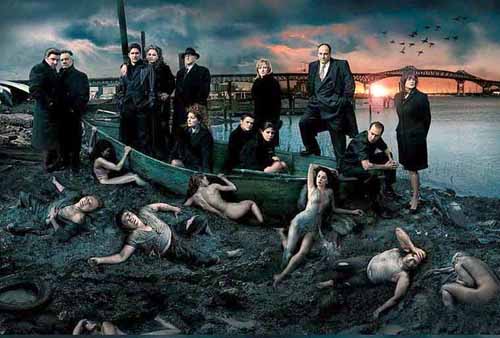
sopranos_5.jpg
This past April, as the final season of The Sopranos hit the airwaves, with seemingly the whole country bracing for impact, I’d still never seen a single episode. Gradually, my indifference turned to concern. It felt like every talk show, news culture section and conversation on the street was about the fate of Tony Soprano -? a latter-day American anti-hero, a titanic figure with the air of myth about him. I began worry that I’d missed out on something big. A cultural touchstone of rare proportions.
So, as the end drew near, I took a deep breath and decided to start from the beginning.
Six months, 86 episodes, and over 70 combined viewing hours later I’m finally done, and while I may have missed out on The Sopranos as a broadcast event -? seven seasons of weekly appointments with Tony, Carmela, Meadow, AJ and the whole crumbling world of New Jersey gangsterdom -? I got to experience something perhaps more satisfying: a hyper-concentrated, solitary viewing experience, curled up nightly in bed with my laptop. Episodes flowing into each other almost seamlessly like chapters of a book. The pause button like a dog-eared page or bookmark inserted as my eyelids began to droop. An experience not unlike reading a big novel.
Book lovers frequently insist they could never get in bed with a computer, but it seems that this is happening all the time. Any of you who have indulged in a multi-season TV binge can probably attest to this -? hours spent prone, the laptop huffing away, plowing through disc after disc (Bob made a similar observation a while back). Substantively too there’s something that recalls leisure reading. It has oft been remarked that The Sopranos heralded a major shift in television into terrain once solely occupied by the novel: serial dramas that transcend their episodic structure and become a new kind of literature. Big cross-seasonal plot arcs. A broad social canvas. Intricately interwoven narrative. A large cast of deeply drawn characters. Not to mention a purchase on the country’s imagination that recalls the popularity of the great serial fictions of Dickens a century and a half ago. With the spate of high-caliber TV serials originated by HBO and then proliferated by channels across the television spectrum, film has moved onto the novel’s turf, matching not only its narrative scope but its expansive dimensions. Stories as big and sprawling as novels can now be told in moving pictures, and thanks to a host of new individualized distribution channels, experienced as intimately, on a laptop or iPod.
Of course I’m not suggesting that film and prose fiction aren’t very different things, just that their roles seem to be converging. From its early days, film has been in conversation with the novel, frequently operating on canvases as vast as Anna Karenina or Great Expectations, but it necessarily has had to compress, select and distill the worlds it shows into something in the vicinity of two hours. When a film edges toward the three-hour mark it is considered epic. Simply in terms of duration of story and investment of time by the viewer/reader, movies and novels have always been very different kinds of fiction requiring very different sets of commitments from their audiences.
The shift arguably began with the multi-episode adaptations of classic books pioneered by the BBC in the 70s -? shows like I, Claudius, on through the 1995 hit rendition of Pride and Prejudice, right up to last year’s Bleak House. Here, television began to stretch out novelistically. And indeed, novels were the source material. Still, the solitary “reading” element was absent here. These were broadcast events, viewed in living rooms at an appointed time set by the channel, with little or no control by the spectator. Soon enough, however, VCRs entered the home and television audiences became time shifters, capturing and bending the broadcasters’ schedules to fit their own. From there the die was pretty much cast. A parade of new “narrowcast” technologies -? DVDs, TiVo, personal computers, iTunes, bit torrent -? imbued these shows with book-like qualities: reader-driven, personal, portable… an intimate cinema of one.
Immediately upon finishing The Sopranos, with the pangs of withdrawal already setting in, I found solace in Wikipedia, which has extensive articles on each episode and character from the show. With the help of the external links, I soon found myself on a strange digital dérive through various arcana: press clippings, blogs, and an forums debating the show’s ambiguous ending, personal web pages of supporting cast members such as Joseph R. Gannascoli, who played the gay mobster Vito Spatafore, and from whose site one can purchase such fine collectibles as t-shirts emblazoned with “I Love You Johnny Cakes.” Through the drifts of trivia, I eventually dug up several interesting quotes from contemporary authors ruminating on the novel’s place in American life and the increasing overlap with television. The first bits were from John Freeman, president of the National Book Critics Circle, who published a piece in The Guardian during those fevered months surrounding the Sopranos finale entitled “Has the novel been murdered by the mob?”

From coast to coast, from white-wine sipping yuppies to real life mobsters, The Sopranos has had Americans talking – even those of us not familiar with the difficulty of illegal interstate trucking or how to bury a body in packed snow. While the New York Times called upon Michael Chabon, Elmore Leonard and Michael Connelly to resurrect the serial novel in its Sunday Magazine, critics were calling Chase the Dickens of our time. The final episode roped in some 11.9 million viewers. One major question, though, remains. Has Tony Soprano whacked the American novel?
….America’s most powerful myth-making muse long ago moved in to Hollywood (and the White House press room), so the ascendancy of
The Sopranos to the level of quasi-literary art should have been expected. Indeed, this wouldn’t be troubling were Americans reading other, actual novels. But they’re not – at least not in the numbers they once did.

Freeman cites two authors, Gary Shteyngart and the late Norman Mailer, both of whom have discussed The Sopranos as a story of novelistic proportions. First, here’s Shteyngart, in a Slate dialogue last year with Walter Kirn:

Our time…is more mutable. Change occurs not from year to year but from day to day – ?the fiction writer’s job of remaining relevant has never been harder. And I don’t think this will be true only of the present age. I think we are entering a period of unprecedented acceleration, of previously unimaginable technological gain that may be derailed only by the kind of apocalypse found in Cormac McCarthy’s latest novel.
The Internet, I both fear and hope, is only the beginning.
But the emotional need to connect with a story remains. One of the folks behind the popular HBO series
The Wire recently said that he sees each season as a novel, with a clearly defined beginning, middle, and end. The Sopranos, which may one day be acknowledged as the definitive fiction of the early 21st century, puts an emphasis on detail, setting, and psychology in a way that could resonate with a reader of, say, A Sentimental Education.

And here’s Mailer, in a 2004 interview on Poynter Online:

The Great American Novel is no longer writable. We can’t do what John Dos Passos did. His trilogy on America came as close to the Great American Novel as anyone. You can’t cover all of America now. It’s too detailed. You couldn’t just stick someone in Tampa without knowing about Tampa. You couldn’t get away with it. People didn’t get upset if you were a little scanty on the details in the past. Now all the details get in the way of an expanse of a novel.
You can take a much broader canvas with nonfiction … and Americans want large canvases because America is getting so confusing. People want more information than you can get from most novels. You can read a novel about a small subject like the breakup of a marriage, but that’s not a wide enough approach for some. It takes something like “The Sopranos,” which can loop into a good many aspects of American culture. As I said, I don’t think the Great American Novel can be written anymore. There will be great novels … forever, I hope … But the notion of a wide canvas may be moving to television with its possibilities of endless hours.

I think it’s this element of time that lies at the heart of this over-drawn analogy. The storytellers of television are driving a golden age of magisterial fictions roomy enough to capture the full flow of time. TV serials used to be a way to kill time: repeatable formulas, the same story told again and again, a tradition that’s alive and well in shows like Law & Order. You can check in, check out, it doesn’t really matter. TV has always been sort of timeless in this way. Whereas prose fiction has long had a special relationship with time. Time, in its fullness, takes time for the author to convey, and the time it takes to read book-length fictions is I think equally part of the reward -? it’s an endurance sport, long-distance running. I always assumed that only a book could show me the landscape of time in this almost bodily way, but my recent odyssey with the Soprano family appears to have blurred the usual distinctions.

siva on kindle

Thoughtful comments from Siva Vaidhyanathan on the Kindle:

As far as the dream of textual connectivity and annotations — making books more “Webby” — we don’t need new devices to do that. Nor do we need different social processes. But we do need better copyright laws to facilitate such remixes and critical engagement.
So consider this $400 device from Amazon. Once you drop that cash, you still can’t get books for the $9 cost of writing, editing, and formating. You still pay close to the $30 physical cost that includes all the transportation, warehousing, taxes, returns, and shoplifting built into the price. You can only use Amazon to get texts, thus locking you into a service that might not be best or cheapest. You can only use Sprint to download texts or get Web information. You can’t transfer all you linking and annotating to another machine or network your work. If the DRM fails, you are out of luck. If the device fails, you might not be able to put your library on a new device.
All the highfallutin’ talk about a new way of reading leading to a new way of writing ignores some basic hard problems: the companies involved in this effort do not share goals. And they do not respect readers or writers.
I say we route around them and use these here devices — personal computers — to forge better reading and writing processes.

not drowning but waving

On the Suffolk coast where we stayed last weekend they had been warned of floods comparable to the deluge of 1953 which submerged whole villages and killed hundreds. In the event the high tide wasn’t as high as predicted, although a breach up the estuary submerged the fields beside the river. Local residents were relishing stories of alarmed visitors; they’ve seen it all before round here.
We walk along the river bank and my novelist friend is keen to discuss the future of the book. Her publisher has been circulating their authors with letters about the impact of digitisation; she’s convinced big changes are coming in how novels are distributed, but doesn’t believe there will be much interest in using new media in literary storytelling.
We visit a fish shop by the river that was flooded out. They’d only just opened an extension built at a height recommended by a local fisherman who had told them, “That’s as high as the tide went nine years ago – you’ll be all right.” They weren’t.
Bloggers mix text with still images with moving pictures embedded from YouTube etc. – young people take that media mix for granted, and as consumers we all do, watching tv adaptations of favourite books, using the web to research more about the author to discuss at our reading group. A new generation of more consciously transliterate reader will take it as read that the text is surrounded by researches, images, networks of reader response to the point where these become an entirely integral part of the work of art, the author’s creative voice distinct but no longer so alone.
The flooded fields are rather beautiful and it’s already hard to recall what the landscape looked like before. Nature can adapt instantly to change; it takes longer to redraw the maps. At this week’s if:book:group at DEMOS in London we’re discussing authorship and user generated content. Let’s push off into uncharted waters and see not if but where we float.

of razors and blades

A flurry of reactions to the Amazon Kindle release, much of it tipping negative (though interestingly largely by folks who haven’t yet handled the thing).
David Rothman exhaustively covers the DRM/e-book standards angle and is generally displeased:

I think publishers should lay down the law and threaten Amazon CEO Jeff Bezos with slow dismemberment if he fails to promise immediately that the Kindle will do .epub [the International Digital Publishing Forum’s new standard format] in the next six months or so. Epub, epub, epub, Jeff. Publishers still remember how you forced them to abandon PDF in favor of your proprietary Mobi format, at least in Amazon-related deals. You owe ’em one.

Dear Author also laments the DRM situation as well as the jacked-up price:

Here’s the one way I think the Kindle will succeed with consumers (non business consumers). It chooses to employ a subscription program whereby you agree to buy x amount of books at Amazon in exchange for getting the Kindle at some reduced price. Another way to drive ereading traffic to Amazon would be to sell books without DRM. Jeff Bezos was convinced that DRM free music was imperative. Why not DRM free ebooks?

There are also, as of this writing, 128 customer reviews on the actual Amazon site. One of the top-rated ones makes a clever, if obvious, remark on Amazon’s misguided pricing:

The product is interesting but extremely overpriced, especially considering that I still have to pay for books. Amazon needs to discover what Gillette figured out decades ago: Give away the razor, charge for the razor blades. In this model, every Joe gets a razor because he has nothing to lose. Then he discovers that he LOVES the razor, and to continue loving it he needs to buy razors for it. The rest is history.
This e-book device should be almost free, like $30. If that were the case I’d have one tomorrow. Then I’d buy a book for it and see how I like it. If I fall in love with it, then I’ll continue buying books, to Amazon’s benefit.
There is no way I’m taking a chance on a $400 dedicated e-book reader. That puts WAY too much risk on my side of the equation.

newsweek covers the future of reading

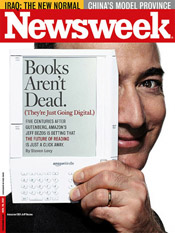
6032-newsweekkindle.jpg Steven Levy’s Newsweek cover story, “The Future of Reading,” is pegged to the much anticipated release of the Kindle, Amazon’s new e-book reader. While covering a lot of ground, from publishing industry anxieties, to mass digitization, Google, and speculations on longer-term changes to the nature of reading and writing (including a few remarks from us), the bulk of the article is spent pondering the implications of this latest entrant to the charred battlefield of ill-conceived gadgetry which has tried and failed for more than a decade to beat the paper book at its own game. The Kindle has a few very significant new things going for it, mainly an Internet connection and integration with the world’s largest online bookseller, and Jeff Bezos is betting that it might finally strike the balance required to attract larger numbers of readers: doing a respectable job of recreating the print experience while opening up a wide range of digital affordances.
Speaking of that elusive balance, the bit of the article that most stood out for me was this decidely ambivalent passage on losing the “boundedness” of books:

Though the Kindle is at heart a reading machine made by a bookseller – ?and works most impressively when you are buying a book or reading it – ?it is also something more: a perpetually connected Internet device. A few twitches of the fingers and that zoned-in connection between your mind and an author’s machinations can be interrupted – ?or enhanced – ?by an avalanche of data. Therein lies the disruptive nature of the Amazon Kindle. It’s the first “always-on” book.

reenactment

From time to time, the Institute returns to thorny and intractable thought experiments. One that’s been kicking around for a long time is what we’ve called the “Communist Manifesto problem”: the problem of representing a book and the conversations it engenders over time, conversations which may grow to include other books. (The Communist Manifesto would be a particularly knotty text to render because it’s had so many cultural repercussions. See here and here for past references on this blog.) It’s a good thought experiment because it’s too big to be easily solved, but aspects of it come up fairly frequent basis. This past week, I found myself thinking about a particular facet of the Communist Manifesto problem: how we think about re-enactment in the age of the archive.
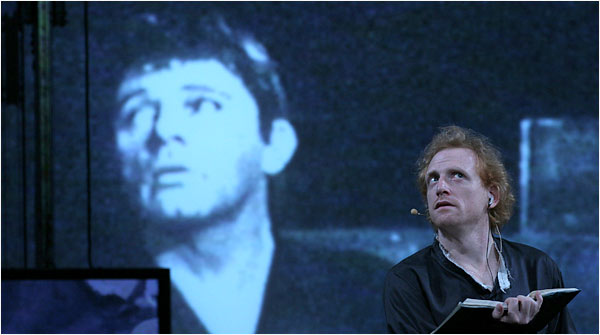
On Wednesday night, I went to see the Wooster Group’s production of Hamlet. I’m not especially qualified as a theater critic (I’m sure others here can say more intelligent things than I), but the central thrust of this production is simple enough: the actors performing Hamlet perform it in front of video of the 1964 filmed version of the play starring Richard Burton. The Burton version is a filmed play, a form intended to bring theater to the theaterless masses that never quite caught on; the Wooster Group’s actors expertly mime the 1964 actors, and sets are moved balletically to match changes in camera angles in the film. Often the original actors are digitally edited out of the film in whole or in part. It’s a clever idea. Hamlet is as familiar to us as any play can be. Even if you’ve never seen another dramatic or filmic production of the play, the language can’t be escaped: in some stretches, every line has been borrowed as a title for something else. It’s lousy with resonances. We can’t watch Hamlet as a self-contained work of art any more than we can look at the Mona Lisa. The Wooster Group’s production makes this explicit: when we watch Hamlet, we’re watching it against the army of other Hamlets we’ve seen.
scott shepherd and richard burton are both hamlet
This has always been an issue with certain well-known works: Hamlet‘s been omnipresent for a long time. The availability of a digital archive, however, has foregrounded this. Before film, theatergoers would be measuring productions against memories of previous productions they’d seen. Now we don’t need to rely on memory: a dozen filmed versions of Hamlet can be queued on Netflix without any trouble, to say nothing of the 4,700 videos that are the results of a YouTube search.
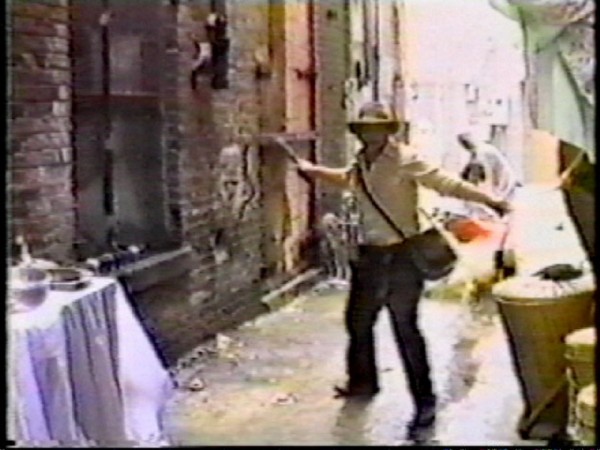
Another cover version: on Thursday night, I went over to Anthology Film Archives to see Raiders of the Lost Ark: The Adaptation. From 1982 to 1989, a group of teens in Mississippi filmed their own scene-for-scene version of Spielberg’s Indiana Jones movie, corralling their friends to play Egyptians, family dogs to play monkeys, and laboriously recreating all but one of the original stunts: they decided there was no way to film a Nazi decapitated by an airplane’s propellor without it looking cheesy, so they left that out. The film & sound quality is muddy, to say the least but one can’t help but be impressed by what they managed to do. It’s clear that an astonishing amount of work went into the film, still more when you realize that they didn’t have a copy of the original on video to work from. And spending seven years on the project: my youth appears pale and lazy by comparison. Strangely, the makers of the film only bothered to show it once before its rediscoveryfour years ago.
chris strompolos is a new and improved indiana jones
Once you start thinking about the idea of re-enactment, you start seeing it everywhere. Maybe the argument could be made that we’re in a cultural moment devoted to re-enactment. Much of what we write off as novelty can be put into this category. The Internet recently was excited about old people re-enacting iconic photos of the twentieth century; see also choirs of old people performing Sonic Youth’s “Schizophrenia”. Or choirs of small children doing much the same. But less ironic presentations abound: off the top of my head, Japancakes just released a note-for-note country-inflected cover of Loveless, My Bloody Valentine’s seminal drone-rock record. Going further, German new music ensemble Zeitkratzer has played and recorded Lou Reed’s Metal Machine Music. Tom McCarthy‘s excellent recent novel Remainder concerns a wealthy man who maniacally reenacts scenes; McCarthy springs from the art world, which has been interested in re-enactment for a while. Examples spiral on ad infinitum. But there seems to be something in us that wants to see or hear what we’ve seen or heard before again.
These are quickly composed thoughts, and I’m ignoring a great deal; parsing the difference between re-enactment and adaptation could be fiendishly complicated, as might be the role of copyright in all of this, etc. I’ll simply tie this back to the Communist Manifesto problem. I think it’s become apparent that we’re no longer reading texts in isolation: now when we read Hamlet, digital media has made it possible to read any number of possible versions at the same time. The archive presents us with an embarrassment of riches, though I suspect that we still lack the tools to let us make sense of the pile: both to make sense of the growing number of versions of texts and to usefully compare versions. The Wooster Group’s Hamlet can be seen as a close reading of the 1964 Hamlet. But such a one-to-one reading might just be the tip of the iceberg.

build your own texbook

Peter Brantley pointed me to an interesting experiment from Pearson Custom Publishing, who is working with faculty at Rio Solado community college in Arizona to print custom textbooks assembled from multiple sources. Inside Higher Ed has details:

The result, in what could be the first institution-wide initiative of its kind, will be a savings to students of up to 50 percent, the college estimates, as well as a savings of time to faculty, who often find themselves revising course materials to keep pace with continuously updated editions.
…Professors can pick from among the books in Pearson’s library as well as outside sources in preparing their custom textbooks. For works not published by Pearson, there’s a limit of 10 percent of the contents, but the company will then handle copyright clearance.

I recently read in the Times about a similar service from Condé Nast for individualized cookbooks culled, à la carte as it were, from the Epicurious.com recipe library.

amazon kindle due out monday

In CNET news: “Amazon to debut Kindle e-book reader Monday.”
While it’s got more going for it than any of its predecessors or present competitors -? wi-fi connection, seamless integration with the biggest online store in the world, access to dozens of periodicals, keyword search for crying out loud, which the Sony Reader still bafflingly lacks -? I’m skeptical about the Kindle. If the device ($399) and individual electronic titles (barely marked down from print) weren’t so absurdly overpriced, it might make more sense to readers. Over at Teleread, David Rothman wonders about the solidity of Jeff Bezos’ long-term commitment to books.

library of congress to archive electronic literature (suggest a link)

The Electronic Literature Organization seeks your assistance in selecting “works of imaginative writing that take advantage of the capabilities of the standalone or networked computer” for preservation by the LOC and Internet Archive:

The Library of Congress has asked the Electronic Literature Organization to collect a sample of 300 web sites related to the field and to contribute that sample to the Internet Archive’s Archive-It project. The sites selected will be crawled and archived to the extent that the Archive-It technology allows. The result will be full-text searchable collections of the spidered HTML files in the Internet Archive’s Wayback Machine. The ELO will enter metadata including a short description and keywords for each URL entered into the database. The ELO Board of Directors, Literary Advisory Board, membership, and community are encouraged to suggest sites here for three sets of links.
-? Electronic Literature: Collections of Works: Sites that aggregate works of electronic literature by multiple authors, such as online journals and anthologies.
-? Electronic Literature: Individual Works: Individual works of electronic literature and collections of works by a single author, as opposed to collections of works by multiple authors.
-? Electronic Literature: Context: Sites related to the critical, theoretical, and institutional contexts of electronic literature.

More info on how to suggest links at the ELO wiki.