welcome, sebastian mary! (it’s official)

We are very happy to welcome Sebastian Mary Harrington onto the “official” Institute masthead. This is long overdue, and merely formalizes what is already without question one of our most important and well established partnerships. But formalized it is. And we’re damn pleased.
It all started two Octobers ago with a casual comment on a post about iPods and reading. An email exchange ensued and before we knew it sMary was blogging away, quickly carving out her place as what you might call our “new online literary forms correspondent.” For over a year now she’s been writing some of the best coverage to be found anywhere on alternative reality games (ARGs), as well as brilliant speculative essays on the future shape of authorship, copyright and the economics of publishing. (She’s also become a dear friend.) I wonder if it’s happened before: a random blog comment leading to a paid writing gig? It’s a good story in itself, and sort of captures why blogging is such an important part of our work.
Here’s little sampler of her if:book portfolio (running newest to oldest):

Once again, we’re delighted sMary will be officially working with us for part of every month, continuing to deliver her sharp insights and humor here on if:book, and taking part in some of our emerging activities on the London scene.
This is also probably a good time to say a bit more about sMary’s other endeavors. In addition to her work with the Institute, she’s co-founder of the UK web startup School of Everything (chosen by Seedcamp as one of Europe’s hottest startups of 2007) and co-founder and creative director of the cult London art event ARTHOUSEPARTY. You can find out a bit more on our staff page.
Another warm welcome to sMary. You’ll no doubt be hearing more from her soon.

the tomb of the book

BibliotecaVasconcelos.jpg
“Vista de la Biblioteca Vasconcelos” by Eneas, on Flickr
A lovely meditation at BLDG Blog on the architecture of storage facilities for unwanted books. Speaks volumes (as it were) to the anxiety of obsolescence that keeps librarians up at night -? the thought of libraries themselves becoming tombs.

…a relatively random piece of 100-year old legislation – dealing with copyright law, of all things – has begun to exhibit architectural effects.
These architectural effects include the production of huge warehouses in the damp commuter belts of outer London. These aren’t libraries, of course; they’re stockpiles. Text bunkers.
…Perhaps it will take some future moment of cultural archaeology to break into these places, spelunking back into the literate past, to find well-tempered rooms still humming at 50ºF, humidity-free, where the past is refrigerated and Shakespeare’s name can still be recognized on the spines of books.

talking of poets and sparkles

‘The cast of mind which searches, which questions, which dissents, has a great history. Each society has given it its own form: religious, literary. scientific. Much of the strength of Blake derives from the twofold form which dissent took in his time: rational and inspired… The history of dissent is not yet ended; it does not end. Men die, and societies die. They are not more lasting for being without dissent, they are more brittle: for they are purposeless, because they deny themselves a future.’
So writes Charles Bronowski in his book on William Blake, A Man Without a Mask, quoted by Shirley Dent of the Institute of Ideas in an article on the anniversary of Blake’s birth 250 years ago.
Brilliant, belligerent, barmy Blake has been claimed as a figurehead by all kinds of hippies and politicoes over the years, and was recently cited as ‘The Godfather of Psychogeography‘ by Ian Sinclair for, among other things, seeing angels in the trees of Peckham Rye and the new Jerusalem in leafy north London:
“The fields from Islington to Maylebone,
To Primrose Hill and Saint John’s Wood:
Were builded over with pillars of gold,
Are there Jerusalems pillars stood.”
(This quote from Jerusalem features in Merlin Coverley’s excellent guide to Psychogeography which includes city strollers from Defoe and Poe to Debord and Will Self).
William Blake, the man who wandered through the charter’d streets of London finding in the face of every passerby ‘marks of weakness, marks of woe’, who engraved and painted his own books of poems, selling his songs on subscription (or failing to sell them), would have made one hell of a blogger too. I imagine him mashing up maps of Hampstead with his personal mythology, forging a new kind of book on the anvil of his laptop, engaging his community of readers in fervent debate, plying them with animations of innocence and experience.

reading responsibly: nancy kaplan on the NEA’s data distortion

The following critique, which expands upon a comment left late yesterday, is from Nancy Kaplan, Executive Director of the School of Information Arts and Technologies at the University of Baltimore.
Analyzing long term trends in Americans’ reading habits, To Read or Not to Read argues that three important trends produce a worrying prognosis for the future of reading, and indeed the future of civic life:
1. a historical decline in voluntary reading rates among teenagers and young adults;
2. a gradual worsening of reading skills among older teens;
3. and declining proficiency in adult readers.
These three trends provide the foundations for the central argument of the report, which can be summarized fairly succinctly:

Reading books in one’s leisure time strongly correlates with reading proficiency so that when rates of voluntary book-reading decline and we also see a decline in reading proficiency, it is reasonable to suppose that people become less proficient readers because they are spending less time reading books for pleasure.

The entire argument, in short, depends on the ability to demonstrate both that reading proficiency is declining and that the number of people who choose to read books in their leisure time is also declining. From those two trends, the NEA draws some inferences about what declines in reading books and declines in reading proficiency mean for the nation as a whole.
Much of the data used to support the core claims derives from statistics gathered and analyzed by the National Center for Education Statistics (NCES). In particular, data on reading proficiency at three ages -? 9, 13, and 17 -? come from the National Assessment of Educational Progress (NAEP) report on long term trends, a “nationally representative and continuing assessment of what America’s students know and can do in various subject areas. Assessments are conducted periodically [since 1971] in mathematics, reading, science, writing, the arts, civics, economics, geography, and U.S. history” (http://nces.ed.gov/nationsreportcard/about/). In addition to assessing reading proficiency across three contexts for reading (“reading for literary experience, reading for information, and reading to perform a task”), the assessment also “asked students to report contextual variables such as time spent on homework, the number of pages read for school and homework, and the amount of time spent reading for fun” (TRONTR, p. 27). Data demonstrating the decline in reading proficiency among adult readers come from a separate NCES study, the National Assessments of Adult Literacy (NAAL), which has been conducted periodically since 1992.
Despite the numerous charts, graphs and tables in To Read or Not ot Read, a careful and responsible reading of the complete data provided by the NAEP and the NAAL undermine the conclusions the NEA draws. Two examples of problematic uses of primary data sets will illustrate the issues.
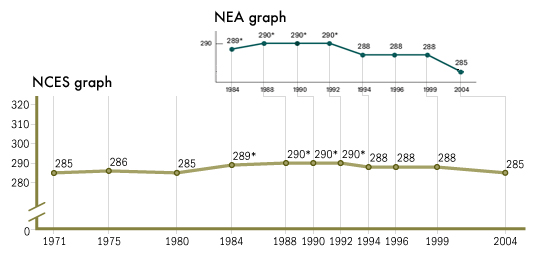
The graph below shows the original data as it is displayed on the NCES web site (http://nces.ed.gov/nationsreportcard/images/ltt/ss01.gif) with the NEA’s truncated and reformatted version superimposed above the original:
reading_decline_graph.jpg

Although the data represented in the NEA version are strictly speaking accurate, they nevertheless seriously distort the data set from which they were derived in two key ways: by truncating the data set and by representing irregular time intervals with regularized spatial intervals. The first distortion creates a trend where none exists. The second distortion magnifies the effect of the decline in scores by making the slope of the line between the scores in 1999 and the scores in 2004 steeper than it should be. The steeper slope, then, suggests a more rapid and deeper decline than the underlying data support.
Note that the NEA graph begins with the year 1984 while the data set from NCES begins in 1971. Note too that the average scale score for 17 year olds in 2004 -? 285 -? is exactly the same as the average scale score for that age group in 1971. In other words, over the whole period for which data are available, there has been no change in reading proficiency among 17 year olds, although there was evidently a brief period of significant improvement between 1984 and 1992 (the asterisks mark statistically significant differences with the 2004 score). In short, there is no downward trend in reading proficiency over the whole period for which we have data. The downturn that did occur after scores peaked from 1988 through 1992 is statistically significant but it is on the whole not very steep nor particularly precipitous. In fact the magnitude and duration of the decline mirror the statistically significant uptick in scores over the four year period from 1980 to 1984.
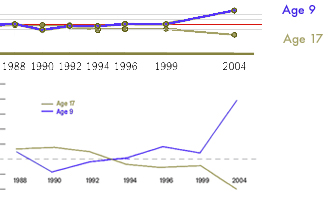
A second graph produced by the NEA and used both in the executive summary and in Chapter 5 of the report highlights and magnifies both kinds of distortions. The graph uses a truncated set of the NCES data for two age groups -? 17 year old students and 9 year old students -? to exaggerate the difference in trends between the two groups. The underlying data are represented on the NCES graph at the top of the illustration. The green dots and line represent the relative changes in scores for 17 year olds from 1988 to 2004 and the blue line represents the relative changes for 9 year olds. The horizontal red line is the base 1988 score for each group. The 9 year old groups’ score is 7 points higher in 2004 than it was in 1988 while the 17 year old groups’ score is 5 points lower. In the NEA graph for these same data, the scale has been altered to create the impression that score differences are much greater than they actually are. The dramatic improvement in the scores of 9 year old readers is statistically significant, as is the 5 point decline in scores for 17 year olds over the period shown in the graphs. Yet in the NEA revision of the NCES graph, the data points for each test year are spaced evenly across the x-axis even though the tests occurred at uneven intervals. As a result, the changes in scores for both groups are made to seem much more dramatic and sudden than they really are.
9_17_comparison.jpg

Misleading graphs based on manipulated data are not the only fudge factor the NEA employs. In addition to relying on two sources of NAEP data, To Read or Not to Read also uses data from the National Assessment of Adult Literacy whose latest report, Literacy in Everyday Life, provides a nuanced and detailed analysis of adult literacy in America over 11 years (1992-2003). Despite the complexity of its subject and the detailed data it provides, the NAAL report begins with a clear and simple assertion: “between 1992 and 2003, there were no statistically significant changes in average prose … literacy for the total population ages 16 and older…” (p. iv). Even though the overall picture did not change, the NAAL did report some data that, when removed from the larger picture, appear to suggest declines in adult proficiency. As the NEA notes, proficiency among adults with bachelor’s degrees and post-graduate degrees declined in statistically significant measures. But the NAAL report explains the apparent contradiction by noting that underlying demographic changes account for the fact that overall proficiency did not decline while levels of proficiency among the more highly educated appear to have decreased:

The fact that average prose literacy decreased or remained the same for all levels of highest educational attainment raises an interesting questiion. How could prose literacy scores decrease at every level of education beyond high school without a decrease in the overall score? This pattern is called Simpson’s Paradox. The answer is that the relative size of the groups changed. From 1992 to 2003, the percentage of adults with postsecondary education increased and the percentage of adults who did not complete high school decreased. The increase in the percentage of adults with postsecondary education, who, on average, had higher prose scores than adults who did not complete high school, offsets the fact that average prose literacy scores declined at every level of educational attainment beyond high school. (p. 37).

Among other things, the NAAL report finds that various demographic factors, especially an adult’s first language and the age at which that person learned English, have significant effects on proficiency with literacy in English. A quick look at changes in population over the same period provides a reasonable hypothesis to explain the NAAL data. Over the period measured in the latest report, the US has experienced large increases in immigrant populations. For example, in 1990, 7.9% of the total US population were foreign born; in 2000, the 11.1% of the population were immigrants. The overwhelming majority of foreign born residents of the US (97% of naturlized citizens and 84% of all other foreign born residents) are adults. Such changes in the make-up of the population might have important effects on the data.
Data may be one kind of thing but polemic is another. The heart of the NEA’s case appears not in the report proper but in preface provided by the Endowment’s Chairman, Dana Gioia. There he explicitly asserts that reading books, preferrably every day, produces more prosperous and more virtuous citizens:

Strictly understood, the data in this report do not necessarily show cause and effect. The statistics merely indicate correlations. The habit of daily reading, for instance, overwhelmingly correlates with better reading skills and higher academic achievement. On the other hand, poor reading skills correlate with lower levels of financial and job success. At the risk of being criticized by social scientists, I suggest that since all the data demonstrate consistent and mostly linear relationships between reading and these positive results – ?and between poor reading and negative results -? reading has played a decisive factor. Whether or not people read, and indeed how much and how often they read, affects their lives in crucial ways.
All of the data suggest how powerfully reading transforms the lives of individuals – ?whatever their social circumstances. Regular reading not only boosts the likelihood of an individual’s academic and economic success – ?facts that are not especially surprising – ?but it also seems to awaken a person’s social and civic sense. Reading correlates with almost every measurement of positive personal and social behavior surveyed. It is reassuring, though hardly amazing, that readers attend more concerts and theater than non-readers, but it is surprising that they exercise more and play more sports – ?no matter what their educational level. The cold statistics confirm something that most readers know but have mostly been reluctant to declare as fact – ? books change lives for the better.

There is little doubt that modern information economies require many more proficient readers than older industrial economies did. Because of changes in the nature and conditions of work, declining proficiency in reading among American adults might cause some concern if not alarm. It is surely also the case that educational institutions at every level can and should do a better job. Yet there is little evidence of an actual decline in literacy rates or proficiency. As a result, the NEA’s core argument breaks down. Even if we assume that high school seniors in 1971 spent more of their leisure time reading books than today’s high school seniors do (although there is no data going back far enough to support the case one way or the other), there simply is no evidence that today’s youngsters don’t read as well as Mr. Gioia’s peers did at a comparable age. From the information available, we simply cannot construct any relationship, let alone a causal one, between voluntary reading of books and reading proficiency.
Reading well, doing well, and doing good may exhibit strong correlations but the underlying dynamics producing each of the three effects may have little to do with what Americans choose to do in their leisure time. Read responsibly, the data underlying the NEA’s latest report simply do not support Mr. Gioia’s assertions.
Like many other federal agencies under our current political regime, the National Endowment for the Arts seems to have fixed the data to fit its desired conclusions.


sparkles from the wheel

Walt Whitman’s poem “Sparkles from the Wheel” beautifully captures the pleasure and exhilaration of watching work in progress:

1
WHERE the city’s ceaseless crowd moves on, the live-long day,
Withdrawn, I join a group of children watching – ?I pause aside with them.
By the curb, toward the edge of the flagging,
A knife-grinder works at his wheel, sharpening a great knife;
Bending over, he carefully holds it to the stone – ?by foot and knee,
With measur’d tread, he turns rapidly – ?As he presses with light but firm hand,
Forth issue, then, in copious golden jets,
Sparkles from the wheel.
2
The scene, and all its belongings – ?how they seize and affect me!
The sad, sharp-chinn’d old man, with worn clothes, and broad shoulder-band of leather;
Myself, effusing and fluid – ?a phantom curiously floating – ?now here absorb’d and arrested;
The group, (an unminded point, set in a vast surrounding;)
The attentive, quiet children – ?the loud, proud, restive base of the streets;
The low, hoarse purr of the whirling stone – ?the light-press’d blade,
Diffusing, dropping, sideways-darting, in tiny showers of gold,
Sparkles from the wheel.

I was reminded of this the other day while reading a brief report in Library Journal on Siva’s recent cross-blog argument with Michigan University Librarian Paul Courant about Google book digitization contracts. These sorts of exchanges are not new in themselves, but blogs have made it possible for them to occur much more spontaneously and, in Siva’s case, to put them visibly in the context of a larger intellectual project. It’s a nice snapshot of the sort of moment that can happen along the way when the writing process is made more transparent -? seeing an argument crystallize or a position get clarified. And there’s a special kind of pleasure and exhilaration that comes from reading this way, seeing Siva sharpening his knife -? or argument -? and the rhetorical sparks that fly off the screen. Here’s that Library Journal bit:

Discussion of Google Scan Plan Heats Up on Blogs:
Now this is why we love the Blogosphere. In launching his blog, University of Michigan’s (UM) dean of libraries Paul Courant recently offered a spirited defense of UM’s somewhat controversial scan plan with Google. That post drew quite a few comments, and a direct response from Siva Vaidhyanathan the author, blogger, and University of Virginia professor currently writing the Googlization of Everything online at the Institute for the Future of the Book; that of course drew a response from Courant. The result? A lively and illuminating dialog on Google’s book scanning efforts.

ephemera

I had dinner last night with an elderly and eminent print collector and art historian. He specialises in the eighteenth century – the period when the quantity of text being produced last exploded by an order of magnitude – and embodies many of the assumptions of that period. The printed word is always meaningful; all printed matter is precious; even the minutiae of history are worth preserving.
So when not writing authoritative texts on engravings of Stubbs, he collects ephemera. To the uninitiated, that’s postcards, leaflets, adverts – basically anything printed, however trivial it might seem – and delivers great sacks of the stuff to the Bodleian Library at intervals to be sifted and, if deemed important, archived.
I tried to imagine what it would be like attempting to keep up with modern-day ephemera. I asked him: in an era of mass desktop self-publishing, is it even conceivable or possible to try and keep up? How can one collect and archive such stuff? He said they usually only take stuff from periods up to around the ’50s or ’60s as a rule. But somewhat to my surprise, he insisted that ephemera was more important today than ever, precisely because of computers: “Sooner or later anything on a computer gets erased. If we don’t collect some print how will anyone know what happened?”.
I’m not sure that delivering sacks of home-printed yoga adverts and party invitations to the Bodleian Library is the answer. But it did make me pause. While pamphlets, books and other ephemera give us some clue as to what life was like three centuries ago, what provisions are we making for our own mass memory? Will this neophiliac digital culture be stored on the future equivalent of floppy drives, only to end up becoming just as swiftly obsolete and unreadable? Answers on a postcard.

reeding riting and ranting

It’s the season for literacy statistics. The reading performance of children in England has fallen from third to 19th in the world according to a major assessment. The Progress in International Reading Literacy Study (Pirls), undertaken every five years, involved children aged about 10 in 40 countries. Attitudes to reading in England appear poor compared to those of children in many other countries, and have declined slightly since 2001. Children in England read for pleasure less frequently than their peers in many other countries.
But what does that mean? The ensuing debate about declining standards has failed to consider how use of screen and page mingle for young consumers (and creators) of culture. Time spent playing on computers is assumed to be wasted, but how much reading and writing is done on screen? My friends’ thirteen year old daughter spent lots of time on line – but was found to be writing fan fiction short stories and uploading them for peer group response, all with no parental or educational support whatsoever. The key to creating more young readers is to keep books of all kinds in the mix with the other information and entertainment sources children make use of. That’s what’s so important about schemes like Bookstart and Booktime which put exciting books into children’s hands and homes at key moments in their early lives.
As long as children can read proficiently – and the PERLS study shows a decline in interest amongst confident readers rather than plummeting literacy levels – then what really matters is not how many books they use as opposed to websites or tv programmes consumed, but how much information and imagination they glean from their entire cultural diet.
At a meeting last week of FLO, the consortium of ‘Friendly Literature Organisations’ in the UK, we presented the case that agencies like the Poetry Society, Spread the Word and the whole network of literature development agencies in the UK need have no fear at all of the digital. Their work is all about literature not books, about access, interaction and excellence; their skills as curators of their artform are exactly those most prized in the age of attention.
It’s important we keep banging the drum for the living word and look ahead to where stories and poetry go next. That’s the way to ensure that young people grow into creative readers and writers of the world they inhabit.

the NEA’s misreading of reading

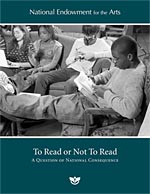
TRNR.jpg Matthew G. Kirschenbaum writes an elegant and concise critique of the National Endowment for the Arts’ ominously titled new study of American reading trends, “To Read or Not to Read: A Question of National Consequence”, which is a sequel to their 2004 opus “Reading at Risk.” The basic argument is that reading, or what they rather awkwardly refer to as “voluntary reading” (that is, reading done purely for pleasure or self-improvement) is in a precipitious state of decline, especially among the young -? a situation which poses a grave threat to our culture, democracy and civic fabric.
Though clearly offered with the best of intentions, the report demonstrates an astonishingly simplistic view of what reading is and where it is and isn’t occurring. Overflowing with bar graphs and and charts measuring hours and minutes spent reading within various age brackets, the study tries to let statistics do the persuading, but fails at almost every turn to put these numbers in their proper social or historical context, or to measure them adequately against other widespread forms of reading taking place on computers and the net.
The study speaks, as Kirschenbaum puts it, “as though there is but a single, idealized model of reading from which we have strayed” -? a liesurely, literary sort of reading embodied by that classic image of the solitary reader hunched over a book in deep concentration. Kirschenbaum rightly argues that this way of reading is simply one of a complicated and varied set of behaviors that have historically operated around texts. More to the point, many of these alternative forms -? skimming, browsing, lateral reading, non-linear reading, reading which involves writing (glossing, annotation etc.) to name some -? today happen increasingly in digital contexts, constituting what Kirschenbaum refers to broadly as a grand “remaking of reading.” The NEA document takes little of this into account. Kirschenbaum:

…while the authors of the report repeatedly emphasize that they include online reading in their data, the report sounds most clumsy and out of touch when referring to new media. The authors of the report tend to homogenize “the computer” without acknowledging the diversity of activity -? and the diversity of reading -? that takes place on its screen. Our screens are spaces where new forms like blogs and e-mail and chats commingle with remediations of older forms, like newspapers and magazines -? or even poems, stories, and novels. Reading your friend’s blog is not likely a replacement for reading Proust, but some blogs have been a venue for extraordinary writing, and we are not going to talk responsibly or well about what it means to read online until we stop conflating genre with value.
The report also fails to acknowledge the extent to which reading and writing have become commingled in electronic venues. The staccato rhythms of a real-time chat session are emblematic in this regard: Reading and writing all but collapse into a single unified activity. But there is a spectrum of writing online, just as there is a spectrum of reading, and more and more applications blur the line between the two.

(He goes on to mention CommentPress and a number of other networked reading applications…)
There’s certainly cause for concern about what might be lost as deep extended reading of deep extensive books declines, and in their crude way the NEA’s stats and figures do tell a worrying tale of shifting cultural priorities. Indeed, the most appealing aspect of “To Read or Not to Read” is its passionate commitment to a set of humanistic values: sustained thinking, personal and moral growth, a critical outlook, the cultivation of knowledge. Few would disagree that these are things that ought to be held onto in the face of relentless technological change and a rapacious commercial culture, but to insist that the book and one particular romanticized notion of reading must be the sole vessels for transporting these values into the future seems both naive and needlessly limiting.
You could say that our group’s mission is to advocate for these same values -? values that we certainly associate with books, hence our name -? but in the diverse landscape of new media. To the question “to read or not to read” we answer emphatically “to read!” But to understand what reading actually is demands a more nuanced investigation.

how to keep google’s books open

Whip-smart law blogger Frank Pasquale works through his evolving views on digital library projects and search engines, proposing a compelling strategy for wringing some public good from the tangle of lawsuits surrounding Google Book Search. It hinges on a more expansive (though absolutely legally precedented) interpretation of fair use that takes the public interest and not just market factors into account. Recommended reading. (Thanks, Siva!)