
Last week I received an email from Sunil Iyengar of the National Endownment for the Arts responding to Nancy Kaplan’s critique (published here on if:book) of the NEA’s handling of literacy data in its report “To Read or Not to Read.” I’m reproducing the letter followed by Nancy’s response.
Sunil Iyengar:
The National Endowment for the Arts welcomes a “careful and responsible” reading of the report, To Read or Not To Read, and the data used to generate it. Unfortunately, Nancy Kaplan’s critique (11/30/07) misconstrues the NEA’s presentation of Department of Education test data as a “distortion,” although all of the report’s charts are clearly and accurately labeled.
For example, in Charts 5A to 5D of the full report, the reader is invited to view long-term trends in the average reading score of students at ages 9, 13, and 17. The charts show test scores from 1984 through 2004. Why did we choose that interval? Simply because most of the trend data in the preceding chapters–starting with the NEA’s own study data featured in Chapter One–cover the same 20-year period. For the sake of consistency, Charts 5A to 5D refer to those years.
Dr. Kaplan notes that the Department of Education’s database contains reading score trends from 1971 onward. The NEA report also emphasizes this fact, in several places. In 2004, the report observes, the average reading score for 17-year-olds dipped back to where it was in 1971. “For more than 30 years…17-year-olds have not sustained improvements in reading scores,” the report states on p. 57. Nine-year-olds, by contrast, scored significantly higher in 2004 than in 1971.
Further, unlike the chart in Dr. Kaplan’s critique, the NEA’s Charts 5A to 5D explain that the “test years occurred at irregular intervals,” and each test year from 1984 to 2004 is provided. Also omitted from the critique’s reproduction are labels for the charts’ vertical axes, which provide 5-point rather than the 10-point intervals used by the Department of Education chart. Again, there is no mystery here. Five-point intervals were chosen to make the trends easier to read.
Dr. Kaplan makes another mistake in her analysis. She suggests that the NEA report is wrong to draw attention to declines in the average reading score of adult Americans of virtually every education level, and an overall decline in the percentage of adult readers who are proficient. But the Department of Education itself records these declines. In their separate reports, the NEA and the Department of Education each acknowledge that the average reading score of adults has remained unchanged. That’s because from 1992 to 2003, the percentage of adults with postsecondary education increased and the percentage who did not finish high school decreased. “After all,” the NEA report notes, “compared with adults who do not complete high school, adults with postsecondary education tend to attain higher prose scores.” Yet this fact in no way invalidates the finding that average reading scores and proficiency levels are declining even at the highest education levels.
“There is little evidence of an actual decline in literacy rates or proficiency,” Dr. Kaplan concludes. We respectfully disagree.
Sunil Iyengar
Director, Research & Analysis
National Endowment for the Arts
Nancy Kaplan:
I appreciate Mr. Iyengar’s engagement with issues at the level of data and am happy to acknowledge that the NEA’s report includes a single sentence on pages 55-56 with the crucial concession that over the entire period for which we have data, the average scale scores of 17 year-olds have not changed: “By 2004, the average scale score had retreated to 285, virtually the same score as in 1971, though not shown in the chart.” I will even concede the accuracy of the following sentence: “For more than 30 years, in other words, 17year-olds have not sustained improvements in reading scores” [emphasis in the original]. What the report fails to note or account for, however, is that there actually was a period of statistically significant improvement in scores for 17 year-olds from 1971 to 1984. Although I did not mention it in my original critique, the report handles data from 13 year-olds in the same way: “the scores for 13-year-olds have remained largely flat from 1984-2004, with no significant change between the 2004 average score and the scores from the preceding seven test years. Although not apparent from the chart, the 2004 score does represent a significant improvement over the 1971 average – ?a four-point increase” (p. 56).
In other words, a completely accurate and honest assessment of the data shows that reading proficiency among 17 year-olds has fluctuated over the past 30 years, but has not declined over that entire period. At the same time, reading proficiency among 9 year-olds and 13 year-olds has improved significantly. Why does the NEA not state the case in the simple, accurate and complete way I have just written? The answer Mr. Iyengar proffers is consistency, but that response may be a bit disingenuous.
Plenty of graphs in the NEA report show a variety of time periods, so there is at best a weak rationale for choosing 1984 as the starting point for the graphs in question. Consistency, in this case, is surely less important than accuracy and completeness. Given the inferences the report draws from the data, then, it is more likely that the sample of data the NEA used in its representations was chosen precisely because, as Mr. Iyengar admits, that sample would make “the trends easier to read.” My point is that the “trends” the report wants to foreground are not the only trends in the data: truncating the data set makes other, equally important trends literally invisible. A single sentence in the middle of a paragraph cannot excuse the act of erasure here. As both Edward Tufte (The Visual Display of Quantitative Information) and Jacques Bertin (Semiology of Graphics), the two most prominent authorities on graphical representations of data, demonstrate in their seminal works on the subject, selective representation of data constitutes distortion of that data.
Similarly, labels attached to a graph, even when they state that the tests occurred at irregular intervals, do not substitute for representing the irregularity of the intervals in the graph itself (again, see Tufte and Bertin). To do otherwise is to turn disinterested analysis into polemic. “Regularizing” the intervals in the graphic representation distorts the data.
The NEA report wants us to focus on a possible correlation between choosing to read books in one’s leisure time, reading proficiency, and a host of worthy social and civic activities. Fine. But if the reading scores of 17 year-olds improved from 1971 to 1984 but there is no evidence that during the period of improvement these youngsters were reading more, the case the NEA is trying to build becomes shaky at best. Similarly, the reading scores of 13 year-olds improved from 1971 to 1984 but “have remained largely flat from 1984-2004 ….” Yet during that same period, the NEA report claims, leisure reading among 13 year-olds was declining. So what exactly is the hypothesis here -? that sometimes declines in leisure reading correlate with declines in reading proficiency but sometimes such a decline is not accompanied by a decline in reading proficiency? I’m skeptical.
My critique is aimed at the management of data (rather than the a-historical definition of reading the NEA employs, a somewhat richer and more potent issue joined by Matthew Kirschenbaum and others) because I believe that a crucial component of contemporary literacy, in its most capacious sense, includes the ability to understand the relationships between claims, evidence and the warrants for that evidence. The NEA’s data need to be read with great care and its argument held to a high scientific standard lest we promulgate worthless or wasteful public policy based on weak research.
I am a humanist by training and so have come to my appreciation of quantitative studies rather late in my intellectual life. I cannot claim to have a deep understanding of statistics, yet I know what “confounding factors” are. When the NEA report chooses to claim that the reading proficiency of adults is declining while at the same time ignoring the NCES explanation of the statistical paradox that explains the data, it is difficult to avoid the conclusion that the report’s authors are not engaging in a disinterested (that is, dispassionate) exploration of what we can know about the state of literacy in America today but are instead cherry-picking the elements that best suit the case they want to make.
Nancy Kaplan, Executive Director
School of Information Arts and Technologies
University of Baltimore
the year of the author
Natalie Merchant, one of my favorite artists, was featured in The New York Times today. She is back after a long hiatus, but if you want to hear her new songs you better stand in line for a ticket to one of her shows because she doesn’t plan to release an album anytime soon. She appeared this weekend at the Hiro Ballroom in New York City. According to the Times, a voice in the crowd asked when Ms. Merchant would release a new album, she said with a smile that she was awaiting “a new paradigm for the recording industry.”
hmm, well, the good news is that the paradigm is shifting, fast. But we don’t yet know if this will be a good thing or a bad thing. It’s certainly a bad thing for the major labels, who are losing market share faster then polar bears are losing their ice (sorry for the awful metaphor). But as they continue to shrink, so do the services and protections they offer to the artists. And the more content moves online the less customers are willing to pay for it. Radiohead’s recent experiment proves that.
But artists are still embracing new media and using it to take matters into their own hands. In the music industry, a long-tail entrepreneurial system supported by online networks and e-commerce is beginning to emerge. Sites like nimbit empower artists to manage their own sales and promotion, bypassing itunes which takes a hefty 50% off the top and and, unlike record labels, does nothing to shape or nurture an artist’s career.
Now, indulge me for a moment while I talk about the Kindle as though it were the ipod of ebooks. It’s not, for lots of reasons. But it does have one thing in common with its music industry counterpart, it allows authors to upload their own content and sell it on amazon. That is huge. That alone might be enough to start a similar paradigm shift in publishing. In this week’s issue of Publisher’s Weekly, Mike Shatzkin predicts it will.
So why have I titled this, “the year of the author”? (I borrowed that phrase from Mike Shatzkin’s prediction #3 btw). I’m not trying to say it will be a great year for authors. New media is going to squeeze them as it is squeezing musicians and striking writer’s guild members. It is the year of the author, because they will be the ones who drive the paradigm shift. They may begin to use online publishing and distribution tools to bypass traditional publishers and put their work out there en masse. OR they will opt out of the internet’s “give-up-your-work-for-free” model and create a new model altogether. Natalie Merchant is opting to (temporarily I hope) bring back the troubadour tradition in the music biz. It will be interesting to see what choices authors make as the publishing industry’s ice begins to shift.
the future of the sustainable book
On New Year’s Eve, I got lost in Yonkers trying to take my son’s gently-used toys to the Salvation Army. The Yonkers store was the only one I could find willing to take them. The guy on the phone hesitated, “Are they in good condition?” he asked, clearly unhappy about my impending donation. I assured him they were, and he sighed and told me to come on over.
On principle, I try (really hard) to give away anything that is not completely worn out. But it is getting harder and harder to do. Nobody wants my old furniture or clothes or books. And they especially don’t want used children’s toys. My attempt to give them away was ill-fated. A police barricade stopped me at Nepperhan Avenue (a construction site disaster). Then I drove around for forty minutes until I found an alternate route but was twarted at Ashburton Ave (building on fire, streets blocked). I gave up and went home. With stomach full of guilt, I put the plastic toys in the dumpster. My son didn’t mind because he had a brand new pile of toys in his playroom, Christmas gifts from relatives and friends who couldn’t be dissuaded.
Point is, it seems increasingly difficult to opt out of the cycle of waste-creation. Plastic kids’ toys are just one example. I’m also guilty of consuming and transforming lots of other things into waste: clothes, computers, cell phones, magazines, all sorts of complicatedly-packaged food and beverage items, etc… So yesterday, when I contemplated how best to spend 2008, I decided to focus on figuring out how to create a more sustainable lifestyle. And since I work in book publishing, job one is to figure out what it means to create a sustainable book. Lots of models come to mind. Good ones like Wikipedia (device-neutral and always in the latest, free, edition) and bad ones like the Kindle, (which tries to create a market for an ebook reader with designed obsolescence).
Anyway, I thought it might be useful to weave the sustainability discussion into if:book’s ongoing consideration of networked ebooks, because at this stage in their developement, networked books could be shaped with sustainability in mind. So, I’m hoping to stir up some interesting discussion and serious contemplation of the perfectly sustainable book: one that is constantly revised, but never needs to be reprinted (or repurchased); one that is lean and simple and doesn’t require a small server farm or a special device; one that makes an enormous impact, but leaves a teeny tiny carbon footprint; one we can live with for ever and ever without getting bored or satiated.
coming soon to a laptop near you
What makes me think 2008 will be a big year for the future of the book?
Last night in London we went to see the movie of The Golden Compass adapted from the excellent Northern Lights by Philip Pullman. Imagine my surprise when all three trailers shown were about films about books – not just film adaptations but movies in which the book itself stars.
Number one: Inkheart. “Maggie and her father had a special gift when it came to reading stories… but there’s one book they should never have read… ” It’s based on the novels of Cornelia Funke.
Number two: Spiderwick, based on books by artist Tony DiTerlizzi and Holly Black. ‘Their World is Closer Than You Think’.
A child reads: ‘Do not dare to read this book for if you do but take a look…”
The trailer ends with an evil monster growling, “Give me the book!”
And finally, for the adults, Nicholas Cage in National Treasure: Book of Secrets.
Quotes from the trailer: “I need to see the page – there’s a symbol… it’s the
President’s secret book, it contains all the conspiracies…The book exists!”
it’s the Search for the Code of the Bride of Harry Potter & Da Vinci.
Meanwhile I loved The Golden Compass, which has been less compromised by Hollywood e than I’d feared. When the movie was launched I was horrified to hear a radio debate in New York about the dangers of Pullman’s philosophy contaminating innocent children – nobody voiced the view that kids deserved more atheist messages not less.
But I thought the least successful element was the tricksy way they showed the all knowing althiometer at work: swirling dust revealing fuzzy orange images. Only in text can you convincingly describe what it would feel like to know the future.
Will this fascination with the secret world of reading lead to increased sales for conventional tomes or is this the beginning of the final battle between page and screen?! And will it lead to more interest in new ways of mixing literature and image to make networked works of staggering genius?
This Spring experience: IFBOOK! ‘It’s a novel, Bob..but not as we know it.’
Happy New Year
quiet
We’re all spending some time away from our computers so things will be pretty quiet round here till after new year’s. Happy holidays, everyone.
Btw, if:book just turned 3!
anatomy of a debate
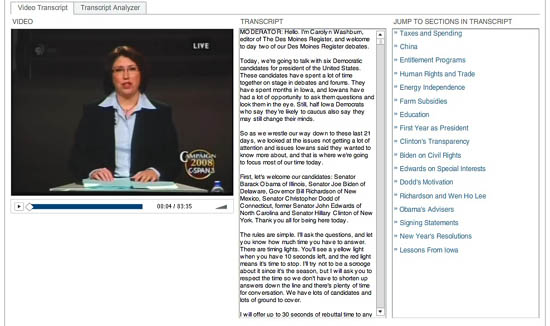
The New York Times continues to do quality interactive work online. Take a look at this recent feature that allows you to delve through video and transcript from the final Democratic presidential candidate debate in Iowa (Dec. 13, ’07). It begins with a lovely navigation tool that allows you to jump through the video topic by topic. Clicking text in the transcript (center column) or a topic from the list (right column) jumps you directly to the corresponding place in the video.
The second part is a “transcript analyzer,” which gives a visual overview of the debate. The text is laid out in miniature in a simple, clean schematic, navigable by speaker. Click a name in the left column and the speaker’s remarks are highlighted on the schematic. Hover over any block of text and that detail of the transcript pops up for you to read. You can also search the debate by keyword and see word counts and speaking times for each candidate.
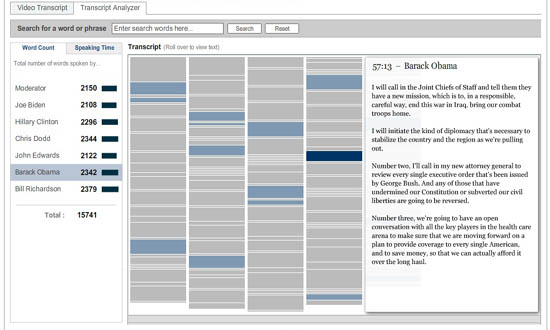
These are fantastic tools -? if only they were more widely available. These would be amazing extensions to CommentPress.
if all the sky was paper
Perhaps the only blog featuring a tag cloud in which ‘Assistant Post Mistress’ looms large, The Travelling Bookbinder in Antarctica somehow seems suitable festive reading for the online book lover.
Book artist and travelling bookbinder, Rachel Hazell, is currently working and living in the world’s most famous post office at Port Lockroy, Antarctica. For six white and blue months, Rachel will be working as Assistant Post Mistress and Penguin Monitor. Entries so far include ‘thinking of poetry and missing it’ and ‘thinking about Ali Smith’s enthusiasm for the spare and simple’. Oh and there are instructions on fashioning a book from a sheet of snow white A4.
a few rough notes on knols
Think you’ve got an authoritative take on a subject? Write up an article, or “knol,” and see how the Web judgeth. If it’s any good, you might even make a buck.

Google’s new encyclopedia will go head to head with Wikipedia in the search rankings, though in format it more resembles other ad-supported, single-author info sources like the About.com or Squidoo. The knol-verse (how the hell do we speak of these things as a whole?) will be a Darwinian writers’ market where the fittest knols rise to the top. Anyone can write one. Google will host it for free. Multiple knols can compete on a single topic. Readers can respond to and evaluate knols through simple community rating tools. Content belongs solely to the author, who can license it in any way he/she chooses (all rights reserved, Creative Commons, etc.). Authors have the option of having contextual ads run to the side, revenues from which are shared with Google. There is no vetting or editorial input from Google whatsoever.
Except… Might not the ads exert their own subtle editorial influence? In this entrepreneurial writers’ fray, will authors craft their knols for AdSense optimization? Will they become, consciously or not, shills for the companies that place the ads (I’m thinking especially of high impact topic areas like health and medicine)? Whatever you may think of Wikipedia, it has a certain integrity in being ad-free. The mission is clear and direct: to build a comprehensive free encyclopedia for the Web. The range of content has no correlation to marketability or revenue potential. It’s simply a big compendium of stuff, the only mention of money being a frank electronic tip jar at the top of each page. The Googlepedia, in contrast, is fundamentally an advertising platform. What will such an encyclopedia look like?
In the official knol announcement, Udi Manber, a VP for engineering at Google, explains the genesis of the project: “The challenge posed to us by Larry, Sergey and Eric was to find a way to help people share their knowledge. This is our main goal.” You can see embedded in this statement all the trademarks of Google’s rhetoric: a certain false humility, the pose of incorruptible geek integrity and above all, a boundless confidence that every problem, no matter how gray and human, has a technological fix. I’m not saying it’s wrong to build a business, nor that Google is lying whenever it talks about anything idealistic, it’s just that time and again Google displays an astonishing lack of self-awareness in the way it frames its services -? a lack that becomes especially obvious whenever the company edges into content creation and hosting. They tend to talk as though they’re building the library of Alexandria or the great Encyclopédie, but really they’re describing an advanced advertising network of Google-exclusive content. We shouldn’t allow these very different things to become as muddled in our heads as they are in theirs. You get a worrisome sense that, like the Bushies, the cheerful software engineers who promote Google’s products on the company’s various blogs truly believe the things they’re saying. That if we can just get the algorithm right, the world can bask in the light of universal knowledge.
The blogosphere has been alive with commentary about the knol situation throughout the weekend. By far the most provocative thing I’ve read so far is by Anil Dash, VP of Six Apart, the company that makes the Movable Type software that runs this blog. Dash calls out this Google self-awareness gap, or as he puts it, its lack of a “theory of mind”:
Theory of mind is that thing that a two-year-old lacks, which makes her think that covering her eyes means you can’t see her. It’s the thing a chimpanzee has, which makes him hide a banana behind his back, only taking bites when the other chimps aren’t looking.
Theory of mind is the awareness that others are aware, and its absence is the weakness that Google doesn’t know it has. This shortcoming exists at a deep cultural level within the organization, and it keeps manifesting itself in the decisions that the company makes about its products and services. The flaw is one that is perpetuated by insularity, and will only be remedied by becoming more open to outside ideas and more aware of how people outside the company think, work and live.
He gives some examples:
Connecting PageRank to economic systems such as AdWords and AdSense corrupted the meaning and value of links by turning them into an economic exchange. Through the turn of the millennium, hyperlinking on the web was a social, aesthetic, and expressive editorial action. When Google introduced its advertising systems at the same time as it began to dominate the economy around search on the web, it transformed a basic form of online communication, without the permission of the web’s users, and without explaining that choice or offering an option to those users.
He compares the knol enterprise with GBS:
Knol shares with Google Book Search the problem of being both indexed by Google and hosted by Google. This presents inherent conflicts in the ranking of content, as well as disincentives for content creators to control the environment in which their content is published. This necessarily disadvantages competing search engines, but more importantly eliminates the ability for content creators to innovate in the area of content presentation or enhancement. Anything that is written in Knol cannot be presented any better than the best thing in Knol. [his emphasis]
And lastly concludes:
An awareness of the fact that Google has never displayed an ability to create the best tools for sharing knowledge would reveal that it is hubris for Google to think they should be a definitive source for hosting that knowledge. If the desire is to increase knowledge sharing, and the methods of compensation that Google controls include traffic/attention and money/advertising, then a more effective system than Knol would be to algorithmically determine the most valuable and well-presented sources of knowledge, identify the identity of authorites using the same journalistic techniques that the Google News team will have to learn, and then reward those sources with increased traffic, attention and/or monetary compensation.
For a long time Google’s goal was to help direct your attention outward. Increasingly we find that they want to hold onto it. Everyone knows that Wikipedia articles place highly in Google search results. Makes sense then that they want to capture some of those clicks and plug them directly into the Google ad network. But already the Web is dominated by a handful of mega sites. I get nervous at the thought that www.google.com could gradually become an internal directory, that Google could become the alpha and omega, not only the start page of the Internet but all the destinations.
It will be interesting to see just how and to what extent knols start creeping up the search results. Presumably, they will be ranked according to the same secret metrics that measure all pages in Google’s index, but given the opacity of their operations, who’s to say that subtle or unconscious rigging won’t occur? Will community ratings factor in search rankings? That would seem to present a huge conflict of interest. Perhaps top-rated knols will be displayed in the sponsored links area at the top of results pages. Or knols could be listed in order of community ranking on a dedicated knol search portal, providing something analogous to the experience of searching within Wikipedia as opposed to finding articles through external search engines. Returning to the theory of mind question, will Google develop enough awareness of how it is perceived and felt by its users to strike the right balance?
One last thing worth considering about the knol -? apart from its being possibly the worst Internet neologism in recent memory -? is its author-centric nature. It’s interesting that in order to compete with Wikipedia Google has consciously not adopted Wikipedia’s model. The basic unit of authorial action in Wikipedia is the edit. Edits by multiple contributors are combined, through a complicated consensus process, into a single amalgamated product. On Google’s encyclopedia the basic unit is the knol. For each knol (god, it’s hard to keep writing that word) there is a one to one correspondence with an individual, identifiable voice. There may be multiple competing knols, and by extension competing voices (you have this on Wikipedia too, but it’s relegated to the discussion pages).
Viewed in this way, Googlepedia is perhaps a more direct rival to Larry Sanger’s Citizendium, which aims to build a more authoritative Wikipedia-type resource under the supervision of vetted experts. Citizendium is a strange, conflicted experiment, a weird cocktail of Internet populism and ivory tower elitism -? and by the look of it, not going anywhere terribly fast. If knols take off, could they be the final nail in the coffin of Sanger’s awkward dream? Bryan Alexander wonders along similar lines.
While not explicitly employing Sanger’s rhetoric of “expert” review, Google seems to be banking on its commitment to attributed solo authorship and its ad-based incentive system to lure good, knowledgeable authors onto the Web, and to build trust among readers through the brand-name credibility of authorial bylines and brandished credentials. Whether this will work remains to be seen. I wonder… whether this system will really produce quality. Whether there are enough checks and balances. Whether the community rating mechanisms will be meaningful and confidence-inspiring. Whether self-appointed experts will seem authoritative in this context or shabby, second-rate and opportunistic. Whether this will have the feeling of an enlightened knowledge project or of sleezy intellectual link farming (or something perfectly useful in between).
The feel of a site -? the values it exudes -? is an important factor though. This is why I like, and in an odd way trust Wikipedia. Trust not always to be correct, but to be transparent and to wear its flaws on its sleeve, and to be working for a higher aim. Google will probably never inspire that kind of trust in me, certainly not while it persists in its dangerous self-delusions.
A lot of unknowns here. Thoughts?
bothered about blogging etc
I’ve never liked seeing movies in groups. After two hours immersed in a fictional world I dread that moment when you emerge blinking into the light and instantly have to give your verdict.
Personally I want time to mull, and for me a pleasure of private reading is not needing to share my opinion – or know what it is – until I’m good and ready.
I have similar problems with blogging. With such brilliant and articulate colleagues knocking out posts for if:book on a regular basis, I must admit I get nervous about adding speedy contributions. And when I do write words I think might be worth sharing, I wonder if I really want to cast them adrift in such fast flowing waters.
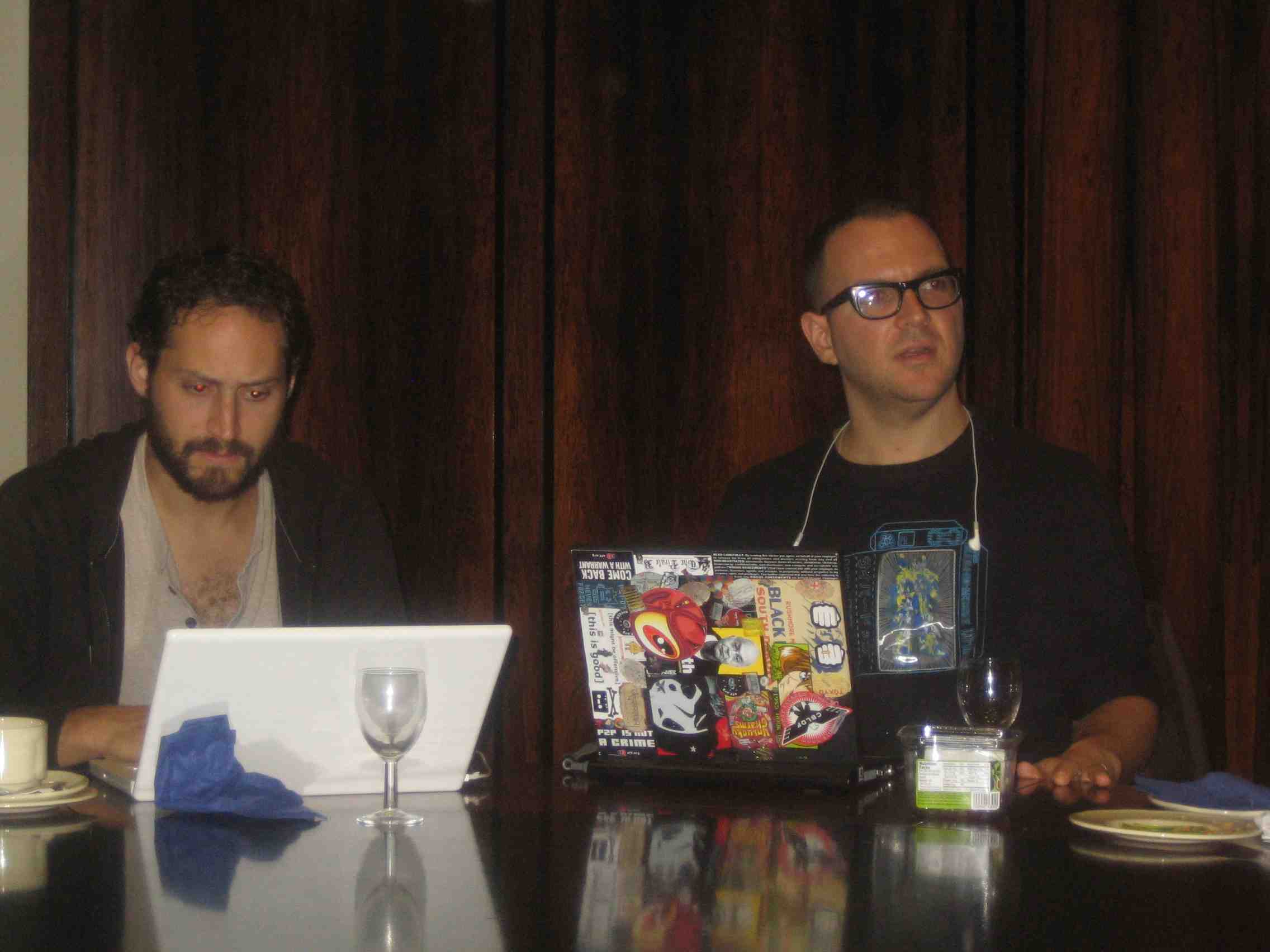
bloggers together – ben vershbow of if:book and cory doctorow of boing boing
I bring this up because the networked book involves active readers happily sharing their thoughts online with others happy to read them.
I dread finding the margins of my e-reader crammed with the scrawlings of cleverclogs, even if I’m free to jump in on their arguments. Having said that, I’m convinced there’s immense potential in building communities of debate around interesting texts. There’s plenty of intelligence and generosity of spirit on the web to counteract the bilge and the bile.
Doris Lessing asks in her Novel prize acceptance speech,
“How will our lives, our way of thinking, be changed by the internet, which has seduced a whole generation with its inanities so that even quite reasonable people will confess that, once they are hooked, it is hard to cut free, and they may find a whole day has passed in blogging etc?”
Lessing’s dismay at addiction to the screen amongst the even quite reasonable is a reminder of the importance of working to heal the cultural divide between bookworms and book geeks. This will involve patience on either side as familiar arguments are replayed to wider audiences. We need to talk in plain English about issues that are so much more interesting and culturally fruitful than many even quite reasonable lovers of literature seem to think they are.
textual montage: the documentary biography
There’s something about the work of Herman Melville that brings out the unexpected in his readers. Example can be drawn almost at random. Call Me Ishmael, the poet Charles Olson’s lyrical little book on Moby-Dick, is as much a meditation on patrimony, artistic and otherwise, as it is about Melville. When the U. S. government locked him up at Ellis Island, the Trinidadian socialist C. L. R. James took the opportunity to move into literary criticism, writing Mariners, Renegades and Castaways: The Story of Herman Melville and the World We Live In, in which he found Melville a sympathetic audience for his argument against state capitalism. Maurice Sendak, best known for Where the Wild Things Are, created semi-pornographic illustrations for an edition of Pierre, Melville’s little-known novel about incest and doubt. Claire Denis turned the comparatively staid Billy Budd into Beau Travail, a sun-dazed film about the French Foreign Legion that culminates in one of the most desparate dance numbers ever. Paul Metcalf, Melville’s great-grandson, smashed together Columbus, teratology, the Bobby Greenlease kidnapping & murder of 1953, and his family’s misgivings about their ancestor to form Genoa, a collage novel.
I set off to write about Metcalf and his unclassifiable books – most of them textual collages made of appropriated writing. Metcalf’s writing is perhaps worth paying attention to in light of electronic media, thoughhere’s precious little about him on the Internet (an interview, an obituary). Thinking about Metcalf’s work, however, I found myself sidetracked: when asked about the inspirations for his textual collages, he pointed to another work on Melville, Jay Leyda’s The Melville Log. I’ll return to Metcalf some other time; he’s not going anywhere.
The Melville Log, though. This is a book that might be just as weird as anything else that Melville ever inspired. It’s also instructive for thinking about how composition in the age of the ubiquitous archive could work. First, a bit of backstory: though Melville was prominent early in his career, he’d faded entirely from the American consciousness by 1920, when Billy Budd was discovered and Moby-Dick was discovered to be the Great American Novel of the nineteenth century. Literary scholars went to work scrutinizing Melville’s life and work; Jay Leyda arrived on the scene in the 1940s, having missed the main boom, but being a big part of a post-war boomlet. In 1951, after years of work, he published The Melville Log, a compilation of first-hand sources about Melville’s life and work. In the half-century since, it’s become a foundational text for anyone seeking to learn about Melville’s life.
I knew that much – just about anyone who’s read Melville has heard of The Melville Log – but I’d never bothered to actually look at a copy of Leyda’s book. From that description, it doesn’t sound interesting. But I found a cheap used copy on Amazon & ordered it; a week later, it turned up on my door. From the dedication, it became clear that this wasn’t the book I’d assumed it was:
This book was begun as a birthday present
for my teacher, Sergei Eisenstein.
 Jay Leyda, it turns out, wasn’t just a literary historian; in fact, he’s best known as a film historian, a field in which he played a foundational role. He had, it seems clear, an interesting life. Considering an career as a filmmaker, Leyda went to Moscow in the 1930s to study film with Eisenstein, the only American to do so; he seems to have worked on Bezhin Meadow as a stills photographer. Returning to the U.S., he served as an advisor to Mission to Moscow, a propaganda film designed to shore up American support for the Soviet Union during WWII (a film later to be soundly denounced as evidence of Hollywood’s un-Americanism). From there he went on to write his Melville book; he also wrote biographies of Emily Dickinson, Sergei Rachmaninoff, and Modest Mussorgsky, as well as a substantial amount of film criticism on Soviet and Chinese films.
What’s the importance of this to his book on Melville? If Leyda learned anything from Eisenstein, it was the value of montage, putting adjacent shots into juxtaposition to create new meaning. Leyda explained what he was doing in his introduction:
The result is a book made of documents, documents of many kinds and from many sources, written by many men and women (and some children); but documents cannot be accepted unconditionally. A ‘document’ should be distrusted as much as a photograph, for documents are a fallible as their human authors. Letters contained as many falsehoods and misunderstandings in 1851 as they do in 1951, and journalists and critics (and typesetters) of a century ago operated under much the same pressures that they do today. Each document quoted here requires some judgment of its author’s motives and character – although perhaps the First Mates who kept the whaling logs may be thought beyond suspicion.
(p. xii.) A few scanned spreads from the book give a feeling for its contents, how it juxtaposes bits and pieces of letters, business documents, journals, and Melville’s work, using time – the march of years from Melville’s birth to his death – as its central axis. Essentially, it’s Eisenstein’s montage, moved from the world of film into that of books, with not a little of what would subsequently be called multimedia. Click to enlarge:
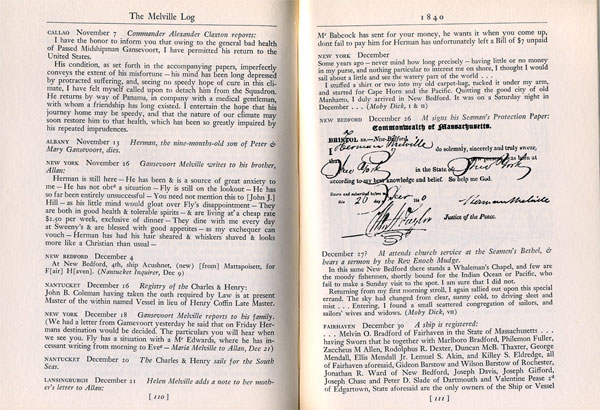
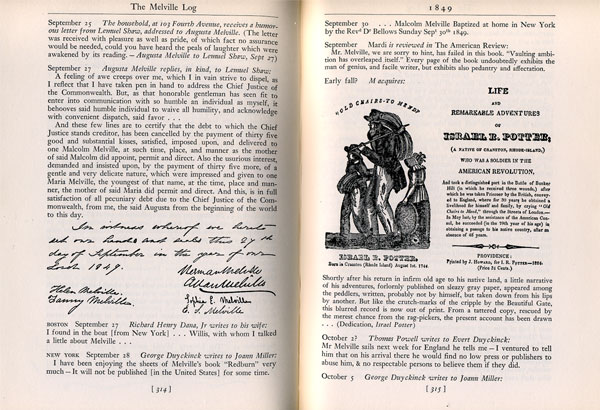
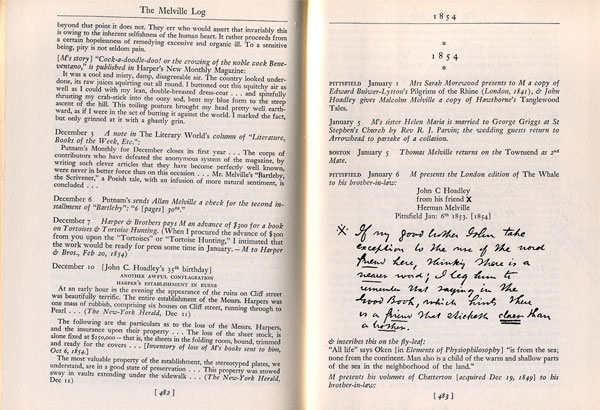
For a book that might be thought of as a biography, there seems to be very little of the biographer: only the unobtrusive introduction to each entry is in Leyda’s hand. (Tucked away at the back of the book, of course, is an enormous list of the sources of quotation.) But lack of the author’s words doesn’t signify the author’s lack of intention. Here’s Eisenstein explaining montage in Film Form, translated by Leyda: “By combining these monstrous incongruities we newly collect the disintegrated event into one whole, but in our aspect.” Leyda, in his own introduction, winks at this: clearly, he’s one of “the First Mates who kept the whaling logs” who would wish to be thought beyond suspicion.
There’s a very interesting reading of Leyda’s collage-work – and the way collage works – in Clare L. Spark‘s Hunting Captain Ahab: Psychological Warfare and the Melville Revival, a thorough dissection of the forces that made Melville into the Melville we think we understand. Melville’s life is a challenge for the prospective biographer: there’s not the usual plot arc or easy moral to be drawn from it, though that hasn’t stopped people from trying to do so: a Great American Novelist needs to behave properly. According to Spark:
Leyda arranged his chronology of Melville’s hitherto confusing or mysterious life to track a progression from Ahab’s family-splitting bourgeois individualism to Billy Budd’s socially responsible sacrifice on behalf of family unity and order, ordering Melville in the process. Every detail of The Melville Log was designed to fortify that message.
(pp. 10–11.) Spark has harsher words for Leyda in her chapter on his work: she sees him as a dyed-in-the-wool Stalinist and details the ways in which suppresses and misrepresents information in the guise of presenting the unvarnished truth. If you’re interested in Melville or twentieth-century American propaganda – from both the right and the left – hers is a fascinating book and well worth seeking out.
* * * * *
But let’s return from the depths of Melville criticism. If, as Spark argues, The Melville Log presents a subjective view of Melville to his readers, it’s only able to do so because Leyda knew that only a miniscule fraction of those who read his book would be able or have the inclination to consult the original documents that he was quoting, the majority of which weren’t publicly accessible.
A thought experiment: what happens if, thanks to book-scanning projects, all those sources were publicly accessible?(The University of Connecticut’s Olson collection might be seen as a start.) Having everything available doesn’t obviate the need for projects like Leyda’s; we need editors to sort through the chaff and to point out the things that are interesting. A born-digital project like this could be instantly accountable in a way that it would be difficult for a print version to be: a link could take the reader from the quotation to the quoted document. Going further: a reader who’s dissatisfied with the slant of a digital Melville Log could assemble their own alternate version.
Technically, this isn’t difficult. But the tools to do this don’t seem to exist yet; and supporting this sort of ecosystem of research doesn’t seem to be an immediate priority for those compiling archives.