
I’ve been meaning to post something for a while about The Reprover, or Le Reprobateur, a hugely impressive work of digital fiction by François Coulon, Paris-based digital writer. It includes excellent cartoons, live video of the main character and a witty text in French and elaborate English which expands and contracts – the same sentence blooming different additional clauses each time you pass a mouse across it. This is a deeply disconcerting effect at first, but once you’ve got used to it, a whole new kind of three dimensional reading emerges. It’s a fascinating idea which could only work on the web.
I’ve been meaning to post.. but haven’t got round to it. That’s why I need a Reprobateur, “someone who would be there simply to give us a bad conscience.” Part psychoanalyst, part priest, part bloke in a suit, the Reprover is a wonderful creation. The story is set in the 80s and you can navigate around it by spinning a 3D polyhedron. “It’s literature plus electricity!” says Coulon.
It’s also plus so many tricks and distractions that it’s hard to settle into – there’s too much fun to be had clicking, spinning and adjusting the layers of soundtrack to actually immerse oneself in the story. The Reprover is beautifully produced and costs real money: 16 Euros or 160 for institutions, but you can get an excellent taster by going to http://www.totonium.com.
I’ve been going back to this one several times for more. Once you’re signed up you can contact the narrator for free advice from your very own Reprover. You’ll wonder how you coped all those years without one.
read this
An interesting experiment on Vimeo. See what’s going on?
Via IT IN place.
emergency books
In the course of looking for something else entirely, I just stumbled upon Emergency Books. It’s a (slightly dormant) side project of Litromagazine, a freesheet that publishes and distributes short fiction outside London Underground stations. Emergency Books are, very simply, out-of-print texts taken from Project Gutenberg and dropped wholesale into a PDF template that makes them easy and economical to print on a standard home printer. They’re designed “for when you’ve nothing to read and a standard issue of Litro is too short”, the publisher (is that the right word here?) explains:
Each ‘double page spread’ fits nicely in an Acrobat Reader window, which results in minimal need for scrolling. On- or off-screen, the columns are relatively narrow and short so you don’t get lost in a sea of text (as you would if you simply printed direct from Project Gutenberg). There is little of the blank white space found in standard books – this is to get as much text on the page as possible thereby reducing the total number of pages required (for example, The Call of the Wild by Jack London, at 128 pages in book form, takes only 15 double-side printed A4 sheets as an Emergency Book – while being just as easy to read). This saves on resources as well as making the printed Emergency Book easier to fold and carry around.
If you are a ‘format purist’, you may well hate them. But if you love literature for the content, Emergency Books could be for you.
Of the small number who’ve saved Emergency Books on del.icio.us, one noted that Emergency Books are ‘for reading when you’re caught short. If that ever happens’. I like the idea of literature being, like cigarettes, something one can be ‘caught short’ without – for all that in this age of information overload the reverse more often feels true. There aren’t that many texts there at present, and I’m slightly baffled by the extant choice. But whatever you think of Conan Doyle, Emergency Books shows a refeshingly pragmatic grasp of the relation between digital and paper publishing formats, and represents an interesting attempt at minimising the downsides of each in the interests of guaranteeing the reading addict a regular fix.
nominate the best tech writing of 2007
digitalculturebooks, a collaborative imprint of the University of Michigan press and library, publishes an annual anthology of the year’s best technology writing. The nominating process is open to the public and they’re giving people until January 31st to suggest exemplary articles on “any and every technology topic–biotech, information technology, gadgetry, tech policy, Silicon Valley, and software engineering” etc.
The 2007 collection is being edited by Clive Thompson. Last year’s was Steven Levy. When complete, the collection is published as a trade paperback and put in its entirety online in clean, fully searchable HTML editions, so head over and help build what will become a terrific open access resource.
orson whales in high def
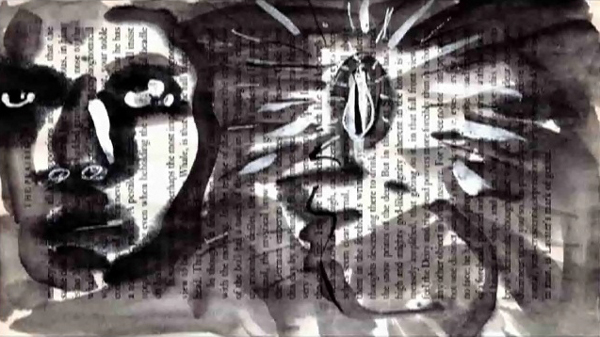
Alex Itin has posted a new “print” of his mind-blowing Moby-Dick animation, “Orson Whales,” on Vimeo, which now offers gorgeous high definition streaming. Click the image below.
youtube purges: fair use tested
Last week there was a wave of takedowns on YouTube of copyright-infringing material -? mostly clips from television and movies. MediaCommons, the nascent media studies network we help to run, felt this rather acutely. In Media Res, an area of the site where media scholars post and comment on video clips, uses YouTube and other free hosting sites like Veoh and blip.tv to stream its video. The upside of this is that it’s convenient, free and fast. The downside is that it leaves In Media Res, which is quickly becoming a valuable archive of critically annotated media artifacts, vulnerable to the copyright purges that periodically sweep fan-driven media sites, YouTube especially.
In this latest episode, a full 27 posts on In Media Res suddenly found themselves with gaping holes where video clips once had been. The biggest single takedown we’ve yet experienced. Fortunately, since we regard these sorts of media quotations as fair use, we make it a policy to rip backups of every externally hosted clip so that we can remount them on our own server in the event of a takedown. And so, with a little work, nearly everything was restored -? there were a few clips that for various reasons we had failed to back up. We’re still trying to scrounge up other copies.
The MediaCommons fair use statement reads as follows:
MediaCommons is a strong advocate for the right of media scholars to quote from the materials they analyze, as protected by the principle of “fair use.” If such quotation is necessary to a scholar’s argument, if the quotation serves to support a scholar’s original analysis or pedagogical purpose, and if the quotation does not harm the market value of the original text — but rather, and on the contrary, enhances it — we must defend the scholar’s right to quote from the media texts under study.
The good news is that In Media Res carries on relatively unruffled, but these recent events serve as a sobering reminder of the fragility of the media ecology we are collectively building, of the importance of the all too infrequently invoked right of fair use in non-textual media contexts, and of the need for more robust, legally insulated media archives. They also supply us with a handy moral: keep backups of everything. Without a practical contingency plan, fair use is just a bunch of words.
Incidentally, some of these questions were raised in a good In Media Res post last August by Sharon Shahaf of the University of Texas, Austin: The Promises and Challenges of Fan-Based On-Line Archives for Global Television.
poem for no one
Just came across something lovely. Video for “Jed’s Other Poem (Beautiful Ground)” by the now disbanded Grandaddy from their great album The Sophtware Slump (2000). Jed is a character who weaves in and out of the album, a forlorn humanoid robot made of junk parts who eventually dies, leaving behind a few mournful poems.
Creator Stewart Smith: “I programmed this entirely in Applesoft BASIC on a vintage 1979 Apple ][+ with 48K of RAM — a computer so old it has no hard drive, mouse up/down arrow keys, and only types in capitals. First open-source music video, code available on website. Cinematography by Jeff Bernier.” A nice detail of the story is that this was originally a fan vid but was eventually adopted as the “official” video for the song.
Thanks to Alex Itin for the link!
no longer separated by a common language
LibraryThing now interfaces with the British Library and loads of other UK sources:
The BL is a catch in more than one way. It’s huge, of course. But, unlike some other sources, BL data isn’t normally available to the public. To get it, our friends at Talis, the UK-based library software company, have granted us special access to their Talis Base product, an elephantine mass of book data. In the case of the BL, that’s some twelve million unique records, two copies Gutenberg Bibles and two copies of the Magna Carta.
reading between the lines?
The NEA claims it wishes to “initiate a serious discussion” over the findings of its latest report, but the public statements from representatives of the Endowment have had a terse or caustic tone, such as in Sunil Iyengar’s reply to Nancy Kaplan. Another example is Mark Bauerlein’s letter to the editor in response to my December 7, 2007 Chronicle Review piece, “How Reading is Being Reimagined,” a letter in which Bauerlein seems unable or unwilling to elevate the discourse beyond branding me a “votary” of screen reading and suggesting that I “do some homework before passing opinions on matters out of [my] depth.”
One suspects that, stung by critical responses to the earlier Reading at Risk report (2004), the decision this time around was that the best defense is a good offense. Bauerlein chastises me for not matching data with data, that is for failing to provide any quantitative documentation in support of various observations about screen reading and new media (not able to resist the opportunity for insult, he also suggests such indolence is only to be expected of a digital partisan). Yet data wrangling was not the focus of my piece, and I said as much in print: rather, I wanted to raise questions about the NEA’s report in the context of the history of reading, questions which have also been asked by Harvard scholar Leah Price in a recent essay in the New York Times Book Review.
If my work is lacking in statistical heavy mettle, the NEA’s description of reading proceeds as though the last three decades of scholarship by figures like Elizabeth Eisenstein, Harvey Graff, Anthony Grafton, Lisa Jardin, Bill Sherman, Adrian Johns, Roger Chartier, Peter Stallybrass, Patricia Crain, Lisa Gitelman, and many others simply does not exist. But this body of work has demolished the idea that reading is a stable or historically homogeneous activity, thereby ripping the support out from under the quaint notion that the codex book is the simple, self-consistent artifact it is presented as in the reports, while also documenting the numerous varieties of cultural anxiety that have attended the act of reading and questions over whether we’re reading not enough or too much.
It’s worth underscoring that the academic response to the NEA’s two reports has been largely skeptical. Why is this? After all, in the ivied circles I move in, everyone loves books, cherishes reading, and wants people to read more, in whatever venue or medium. I also know that’s true of the people at if:book (and thanks to Ben Vershbow, by the way, for giving me the opportunity to respond here). And yet we bristle at the data as presented by the NEA. Is it because, as academics, eggheads, and other varieties of bookwormish nerds and geeks we’re all hopelessly ensorcelled by the pleasures of problematizing and complicating rather than accepting hard evidence at face value? Herein lies the curious anti-intellectualism to which I think at least some of us are reacting, an anti-intellectualism that manifests superficially in the rancorous and dismissive tone that Bauerlein and Iyengar have brought to the very conversation they claim they sought to initiate, but anti-intellectualism which, at its root, is – ?just possibly – ?about a frustration that the professors won’t stop indulging their fancy theories and footnotes and ditzy digital rhetoric. (Too much book larnin’ going on up at the college? Is that what I’m reading between the lines?)
Or maybe I’m wrong about that last bit. I hope so. Because as I said in my Chronicle Review piece, there’s no doubt it’s time for a serious conversation about reading. Perhaps we can have a portion of it here on if:book.
Matthew Kirschenbaum
University of Maryland
Related: “the NEA’s misreading of reading”
the year of reading dangerously
2008 is going well so far for the Institute in London – I was invited to 10 Downing Street this morning for the launch of the National Year of Reading which takes place in 2008, as one of a small group including literacy promoters, librarians, teachers, schoolchildren, authors and Richard Madeley, the presenter who with his partner Judy has become the British equivalent of Oprah, hosting a hugely influential TV book group which helps the trade to sell stacks of the titles it recommends. Prime Minister Gordon Brown has had a rough few months since taking over from Blair, but was at his best today – he’s a genuine enthusiast for reading.
One topic for discussion was the importance of fathers reading to their children, and in particular to their sons. There are so many opportunities for new media here to help reach out to those who don’t think of themselves as ‘book people’.
Ten years ago the first Year of Reading kicked off a lot of activities and alliances which have thrived since, but I don’t remember anyone giving much attention to the internet – except as a place to download resources from. So I was delighted to be there this time representing the Institute, and able to make the point at the outset that any promotion of the importance of literacy skills, reading appetite and the pleasure of literature must recognise the cultural importance of the networked screen and the interconnectedness of different media in the minds of young people and the lives of us all, even those who don’t acknowledge this. Well, I kind of made that point…briefly and perhaps not so clearly. Anyway, I was there and got to speak up for if:book. The year has a different theme each month, ending with the Future of Reading in December, so we are planning all kinds of activities to link with that. Watch this space.