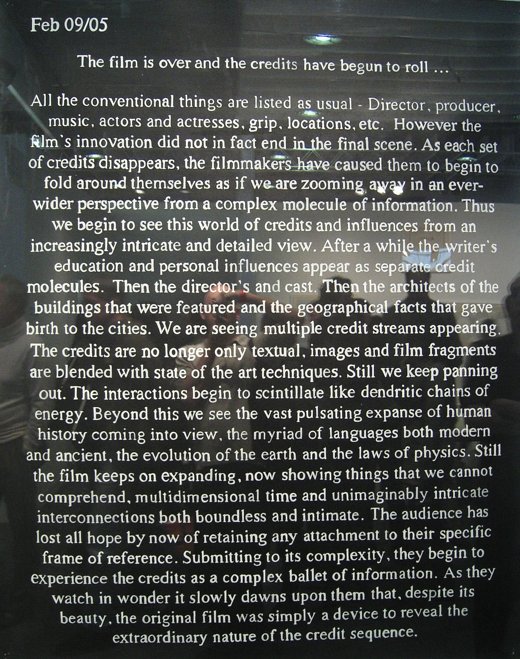
the film is over and the credits have begun to roll

went to the armory show over the weekend. most conceptually interesting piece i saw was a large “poster” which described the credits to a film as an entry point to an ever-expanding chain of related information . . . basically suggesting that all knowledge can be linked in a semantic web to all other knowledge . . . theoretically the internet will develop to the point that this will be actually true instead of just conceptiually true. (emabarrassed to admit that in my excitement i didn’t get the name of the artist; if anyone recognizes the work, please tell us.)

film credit.jpg

generation M and the mediated mind

generationM.jpg A major study of media consumption habits among American youth (ages 8-18) was released yesterday by the Kaiser Family Foundation. A “representative sample” of over 2,000 3rd through 12th graders were surveyed, including 700 who volunteered to maintain seven-day “media diaries,” charting media consumption in half hour chunks, noting location, company they had, and any simultaneous activities. Findings were announced at a high-profile release in Washington attended by Hillary Clinton and other luminaries.
The study finds that kids are often multitasking – absorbing several media simultaneously, often at consoles set up in their bedrooms. Average daily exposure is a full third of the day (8.33 hours), which, when combined with approximately a third of the day at school and a third of the day asleep (although most kids are probably not sleeping that much), amounts to nearly every waking, extra-curricular hour spent tuned in, logged on, glued to, etc…
The evidence of multitasking paints a picture of a generation skilled at combining passive and interactive media – the TV is on, but you’re also instant messaging with friends, and doing a bit of quick research on Google for that homework assignment. Constant skimming and constant scattering. Are these fractured minds in the making?

institute for the future of the book field trip to the recent past

last night Printed Matter “the world’s greatest source for artists’ publications” threw open the doors to their storage space. my colleague, dan visel, and i couldn’t resist the opportunity to rummage through the bins for hidden treasures dating from the late 70s. 2 thoughts: we’re still a long way from the time when browsing an electronic archive will be anywhere near as pleasing, at least on the sensual plane; paper art may have hit it’s height in that moment with the arrival of desktop publishing and cheap xeroxing; now a lot of the energy that people were putting into the creation of paper art is likely going into e-artifacts and e-zines.

the gates: an experiment in collective memory

So . . . .about two weeks ago I had a dream, (actually more of a nightmare) in which I was asked to judge a contest to choose “the best photograph of the Gates” from among three million orange photos. Over the next few days, however, the more I thought about it,I became intrigued by the idea of seeing people’s different creative solutions to photographing the gates.gates close up.jpg
[Note: I loved the Gates. Ashton (partner-in-crime) and I were in the park almost every day we were in the city, we even gave a party for 150 friends who came from all over the world to walk through the park at dawn (see nifty video by alex itin, orange you glad).
On the last day Ashton and I walked through the park for seven straight hours with Rebeca Mendez and Adam Euwens — talking almost the whole time about the phenomenon of the Gates — as an art work that requires significant effort on the part of its audience; like all of Christo and Jeanne-Claude’s work, it requires you to be at a certain latitude and longitude at a specific moment in time; you need to see it from different vantage points at different times of the day; as Ashton said, “there are as many views of the Gates as footsteps in the park.”
And of course you talk endlessly to the people you meet along the way.
Early that last day, high up on the Harlem Meer, we came upon a big man with red orange hair who was quickly slipping a big coat over his obviously naked body. His friend had just as obviously been taking pictures. Ashton and Rebeca immediately realized that they were taking pictures of his orange pubic hair against the backdrop of the Gates. Impulsively I mentioned that I was planning to sponsor a contest for the best amateur photograph of the Gates. Surprisingly they wrote down a URL for the competition I made up on the spot. A few other times during the day I mentioned this to people who seemed to be taking interesting photos. Without any prompting, they also wrote down the URL.
So the next day, Monday, while sitting around the table with Kim, Dan, and Ben, my colleagues at the Institute for the Future of the Book, I mentioned the whole Gates photo idea and to my delight everyone thought it would fit in perfectly with our experiments in the area of open-ended networked “books.”
Voila — the beginning of the Gates Memory Project which we are launching today at gatesmemory.org. It’s quite a bit more ambitious than the original (and impossible) idea of choosing “the best photo.” Now we are aiming to to harness the creativity and insight of thousands to build a kind of collective memory machine — one that is designed not just for the moment, but as a gates in distance.jpglasting and definitive document of the Gates and our experience of them. As Ben Vershbow says in the press release announcing the project, “The photographs are a jumping off point for further exploration. Ultimately, we are interested in collecting anything that can be shared over the web – film, audio, text – parodies and remixes.”
While the photos and stories are being collected, the institute will encourage discussion and debate on how best to present the archives in hopes of finding new, unexpected ways to view and bring meaning to the content. The institute also welcomes the possibility of collaboration with designers, developers and web curators. This project is the beginning of a long-term exploration for us. Through this work, we are asking: how do we use social software to create works that are in the spirit of the web – i.e. free-form, ad hoc, always evolving, and driven by people’s enthusiasm to share – but are also edited and shaped into something of lasting value? It is that tension – between frozen and fluid works – that we aim to explore. We are excited to see the ideas people will bring to the table.
See the complete call for the project HERE.

hyperlinks in print

wallaceatlantic6thumbnail.gifThere’s increasingly a give-and-take between print and screen text design. A prime example of this: David Foster Wallace’s cover story about talk radio in the April issue of The Atlantic Monthly. It’s unfortunate this article is only online for subscribers. However, clicking on the thumbnail at right will give you an idea of how the pages work, and there are a couple of working hyperlinks in The Atlantic‘s HTML preview of the article.

Wallace is well-known for his copious use of footnotes & endnotes, and this article is no exception. However, either Wallace or The Atlantic‘s art director have decided to treat his digressions differently in this case: words or phrases in the main text that signal a jumping-off point have lightly colored boxes drawn around them, rather than a superscripted numeral after them. In the print edition, boxes in the margins – one immediately thinks of windows – with notes in them appear, color-coded to match the set-off phrases. Some of the notes have notes; they get more boxes of their own.

It’s subtle and well thought out, and considerably more inviting to read over 23 pages than footnotes or endnotes would be. Most interesting is how the aesthetic draws inspiration from the web: the boxed notes suggest pop-up windows (or the electronic – not so much the paper – version of Post-It notes), especially when they’re layered. And the boxed phrases suggest nothing so much as the underlining that the Web has taught us signifies a hyperlink. The HTML version on their website follows this exactly, presenting the notes as pop-up windows (some of which pop up their own windows).

There’s also a PDF version available to subscribers. Unlike the Kembrew McLeod PDF I posted about a few weeks back, some thought has clearly gone into making this article screen-friendly. What you get is just the article: there aren’t any crop marks or ads or any of the detritus which crowd an article when it appears in a magazine. Nor, interestingly, are there page numbers, which aren’t quite as necessary in a PDF environment: Adobe Reader tells you what page you’re on. To complain: it does, however, still replicate the print environment in ways which make on-screen reading suffer. Like the magazine and unlike computer screens, the page is vertically oriented, rather than horizontally. The Bodoni type – which looks fantastic on the glossy paper that The Atlantic uses – loses its narrow horizontal strokes on screen except when zoomed in to a very high resolution. To be fair to The Atlantic, these concessions to the print design are understandable: the typeface does form a good part of the magazine’s image, and it would be a fair amount of work to rework such a carefully designed article to appear in a horizontal, rather than a vertical, format.

describing humanity in data sets

Yahoo’s recently released commemorative microsite, “Yahoo Netrospective: 10 years, 100 moments,” is a selection of one hundred significant moments in the history of the web (1995-2005). The format for the site was inspired by the work of information architect Jonathan Harris. Harris created 10 x 10, a piece visually identical to, but considerably more interesting than the Yahoo birthday card, (whose content leans quite heavily toward self-promotion, i.e. there are 20 mentions of Yahoo products and no mention at all of Google.) By contrast, Harris’ 10 x 10 builds its fascinating content from RSS feeds. The piece selects the most frequently used words from the major news networks to assemble an hourly “portrait” of our world. “What interests me is trying to find descriptions of humanity in very large data sets, creating programs that tell us something about ourselves,” Harris told Wired News. “We set them free and they come back and tell us what we are like.”
What makes Harris’ work interesting is the self-discipline he exercises in designing these objective systems. By withholding the urge to edit (except, perhaps, when Yahoo is involved) he allows an authentic “picture” of current events, of human behavior online, of the fluid exchange of words and images. His linguistic self-portrait WordCount, harvests data from the British National Corpus. WordCount displays the 86,800 most commonly used words in the English language in order of their commonness. Harris alleges that “observing closely ranked words tells us a great deal about our culture. For instance, “God” is one word from “began”, two words from “start”, and six words from “war”. I tried WordCount and was instantly addicted. To read WordCount or 10 x 10, you have to interact with it and bring meaning to it. Or put another way, you have to be willing to bring meaning to it. This is quite different from the way we experience traditional narratives, whose structure and meaning are crafted by the writer and handed down to the reader. I am eagerly anticipating his next project which, he told Wired, “involves looking at human feelings on a large scale from the web.”

another great brief in the fight for p2p

There’s a growing body of legal literature defending peer-to-peer file sharing in the lead-up to the Supreme Court showdown, MGM vs. Grokster. Here’s one of the latest additions, an amicus brief filed today by the Free Software Foundation and New Yorkers For Fair Use. The following excerpt nicely skewers the petioners (thanks again, Boing Boing):
“At the heart of Petitioners’ argument is an arrogant and unreasonable claim–even if made to the legislature empowered to determine such a general issue of social policy–that the Internet must be designed for the convenience of their business model, and to the extent that its design reflects other concerns, the Internet should be illegal.
Petitioners’ view of what constitutes the foundation of copyright law in the digital age is as notable for its carefully-assumed air of technical naivete as for the audacity with which it identifies their financial interest with the purpose of the entire legal regime.
Despite petitioners’ apocalyptic rhetoric, this case follows a familiar pattern in the history of copyright: incumbent rights-holders have often objected to new technologies of distribution that force innovation on the understandably reluctant monopolist.”

(see MGM vs. Grokster: Brief Update)

mgm vs. grokster: brief update

With MGM vs. Grokster fast approaching (initial hearings have been set for March 29), several amicus briefs have recently been filed with the Supreme Court in impassioned and eloquent defense of peer-to-peer file sharing. Notable among them are a brief filed Tuesday by a group of 17 computer scientists, and another filed today by 22 media studies scholars. Each accuses both the court and the petitioners (MGM) of “fundamental misunderstanding.” Of technology, in the view of the scientists. And in the view of the scholars, of “fair use” and the importance of p2p in the academy and in the construction of collective memory. To drive home this last point, the scholars direct our attention to the landmark 1984 Sony vs. Universal case in which the legality of VCRs (VTRs at the time) was challenged and ultimately upheld. There’s no doubt that MGM vs. Grokster is the Sony vs. Universal for this generation.
From the media scholars:
“…the unambiguous declaration by the Ninth Circuit Court of Appeals inGrokster — that the standards this Court set forth in Sony are alive and appropriate for this digital age — does grant educators comfort and confidence. Nor do certain “compromise” positions outlined in briefs submitted in support of neither party in this case protect the interests of educators and researchers. Ultimately, we wish to encourage the Court to consider that Sony did more than legalize home taping and “time shifting.” It democratized participation in the project of recording the collective memory of this dynamic nation. Sony went beyond the traditional parameters of fair use and showed the potential for an emerging set of clearly articulated “users’ rights.” Teachers, scholars, critics, journalists, fans, and hobbyists would all benefit greatly under a regime that offered them clarity and confidence about how they interact with works and the copyright system that governs them.”

How Do Books Work? A Conversation with Mom

My mother, a veteran kindergarten teacher, who, over the last 30 years, has taught scores of children to read, recently engaged me in an interesting conversation regarding the ebook vs. the paper book. She was responding to something I posted a few months ago called: Children and Books: Forming a World-view. She was particularly interested in this passage:
images.jpgMy son is 14 months old and he loves books. That is because his grandmother sat down with him when he was six months old and patiently read to him. She is a kindergarten teacher, so she is skilled at reading to children. She can do funny voices and such. My son doesn’t know how to read, he barely has a notion of what story is, but his grandmother taught him that when you open a book and turn its pages, something magical happens–characters, voices, colors–I think this has given him a vague sense of how meaning is constructed. My son understands books as objects printed with symbols that can be translated and brought to life by a skilled reader. He likes to sit and turn the pages of his books and study the images. He has a relationship with books, but he wouldn’t have that if someone hadn’t taught him. My point is, even after you learn to read, the book is still part of a complex system of relationships. It is almost a matter of chance, in some ways, which books are introduced to you and opened to you by someone.
Hi Kim,
I was really touched by the comments about Aidan and me. I truly believe that a child’s first experiences with books (even before he/she can read) are vital to his/her enjoyment of them in later life. I would like to add to your observations about books being intertwined with experiences and how I see very young children learning to love literature.
Much research has been done on how and why children want to learn to read. We know that the single most important thing that parents can do to make an avid reader of their child, is to read to them. We also know that, for most children, it takes approximately 700 to 1000 hours of lap/read time to have them ready to read. That sounds like a great deal of time, but if you put your child in your lap from the time they are 6 months old until they are 5, that is about 3 minutes a day. If you are holding your child close to you and together you read a colorful, well-written and illustrated children’s book, 3 minutes will disappear very quickly. I cannot imagine any 6 month old interested in a book written in a machine. YES, they would be interested in the machine, but the book (the story and the beautiful illustrations) would be lost to the small child. Because–the biggest part of the reading experience for a small child is being able to participate by holding the book themselves, turning the pages, pointing at the pictures, going back to the pages that they most enjoyed, in other words interacting with a handheld book. A machine will not offer this opportunity.
When children come to my preschool/kindergarten classroom the ones who have had many experiences with books have a wealth of background and knowledge that others do not have. Even if they do not read, when they are given the initial literacy exam they have learned by experience how to hold a book, which is the front versus the back, where do you start reading, what’s wrong with this picture? Etc., etc., etc.
Perhaps, I am jumping too far ahead in assuming that all, even children’s books will ultimately be on machines. If this is to be the case, it will DRASTICALLY change the way children are taught to read and how early experiences prepare them for this task.
Thanks mom, this is great. It brought up a few questions, I wonder if you can address them. I agree that the nurturing aspect of reading to a child is most important, but if the child is sitting in my lap while we look at a book on the computer screen, how will the experience be different? Also, I’m trying to understand why paper books are better than screen-based books, if the book progresses by clicking a mouse or touching the screen, why would those actions be less developmentally useful than page turning? Also, why wouldn’t a 6 month old be interested in a screen-based book? Aidan was mesmerized by the baby einstein videos, those are screen-based. When I play dvds on my laptop machine he screams because he wants to touch the keys and I have to restrain him. He loves pushing buttons, clicking my mouse and touching the screen. It seems like these are skills that he will have to learn in this computer-driven world, why not link computers with reading/nurturing/sitting in mom’s lap, etc., from an early age?
Hi Kim,
These are excellent questions and I do not know how to answer them, as no research has been done in that area. (Great place for Ph.D. research, or for another year of grant money.) You are right, a small child is mesmerized by things they see on the TV and on the computer screen. If you, the parent, is holding the child, perhaps the child would get the same nurturing experiences with the book machine as with a hand held book. I have only had experiences and read research about the hand held book, this is a whole new arena. I do agree that young children of this generation will have to have extensive technological knowledge and why not start it early. My kindergartners went to the computer lab once a week for 45 minutes and most of them were totally computer savvy and those that were not caught on quickly, as they are not afraid to experiment. As to the point that pushing a button is as developmentally appropriate as the skill of turning a page, they are very different skills, but if books are to be in ibooks, turning a page will not be a skill that young children need. Basically this is all uncharted territory and these questions are exactly what “the future of the book” should be asking. Bravo!