
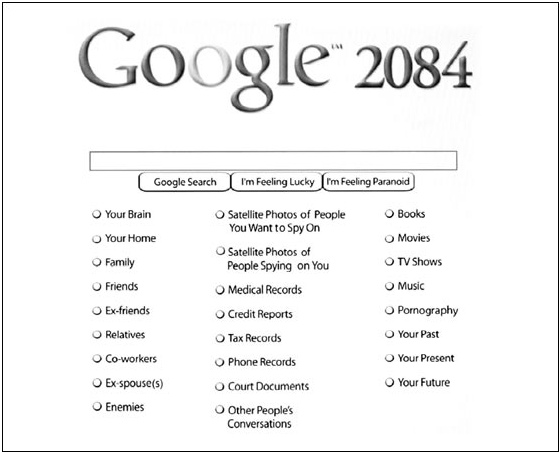
Google as big brother: “Op-Art” by Randy Siegel from today’s NY Times.
welcome to the 19th century
The following was posted by Gary Frost as a comment to our post on Neil Postman’s “Building a Bridge to the 18th Century.” Gary recently returned from the Mississippi coast where he was part of a team helping to assess library and museum damage after Katrina.
The mystic advise that we walk into the darkness. Postman’s only qualification is that we do futurism with the right gear. But we cannot wander off into the future with enough AA batteries. An archeologist at the storm damaged Jefferson Davis presidential library greeted me saying; “Welcome to the19th century.” He was not kidding. No water, no electricity, no gas, no groceries. He was digging up the same artifacts for the second time in the immense debris fields left by Katrina.
We were driven to a manuscript era and we were invigorated to do our best. Strangely the cell phones worked and we talked to Washington from the 19th century. We asked if the Nation was still interested in the culture of the deep south. Not really, Transformers were at work and in our mobile society the evacuees had left for good. The army trucks were building new roads over the unmarked gravesites of 3000 Confederate veterans, who in their old age, came to Jeff Davis’ home to die.
We were left hanging about the future and technologies were a sidebar. It wasn’t really important that the 19th century had invented instantaneous communication, digital encoding or photographic representation or that the 21st century was taking the credit for its exploitation of these accomplishments. The gist was that the future deserved to be informed and not deluded. The gist was that the future would be fulfilled as a measure of its use of the accomplishments of a much longer past.
ubu, king again
It’s nice to see that UbuWeb, the great public web library of the avant garde, is back online after “a long summer of rebuilding.” At times when the web feels depressingly shallow, Ubu can be the perfect medecine. Among the many masterworks you will find is Samuel Beckett’s “Film” (1965), starring a very old Buster Keaton. It’s wonderful that anyone can watch this online (I’ve just spent half an hour in its thrall).
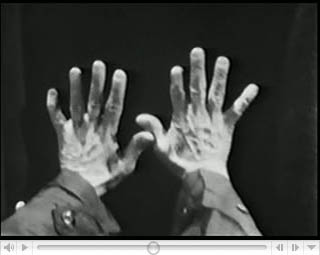
Also worth checking out are /ubu Editions – handsomely designed electronic texts ranging across an interesting selection of poetry, prose and theatre, including Ron Silliman’s “The Chinese Notebook,” which Dan blogged about a couple weeks back. These, like everything else on Ubu, are free.
premature burial, or, the electronic word in time and space
We were talking yesterday (and Bob earlier) about how to better organize content on if:book – how to highlight active discussion threads, or draw attention to our various categories. Something more dynamic than a list of links on the sidebar, or a bunch of hot threads advertised at the top. A significant problem with blogs is the tyranny of the vertical column, where new entries call out for attention on a stack of rapidly forgotten material, much of which might still be worth reading even though it was posted back in the dark ages (i.e. three days ago). Some of the posts that get buried still have active discussions stemming from them. Just today, “ways of seeing, ways of writing” – posted nearly two weeks ago – received another comment. The conversation is still going. (See also Dan’s “blog reading: what’s left behind”.)
This points to another thorny problem, still unsolved nearly 15 years into the world wide web, and several years into the blogging craze: how to visualize asynchronous conversations – that is, conversations in which time lapses between remarks. If the conversation is between only two people, a simple chronological column works fine – it’s a basic back-and-forth. But consider the place where some of the most dynamic multi-person asynchronous conversations are going on: in the comment streams of blog entries. Here you have multiple forking paths, hopping back and forth between earlier and later remarks, people sticking close to the thread, people dropping in and out. But again, you have the tyranny of the vertical column.
We’re using an open source platform called Drupal for our NextText project, which has a blog as its central element but can be expanded with modular units to do much more than we’re able to do here. The way Drupal handles comments is nice. You have the usual column arranged chronologically, with comments streaming downward, but readers have the option of replying to specific comments, not just to the parent post. Replies to specific comments are indented slightly, creating a sort of sub-stream, and the the fork can keep on going indefinitely, indenting rightward.
This handles forks and leaps fairly well, but offers at best only a partial solution. We’re still working with a print paradigm: the outline. Headers, sub-headers, bullet points. These distinguish areas in a linear stream, but they don’t handle the non-linear character of complex conversations. There is always the linear element of time, but this is extremely limiting as an organizing principle. Interesting conversations make loops. They tangle. They soar. They sag. They connect to other conversations.
But the web has so far been dominated by time as an organizing principle, new at the top and old at the bottom (or vice versa), and this is one the most-repeated complaints people have about it. The web favors the new, the hot, the immediate. But we’re dealing with a medium than can also handle space, or at least the perception of space. We need not be bound to lists and outlines, we need not plod along in chronological order. We could be looking at conversations as terrains, as topographies.
The electronic word finds itself in an increasingly social context. We need to design a better way to capture this – something that gives the sense of the whole (the big picture), but allows one to dive directly into the details. This would be a great challenge to drop into a design class. Warren Sack developed a “conversation map” for news groups in the late 90s. From what I can tell, it’s a little overwhelming. I’m talking about something that draws people right in and gets them talking. Let’s look around.
the big picture
Though a substantial portion of our reading now takes place online, we still chafe against the electronic page, in part because today’s screens are hostile to the eye, but also, I think, because we are waiting for something new – something beyond a shallow mimicry of print. Occasionally, however, you come across something that suggests a new possibility for what a page, or series of pages, can be when words move to the screen.
I came across such a thing today on CNET’s new site, which has a feature called “The Big Picture,” a dynamic graphical display that places articles at the center of a constellation, drawing connections to related pieces, themes, and company profiles.

Click on another document in the cluster and the items re-arrange around a new center, and so on – ontologies are traced. But CNET’s feature does not go terribly far in illuminating the connections, or rather the different kinds of connections, between articles and ideas. They should consider degrees of relevance, proximity in time, or overlaps in classification. Combined with a tagging system, this could get interesting. As it stands, it doesn’t do much that a simple bullet list of related articles can’t already do admirably, albeit with fewer bells and whistles.
But this is pushing in an interesting direction, testing ways in which a web publication can organize and weave together content, shedding certain holdovers from print that are no longer useful in digital space. CNET should keep playing with this idea of an article ontology viewer – it could be refined into a legitimately useful tool.
hacking nature
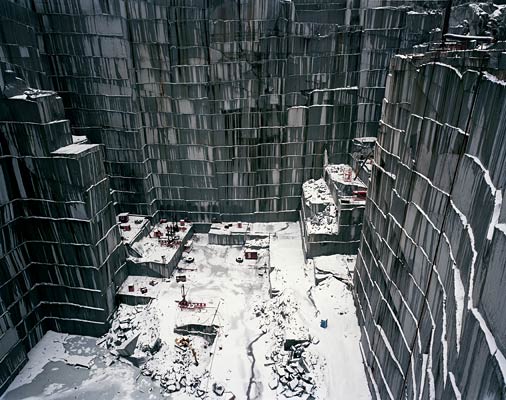
Slate is trying something new with its art criticism: a new “gallery” feature where each month an important artist will be discussed alongside a rich media presentation of their work.
…we’re hoping to emphasize exciting new video and digital art–the kind of art that is hard to reproduce in print magazines.
For their first subject, they don’t push the print envelope terribly far (just a simple slideshow), but they do draw attention to some stunning work by Canadian photographer Edward Burtynsky, who (happily for us New Yorkers) has shows coming this week to the Brooklyn Museum and the Charles Cowles Gallery in Manhattan. Burtynsky documents landscapes bearing the mark of extreme human exploitation – the infernal streams flowing from nickel mines, junked ocean liners rusting in chunks on the beach, abandoned quarries ripe with algae in their cubic trenches, and an arresting series from recent travels through China’s industrial belt.
These photographs carry startling information through the image-surplussed web. But Burtynsky disappoints in one vital, perhaps deciding, respect:
…his position on the moral and political implications of his work is studiously neutral. He doesn’t point fingers or call for change; instead, he accepts industry’s exploitation of the land as the inevitable result of modern progress. “We have extracted from the land from the moment we stood on two feet,” he said in an interview in the exhibition catalog. “The entire 20th century has been a revving up of this large consumptive engine. It’s not a question of whether we are going to stop consuming. It’s not going to happen…”
As someone who believes that struggling to prevent (or at least mitigate) global ecological disaster should be the transcending narrative of our times, I find Burtynsky’s detachment deeply depressing and self-defeating. His images glory in the sick beauty of these ravaged scenes, and the cultural consumers that will no doubt pay large sums for these photographs at his upcoming Chelsea show only compound the cynicism.
blogs — trying to fit round pegs into square holes
i’ve been without an internet connection for a few days. was catching up on if:book posts and finding myself delighted by the wonderful range of interesting posts my colleagues had managed in just a few days. which made me want to send a note to lots of friends and acquaintances urging them to check out our blog. but then my more nervous, modest side took over and convinced me that urging people to sample a blog as wide-ranging as if:book is a dicey proposition since sampling one day’s posts doesn’t necessarily indicate the extent of our interests. the structure of blogs favors the chronology of entry; thematic categories are listed on the side but without much fanfare. wonder if we could re-arrange the “front page” to be more magazine like, where for example “recent posts” would be one feature among many.
media consumption #2
While browsing bookstores in london yesterday — still one of my most favorite pastimes — i came across a beautiful box of 70 thin-spined pocketbooks, the colors of the spine intentionally creating a stunning run of the spectrum from blue to orange. turns out it is a series of 70 essays and short fiction celebrating Penguin’s 70th anniversary and its claim to have initiated the ‘paperback revolution.’ [note: legendary editor jason epstein claims to have done this for Doubleday. does anyone have any insight into whether either claimant really has bragging rights?].
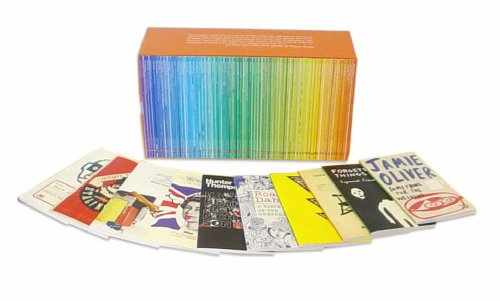
Although i wanted to spring for the whole box, the $125 price tag was too daunting so i bought 3 of the slim volumes — “The Desert and the Dancing Girls,”, a travelogue by Gustave Flaubert describing his journey to Egypt; On Seeing and Noticing,” a collection of philosopher Alain de Botton’s short essays, and “The Mirror of Ink,” seven of Jorge Luis Borge’s wonderful short stories. the cover of each volume is exquisitely and thoughtfully designed, each by a different artist.
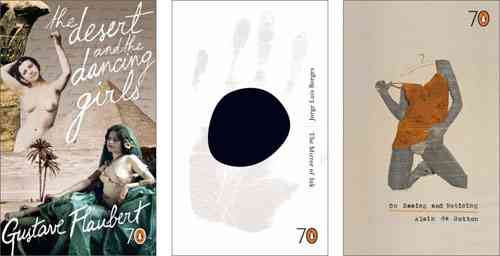
Each title is so beautiful in its own right, Penguin has succeeded in putting together a series which underlines the appeal of books as objects. the success of the series stems less from the elegance of the graphic design than from the decision to “go small.” none of the books in the series exceeds 60 pages; given the size of the page and the font, they are probably equivalent to a long piece in the New Yorker or the chapter of a book. had Penguin decided to celebrate their birthday with 70 beautifully designed books i would have wanted to own the objects but wouldn’t necessarily expect to read any of them. however, the curatorial intelligence behind this series seems to have come up with a concept which is “just right.” there is something about the discrete boundaries of these short volumes which makes me think i could read them and that i want to read them, not just own them. the closest analogy is to a box of deliciously appetizing chocolates where i browse the contents over and over, making decsions about which to eat first and which to save for later.
Sad to say i can’t even imagine writing the above to describe offerings in the digital domain. we may get there, but the terms will be different.
(media consumption #1)
yahoo! announces book-scanning project to rival google’s
Yahoo, in collaboration with The Internet Archive, Adobe, O’Reilly Media, Hewlett Packard Labs, the University of California, the University of Toronto, The National Archives of England, and others, will be participating in The Open Content Alliance, a book and media archiving project that will greatly enlarge the body of knowledge available online. At first glance, it appears the program will focus primarily on public domain works, and in the case of copyrighted books, will seek to leverage the Creative Commons.
Google Print, on the other hand, is more self-consciously a marketing program for publishers and authors (although large portions of the public domain will be represented as well). Google aims to make money off its indexing of books through keyword advertising and click-throughs to book vendors. Yahoo throwing its weight behind the “open content” movement seems on the surface to be more of a philanthropic move, but clearly expresses a concern over being outmaneuvered in the search wars. But having this stuff available online is clearly a win for the world at large.
The Alliance was conceived in large part by Brewster Kahle of the Internet Archive. He announced the project on Yahoo’s blog:
To kick this off, Internet Archive will host the material and sometimes helps with digitization, Yahoo will index the content and is also funding the digitization of an initial corpus of American literature collection that the University of California system is selecting, Adobe and HP are helping with the processing software, University of Toronto and O’Reilly are adding books, Prelinger Archives and the National Archives of the UK are adding movies, etc. We hope to add more institutions and fine tune the principles of working together.
Initial digitized material will be available by the end of the year.
More in:
NY Times
Chronicle of Higher Ed.
creative versioning project
“I don’t have a single early draft of any novel or story. I just ‘saved’ over the originals until I reached the final version. All there is is the books themselves.” – Zadie Smith
This is a call (re-published from the Electronic Literature Organization) for writers to participate in a creative versioning project, hopefully to begin this winter:
Matthew Kirschenbaum is looking for poets and fiction writers willing to participate in a project to archive versions of texts in progress. An electronic document repository (known as a Concurrent Versions System, or CVS) will be used to track revisions and changes to original fiction and poetry contributed by participating writers who will work by checking their drafts in and out of the repository system. The goal is to provide access to a work at each and every state of its composition and conceptual evolution — thereby capturing the text as a living, dynamic object-in-the-making rather than a finished end-product. A reader will be able to watch the composition process unfold as though s/he were looking over the writer’s shoulder.
For guidelines and contact info, visit ELO.