Author Archives: ben vershbow

more than half of journalists use blogs, study shows

The Eleventh Annual Euro RSCG Magnet and Columbia University Survey of Media found that 51% of journalists use blogs, many of them for work, though few are actually writing their own. The study also found that, although more than half admit to using blogs, only 1% find them to be credible. Hmmm… From Business Wire:

The study found that blogs have become a large — and arguably, increasingly integral — part of how journalists do their jobs. Indeed, 70% of journalists who use blogs do so for work-related tasks. Most often, those work-related tasks involve finding story ideas, with 53% of journalist respondents reporting using blogs for such purposes. But respondents also turn to blogs for other uses, including researching and referencing facts (43%) and finding sources (36%). Most notable, fully 33% of journalists say they use blogs as a way of uncovering breaking news or scandals. Few blog-using journalists are engaging with this new medium by posting to blogs or publishing their own; such activities might be seen as compromising objectivity and thus credibility.

on second thought… (wikis are hard)

The LA Times has temporarily shelved its plans for running “wikatorials” – editorials that any reader can edit – due to a flood of “inappropriate material.” The whole experiement with wikis was a risky move for a well-established newspaper to take, and it’s not surprising that they immediately panicked once the riff raff showed up. It’s hard to establish an open, collaborative environment from the top-down. Whereas, if you start from a point of low stakes, with little prestige on the line (as Wikipedia did), then the enterprise can evolve slowly, embarrassing missteps, spam and all.
Someone should start an experiment: dump the LA Times content in a non-affiliated wiki and try the wikatorials there. Give it time, let the community build, work out the hiccups, and then give the LA Times a call.

Gataga – social bookmark search and exploration engine

gataga_big.gif We came across this the other day – an engine for searching the social bookmarking commons. Gataga allows you to search by tag across several popular web-clipping services including del.icio.us, furl, and others. Gataga’s simple interface looks a lot like Google’s, but the similarity ends there. The only ranking system is time – the most recent links come up at the top. So Gataga is a nice tool for the moment’s glimpse of the links people are saving, but that’s about all.
Bit by bit, the web is being catalogued by its users. But at the moment, Gataga (and the rest of these bookmarking tools) works more like a wire service than a library. Tags are sort of like a reporter’s “beat” and Gataga provides RSS feeds for all possible queries, so you can track areas of interest. But if you want to use it as an archive, you’ll have some pretty serious digging to do.
In the early days of the web, sites sprung up like Voice of the Shuttle (VOS) that thoughtfully catalogued interesting links. The fact that there was a single editor ensured that things stayed fairly organized, that broken links were repaired, and dead ones pruned. But as the web grew, the model quickly became unmanageable. Alan Liu, who single-handedly managed VOS from 1994-1999, said it came to the point where he was spending 2-3 hours per night simply combing for dead links. VOS allowed the community to suggest sites, but the burden of organizing, annotating, and “weeding” fell solely on Liu. The rise of blogs made it easier and less stressful to gather links, but ensured that it was a casual affair – a kind of day-to-day grazing. Of course, all blogs have archives, but they are not terribly useful (Dan talks about this here).
With social bookmarking, we seem to be laying the foundation for something more sustainable – “the only group that can organize everything is everybody.” The next step is for librarians, archivists, and new kinds of editors and curators to start making sense of this wilderness of tags.

the cramped root: worshipping the artifact

A plant in a container grows differently than a plant in open soil. The roots conform to the shape of the pot. Similarly, our very notions of reading, of books, of knowledge classification are defined by the pot in which they grew. The texture of paper, the topography of the library, the entire university system – these were defined by restraints. Physical, economic, etc. And to a significant extent they are artifacts of their times. An example: the act of reading in bed, as Dan mentions, is frequently invoked as the ideal, as the supreme pleasure of reading, something that computers could never match. But this supine, passive reading stance is not pre-ordained. It is in many ways an artifact of the growth of the novel – a grand, fictional creation to be read in leisure settings. Lying down works well. It’s pleasurable. You get lost in rich, immersive worlds. But there are immersive worlds that require a different posture. And there are kinds of reading that are more active.
The computer, too, in its current stage of development, is an artifact of the paper book, the typewriter, and the supercomputer terminal. These define the “pot” in which the computer has grown. And so far, the questions about online “reading” are defined by this cramped root structure. Even though the pot has shattered, we continue to grow as though the walls were there.
Another analogy: the horseless carriage. For years after its invention, the automobile was known as “the horseless carriage.” People could define it only in terms of what had come before. You could say that online reading is the territory of “the horseless book.”

transliteracies begins.. reading is complex

Over the next couple of days, we’ll be posting live from the Transliteracies conference..
The conference kicked off with a rich historical lecture by Adrian Johns, a professor at the University of Chicago and author of The Nature of the Book. Johns examined three revolutionary moments in the development of scientific knowledge – Galileo, Newton, and James Clark Maxwell – and their relationship to the evolving print medium and the social practices of interpretation and transmission that were then developing. Beginning with the iconoclastic moment of Galileo’s theological collision with the Catholic church, moving through Newton and the incipient system of journal production – “philosophical transaction” – in authoritative matrices like the Royal Society, up to Maxwell at Cambridge University, his breakthroughs on electricity and magnetism, and the development of written examinations. The overriding lesson: reading is complex. We should not overestimate the power of the book purely as the “container of meaning.” The surrounding social reading practices, the charismatic human deliverers of certain texts, are no less important. Each book has a sort of periodical system that follows from it – its ideas move through local systems of perusal, reinterpretation and dissemination. It gets continually “re-published” through this human ecology.
Then there is the scientific revolution going on today: information technology and medical information. Medical error – diagnostic and prescriptive – kills thousands each year, largely due to interruptions in information flow. Info tech could create seamless systems that greatly reduce error. But Johns points out that a good half of the systems implemented so far fail to solve the problems. In fact, all of them create new kinds of errors – confusions between the different groups in the massive medical tangle. So here we have a kind of online reading that has been tested in a highly consequential setting. Johns suggests that medical reading is more like literary reading than we think. For instance, physicians and pharmacists read differently. They have differences in training, worldview, sense of self. Seemingly cosmetic features of the text – fonts, color, layout – are of great consequence.

transliteracies: research in the technological, social, & cultural practices of online reading

Bob’s post last week about changing patterns of media consumption kicked off an interesting discussion, one that leads up perfectly to the “Transliteracies” conference we are attending this weekend at UC Santa Barbara.
Alan Liu
, director of the Transliteracies project, posted this response, which very elegantly lays out some of the important questions. He’s allowed me to re-post it here..
BEGIN: The relationship between “browsing” and the “sheer volume” of information is complicated. To start with, I think there is much to be gained in complicating our usually uniform concepts of “browsing” (all shallow, fragmented, attention-deficient) and “volume” (“sheer,” as in a towering, monolithic cliff).
We get a sense of the hidden complexity I indicate if we think historically. Below is a passage from Roger Chartier — the leading scholar in the “history of the book” field — that should give us pause about making any quick associations between browsing and today’s information glut:

“Does this reaction toward the end of the [18th] century indicate a consciousness that reading styles had changed, that the elites in western Europe had passed from intensive and reverent reading to a more extensive, nonchalant reading style, and that such a change called for correction? . . . In the older style: (1) Readers had the choice of only a few books, which perpetuated texts of great longevity. (2) Reading was not separated from other cultural activities such as listening to books read aloud time and again in the bosom of the family, the memorization of such texts . . . , or the recitation of texts read aloud and learned by heart. (3) The relation of reader to book was marked by a weighty respect and charged with a strong sense of the sacred character of printed matter. (4) The intense reading and rereading of the same texts shaped minds that were habituated to a particular set of references and inhabited by the same quotations. It was not until the second half of the eighteen century in Germany and the beginning of the nineteenth century in New England that this style of reading yielded to another style, based on the proliferation of accessible books, on the individualization of the act of reading, on its separation from other cultural activities, and on the descralization of the book. Book reading habits became freer, enabling the reader to pass from one text to another and to have a less attentive attitude toward the printed word, which was less concentrated in a few privileged books.” — Roger Chartier, “Urban Reading Practices, 1660-1770,” in his The Cultural Uses of Print in Early Modern France, trans. Lydia G. Cochrane (Princeton: Princeton Univ. Press, 1987), pp. 222-24

It’s pretty certain that browsing in the face of sheer volume were deep habits of literacy (specifically, of high print literacy). By contrast, one might ask: who read so intensely and deeply — to instance the extreme — that they only really read one book? There were probably just three classes of such people: the very poor (I remembe r, but can’t find at present, an essay by Chartier about people in the past who owned just one book, which was found on their body after a coach accident in Paris), the extremely pious (who read the Bible), or the “genius” author. (Think of Blake, for example: no matter how many books he read, he really only had one or two books on his mental bookshelf: the Bible and Milton.) By contrast, everyone else browsed.
Mass literacy in the twentieth century, perhaps, may be a phenomenon of browsing. Think of Reader’s Digest. After my family immigrated to the U.S. in my childhood, we were a kind of microcosm of assimilation (into English literacy) in this regard. There were two major investments in books in my household: the Reader’s Digest series of condensed books (a kind of packaged browsing) and The World Book encyclopedia (a veritable lesson in reading as browsing-cum-volume). I drank deeply from both founts as a child, since these were the main books in the house. I was intense in my browsing.
So now let’s snap back to the present and the act of browsing cyber- or multi-media volumes of information. I’ve started a project (combining humanists, social scientists, and computer scientists) called Transliteracies to look into “online reading.” It’s my hypothesis that there are hidden complexities and intelligences in low-attention modes of browsing/surfing that we don’t yet know how to chart. Google, after all, is making a fortune for algorithms enacting this hypothesis. Or to cite a historical googler: Dr. Johnson, sage of the Age of Reason, was famous for “devouring” books just by browsing them instead of reading “cover to cover.” (To allude to the titles of the two serial magazines he was involved with, he would have called browsing Rambling or Idling [The Rambler, The Idler.)
Just as “browsing” is complex, so I think that there are hidden complexities in the notion of “sheer volume.” Some of the digital artists I know — e.g., George Legrady, Pockets Full of Memories — are “database artists” whose work asks the question, in essence: what happens to the notion of art when we gaze not at one work in rapt wonder but several thousand works — when, in other words, the “work” is “volume”? What if quantity, in other words, was a matter of quality? Aren’t there different kinds of “volume,” some more intelligent, beautiful, kinder, humane (not to mention efficient and flexible, the usual postindustrial desiderata) than others?
I’d better stop, since this comment is too long. As Blake said about volume: “Enough! or too much.”

reading over your shoulder

A particularly offensive section of the Patriot Act was slapped down yesterday in Congress. From Reuters:

The U.S. House of Representatives on Wednesday defied President Bush by approving a measure making it harder for federal agents to secretly gather information on people’s library reading habits and bookstore purchases.

pay for the service, not the copy

Macropus_brehm.png The other day, I came across an interesting experiment with a new model of distribution and ownership on the web, something that writers, publishers and journalists should pay attention to. KeepMedia charges $4.95 a month for unlimited access to 200 mainstream periodicals (see list) spanning the last 12 years up to the present day. That’s significantly less than what I pay annually for my handful of print periodical subscriptions, and gives me access to much more material (kind of like LexisNexis for the masses). Plus, you do get to “keep” – that’s part of how it works (indeed, their logo is a kangaroo with a stack of magazines stuffed in her pouch). KeepMedia allows you to attach notes to articles and to store away “clippings.” It also makes it easy to track subjects across publications, and has automated recommendations for related stories. I assume that stored articles will get caged off if you stop subscribing. That’s what makes me nervous about the pay-for-the-service model. You don’t actually get to keep anything for the long haul, unless you print it out. But KeepMedia suggests one way that newspapers and publishers might adapt to the digital age.
Right now, publishers are still stuck on the idea of individual “copies.” The web – an enormous, interconnected copying machine – is inherently hostile to this idea. So publishers generally insist on digital rights management (DRM) – coded controls that restrict what you can do with a piece of media. This, almost invariably, is infuriating, and ends up unfairly punishing people who have willingly paid a fair price for an item. Pay-for-the-service models won’t solve the problem entirely, but they do get away from the idea of “copies.” On the web, copies are cheap, or free. But access to a library or database is valuable. It’s not about how many copies are sold, it’s about how many people are reading. So charge at the gate. Once people are inside, it’s all you can eat. This is nothing new. People play a flat rate for cable television, which is essentially a list of publications. You pay extra for premium channels, or pay-per-view special features, but your basic access is assured. What and how much you watch is up to you. Yahoo! is trying this right now for music. Why not do the same for newspapers, or for books? The web is combining publishing with broadcasting. Publishers and broadcasters need to adapt.
Related posts:
“web news as gated community”
“self-destructing books”

reading manga on Sony Librie

18916824_d08adac331.jpg
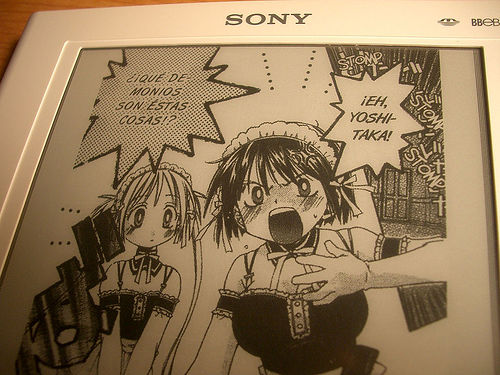
Came across this Flickr photoset of Japanese comics on a Librie – Sony’s electric ink ebook reader. Even in a photo, the reflective, print-like quality of the screen is striking. People have generally raved about the Librie’s display, but are outraged by its senseless DRM policies: books self-destruct after 60 days. (discussed here and here)
Once E ink enters the mainstream, people might flock to electronic books as rapidly and enthusiastically as they did to digital photography. Screen display technology will undoubtedly advance. The DRM problem is trickier.
(Incidentally, I found this image while browsing recent blog posts under the “ebook” tag on Technorati. Flickr images tagged with “ebook” are placed alongside. An example of how these social tagging systems are becoming interconnected.)