
Jamie Kane, fictional heartthrob and pop star, is the subject of a new BBC online game where players must solve the mystery of the singer’s death (story). Last Friday, a Jamie Kane article appeared on Wikipedia (original, current) that made no acknowledgement of the boy band singer’s fictional status. Encylopedians soon sniffed out the viral marketing ploy and edited the page, making it a likely candidate for deletion. Today, the BBC admitted that the page had been set up by an employee, but not as part of an official marketing campaign.
Should we be worried about the veracity of information on the web? Of course. On Wikipedia? Definitely. But not because of episodes like this. If anything, this demonstrates how Wikipedia can work quite well for pop culture, and how the community can respond swiftly to so-called vandalism. I say, let Jamie Kane have his page, just not under false pretenses. Let the page incorporate the history of this tiny scandal. That’s one of the things I find most fascinating about Wikipedia – that it can handle that kind of self-awareness.
Author Archives: ben vershbow
electronic textbook program gets real (slightly)
So, the pilot e-textbook program (see post) on trial this fall at Princeton, the University of Utah and nearly a dozen other universities, is modifying inititial plans to make digital textbooks expire after five months, extending terms to at least a year, and, in some cases, scrapping the limit altogether. Congratulations to publishers for bravely pushing their program to the bare minimum.
See “Publishers loosen rules on e-textbooks” in CNET.
the open source curriculum: wikimania

A little over a week ago, at the first international Wikimedia conference (Wikimania) in Frankfurt, Wikipedia founder Jimmy “Jimbo” Wales presented a free culture manifesto comprising ten problems, or, “ten things that will be free” over the course of the next generation. Invoking the famous “23 problems” presented by mathematician David Hilbert to the world mathematics community in Paris in 1900, Wales laid out the ten forms of information that he believes have a solid chance of actually becoming free, provided that his burgeoning Wikimedia empire, and other similar ventures, continue to gain influence.
The list:
1. free the encyclopedia
2. free the dictionary
3. free the curriculum
4. free the music
5. free the art
6. free the file formats
7. free the maps
8. free the product identifiers (e.g. ISBN etc.)
9. free the TV listings
10. free the communities (e.g. web forums, wiki hosting sites etc.)
Recently a guest writer on the Lessig blog, Wales had the opportunity to expand on some of the ten items. I found the “free the curriculum” entry particularly suggestive, especially considering recent feeble efforts from textbook publishers to adopt an electronic model (see “tired of feeling so used, textbook publishers go digital”). Wales predicts that “a complete curriculum in English and a number of major languages will exist by 2040, and translation to minor languages will likely follow soon after.”
In the long run, it will be very difficult for proprietary textbook publishers to compete with freely licensed alternatives. An open project with dozens of professors adapting and refining a textbook on a particular subject will be a very difficult thing for a proprietary publisher to compete with. The point is: there are a huge number of people who are qualified to write these books, and the tools are being created to leave them to do that.
Wales dreams that Wiki Books – a clearinghouse of free, open content textbook modules – will lay the groundwork for this new era of openness. There’s not a whole lot there yet, certainly nothing to match the 22 million articles that in half a decade have filled the pages of Wikipedia. But let’s wait and see.
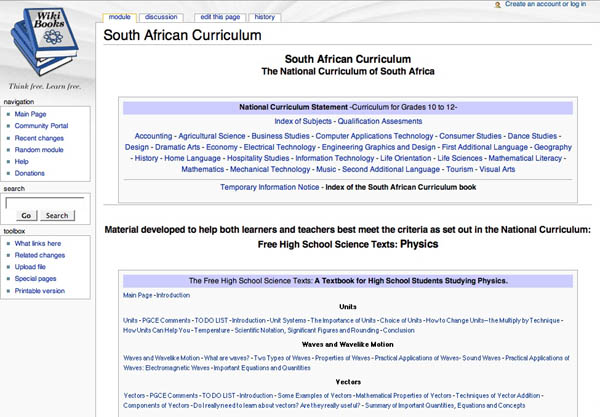
I would guess that it won’t be Americans or Europeans who will make the first big move into open source curricula. The West may be a great source of ideas, but it is also a stronghold for the entrenched interests of publishers and software companies. In so-called developing nations, there is much less to lose and probably much more to gain from experimenting with something like Wiki Books. Take a look: someone has even “wiki-fied” the entire National Curriculum of South Africa as a skeleton for the kind of public domain curriculum Wales has forecast. Right now, free software is spreading rapidly through the developing world, especially in educational initiatives. Freeing the curriculum would be a logical next step. If or when these changes take root, we’ll find ourselves living in a very different world.
Over the next few days, I’ll be discussing some other open curriculum initiatives. Stay tuned.
new post now up: MIT’s OpenCourseWare
google halts book scans until november
Faced with intense pressure from publishers since it announced its Print and Library projects, Google has decided to back down, at least somewhat, from its ambitious program to scan major library collections and make them searchable online. Until now, Google has defended its project as falling under “fair use,” but publishers have not been convinced. From the Google blog:
We think most publishers and authors will choose to participate in the publisher program in order to introduce their work to countless readers around the world. But we know that not everyone agrees, and we want to do our best to respect their views too. So now, any and all copyright holders – both Google Print partners and non-partners – can tell us which books they’d prefer that we not scan if we find them in a library. To allow plenty of time to review these new options, we won’t scan any in-copyright books from now until this November.
MIT Technology Review hones in on Google’s hubris:
Seems copyright owners have problems with the effort, and who can really blame them–copyright protection is, after all, one way publishers make their money. Somewhat amazingly, Google wants copyright owners to opt-out of their program, instead of Google having to do the work of contacting copyright owners to get them to opt-in.
rss feeds for google news
You can now syndicate sections, results, and customized pages on Google News using RSS (really simple syndication) feeds.
For many, Google News is -the- one-stop aggregator for current events. But now you can aggregate from the aggregator. With so many filters coming in between news outlets and their readers, can the identity of a publication be retained? If a newspaper decides to start charging for access to its website (as the New York Times is beginning to do), they’ll cite revenue concerns. But in a way, they’re saying something much more primal: we’re unique, we exist!
computer games in british schools, and, death by gaming
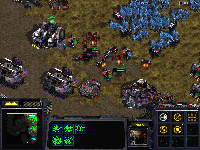
 Four secondary schools in Britain (ages 11-16) are to incorporate computer games into daily classroom activities as part of a one-year trial run. Researchers are looking to begin drafting a “road map” for game integration in schools across Europe. See BBC: “Games to be tested in classrooms.”
Another BBC item: “S Korean dies after games session.” Seems a 28-year-old man became so immersed in Starcraft that he neglected to eat or sleep. After 50 hours, his heart stopped.
(image is a screenshot from Starcraft)
tired of feeling so used, textbook publishers go digital
CNET News reports that ten schools, including Princeton, the University of Oregon, and the University of Utah, are to participate this fall in a trial program in which college bookstores will offer digital editions of high-demand titles at a 33% mark-down from print prices.  In exchange for these enormous savings, students get to download one, intensely straight-jacketed .pdf file – a book that is readable on only one machine, cannot be printed out in full, and will expire after 150 days.
Some of America’s biggest textbook publishers, including McGraw-Hill, Houghton Mifflin, John Wiley & Sons, and Thomson Learning are offering digital titles in the program through wholesaler MBS Textbook Exchange. Their aim? To tempt cash-strapped students away from used textbooks, the bane of the textbook industry. All in all, it’s a cynical move that implicitly acknowledges the absurdly inflated price of print textbooks, yet offers only token relief, trying to pass off self-destructing, digital facsimiles as a reasonable substitute for a perfectly durable, slightly dinged used book.
What the textbook publishers ought to be doing is cultivating a more creative vision of the digital textbook, and getting over their terror of online distribution, which they can only see as an intellectual property disaster. Textbook publishers should take a look around and see that there are ways to make good business online. Charge for the service, not the copy – explore syndicated content that students can subscribe to at reasonable rates. Develop new kinds of multimedia titles that can truly take advantage of the online environment. Stop spending millions on digital rights management, stop worrying about your precious copies getting stolen.
On the web, everything is a copy, and it’s pointless trying to police this reality. What’s meaningful is access, what’s meaningful is staying up to date. Develop a good service, with consistently updated, valuable content, and students and professors will buy in. If the textbook industry does not wake up and adapt, they could find themselves in the ash heap. More on that to come.
e-poetry 2005
E-Poetry 2005, “an international digital poetry festival,” will be held this fall, September 28 through October 1, in London:
E-Poetry 2005 is both a conference and festival, dedicated to showcasing the best talent in digital poetry and poetics from around the world. E-Poetry combines both a high-level academic conference and workshop, examining growing trends in this young and emergent art form, with a festival of the latest and most exciting work from both established and new practitioners.
(via Grand Text Auto)
lulu.com – equal opportunity backlist
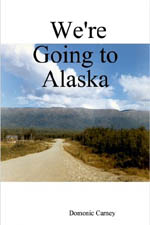
lulu.com is an intriguing, just-launched enterprise from open source software pioneer Bob Young (see recent BBC profile) that applies the ebay model of the global online bazaar to print-on-demand publishing. Lulu will host and publish your creative work (text, video, music, photography, whatever) for free. “Lulu is a technology company, not a publisher,” the site makes clear. When somebody purchases a copy, a paperback is spit out of a printer, or a CD or DVD is stamped. The single copy is then packed up and shipped to the buyer.
Authors specify a royalty that they will receive from each sale. All Lulu does is add a modest mark-up to each item, covering the cost of set up, printing and shipping. The rest is profit. For downloads, Lulu doesn’t charge anything above the author’s royalty. Lulu also retains no rights to the work, and has no problem with an author selling their book elsewhere, or even going in and doing an edit of an already listed work. For an extra fee, however, Lulu will help with retail distribution, getting the book listed on Amazon and Barnes & Noble, and giving it a unique ISBN. In this case, Lulu does retain exclusive rights to market your book.
 Usually, it’s the publisher and the retailers that keep most of the money, while the author receives only a tiny fraction. With Lulu, it’s the other way around. And with that reversal goes all the strictures – good and bad – that come with traditional, “elitist” publishing. Authority, prestige, quality control, yes, but also the extreme deficit of imagination and willingness to take risk that plague publishing in the age of mega conglomerates.
Lulu is like a cattle auction for books. The challenge is not to be “in print” – inexpensive print-on-demand publishing from digital backlists eradicates that concern. Everyone is theoretically in print. Whether anyone wants to read them, however, is a different matter. And so, Lulu is a sort of battleground for the elemental aspirations of creative egos. A writhing mass. The hope is that niche titles will find an audience and that valuable new voices might emerge.
Looking at the Lulu Top 100, you’ll get an idea of what I mean by “niche” titles. At number one (at the time of this writing) is “The Havanese” by Diane Klumb – “the quintessential handbook for Havanese dog owners, breeders and fanciers.” From there on down the list, you’ll encounter such titles as: “Raw Foods for Busy People: Simple and Machine-Free Recipes for Every Day”; “The Best Way to Stay Healthy: Stay as Far Away From Doctors as You Can; Volume I” by George Steele M.D.”; “Finding the CAN in Cancer”; “The Messiah Seed Volume I”; “Atlanta Nights” (“a bad book written by experts”); “Luciferian Witchcraft”; “The Authoritative Encyclopedia of Scientific Wrestling”; “Rangefinder Photography”; “Ornamental Gardening in Acadiana & the Gulf States: Questions and Answers”; “The Pelvic Pain Solution”; and “Chugworth Academy: All Aboard the Mentalist Train” – an anthology of web comics by David Cheung.
ebooks in korea
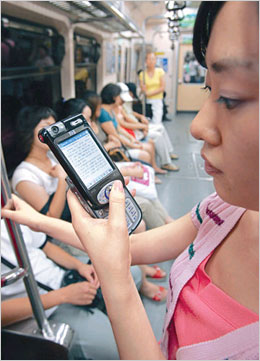 An article in Chosun Ilbo describes the increasing popularity of ebooks in Korea, a shift driven by readers on a tight budget who are drawn to the affordability of digital texts. It’s estimated that about 100,000 electronic titles are currently available, a number that is expected to more than triple over the coming year as publishers ratchet up their digital publishing operations. But most interesting was this prediction of how the form of electronic books will change as they become more widely accepted:
For now, e-books remain at the level of taking printed books and converting them into digital files. But they will soon develop into multimedia books that combine text, sound and video.
(image from Chosun Ilbo)