Author Archives: ben vershbow

nicholas carr on “the amorality of web 2.0”

Nicholas Carr, who writes about business and technology and formerly was an editor of the Harvard Business Review, has published an interesting though problematic piece on “the amorality of web 2.0”. I was drawn to the piece because it seemed to be questioning the giddy optimism surrounding “web 2.0”, specifically Kevin Kelly’s rapturous late-summer retrospective on ten years of the world wide web, from Netscape IPO to now. While he does poke some much-needed holes in the carnival floats, Carr fails to adequately address the new media practices on their own terms and ends up bashing Wikipedia with some highly selective quotes.
Carr is skeptical that the collectivist paradigms of the web can lead to the creation of high-quality, authoritative work (encyclopedias, journalism etc.). Forced to choose, he’d take the professionals over the amateurs. But put this way it’s a Hobson’s choice. Flawed as it is, Wikipedia is in its infancy and is probably not going away. Whereas the future of Britannica is less sure. And it’s not just amateurs that are participating in new forms of discourse (take as an example the new law faculty blog at U. Chicago). Anyway, here’s Carr:

The Internet is changing the economics of creative work – or, to put it more broadly, the economics of culture – and it’s doing it in a way that may well restrict rather than expand our choices. Wikipedia might be a pale shadow of the Britannica, but because it’s created by amateurs rather than professionals, it’s free. And free trumps quality all the time. So what happens to those poor saps who write encyclopedias for a living? They wither and die. The same thing happens when blogs and other free on-line content go up against old-fashioned newspapers and magazines. Of course the mainstream media sees the blogosphere as a competitor. It is a competitor. And, given the economics of the competition, it may well turn out to be a superior competitor. The layoffs we’ve recently seen at major newspapers may just be the beginning, and those layoffs should be cause not for self-satisfied snickering but for despair. Implicit in the ecstatic visions of Web 2.0 is the hegemony of the amateur. I for one can’t imagine anything more frightening.

He then has a nice follow-up in which he republishes a letter from an administrator at Wikipedia, which responds to the above.

Encyclopedia Britannica is an amazing work. It’s of consistent high quality, it’s one of the great books in the English language and it’s doomed. Brilliant but pricey has difficulty competing economically with free and apparently adequate….
…So if we want a good encyclopedia in ten years, it’s going to have to be a good Wikipedia. So those who care about getting a good encyclopedia are going to have to work out how to make Wikipedia better, or there won’t be anything.

Let’s discuss.

pinter and the nobel prize

pinter.jpg Twice in one year now the Swedish academy has used the Nobel Prize as a political swipe at the Bush administration, first giving the peace medal to Mohamed ElBaradei of the IAEA (a difference of opinion on disarmament, you could say), and today awarding the prize for literature to British playwright Harold Pinter, who in recent years has been a vocal critic of US and British policies, once referring to Tony Blair as a “deluded idiot.”
But recent years aside, Pinter undoubtedly deserves the prize for his life’s work in the theatre, where he developed a politics far more complex, painful and profound than what is on display in his latter-day fumings (generally right though they may be) about American empire.
In college I acted in one of Pinter’s later plays, Ashes to Ashes (1996), a mysterious single act about a marriage in crisis, and a good example of the kind of frightening moral puzzle, encompassing the personal and the political, that Pinter excelled at creating. In a comfortable English living room, in a comfortable English university town, a woman seems to psychically rupture before her husband’s eyes, traumatized by events she relates only in part, and which she could not possibly have been alive to experience.
She confesses to having had an affair with the warden of a Nazi death camp, and having lived with him there. She describes the horror of the place, obscenely channeling the Holocaust as a sort of sexual taunt toward her mystified husband, but at the same time communicating her distress at the slow suffocation of their marriage. It is a sickening game, but one they must play in order to cut to the heart of their relationship. Ashes to Ashes is a domestic play, but somehow the entire century speaks through it.
On a more general note, it’s encouraging to see a dramatist get recognized on this scale, a statement about the continued relevance, at least in concept, of the theatre — an unmediated medium in a thoroughly mediated age. It also says something about language. Pinter, whose bleak but darkly humorous sensibilities were formed in bombed-out, post-WWII England, uses language sparely and with scalpel-like precision. Playwright David Hare said of him:

“Pinter did what Auden said a poet should do. He cleaned the gutters of the English language, so that it ever afterwards flowed more easily and more cleanly.”

His plays have the ominousness of still water, the words like stones breaking the surface. You have to read and feel the ripples. In an age where mass media, and now the internet, have devalued words, Pinter found a way to make them startling again. He also understands the power of silence.
Elevating Pinter as international spokesman for the left, the Swedes missed the point. His recent protests haven’t been terribly interesting or original. But in missing, they still struck gold. All this media attention cannot really convey the power of his plays. Hopefully, this will lead to a reinvigorated interest in producing them. They still speak vitally to our times.

an ipod for text

tt55_top_01.jpg
When I ride the subway, I see a mix of paper and plastic. Invariably several passengers are lost in their ipods (there must be a higher ipod-per-square-meter concentration in New York than anywhere else). One or two are playing a video game of some kind. Many just sit quietly with their thoughts. A few are conversing. More than a few are reading. The subway is enormously literate. A book, a magazine, The Times, The Post, The Daily News, AM New York, Metro, or just the ads that blanket the car interior. I may spend a lot of time online at home or at work, but on the subway, out in the city, paper is going strong.
Before long, they’ll be watching television on the subway too, seeing as the latest ipod now plays video. But rewind to Monday, when David Carr wrote in the NY Times about another kind of ipod — one that would totally change the way people read newspapers. He suggests that to bounce back from these troubled times (sagging print circulation, no reliable business model for their websites), newspapers need a new gadget to appear on the market: a light-weight, highly portable device, easy on the eyes, easy on the batteries, that uploads articles from the web so you can read them anywhere. An ipod for text.
This raises an important question: is it all just a matter of the reading device? Once there are sufficient advances in display technology, and a hot new gadget to incorporate them, will we see a rapid, decisive shift away from paper toward portable electronic text, just as we have witnessed a widespread migration to digital music and digital photography? Carr points to a recent study that found that in every age bracket below 65, a majority of reading is already now done online. This is mostly desktop reading, stationary reading. But if the greater part of the population is already sold on web-based reading, perhaps it’s not too techno-deterministic to suppose that an ipod-like device would in fact bring sweeping change for portable reading, at least periodicals.
But the thing is, online reading is quite different from print reading. There’s a lot of hopping around, a lot of digression. Any new hardware that would seek to tempt people to convert from paper would have to be able to surf the web. With mobile web, and wireless networks spreading, people would expect nothing less (even the new Sony PSP portable gaming device has a web browser). But is there a good way to read online text when you’re offline? Should we be concerned with this? Until wi-fi is ubiquitous and we’re online all the time (a frightening thought), the answer is yes.
We’re talking about a device that you plug into your computer that automatically pulls articles from pre-selected sources, presumably via RSS feeds. This is more or less how podcasting works. But for this to have an appeal with text, it will have to go further. What if in addition to uploading new articles in your feed list, it also pulled every document that those articles linked to, so you could click through to referenced sites just as you would if you were online?
It would be a bounded hypertext system. You could do all the hopping around you like within the cosmos of that day’s feeds, and not beyond — you would have the feeling of the network without actually being hooked in. Text does not take up a lot of hard drive space, and with the way flash memory is advancing, building a device with this capacity would not be hard to achieve. Of course, uploading link upon link could lead down an infinite paper trail. So a limit could be imposed, say, a 15-step cap — a limit that few are likely to brush up against.
So where does the money come in? If you want an ipod for text, you’re going to need an itunes for text. The “portable, bounded hypertext RSS reader” (they’d have to come up with a catchier name –the tpod, or some such techno-cuteness) would be keyed in to a subscription service. It would not be publication-specific, because then you’d have to tediously sign up with dozens of sites, and no reasonable person would do this.
So newspapers, magazines, blogs, whoever, will sign licensing agreements with the tpod folks and get their corresponding slice of the profits based on the success of their feeds. There’s a site called KeepMedia that is experimenting with such a model on the web, though not with any specific device in mind (and it only includes mainstream media, no blogs). That would be the next step. Premium papers like the Times or The Washington Post might become the HBOs and Showtimes of this text-ripping scheme — pay a little extra and you get the entire electronic edition uploaded daily to your tpod.

sony librie.jpg As for the device, well, the Sony Librie has had reasonable success in Japan and will soon be released in the States. The Librie is incredibly light and uses an “e-ink” display that is reflective like paper (i.e. it can be read in bright sunlight), and can run through 10,000 page views on four triple-A batteries.
The disadvantages: it’s only black-and-white and has no internet connectivity. It also doesn’t seem to be geared for pulling syndicated text. Bob brought one back from Japan. It’s nice and light, and the e-ink screen is surprisingly sharp. But all in all, it’s not quite there yet.
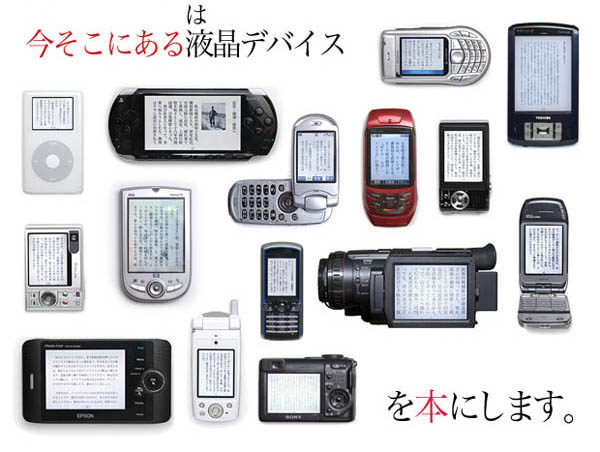
There’s always the do-it-yourself approach. The Voyager Company in Japan has developed a program called T-Time (the image at the top is from their site) that helps you drag and drop text from the web into an elegant ebook format configureable for a wide range of mobile devices: phones, PDAs, ipods, handheld video games, camcorders, you name it. This demo (in Japanese, but you’ll get the idea) demonstrates how it works.
Presumably, you would also read novels on your text pod. I personally would be loathe to give up paper here, unless it was a novel that had to be read electronically because it was multimedia, or networked, or something like that. But for syndicated text — periodicals, serials, essays — I can definitely see the appeal of this theoretical device. I think it’s something people would use.


bible transl8ed for mobile phones

Luther translated the Bible into German so that revelation could be received in the language of the common folk. A similar spirit seems to have moved the Bible Society of Australia, which just translated all 31,173 verses of the of the new and old testaments (Contemporary English Version) into SMS-style english — the abbreviated patois of mobile phone text messaging. The idea is to enable parents, parishioners and everyday people to send each other bite-sized inspirational verses by phone.
A taste:

In da Bginnin God cre8d da heavens & da earth. Da earth waz barren, wit no 4m of life; it waz unda a roaring ocean cuvred wit dRkness. (Genesis, chapter 1, verses 1-2)
Wrk hard at wateva u do. U will soon go 2 da wrld of da dead, where no 1 wrks or thinks or reasons or knws NEting. (Ecclesiastes, chapter nine, verse 10)

Read more in the Sydney Morning Herald (via textually).

trackback, adieu

We’ve officially and permanently shut off the trackback function on if:book. We’re sad to do it. The idea of trackback is such a good one — a way to send signals (pings) to other blogs alerting them that one of their posts is being discussed on your site. It ties the blogosphere together, fosters conversations across the web. It was a beautiful dream, but spammers killed it.
Tom Coates pronounced trackback dead back in April, but if:book was only a few months old at the time, still green and optimistic. We were also less known, so spam was only coming in a light sprinkle. Now it’s been a month since our last legitimate ping, and the daily dose of spam has grown so large (and so filthy) that it hardly seems worth it to keep the door open. Fewer bloggers are tracking back now anyway since most have accepted that it is a dying practice, or perhaps haven’t even heard of it at all.
So trackback is done. I just want to say a few goodbyes…
Goodbye, diet pills.
Goodbye, discount sneakers.
Goodbye, ringtones.
Goodbye, hentai comics.
Goodbye, cheap loans (spelled lones).
Goodbye, online pharmacy.
Goodbye, online casino.
Goodbye, texas holdem.
Goodbye, arbitrage sports betting.
Goodbye, free nude black jack.
Goodbye, rape fantasies.
Goodbye, incest stories.
Goodbye, shemale porn.
Goodbye, animal sex.
Goodbye, gay erotica.
Goodbye, tranny surprise.
Goodbye, sex grannies.
A big middle finger to all of you.

chicago law faculty starts blogging

Law professors at the University of Chicago have launched an experimental faculty blog to connect with students, the legal community, and the world at large. They’ve chosen a good moment to jump into the public sphere, when the Supreme Court is in flux. I wouldn’t be surprised if this spurred similar developments at other universities.

The University of Chicago School of Law has always been a place about ideas. We love talking about them, writing about them, and refining them through open, often lively conversation. This blog is just a natural extension of that tradition. Our hope is to use the blog as a forum in which to exchange nascent ideas with each other and also a wider audience, and to hear feedback about which ideas are compelling and which could use some re-tooling.

Though a growing number of scholars have embraced blogging, the academy as a whole has been loathe to take treat it as anything more than a dalliance. But a few more high profile moves like the one in Chicago and university boards may start clamoring to jump in. Perhaps then there can begin a serious discussion about legitimizing blogging as a form of scholarly production, and even as a kind of peer review. It’s not that all academics should be expected (or should want) to become high-profile public intellectuals. Fundamentally, academic blogging should be considered as an extension of “office hours,” a way to extend the dialogue with students and other faculty.
But there’s a definite benefit for the public when authoritative voices start blogging about what they know best. It’s refreshing to read sober, deeply informed reflections on the Miers nomination and surrounding questions of judicial philosophy written by people who know what they’re talking about. It helps us to parse the news and to tune out some of the more worthless punditry that goes on, both in mainstream media and in the blogosphere. Less noise, more signal.
Of course, experts can get noisy too. I was thrilled when Paul Krugman began writing his column for the NY Times — here was someone with a deep grasp of economics and a talent for explaining it in a political context. But as Krugman’s audience has grown, so has his propensity to blow off partisan steam. To me at least, his value as a public intellect has waned.

news and blogs to live under one roof at yahoo!

Yahoo’s revamped news search will present news and blogs side by side on the same page. In addition, the site will feature related images from Flickr, the social photo-sharing site that Yahoo purchased earlier this year, as well as user-contributed links from My Web (a feature that allows you to save and store web pages, and share them with others).
As before, the front news page will promote only stories from mainstream media sources, while the blog-news combo appears on a second-tier page that you arrive at when you conduct a specific search, or click for more details or more stories. No doubt, this was done, at least in part, to mollify angry news outlets who will likely call foul for making hard news share space with blogs. Still, the webscape has changed. All but the most cursory glance at the headlines will yield a richly confusing array of mainstream and grassroots sources.
(story, Yahoo Search Blog)
(thoughtful analysis from Tim Porter)

the blog carnival

The Chronicle of Higher Education ran a good piece last week by Henry Farrell — “The Blogosphere As A Carnival of Ideas” — looking at the small but growing minority of scholars who have become bloggers. Farrell is a poli sci professor at George Washington, and a contributor to the popular group blog Crooked Timber. He argues from experience how blogs have invigorated scholarly exchange within and across fields, allowing for a more relaxed discourse, free of the jargon and stuffy manner of journals. In some cases, blogs have enabled previously obscure academics to break beyond the ivory tower to connect with a large general readership hungry for their insight and expertise.
What Farrell neglects to mention — which is surprising given the title of the piece — is the phenomenon of the “blog carnival,” an interesting subculture of the web that has been adopted in certain academic, or quasi-academic, circles. A blog carnival is like a roving journal, a rotating showcase of interesting writing from around the blogosphere within a particular discipline. Individual bloggers volunteer to host a carnival on their personal blog, acting as chief editor for that edition. It falls to them to collect noteworthy items, and to sort through suggestions from the community, many of which are direct submissions from authors. On the appointed date (carnivals generally keep to a regular schedule) the carnival gets published and the community is treated to a richly annotated feast of new writing in the field.
Granted, not all participating bloggers are academics. Some are students, some simply enthusiasts. Anyone with a serious interest in the given area is usually welcome. Among the more active blog carnivals are Tangled Bank, a science carnival currently in its 38th edition, the Philosophers’ Carnival, whose 20th edition was just posted this past Sunday, and the History Carnival, currently in its 17th edition.
Here’s a small taste from the most recent offering at History Carnival, hosted by The Apocalyptic Historian:

New Deal liberalism has been on the minds of politicians lately. Hiram Hover posts about the recent talk of New Deal analogies from politicians in deciding how to help the victims of Katrina in “Responding to Katrina: Is History Any Guide?” Caleb McDaniel at Mode for Caleb draws a startling historical parallel between the 1793 yellow fever epidemic in Phildelphia and New Orleans after Katrina in 2005.
In a comparison of another of Bush’s crises in the making, Jim MacDonald revisits the history of the Sepoy Rebellion with comments on the current situation in Iraq. Meanwhile Sepoy contributes to a recent attempt to compile the views Westerners have about Islam at Chapati Mystery.
How many times have humans believed the world was coming to an end? Natalie Bennett reviews a recent work on the Anabaptist takeover of Münster in 1534, when the belief in the impending apocalypse sent that city into chaos.

Most carnivals have a central site that indexes links to past editions and provides a schedule of upcoming ones, but the posts themselves exist on the various blogs that comprise the community. Hence the “carnival” — a traveling festival of ideas, a party that moves from house to house. Participating blogs generally display a badge on their sidebar signaling their affiliation with a particular collective.
carnivalesque.jpg Though carnivals keep to a strict schedule, there is no mandated format or style. Host bloggers can organize the material however they choose, putting their own personal spin or filter on the current round — just as long as they stick to the overall topic. The latest issue of Carnivalesque, a monthly circuit on medieval and early modern history, shows how far some hosts will go — styled as a full magazine, the October issue is complete with a mock cover, a letter from the editor, and links organized by section.
The concept of the carnival seems to have originated in 2002 with “The Carnival of the Vanities,” which for a while served as a venue for bloggers to promote their best writing — a way of fighting the swift sinking of words in a sea of rapidly updating blogs. It’s not surprising that the idea was then taken up by academic types, since the carnival model, in its essence, rather jives with the main warranting mechanism of all scholarly publication: peer review. It’s a looser, less formal peer review to be sure, but still operates according to the ethos of the self-evaluating collective.
It’s worth paying attention to how these carnivals work because they provide at least part of the answer to a larger concern about the web: how to maintain quality and authority in a flood of amateur self-publishing. In the cycle of the carnival, blogging becomes a kind of open application process where your best work is dangled in the path of roving editors. You might say all bloggers are roving editors, but these ones represent an authoritative collective, one with a self-sustaining focus.
So the idea of the carnival, refined and sharpened by academics and lifelong learners, might in fact have broader application for electronic publishing. It happily incorporates the de-centralized nature of the web, thriving through collaborative labor, and yet it retains the primacy of individual voices and editorial sensibilities. Again, you might point out that its formula is far from unique, that this is in fact the procedure of just about any blog: find interesting stuff on the web and link to it with a few original comments. But the carnival focuses this practice into a regular, more durable form, providing an authoritative context that can be counted on week after week, even year after year. Sounds sort of like a magazine doesn’t it? But its offices are constantly in flux, its editorial chair a rotating one. I’m interested to see how it evolves. If blogs in cyberspace are like the single-cell organism in the primordial porridge, might the carnival be a form of multi-cell life?

google dystopia

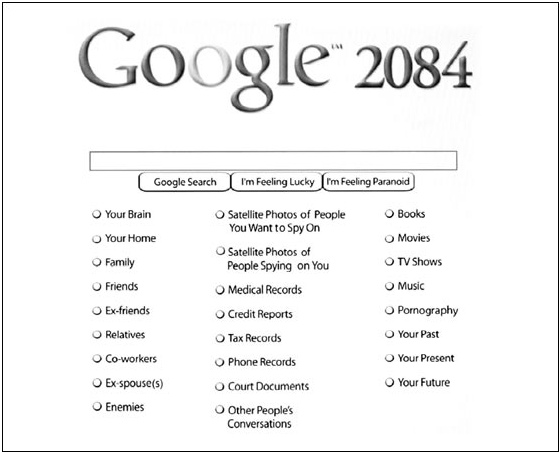
Google as big brother: “Op-Art” by Randy Siegel from today’s NY Times.
google 2084.jpg

welcome to the 19th century

The following was posted by Gary Frost as a comment to our post on Neil Postman’s “Building a Bridge to the 18th Century.” Gary recently returned from the Mississippi coast where he was part of a team helping to assess library and museum damage after Katrina.
The mystic advise that we walk into the darkness. Postman’s only qualification is that we do futurism with the right gear. But we cannot wander off into the future with enough AA batteries. An archeologist at the storm damaged Jefferson Davis presidential library greeted me saying; “Welcome to the19th century.” He was not kidding. No water, no electricity, no gas, no groceries. He was digging up the same artifacts for the second time in the immense debris fields left by Katrina.
We were driven to a manuscript era and we were invigorated to do our best. Strangely the cell phones worked and we talked to Washington from the 19th century. We asked if the Nation was still interested in the culture of the deep south. Not really, Transformers were at work and in our mobile society the evacuees had left for good. The army trucks were building new roads over the unmarked gravesites of 3000 Confederate veterans, who in their old age, came to Jeff Davis’ home to die.
We were left hanging about the future and technologies were a sidebar. It wasn’t really important that the 19th century had invented instantaneous communication, digital encoding or photographic representation or that the 21st century was taking the credit for its exploitation of these accomplishments. The gist was that the future deserved to be informed and not deluded. The gist was that the future would be fulfilled as a measure of its use of the accomplishments of a much longer past.