
Microsoft’s forthcoming “MSN Book Search” is the latest entity to join the Open Content Alliance, the non-controversial rival to Google Print. ZDNet says: “Microsoft has committed to paying for the digitization of 150,000 books in the first year, which will be about $5 million, assuming costs of about 10 cents a page and 300 pages, on average, per book…”
Apparently having learned from Google’s mistakes, OCA operates under a strict “opt-in” policy for publishers vis-a-vis copyrighted works (whereas with Google, publishers have until November 1 to opt out). Judging by the growing roster of participants, including Yahoo, the National Archives of Britain, the University of California, Columbia University, and Rice University, not to mention the Internet Archive, it would seem that less hubris equals more results, or at least lower legal fees. Supposedly there is some communication between Google and OCA about potential cooperation.
Also story in NY Times.
Author Archives: ben vershbow
to some writers, google print sounds like a sweet deal
Wired has a piece today about authors who are in favor of Google’s plans to digitize millions of books and make them searchable online. Most seem to agree that obscurity is a writer’s greatest enemy, and that the exposure afforded by Google’s program far outweighs any intellectual property concerns. Sometimes to get more you have to give a little.
The article also mentions the institute.
some thoughts on katamari damacy:everything bad is good for you, part 3.5
Responding to Bob’s “games provide much more than a cognitive workout”…
Growing up in the 80s, video games were much less sophisticated and probably less effective as a matrix for training consumption. TV performed that role. I remember watching on Nickelodeon competitions between children in a toy store in which each contestant had 60, or 120 seconds to fill a shopping cart with as many toys as they possibly could. The winner — whoever had managed to grab the most — got to keep the contents of their cart. The physical challenge of the game was obvious. You could even argue that it presented a cognitive challenge insofar as you had to strategize the most effective pattern through the aisles, balancing the desirability of toys with their geometric propensity to fly off the shelves quickly. But did that excuse the game ethically?
I’ve played a bit of Katamari lately and have enjoyed it. It’s a world charged with static electricity, everything sticks. Each object has been lovingly rendered in its peculiarity and stubbornness. If your katamari picks up something long and narrow, say, a #2 pencil, and attaches to it in such a way that it sticks out far from the clump, it will impede your movement. Each time the pencil hits the ground, you have to kind of pole vault the entire ball. It’s not hard to see how the game trains visual puzzle-solving skills, sensitivity to shape, spatial relationships (at least virtual ones), etc.
That being said, I agree with Bob and Rylish that there is an internal economy at work here that teaches children to be consumers. A deep acquisition anxiety runs through the game, bringing to mind another Japanese pop phenom: Pokémon. Pokémon (called “Pocket Monsters” in Japan) always struck me as particularly insidious, far more predatory than anything I grew up with, because its whole narrative universe is based on consumption. “Collect ’em all” is not just the marketing slogan for spinoff products, but the very essence of the game itself. The advertising is totally integrated with the story. Here’s Wikipedia (not a bad source for things like this) on how it works:
“The Pokémon games are role-playing games with a strategy element which allow players to catch, collect, and train pets with various abilities, and battle them against each other to build their strength and evolve them into more powerful Pokémon. Pokémon battles are based on the non-lethal Eastern sport of fighting insects, but the Pokémon never bleed or die, only faint. The game’s catchphrase used to be “Gotta catch ’em all!”, although now it is no longer officially used.”
Similarly, the Katamari backstory involves the lord of the universe getting drunk one night and shattering the solar system. Each level of the game is the reassembly of a star or planet. If you succeed, a heavenly body is restored to the firmament.
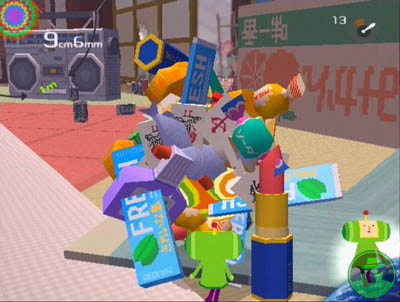
After an hour playing Katamari, having traversed a number of wildly imaginative landscapes (and having absorbed a soundtrack that can only be described as Japanese chipmunks on nitrous) I re-enter the actual world in a mildly fevered state. The cardinal rule in the game is that to succeed I must devour as much as possible. No time is afforded to savor the strange, psychedelic topography, to examine the wonderful array of objects (everything from thumbtacks to blue whales) scattered about in my path. Each stage is a terrain that must be gobbled up, emptied. A throbbing orb of light in the upper left corner of the screen, set within concentric rings representing target diameters, measures my progress toward the goal: a katamari “n” meters in size. The clock in the upper right corner pressures me to keep rolling.
Video games today may not be as blatant as the consumerist spectacle of the Nickelodeon game, and they may provide richly textured worlds posing greater problem-solving challenges than any electronic media that has preceded them. But it seems to me that many of them do not differ ideologically from that shopping cart contest.
debating google print
The Washington Post has run a pair of op-eds, one from each side of the Google Print dispute. Neither says anything particularly new. Moreover, they enforce the perception that there can be only two positions on the subject — an endemic problem in newspaper opinion pages with their addiction to binaries, where two cardboard boxers are allotted their space to throw a persuasive punch. So you’re either for Google or against it? That’s awfully close to you’re either for technology — for progress — or against it. Unfortunately, like technology’s impact, the Google book-scanning project is a little trickier to figure out, and a more nuanced conversation is probably in order.
The first piece, “Riches We Must Share…”, is submitted in support of Google by University of Michigan President Sue Coleman (a partner in the Google library project). She argues that opening up the elitist vaults of the world’s great (english) research libraries will constitute a democratic revolution. “We believe the result can be a widening of human conversation comparable to the emergence of mass literacy itself.” She goes on to deliver some boilerplate about the “Net Generation” — too impatient to look for books unless they’re online etc. etc. (great to see a major university president being led by the students instead of leading herself).
Coleman then devotes a couple of paragraphs to the copyright question, failing to tackle any of its controversial elements:
Universities are no strangers to the responsible management of complex copyright, permission and security issues; we deal with them every day in our classrooms, libraries, laboratories and performance halls. We will continue to work within the current criteria for fair use as we move ahead with digitization.
The problem is, Google is stretching the current criteria of fair use, possibly to the breaking point. Coleman does not acknowledge or address this. She does, however, remind the plaintiffs that copyright is not only about the owners:
The protections of copyright are designed to balance the rights of the creator with the rights of the public. At its core is the most important principle of all: to facilitate the sharing of knowledge, not to stifle such exchange.
All in all a rather bland statement in support of open access. It fails to weigh in on the fair use question — something about which the academy should have a few things to say — and does not indicate any larger concern about what Google might do with its books database down the road.
The opposing view, “…But Not at Writers’ Expense”, comes from Nick Taylor, writer, and president of the Authors’ Guild (which sued Google last month). Taylor asserts that mega-rich Google is tramping on the dignity of working writers. But a couple of paragraphs in, he gets a little mixed up about contemporary publishing:
Except for a few big-name authors, publishers roll the dice and hope that a book’s sales will return their investment. Because of this, readers have a wealth of wonderful books to choose from.
A dubious assessment, since publishing conglomerates are not exactly enthusiastic dice rollers. I would counter that risk-averse corporate publishing has steadily shrunk the number of available titles, counting on a handful of blockbusters to drive the market. Taylor goes on to defend not just the publishing status quo, but the legal one:
Now that the Authors Guild has objected, in the form of a lawsuit, to Google’s appropriation of our books, we’re getting heat for standing in the way of progress, again for thoughtlessly wanting to be paid. It’s been tradition in this country to believe in property rights. When did we decide that socialism was the way to run the Internet?
First of all, it’s funny to think of the huge corporations that dominate the web as socialist. Second, this talk about being paid for appropriating books for a search database is revealing of the two totally different worldviews that are at odds in this struggle. The authors say that any use of their book requires a payment. Google sees including the books in the database as a kind of payment in itself. No one with a web page expects Google to pay them for indexing their site. They are grateful that they do! Otherwise, they are totally invisible. This is the unspoken compact that underpins web search. Google assumed the same would apply with books. Taylor says not so fast.
Here’s Taylor on fair use:
Google contends that the portions of books it will make available to searchers amount to “fair use,” the provision under copyright that allows limited use of protected works without seeking permission. That makes a private company, which is profiting from the access it provides, the arbiter of a legal concept it has no right to interpret. And they’re scanning the entire books, with who knows what result in the future.
Actually, Google is not doing all the interpreting. There is a legal precedent for Google’s reading of fair use established in the 2003 9th Circuit Court decision Kelly v. Arriba Soft. In the case, Kelly, a photographer, sued Arriba Soft, an online image search system, for indexing several of his photographs in their database. Kelly believed that his intellectual property had been stolen, but the court ruled that Arriba’s indexing of thumbnail-sized copies of images (which always linked to their source sites) was fair use: “Arriba’s use of the images serves a different function than Kelly’s use – improving access to information on the internet versus artistic expression.” Still, Taylor’s “with who knows what result in the future” concern is valid.
So on the one hand we have many writers and most publishers trying to defend their architecture of revenue (or, as Taylor would have it, their dignity). But I can’t imagine how Google Print would really be damaging that architecture, at least not in the foreseeable future. Rather it leverages it by placing it within the frame of another architecture: web search. The irony for the authors is that the current architecture doesn’t seem to be serving them terribly well. With print-on-demand gaining in quality and legitimacy, online book search could totally re-define what is an acceptable risk to publishers, and maybe more non-blockbuster authors would get published.
On the other hand we have the universities and libraries participating in Google’s program, delivering the good news of accessibility. But they are not sufficiently questioning what Google might do with its database down the road, or the implications of a private technology company becoming the principal gatekeeper of the world’s corpus.
If only this debate could be framed in a subtler way, rather than the for-Google-or-against-it paradigm we have now. I’m cautiously optimistic about the effect of having books searchable on the web. And I tend to believe it will be beneficial to authors and publishers. But I have other, deep reservations about the direction in which Google is heading, and feel that a number of things could go wrong. We think the cencorship of the marketplace is bad now in the age of publishing conglomerates. What if one company has total control of everything? And is keeping track of every book, every page, that you read. And is reading you while you read, throwing ads into your peripheral vision. I’m curious to hear from readers what they feel could be the hazards of Google Print.
the huffington post… we’re intrigued
A week after the May 9 debut of The Huffington Post, Nikki Finke delivered this bitter assessment in LA Weekly:
Judging from Monday’s horrific debut of the humongously pre-hyped celebrity blog the Huffington Post, the Madonna of the mediapolitic world has undergone one reinvention too many. She has now made an online ass of herself. What her bizarre guru-cult association, 180-degree right-to-left conversion, and failed run in the California gubernatorial-recall race couldn’t accomplish, her blog has now done: She is finally played out publicly. This website venture is the sort of failure that is simply unsurvivable. Her blog is such a bomb that it’s the movie equivalent of Gigli, Ishtar and Heaven’s Gate rolled into one. In magazine terms, it’s the disastrous clone of Tina Brown’s Talk, JFK Jr.’s George or Maer Roshan’s Radar.
Finke was not alone in her prediction of disaster. And at the time, it wasn’t so unreasonable to suspect Arianna Huffington’s experiment with celebrity group blogging might crash and burn spectacularly (The Guardian ran a very funny satire in anticipation). But by now it’s clear that not only are reports of Huffington’s death greatly exaggerated, but that something of value has been created.
The site is getting a load of traffic (a million and a half a month as of September, probably significantly more by now). As expected, it is snarky, eclectic and irreverant. What’s surprising is that Huffington’s rolodex of 250-plus occasional bloggers has managed to fill it with serious, thoughtful discussion. Many of the biggest names have failed to make much use of their soapbox (Norman Mailer has posted twice, Ellen Degeneres only once (about horses), both at the beginning of the run). What has built the site into a popular daily destination is not the promise of star-spun wisdom, but the insight provided by the more dedicated bloggers, many of them lesser-known figures with a great deal of expertise in a given area. What you end up with is a nice mix of opinion, satire, gossip, and serious analysis of current events — a kind of heightened public square.
In yesterday’s Washington Post, against the steady hum of online intrigue about Judy “run-amok” Miller, and the sound of millions of nails being gnawed in anticipation of what hopes to be a major league indictment of Rove and/or Libby, the afore-mentioned Tina Brown observed:
For Arianna Huffington, the Miller story has been to her newly birthed blog, the Huffington Post, a miniature version of what O.J. Simpson was to cable news.
And she’s right. Over this past week, something seems to have crystallized. Amidst all the head-scratching following the Times’ marathon coverage of the Judith Miller imbroglio this Sunday, the bloggers, not the press, have done the better job of cutting through the fog, or at the very least, of keeping our sights on the big picture. The Huffington Post has been particularly on the ball, with Arianna leading the way.
The big picture, of course, is that we are at war. And that The New York Times — the supposed “paper of record” — allowed itself to become part of the propaganda campaign that put us there. It’s the story of an entire news organization that, through one misguided reporter, got too “embedded” with its sources and totally lost its perspective. This is not the self-contained sort of scandal we saw with Jayson Blair. Nor is it really about some high-minded cause: the right to maintain confidentiality of sources. This is about the lies that led to war.
Unfortunately, we probably know less now about what happened with Judith Miller than we did before she delivered her mystifying testimonial on Sunday (aspens! clusters!). But the rigorous work-through the story has received around the blogosphere, and from a handful of columnists in the mainstream press, has defined the larger moral frame, keeping the democratic stakes appropriately high (hopes that the Democrats themselves might do the same will almost surely be disappointed).
In an interview with Wired last month, Huffington described what she sees as the problem with cable and online news coverage (increasingly one in the same):
The problem isn’t that the stories I care about aren’t being covered, it’s that they aren’t being covered in the obsessive way that breaks through the din of our 500-channel universe. Because those 500 channels don’t mean we get 500 times the examination and investigation of worthy news stories. It often means we get the same narrow, conventional-wisdom wrap-ups repeated 500 times. Paradoxically, in these days of instant communication and 24-hour news channels, it’s actually easier to miss information we might otherwise pay attention to. That’s why we need stories to be covered and re-covered and re-re-covered and covered again — until they filter up enough to become part of the cultural bloodstream.
The Judygate re-re-coverage on H. Post and throughout the blogosphere emphasizes the redefinition of the news as a two-way medium. The readers are now a major part of the process. What Huffington has done is to aggregate some of the more interesting readers.
speaking of aggregation, speaking of war…
Speaking of aggregating blog commentary on the Judy Miller intrigue, Open Source’s Monday podcast, “Getting Judith Miller” (listen), aggregates the bloggers themselves in a rigorous discussion of the “inexplicable gaps” in the Times’ self-investigation, placing it in the larger context of the war, the state of journalism, and American democracy in crisis. Guests include Jay Rosen (Press Think), Ariana Huffington (Huffington Post), Josh Marshall (Talking Points Memo, TPM Cafe), and Kevin Drum (Political Animal). A great example of the kind of triangulation Bob was talking about earlier, in this case, a radio show, drawing its material and voices from the web like a hurricane pulls its fury from a warm ocean.
(Drawing from the web to discuss the world is what Open Source is all about. Highly recommended.)
google is sued… again
This time by publishers. Penguin Group USA, McGraw-Hill, Pearson Education, Simon & Schuster and John Wiley & Sons. The gripe is the same as with the Authors’ Guild, which filed suit last month alleging “massive copyright infringement.” Publishers fear a dangerous precedent is set by Google’s scanning of books to construct what amounts to a giant card catalogue on the web. Google claims “fair use” (see rationale), again pointing out that for copyrighted works only tiny “snippets” of text are displayed around keywords (though perhaps this is not yet fully in effect – I was searching around in this book and was able to look at quite a lot).
Google calls the publishers’ suit “near-sighted.” And it probably is. The benefit to readers and researchers will be tremendous, as will (Google is eager to point out) the exposure for authors and publishers. But Google Print is undoubtedly an earth-shaking program. Look at the reaction in Europe, where alarm bells rung by France warned of cultural imperialism, an english-drenched web. Heads of state and culture convened and initial plans for a European digital library have been drawn up.
What the transatlantic flap makes clear is that Google’s book scanning touches a deep nerve, and the argument over intellectual property, signficant though it is, distracts from a more profound human anxiety — an anxiety about the form of culture and the shape of thoughts. If we try to grope back through the millennia, we can find find an analogy in the invention of writing.
The shift from oral to written language froze speech into stable strings that could be transmitted and stored over distance and time. This change not only affected the modes of communication, it dramatically refigured the cognitive makeup of human beings (as McLuhan, Ong and others have described). We are currently going through another such shift. The digital takes the freezing medium of text and throws it back into fluidity. Like the melting of polar ice caps, it unsettles equilibriums, changes weather patterns. It is a lot to adjust to, and we wonder if our great-great-grandchildren will literally think differently from us.
But in spite of this disorienting new fluidity, we still have print, we still have the book. And actually, Google Print in many ways affirms this since its search returns will point to print retailers and brick-and-mortar libraries. Yet the fact remains that the canon is being scanned, with implications we can’t fully perceive, and future uses we can’t fully predict, and so it is understandable that many are unnerved. The ice is really beginning to melt.
In Phaedrus, Plato expresses a similar anxiety about the invention of writing. He tells the tale of Theuth, an Egyptian deity who goes around spreading the new technology, and one day encounters a skeptic in King Thamus:
…you who are the father of letters, from a paternal love of your own children have been led to attribute to them a power opposite to that which they in fact possess. For this discovery of yours will create forgetfulness in the minds of those who learn to use it; they will not exercise their memories, but, trusting in external, foreign marks, they will not bring things to remembrance from within themselves. You have discovered a remedy not for memory, but for reminding. You offer your students the appearance of wisdom, not true wisdom. They will be hearers of many things and will have learned nothing; they will appear to be omniscient and will generally know nothing; they will be tiresome company, having the show of wisdom without the reality.
As I type, I’m exhibiting wisdom without the reality. I’ve read Plato, but nowhere near exhaustively. Yet I can slash and weave texts on the web in seconds, throw together a blog entry and send it screeching into the commons. And with Google Print I can get the quote I need and let the rest of the book rot behind the security fence. This fluidity is dangerous because it makes connections so easy. Do we know what we are connecting?
new york times links to blogs discussing miller case
Take a look at this: the Times has put up a page with links to prominent posts around the blogosphere that analyze its reporting on the Judith Miller story.
Bob was thinking about this the other day:
“perhaps it would be a good thought experiment to try to come up with interesting ideas of how to organize references on the web to the judith miller situation. how would you present an overview of the references?”
Doing it themselves, I guess the Times figures it can soften the blow. Gutsier, though, would be to place the links directly alongside the article. The Washington Post does this with all its stories in a little Technorati-powered “Who’s Blogging?” window.
google expands book-scanning project to europe
This week Google will be paying a visit to the Frankfurt Book Fair to talk with European publishers and chief librarians (including arch nemesis Jean-Nöel Jeanneney) about eight new local incarnations of Google Print. (more)
a future written in electronic ink?
Discussions about the future of newspapers often allude to a moment in the Steven Spielberg film “Minority Report,” set in the year 2054, in which a commuter on the train is reading something that looks like a paper copy of USA Today, but which seems to be automatically updating and rearranging its contents like a web page. This is a comforting vision for the newspaper business: reassigning the un-bottled genie of the internet to the familiar commodity of the broadsheet. But as with most science fiction, the fallacy lies in the projection of our contemporary selves into an imagined future, when in fact people and the way they read may have very much changed by the year 2054.
 Being a newspaper is no fun these days. The demand for news is undiminished, but online readers (most of us now) feel entitled to a free supply. Print circulation numbers continue to plummet, while the cost of newsprint steadily rises — it hovers right now at about $625 per metric ton (according to The Washington Post, a national U.S. paper can go through around 200,000 tons in a year).
Staffs are being cut, hiring freezes put into effect. Some newspapers (The Guardian in Britain and soon the Wall Street Journal) are changing the look and reducing the size of their print product to lure readers and cut costs. But given the rather grim forecast, some papers are beginning to ponder how other technologies might help them survive.
Last week, David Carr wrote in the Times about “an ipod for text” as a possible savior — a popular, portable device that would reinforce the idea of the newspaper as something you have in your hand, that you take with you, thereby rationalizing a new kind of subscription delivery. This weekend, the Washington Post hinted at what that device might actually be: a flexible, paper-like screen using “e-ink” technology.
An e-ink display is essentially a laminated sheet containing a thin layer of fluid sandwiched between positive and negative electrodes. Tiny capsules of black and white pigment float in between and arrange themselves into images and text through variance in the charge (the black are negatively charged and the white positively charged). Since the display is not light-based (like the electronic screens we use today), it has an appearance closer to paper. It can be read in bright sunlight, and requires virtually no power to maintain an image.
 Frank Ahrens, who wrote the Post piece, held a public online chat with Russ Wilcox, the chief exec of E Ink Corp. Wilcox predicts that large e-ink screens will be available within a year or two, opening the door for newspapers to develop an electronic product that combines web and broadsheet. Even offering the screens to subscribers for free, he calculates, would be more cost-efficient than the current paper delivery system.
A number of major newspaper conglomerates — including The Hearst Corporation, Gannett Co. (publisher of USA Today), TOPPAN Printing Company of Japan, and France’s Vivendi Universal Publishing — are interested enough in the potential of e-ink that they have become investors.
But maybe it won’t be the storied old broadsheet that people crave. A little over a month ago at a trade show in Berlin, Philips Polymer Vision presented a prototype of its new “Readius” — a device about the size of a mobile phone with a roll-out e-ink screen. This, too, could be available soon. Like it or not, it might make more sense to watch what’s developing with cell phones to get a hint of the future.
But even if electronic paper catches on — and it seems likely that it, or something similar, will — I wouldn’t count on it to solve the problems of the print news industry. It’s often tempting to think of new technologies that fundamentally change the way we operate as simply a matter of pouring old wine into new bottles. But electronic paper will be a technology for delivering the web, or even internet television — not individual newspapers. So then how do we preserve (or transfer) all that is good about print media, about institutions like the Times and the Post, assuming that their prospects continue to worsen? The answer to that, at least for now, is written in invisible ink.