
Hi, this is from Ray Cha, and I’ve just joined the folks at the Institute after working in various areas of commerical and educational new media. I also spend a lot of time thinking about the interplay between culture and technology. I read a small tidbit in this week’s Time magazine about PowerPoint and thought it would be a good topic for my first post.
Whether you love it (David Byrne) or hate it (Edward Tufte), PowerPoint is the industry standard presentation tool. Microsoft is gearing up to launch its long overdue PowerPoint upgrade in 2006. Time reports 400 million people use the application, and in a single day, 30 million presentations are given using it. Although the PowerPoint handout is still common, presentations are commonly created and showed only in a digital format. The presentation is a great example of how a medium goes through the process of becoming digitized.
When Microsoft purchased PowerPoint and its creator Forethought in 1987, presentations were shown on the once standard overhead projector and acetate slides. With PowerPoint’s Windows and DOS release, the software quickly replaced painstaking tedious letter transfers. However, PowerPoint presentations were still printed on expensive transparencies to be used with overhead projectors throughout the 1990s. As digital projectors became less expensive and more common in conference rooms, acetate slides became a rarity as the hand written letter did in the age of email.
Presentations were an obvious candidate to pioneer the transition into digital text. As stated, presentations were time intensive and expensive to produce and are often given off site. Therefore, a demand existed to improve on the standard way of creating and delivering presentations. I will also go out on a limb and also suggest that people did not have the emotional connection as they do with books, making the transition easier. In terms of the technological transfer, presentation creators already had desktop computers when PowerPoint was released with MS Office in 1990. By printing their PowerPoint output onto transparencies, display compatibility was not an issue. The PowerPoint user base could grow as the digital projector market expanded more slowly. This growth encouraged organizations to adapt to digital projectors as well. Overhead and digital projectors are a shared resource, therefore an organization only needs one project per conference room. These factors lead to fast track adoption. In contrast, ebook hardware is not efficiently shared, people have an emotional bond with paper-based books, and far fewer people write books than presentations. Only when handheld displays become as common and functional as mobile phones, will the days of paper handouts will be numbered.
Moving to a digital format has negative effects as mentioned by critics such as Tufte. Transferring each letter by hand did encourage text to concise and to the point. Also, transparencies were expensive as compared to PowerPoint slides, where the cost of the marginal slide is effectively zero, which is why we are often subjected to painstakingly long PowerPoint presentation. Although, these same critics argue that valuable time is wasted now in the infinite fiddling that occurs in the production of PowerPoint presentations at the expense of thinking about and developing content.
The development of the digital presentation begins to show the factors required to transfer text into a digital medium. Having an existing user base, a clear advantage in terms of cost and capability, the ability to allow users to use existing technology to either create or display the text, all start to reveal insight on how a printed text transforms into a digital medium.
elements of style
On NPR’s “Morning Edition” (11/2/2005) Lynn Neary reported on the multimedia new life that The Elements of Style by E.B. White and William Strunk Jr. has been going through. The classic manual on writing and usage in American English first published in 1919 has sold millions of copies, and has been the guide for practically all writers from the 1950’s on. The authors advocated a simple and direct way of expressing ideas in a manual full of witty sentences that serve as examples on how to use those rules.
Maira Kalman, illustrator of children’ books and “The New Yorker” found the book at a yard sale and immediately knew she wanted to illustrate it. She saw the visual potential not in the rules but in the examples the authors used to illustrate them. She saw humor, eccentricity and an interesting combination of beauty and truth in their sentences, and felt compelled to draw them. The result is an illustrated, humorous and eccentric manual of style.
After illustrating the book, Kailman decided to create an opera. She commissioned Nico Muhly to create operatic songs with lyrics from The Elements of Style. The music was recently played at the New York Public Library. The songs are beautiful and convey the book’s sense of humor and eccentricity, at the same time they make it uncannily contemporary.
Examples of illustrations and songs are at NPR.
no laptop left behind
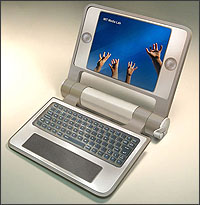 MIT has re-dubbed its $100 Laptop Project “One Laptop Per Child.” It’s probably a good sign that they’ve gotten children into the picture, but like many a program with sunny-sounding names and lofty goals, it may actually contain something less sweet. The hundred-dollar laptop is about bringing affordable computer technology to the developing world. But the focus so far has been almost entirely on the hardware, the packaging. Presumably what will fit into this fancy packaging is educational software, electronic textbooks and the like. But we aren’t hearing a whole lot about this. Nor are we hearing much about how teachers with little or no experience with computers will be able to make use of this powerful new tool.
The headlines tell of a revolution in the making: “Crank It Up: Design of $100 Laptop for the World’s Children Unveiled” or “Argentina Joins MIT’s Low-Cost Laptop Plan: Ministry of Education is ordering between 500,000 to 1 million.” Conspicuously absent are headlines like “Web-Based Curriculum in Development For Hundred Dollar Laptops” or “Argentine Teachers Go On Tech Tutorial Retreats, Discuss Pros and Cons of Technology in the Classroom.”

Help! Help! We’re sinking!
This emphasis on the package, on the shell, makes me think of the Container Store. Anyone who has ever shopped at the Container Store knows that it is devoted entirely to empty things. Shelves, bins, baskets, boxes, jars, tubs, and crates. Empty vessels to organize and contain all the bric-a-brac, the creeping piles of crap that we accumulate in our lives. Shopping there is a weirdly existential affair. Passing through aisles of hollow objects, your mind filling them with uses, needs, pressing abundances. The store’s slogan “contain yourself” speaks volumes about a culture in the advanced stages of consumption-induced distress. The whole store is a cry for help! Or maybe a sedative. There’s no question that the Container Store sells useful things, providing solutions to a problem we undoubtedly have. But that’s just the point. We had to create the problem first.
I worry that One Laptop Per Child is providing a solution where there isn’t a problem. Open up the Container Store in Malawi and people there would scratch their heads. Who has so much crap that they need an entire superstore devoted to selling containers? Of course, there is no shortage of problems in these parts of the world. One need not bother listing them. But the hundred-dollar laptop won’t seek to solve these problems directly. It’s focused instead on a much grander (and vaguer) challenge: to bridge the “digital divide.” The digital divide — that catch-all bogey, the defeat of which would solve every problem in its wake. But beware of cure-all tonics. Beware of hucksters pulling into the dusty frontier town with a shiny new box promising to end all woe.
A more devastating analogy was recently drawn between MIT’s hundred dollar laptops and pharmaceutical companies peddling baby formula to the developing world, a move that has made the industries billions while spreading malnutrition and starvation.
Breastfeeding not only provides nutrition, but also provides immunity to the babies. Of course, for a baby whose mother cannot produce milk, formula is better than starvation. But often the mothers stop producing milk only after getting started on formula. The initial amount is given free to the mothers in the poor parts of the world and they are told that formula is much much better than breast milk. So when the free amount is over and the mother is no longer lactating, the formula has to be bought. Since it is expensive, soon the formula is severely diluted until the infant is receiving practically no nutrition and is slowly starving to death.
…Babies are important when it comes to profits for the peddlers of formula. But there are only so many babies in the developed world. For real profit, they have to tap into the babies of the under-developed world. All with the best of intentions, of course: to help the babies of the poor parts of the world because there is a “formula divide.” Why should only the rich “gain” from the wonderful benefits of baby formula?
Which brings us back to laptops:
Hundreds of millions of dollars which could have been more useful in providing primary education would instead end up in the pockets of hardware manufacturers and software giants. Sure a few children will become computer-savvy, but the cost of this will be borne by the millions of children who will suffer from a lack of education.
Ethan Zuckerman, a passionate advocate for bringing technology to the margins, was recently able to corner hundred-dollar laptop project director Nicholas Negroponte for a couple of hours and got some details on what is going on. He talks at great length here about the design of the laptop itself, from the monitor to the hand crank to the rubber gasket rim, and further down he touches briefly on some of the software being developed for it, including Alan Kay’s Squeak environment, which allows children to build their own electronic toys and games.
The open source movement is behind One Laptop Per Child in a big way, and with them comes the belief that if you give the kids tools, they will teach themselves and grope their way to success. It’s a lovely thought, and may prove true in some instances. But nothing can substitute for a good teacher. Or a good text. It’s easy to think dreamy thoughts about technology emptied of content — ready, like those aisles of containers, drawers and crates, to be filled with our hopes and anxieties, to be filled with little brown hands reaching for the stars. But that’s too easy. And more than a little dangerous.
Dropping cheap, well-designed laptops into disadvantaged classrooms around the world may make a lot of money for the manufacturers and earn brownie points for governments. And it’s a great feel-good story for everyone in the thousand-dollar laptop West. But it could make a mess on the ground.
ebr is back

ebr is back after a several month hiatus during which time it was overhauled. The site, published by AltX was among the first places where the “technorati meets the literati” and I always found it attractive for its emphasis on sustained analysis of digital artifacts and the occasional pop culture reference. The latest project, first person series, seems to answer a lot of what bob finds attractive in the blogs of juan cole and others. And although I’ve heard ebr called “too linear” (as compared to Vectors, USC’s e-journal) the interface goes a long way toward solving the problem of the scrolling feature of many sites/blogs which privilege what’s new. The interweaving threads with search capabilities seem quite hearty.
pages á la carte
The New York Times reports on programs being developed by both Amazon and Google that would allow readers to purchase online access to specific sections of books — say, a single recipe from a cookbook, an individual chapter from a how-to manual, or a particular short story or poem from an anthology. Such a system would effectively “unbind” books into modular units that consumers patch into their online reading, just as iTunes blew apart the integrity of the album and made digital music all about playlists. We become scrapbook artists.
It seems Random House is in on this too, developing a micropayment model and consulting closely with the two internet giants. Pages would sell for anywhere between five and 25 cents each.
google print’s not-so-public domain
 Google’s first batch of public domain book scans is now online, representing a smattering of classics and curiosities from the collections of libraries participating in Google Print. Essentially snapshots of books, they’re not particularly comfortable to read, but they are keyword-searchable and, since no copyright applies, fully accessible.
The problem is, there really isn’t all that much there. Google’s gotten a lot of bad press for its supposedly cavalier attitude toward copyright, but spend a few minutes browsing Google Print and you’ll see just how publisher-centric the whole affair is. The idea of a text being in the public domain really doesn’t amount to much if you’re only talking about antique manuscripts, and these are the only books that they’ve made fully accessible. Daisy Miller‘s copyright expired long ago but, with the exception of Harvard’s illustrated 1892 copy, all the available scanned editions are owned by modern publishers and are therefore only snippeted. This is not an online library, it’s a marketing program. Google Print will undeniably have its uses, but we shouldn’t confuse it with a library.
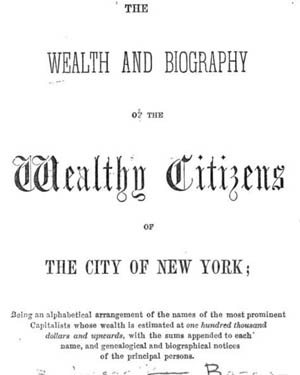
(An interesting offering from the stacks of the New York Public Library is this mid-19th century biographic registry of the wealthy burghers of New York: “Capitalists whose wealth is estimated at one hundred thousand dollars and upwards…”)
electronic literature collection – call for works
The Electronic Literature Organization seeks submissions for the first Electronic Literature Collection. We invite the submission of literary works that take advantage of the capabilities and contexts provided by the computer. Works will be accepted until January 31, 2006. Up to three works per author will be considered.
The Electronic Literature Collection will be an annual publication of current and older electronic literature in a form suitable for individual, public library, and classroom use. The publication will be made available both online, where it will be available for download for free, and as a packaged, cross-platform CD-ROM, in a case appropriate for library processing, marking, and distribution. The contents of the Collection will be offered under a Creative Commons license so that libraries and educational institutions will be allowed to duplicate and install works and individuals will be free to share the disc with others.
The editorial collective for the first volume of the Electronic Literature Collection, to be published in 2006, is:
N. Katherine Hayles
Nick Montfort
Scott Rettberg
Stephanie Strickland
Go here for full submission guidelines.
wikipedia hard copy
Believe it or not, they’re printing out Wikipedia, or rather, sections of it. Books for the developing world. Funny that just days ago Gary remarked:
“A Better Wikipedia will require a print version…. A print version would, for better or worse, establish Wikipedia as a cosmology of information and as a work presenting a state of knowledge.”
Prescient.
the creeping (digital) death of fair use
Meant to post about this last week but it got lost in the shuffle… In case anyone missed it, Tarleton Gillespie of Cornell has published a good piece in Inside Higher Ed about how sneaky settings in course management software are effectively eating away at fair use rights in the academy. Public debate tends to focus on the music and movie industries and the ever more fiendish anti-piracy restrictions they build into their products (the latest being the horrendous “analog hole”). But a similar thing is going on in education and it is decidely under-discussed.
Gillespie draws our attention to the “Copyright Permissions Building Block,” a new add-on for the Blackboard course management platform that automatically obtains copyright clearances for any materials a teacher puts into the system. It’s billed as a time-saver, a friendly chauffeur to guide you through the confounding back alleys of copyright.
But is it necessary? Gillespie, for one, is concerned that this streamlining mechanism encourages permission-seeking that isn’t really required, that teachers should just invoke fair use. To be sure, a good many instructors never bother with permissions anyway, but if they stop to think about it, they probably feel that they are doing something wrong. Blackboard, by sneakily making permissions-seeking the default, plays to this misplaced guilt, lulling teachers away from awareness of their essential rights. It’s a disturbing trend, since a right not sufficiently excercised is likely to wither away.
Fair use is what oxygenates the bloodstream of education, allowing ideas to be ideas, not commodities. Universities, and their primary fair use organs, libraries, shouldn’t be subjected to the same extortionist policies of the mainstream copyright regime, which, like some corrupt local construction authority, requires dozens of permits to set up a simple grocery store. Fair use was written explicitly into law in 1976 to guarantee protection. But the market tends to find a way, and code is its latest, and most insidious, weapon.
Amazingly, few academics are speaking out. John Holbo, writing on The Valve, wonders:
Why aren’t academics – in the humanities in particular – more exercised by recent developments in copyright law? Specifically, why aren’t they outraged by the prospect of indefinite copyright extension?…
…It seems to me odd, not because overextended copyright is the most pressing issue in 2005 but because it seems like a social/cultural/political/economic issue that recommends itself as well suited to be taken up by academics – starting with the fact that it is right here on their professional doorstep…
Most obviously on the doorstep is Google, currently mired in legal unpleasantness for its book-scanning ambitions and the controversial interpretation of fair use that undergirds them. Why aren’t the universities making a clearer statement about this? In defense? In concern? Soon, when search engines move in earnest into video and sound, the shit will really hit the fan. The academy should be preparing for this, staking out ground for the healthy development of multimedia scholarship and literature that necessitates quotation from other “texts” such as film, television and music, and for which these searchable archives will be an essential resource.
Fair use seems to be shrinking at just the moment it should be expanding, yet few are speaking out.
ted nelson & the ideologies of documents
I. Nelson’s criticism
Ted Nelson (introduced last week by Ben) is a lonely revolutionary marching a lonely march, and whenever he’s in the news mockery is heard. Some of this is with good reason: nobody’s willing to dismantle the Internet we have for his improved version of the Internet (which doesn’t quite work yet). You don’t have to poke around too long on his website to find things that reek of crackpottery. But the problems that Nelson has identified in the electronic world are real, even if the solutions he’s proposing prove to be untenable. I’d like to expand on on one particular aspect of Nelson’s thought prominent in his latest missive: his ideas about the inherent ideologies of document formats. While this sounds very blue sky, I think his ideas do have some repercussions for what we’re doing at the Institute, and it’s worth investigating them, if not necessarily buying off on Xanadu.
Nelson starts from the position that attempting to simulate paper with computers is a mistaken idea. (He’s not talking about e-ink & the idea of electronic paper, though a related criticism could be made of that: e-ink by itself won’t solve the problem of reading on screens.) This is correct: we could do many more things with virtual space than we can with a static page. Look at this Flash demonstration of Jef Raskin’s proposed zooming interface (previously discussed here), for example. But we don’t usually go that far because we tend to think of electronic space in terms of the technology that preceded it – paper space. This has carried over into the way in which we structure documents for online reading.
There are two major types of electronic documents online. In one, the debt to paper space is explicit: PDFs, one of the major formats currently used for electronic books, are a compressed version of Postscript, a specification designed to tell a printer exactly what should be on a printed page. While a PDF has more functionality than a printed page – you can search it, for example, and if you’re tricky you can embed hyperlinks and tables of content in them – it’s built on the same paradigm. A PDF is also like a printed page in that it’s a finalized product: while content in a PDF can be written over with annotations, it’s difficult to make substantial changes to it. A PDF is designed to be an electronic reproduction of the printed page. More functionality has been welded on to it by Adobe, who created the format, but it is, at its heart attempting to maintain fidelity to the printed page.
The other dominant paradigm is that of the markup language. A quick, not too technical introduction: a markup language is a way of encoding instructions for how a text is to be structured and formatted in the text. HTML is a markup language; so is XML. This web page is created in a markup language; if you look at it with the “View Source” option on your browser, you’ll see that it’s a text file divided up by a lot of HTML tags, which are specially designed to format web pages: putting <i> and </i> around a word, for example, makes it italic. XML is a broader concept than HTML: it’s a specification that allows people to create their own tags to do other things: some people are using their own version of XML to represent ebooks.
There’s a lot of excitement about XML – it’s a technology that can be (and is)bent to many different uses. A huge percentage of the system files on your computer, for example, probably use some flavor of XML, even if you’ve never thought of composing an XML documents. Nelson’s point, however, is that there’s a central premise to all XML: that all information can be divided up into a logical hierarchy – an outline, if you will. A lot of documents do work this way: book is divided into chapters; a chapter is divided into paragraphs; paragraphs are divided into words. A newspaper is divided into stories; each story has a headline and body copy; the body copy is divided into paragraphs; a paragraph is divided into sentences; a sentence is divided into words; and words are divided into letters, the atom of the markup universe.
II. A Victorian example
But while this is the dominant way we arrange information, this isn’t necessarily a natural way to arrange things, Nelson points out, or the only way. It’s one way of many possible ones. Consider this spread of pages (double-click to enlarge them):

This is a title page from a book printed by William Morris, another self-identified humanist. We mostly think of William Morris (when we’re not confusing him with the talent agency) as a source of wallpaper, but his work as a book designer can’t be overvalued. The book was printed in 1893; it’s entitled The Tale of King Florus and the Fair Jehane. Like all of Morris’s books, it’s sumptuous to the point of being unreadable: Morris was dead set on bringing beauty back into design’s balance of aesthetics & utility, and maybe over-corrected to offset the Victorian fixation on the latter.
I offer this spread of pages as an example because the elements that make up the page don’t break down easily into hierarchical units. Let’s imagine that we wanted to come up with an outline for what’s on these pages – let’s consider how we would structure them if we wanted to represent them in XML. I’m not interested in how we could represent this on the Web or somewhere else – it’s easy enough to do that as an image. I’m more interested in how we would make something like this if we were starting from scratch & wanted to emulate Morris’s type and woodcuts – a more theoretical proposition.
First, we can look at the elements that comprise the page. We can tell each page is individually important. Each page has a text box, with decorative grapevines around the text box; inside the text box, the title gets its own page; on the second page, there’s the title repeated, followed by two body paragraphs, separated by a fleuron. The first paragraph gets an illustrated dropcap. Each word, if you want to go down that far, is composed of letters.
But if you look closer, you’ll find that the elements on the page don’t decompose into categories quite so neatly. If you look at the left-hand page, you can see that the title’s not all there – this is the second title page in the book. The title isn’t part of the page – as would almost certainly be assumed under XML – rather, they’re overlapping units. And the page backgrounds aren’t mirror images of each other: each has been created uniquely. Look at the title at the top of the right-hand page: it’s followed by seven fleurons because it takes seven of them to nicely fill the space. Everything here’s been minutely adjusted by hand. Notice the characters in the title on the right and how they interact with the flourishes around them: the two A’s are different, as are the two F’s, the two N’s, the two R’s, the two E’s. You couldn’t replicate this lettering with a font. You can’t really build a schema to represent what’s on these two pages. A further argument: to make this spread of pages rigorous, as you’d have to to represent it in XML, would be to ruin them aesthetically. The vines are the way they are because the letters are the way they are: they’ve been created together.
The inability of XML to adequately handle what’s shown on these pages isn’t a function of the screen environment. It’s a function of the way we build electronic documents right now. Morris could build pages this way because he didn’t have to answer to the particular restraints we do now.
III. The ideologies of documents
Let’s go back to Ted:
Nearly every form of electronic document- Word, Acrobat, HTML, XML- represents some business or ideological agenda. Many believe Word and Acrobat are out to entrap users; HTML and XML enact a very limited kind of hypertext with great internal complexity. All imitate paper and (internally) hierarchy.
For years, hierarchy simulation and paper simulation have been imposed throughout the computer world and the world of electronic documents. Falsely portrayed as necessitated by “technology,” these are really just the world-view of those who build software. I believe that for representing human documents and thought, which are parallel and interpenetrating– some like to say “intertwingled”– hierarchy and paper simulation are all wrong.
It’s possible to imagine software that would let us follow our fancy and create on the screen pages that look like William Morris’s – a tool that would let a designer make an electronic woodcut with ease. Certainly there are approximations. But the sort of tool I imagine doesn’t exist right now. This is the sort of tool we should have – there’s no reason not to have it already. Ted again:
I propose a different document agenda: I believe we need new electronic documents which are transparent, public, principled, and freed from the traditions of hierarchy and paper. In that case they can be far more powerful, with deep and rich new interconnections and properties- able to quote dynamically from other documents and buckle sideways to other documents, such as comments or successive versions; able to present third-party links; and much more.
Most urgently: if we have different document structures we can build a new copyright realm, where everything can be freely and legally quoted and remixed in any amount without negotiation.
Ben does a fine job of going into the ramifications of Nelson’s ideas about transclusion, which he proposes as a solution. I think it’s an interesting idea which will probably never be implemented on a grand scale because there’s not enough of an impetus to do so. But again: just because Nelson’s work is unpragmatic doesn’t mean that his critique is baseless.
I feel there’s something similar in the grandiosity of Nelson’s ideas and Morris’s beautiful but unreadable pages. William Morris wasn’t just a designer: he saw his program of arts and crafts (of which his books were a part) as a way to emphasize the beauty of individual creation as a course correction to the increasingly mechanized & dehumanized Victorian world. Walter Benjamin declares (in “The Author as Producer”) that there is “a difference between merely supplying a production apparatus and trying to change the production apparatus”. You don’t have to make books exactly like William Morris’s or implement Ted Nelson’s particular production apparatus to have your thinking changed by them. Morris, like Nelson, was trying to change the production apparatus because he saw that another world was possible.
And a postscript: as mentioned around here occasionally, the Institute’s in the process of creating new tools for electronic book-making. I’m in the process of writing up an introduction to Sophie (which will be posted soon) which does its best to justify the need for something new in an overcrowded world: Nelson’s statement neatly dovetailed with my own thinking on the subject on why we need something new: so that we have the opportunity to make things in other ways. Sophie won’t be quite as radical as Nelson’s vision, but we will have something out next year. It would be nice if Nelson could do the same.