
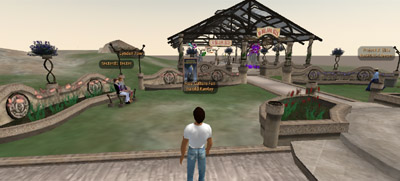
Last week, Bob mentioned that Larry Lessig, law profressor and intellectual property scholar, was being interviewed in Second Life, the virtual world created by Linden Lab. Having heard a lot of Second Life before, I was pleased to have a reason and opportunity to create an account and explore it. Basically I quickly learned that it’s Metaverse, as described in Neil Stephenson’s Snowcrash, in operation today, and I’m now a part of it too.
I already covered the actual interview. Here are a few observations from my introduction to SL.
Second Life is a humbling place, especially for beginners. Everything ,even the simplest things, must be relearned. It took me 5 minutes to learn how to sit down, another 5 minutes to read something, and on and on. Traveling to the site of Lessig event was an even more daunting task. I was given the location of this event, a name and coordinates, without any idea of what to do with them. Second Life is a vast space, and it wasn’t clear to me how to get from one point to another. I had no idea how to travel in SL, and had to ask around someone.
I presume it is evident that I’m very new to SL, by my constant trampling over people and inanimate objects. So, I continue walking into trees and rocks until I come across someone whose title contains “Mentor,” and figure that this is a good person to ask for help. Not knowing how to strike up a private conversation, I start talking out loud, not even sure if anyone is even going to pay attention.
(I will come to learn that you travel from place to place via teleportation.)
“Hi.”
“Hi Harold.”
I am relieved to discover that people are basically nice in SL, maybe even nicer than in New York. This fellow avatar is happy to chat and answer questions. Second List has a feature called “Friends” which operates like Buddies in Instant Messaging. However, I’m not sure what the social protocol for making friends is, so I make no assumptions. As I was typing “can we be friends?” I sigh with the realization that I am, in fact, back in fourth grade.
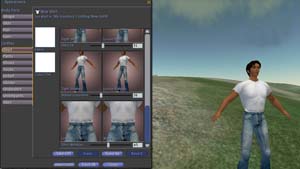 People around me have much more sophisticated outfits than I do. So, I try out the free clothing features. I darken my pants to a deep blue and my shoes black. Then, my default shirt gets turned into a loose white t-shirt. Somehow I end up a bit like a GAP model crossed with Max Headroom. After making my first “friend,” another complete stranger comes up to me and just starts giving me clothes. Apparently, my clothes still need a little work. I try on the cowboy boots and faded jeans. Happy that I’ve moved beyond the standard issue clothes, I thank my benefactor and begin to make my way to the event.
The builders of Second Life force people to rely on other people within the virtual world. However, assistance in the real world certainly helps too. Entering Second Life, the feeling of displacement is quite clear, as if I arrived to a new city in the real world with a single address, where I don’t know anyone or how to navigate the city. The virtual world often mimics the real world, but my surprise each time I learn this fact is still ongoing. It definitely helps to know people, both in where to go that’s interesting and how to do things.
After teleporting to the event, I found myself around people who had common interests, which was great and similar to attending a lecture in the real world. At different times, I struck up a conversation with an avatar who is a publisher on the West Coast and then talked to an academic who runs a media center. In both cases, I was talking to the person literally “next” to me.
When I first heard about the interview, I learned at there was limited spacing. Which seemed strange to me, as it was taking place in a viritual space. When I arrived at the event place, I saw the ampitheater with video screens, that would show a live web stream of Lessig. The limited seating made more sense, seeing the seat of the theater. I also believe that the SL servers also have a finite capacity for the number of people to be located within a small area, because movement was jerky around concentrated groups of people. I guess I’ll have to wait for the Second Life Woodstock.
The space was crowded with people walking around, chatting, and getting up their free digital copy of Lessig’s book, “Free Culture.” (I’ve included a picture of me reading Free Culture in Second Life. You can actually read the text.) 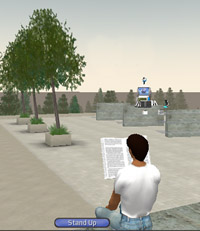 The interview is about to begin, as an avatar with large red wings walks by me. I say out loud, “I know she was going to sit in front of me.” Adding, “Just kidding,” in case I might be offending someone, who knows who this person could be. Fortunately, she found a seat outside my sight line without incident, and the introductory remarks began.
There was a strange duality where I had to both learn what was being said, but also how to navigate the environment of a lecture as well. The interview proceeds within the social norms of a lecture. People are mostly quiet, clap and for the moderator runs the question and answer session. Afterwards, I line up to get Lessig to “sign” my virtual book at the virtual booksigning, as in my virtual public event. I finally stumble my way through the line, all the while asking many question on what I’m supposed to do. With my signed book in hand, I look at the sky, which is quite dark. I log out and return to the real world.
wikipedia as civic duty
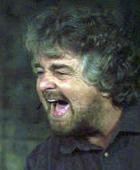 Number 14 on Technorati’s listings of the most popular blogs is Beppe Grillo. Who’s Beppe Grillo? He’s an immensely popular Italian political satirist, roughly the Italian Jon Stewart. Grillo has been hellbent on exposing corruption in the political system there, and has emerged as a major force in the ongoing elections there. While he happily and effectively skewers just about everybody involved in the Italian political process, Dario Fo, currently running for mayor of Milan under the refreshing slogan “I am not a moderate” manages to receive Grillo’s endorsement.
Grillo’s use of new media makes sense: he has effectively been banned from Italian television. While he performs around the country, his blog – which is also offered in English just as deadpan and full of bold-faced phrases as the Italian – has become one of his major vehicles. It’s proven astonishingly popular, as his Technorati ranking reveals.
His latest post (in English or Italian) is particularly interesting. (It’s also drawn a great deal of debate: note the 1044 comments – at this writing – on the Italian version.) Grillo’s been pushing the Wikipedia for a while; here, he suggests to his public that they should, in the name of transparency, have a go at revising the Wikipedia entry on Silvio Berlusconi.
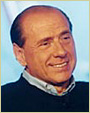 Berlusconi is an apt target. He is, of course, the right-wing prime minister of Italy as well as its richest citizen, and at one point or another, he’s had his fingers in a lot of pies of dubious legality. In the five years that he’s been in power, he’s been systematically rewriting Italian laws standing in his way – laws against, for example, media monopolies. Berlusconi effectively controls most Italian television: it’s a fair guess that he has something to do with Grillo’s ban from Italian television. Indirectly, he’s probably responsible for Grillo turning to new media: Berlusconi doesn’t yet own the internet.
Or the Wikipedia. Grillo brilliantly posits the editing of the Wikipedia as a civic duty. This is consonant with Grillo’s general attitude: he’s also been advocating environmental responsibility, for example. The public editing Berlusconi’s biography seems apt: famously, during the 2001 election, Berlusconi sent out a 200-page biography to every mailbox in Italy which breathlessly chronicled his rise from a singer on cruise ships to the owner of most of Italy. This vanity press biography presented itself as being neutral and objective. Grillo doesn’t buy it: history, he argues, should be written and rewritten by the masses. While Wikipedia claims to strive for a neutral point of view, its real value lies in its capacity to be rewritten by anyone.
How has Grillo’s suggestion played out? Wikipedia has evidently been swamped by “BeppeGrillati” attempting to modify Berlusconi’s biography. The Italian Wikipedia has declared “una edit war” and put a temporary lock on editing the page. From an administrative point of view, this seems understandable; for what it’s worth, there’s a similar, if less stringent, stricture on the English page for Mr. Bush. But this can’t help but feel like a betrayal of Wikipedia’s principals. Editing the Wikipedia should be a civic duty.
X_Reloaded.
 This is a bilingual (English/Spanish) post. Spanish version can be found lower down.
Santofile, uses “meme” to allude to creative freedom in the digital world. Meme is mimesis and is self-generating. It refers to mediation in the sense of remix and appropriation, to the mixing of works that circulate in the Internet in order to produce an original piece. Among Santofile’s projects is X_Reloaded, an interpretation of the first chapter of Don Quixote, compiled from disparate works inspired by the fourth centennial of its publication.
They put together such diverse creators as William Burroughs and Adbusters, whose common context is precisely the idea of busting. Busting decontextualizes a piece (work of art, advertisement, text) causing it to lose its character as a static icon by giving it a new life inside a new context.
To choose Don Quixote as the text for X_Reloaded, is an allusion to the concept of remix per excellence. Cervantes appropriated chivalry novels with the intention to subvert the genre, and his final remix, decontextualized, is a unique and original work. Printing itself in Cervantes’ times required a highly legible copy, which wasn’t necessarily the original manuscript. Thus, the “original” was a copy made by one or more amanuenses. And from this “original” corrected by the author, a sort of predecessor of proofreading, the book was put together by the typesetter, with its consequent errata. It is interesting to note that the Spanish Royal Academy’s edition of Don Quixote, that celebrates its fourth centennial, claims to be based on about a hundred editions, old and new. If this is not remix, what is?
Cervantes himself is absolutely aware of what he is doing, and of the subversive
character of his action. When Don Quixote reads, we don’t know who is the madman, him or the one who wrote this:
The reason of the unreason with which my reason is afflicted so weakens my reason that with reason I murmur at your beauty.
Don Quixote changed forever the way novels were written, and three centuries later, Borges’ “Pierre Menard, author of Don Quixote” would change forever the way one reads. Pierre Menard writes Don Quixote without ceasing to be Pierre Menard, demonstrating how it is possible to transform a text without altering a single word. Decontextualization was inaugurated.
Following that tradition, X_Loaded presents us jodi’s map, images like, Olia Lialina’s, the conceptual text of Jennny Holzer, or Rosa Llop’s windmills.
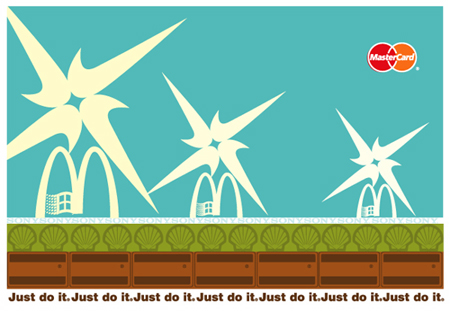
With her windmills we have to say with Don Quixote, they are indeed giants.
X_Reloaded en español.
Santofile, usa el concepto de meme para aludir a libertad de creación en el mundo digital. Meme es mimesis y es autogenerador. Se refiere a mediación, en el sentido de remix, de mezclar apropiándose de trabajos de otros, generalmente trabajo digital que circula por la red, para a la vez producir una nueva obra original. Entre sus proyectos está X_Reloaded una interpretación del capítulo primero de El Quijote, que recoge obras dispares inspiradas por el cuarto centenario de su publicación.,
 Se reunen creadores tan disímiles como William Burroughs y Adbusters, cuyo contexto comun sería precisamente la idea de romper, de volver trizas, que está en el seno mismo del verbo “to bust”. Al descontextualizar lo que se quiere romper, se le roba permanencia como ícono estático y se le confiere nueva vida dentro de un nuevo contexto.
El escoger precisamente El Quijote como texto para X_Reloaded, es aludir al remix por excelencia. Cervantes se apropia de las novelas de caballería para subvertir el génro, y su remix final, al descontextualizarlas, es una obra unica y original. La impresión misma del texto en tiempos de Cervantes, requería de una copia altamente legible, lo que no necesariamente era el manuscrito original. De ahí que el “original” eran una copia hecha por uno o más amanuenses. Y de ese “original”corregido por el autor, salía el libro, armado por el cajista, con sus consiguientes errores. Es interesante notar que la edición de la Real Academia Española, con motivo del cuarto centenario de El Quijote, es un “texto crítico de la obra constituido sobre la consulta de cerca de un centenar de ediciones antiguas y modernas”. Si esto no es remix, ¿qué es?
Cervantes mismo es absolutamente consciente de lo que está haciendo, y del carácter subversivo de su acción. Cuando Don Qujiote lee no sabemos si es él el loco, o el que escribió esto:
La razón de la sinrazón que a mi razón se hace, de tal manera mi razón enflaquece, que con razón me quejo de la vuestra fermosura
El Quijote va a cambiar para siempre la manera como se escribe y tres siglos más tarde, “Pierre Menard autor del Quijote” de Borges, va a cambiar la manera como se lee. Pierre Menard escribe El Quijote sin dejar de ser Pierre Menard, demostrando cómo se transforma un texto sin cambiarlo, inaugurando la descontextualización.
Siguiendo esta tradición, X_Loaded nos presenta el mapa de jodi, imágenes como la de, Olia Lialina’, el texto conceptual de Jennny Holzer, o los molinos de viento de Rosa Llop’. Y con ellos, tenemos que decir con Don Quijote, los molinos son en verdad gigantes. Rosa Llop. Y con ellos, tenemos que decir con Don Quijote, los molinos son en verdad gigantes.
fair use and the networked book
I just finished reading the Brennan Center for Justice’s report on fair use. This public policy report was funded in part by the Free Expression Policy Project and describes, in frightening detail, the state of public knowledge regarding fair use today. The problem is that the legal definition of fair use is hard to pin down. Here are the four factors that the courts use to determine fair use:
- the purpose and character of the use, including whether such use is of a commercial nature or is for nonprofit educational purposes;
- the nature of the copyrighted work;
- the amount and substantiality of the portion used in relation to the copyrighted work as a whole; and
- the effect of the use upon the potential market for or value of the copyrighted work.

From Dysfunctional Family Circus, a parody of the Family Circus cartoons. Find more details at illegal-art.org
Unfortunately, these criteria are open to interpretation at every turn, and have provided little with which to predict any judicial ruling on fair use. In a lawsuit, no one is sure of the outcome of their claim. This causes confusion and fear for individuals and publishers, academics and their institutions. In many cases where there is a clear fair use argument, the target of copyright infringement action (cease and desist, lawsuit) does not challenge the decision, usually for financial reasons. It’s just as clear that copyright owners pursue the protection of copyright incorrectly, with plenty of misapprehension about what qualifies for fair use. The current copyright law, as it has been written and upheld, is fraught with opportunities for mistakes by both parties, which has led to an underutilization of cultural assets for critical, educational, or artistic purposes. For the next two days, Ray and I are attending what hopes to be a fascinating conference in Cambridge, MA — The Economics of Open Content — co-hosted by Intelligent Television and MIT Open CourseWare. This project is a systematic study of why and how it makes sense for commercial companies and noncommercial institutions active in culture, education, and media to make certain materials widely available for free–and also how free services are morphing into commercial companies while retaining their peer-to-peer quality. They’ve assembled an excellent cross-section of people from the emerging open access movement, business, law, the academy, the tech sector and from virtually every media industry to address one of the most important (and counter-intuitive) questions of our age: how do you make money by giving things away for free? (this is a follow-up to ben’s recent post “the book is reading you.”
Lawrence Lessig: Because as life moves online we should have the SAME FREEDOMS (at least) that we had in real life. There’s no doubt that in real life you could act out a movie or a different ending to a movie. There’s no doubt that would have been “free” of copyright in real life. But as we move online things that were before were free now are regulated.
Yesterday, Bob made the point that our memories increasingly exist outside of ourselves. At the institute, we have discussed the mediated life, and a substantial part of that mediation occurs as we continue to digitize more parts of our lives, from photo albums to diaries. Things we once created in the physical world now reside on the network, which means that it is being published. Photo albums documenting our trips to Disneyland or the Space Needle (whose facade is trademarked and protected) that one rested within the home, are uploaded to flickr, potentially accessible to anyone browsing the Internet, a regulated space. This regulation has enormous influence on the creative outlets of everyone, not just professionals. Without trying to sound overly naive, my concern is not just that speech and discourse of all people are being compromised. As companies become more litigious towards copyright infringement (especially when their arguments are weak), the safe guards of the courts and legislation are not protecting its constituents.
Lawrence Lessig: Copyright is about creating incentives. Incentives are prospective. No matter what even the US Congress does, it will not give Elvis any more incentive to create in 1954. So whatever the length of copyright should be prospectively, we know it can make no sense of incentives to extend the term for work that is already created.
The increasing accessibility of digital technology allows people to become creators and distributors of content. Lessig notes that with each year, the increasing evidence from cases such as the Google Book Search controversy show the inadequacy of current copyright legislation. Further, he insightfully suggests to learn from the creations that young people produce such as anime music videos. Their completely different approach to intellectual property informs the cultural shift that is running counter to the legal status quo. Lessig suggest that these creative works have the potential to inform policy makers that these attitudes are moving toward the original intentions of copyright law. Then, policy makers hopefully may begin to question why these works are currently considered illegal. I just noticed that Google Book Search requires users to be logged in on a Google account to view pages of copyrighted works. Why do I have to log in to see certain pages? So they’re tracking how much we’ve looked at and capping our number of page views. Presumably a bone tossed to publishers, who I’m sure will continue suing Google all the same (more on this here). There’s also the possibility that publishers have requested information on who’s looking at their books — geographical breakdowns and stats on click-throughs to retailers and libraries. I doubt, though, that Google would share this sort of user data. Substantial privacy issues aside, that’s valuable information they want to keep for themselves. A couple of interesting items: Larry Sanger posted this comment to if:book’s recent Digital Universe and expert review post. In the second paragraph Sanger suggests that experts should not have to constantly prove the value of their expertise. We think this is a crucial question. What do you think?
This restrictive atmosphere is even more prevalent in the film and music industries. The RIAA lawsuits are a well-known example of the industry protecting its assets via heavy-handed lawsuits. The culture of shared use in the movie industry is even more stifling. This combination of aggressive control by the studio and equally aggressive piracy is causing a legislative backlash that favors copyright holders at the expense of consumer value. The Brennan report points to several examples where the erosion of fair use has limited the ability of scholars and critics to comment on these audio/visual materials, even though they are part of the landscape of our culture.
That’s why
This entry was posted in brennan_center, copyright, Copyright and Copyleft, creative_commons, fair_use, law, open_content and tagged fair_use copyright brennan_center creative_commons open_content law on .
the economics of open content
Rather than continue, in an age of information abundance, to embrace economic models predicated on information scarcity, we need to look ahead to new models for sustainability and creative production. I look forward to hearing from some of the visionaries gathered in this room.
More to come…
cheney and google
i rarely read Maureen Dowd but the headline of her column in today’s New York Times, “Googling past the Graveyard,” caught my attention. Dowd calls Dick Cheney on the carpet for asking Google to release the search records of U.S. citizens. while i’m horrified that the govt. would even consider asking for such information, i’m concerned that the way this particular issue is playing out, Google is being portrayed as the poor beleaguered neutral entity caught between an over-reaching bureaucracy and its citizens. Cheney will expire eventually. in the meantime Google will collect even more data. Google is a very big corporation, who’s power will grow over time. in the long run, why aren’t people outraged that this information is in Google’s hands in the first place. shouldn’t we be?
lessig in second life
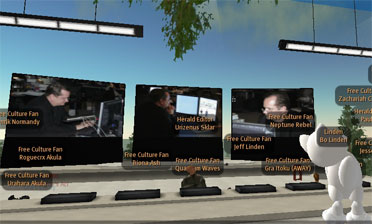
Wednesday evening, I attended an interview with Larry Lessig, which took place in the virtual world of Second Life. New World Notes announced the event and is posting coverage and transcripts of the interview. As it was my first experience in SL, I will post more on the experience of attending an interview/ lecture in a virtual space. For now, I am going to comment upon two quotes that Lessig covered as it relates to our work at the institute.
The courts’ failure to clearly define an interpretation of fair use puts at risk the discourse that a functioning democracy requires. The stringent attitudes towards using copyrighted material goes against the spirit of the original intentions of the law. Although, it may not be a role of the government and the courts to actively encourage creativity. It is sad that bipartisan government actions and courts rulings actively discourage innovation and creativity.
the book is reading you
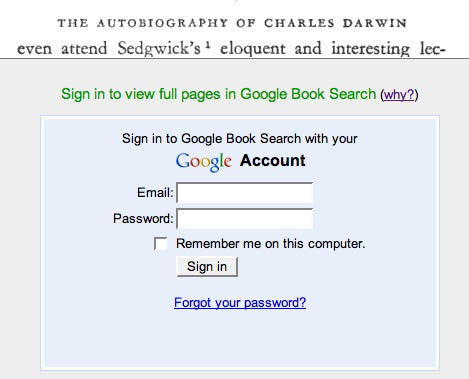
They provide the following explanation:
Because many of the books in Google Book Search are still under copyright, we limit the amount of a book that a user can see. In order to enforce these limits, we make some pages available only after you log in to an existing Google Account (such as a Gmail account) or create a new one. The aim of Google Book Search is to help you discover books, not read them cover to cover, so you may not be able to see every page you’re interested in.
That’s because “the aim of Google Book Search” is also to discover who you are. It’s capturing your clickstreams, analyzing what you’ve searched and the terms you’ve used to get there. The book is reading you. Substantial privacy issues aside, (it seems more and more that’s where we’ll be leaving them) Google will use this data to refine Google’s search algorithms and, who knows, might even develop some sort of personalized recommendation system similar to Amazon’s — you know, where the computer lists other titles that might interest you based on what you’ve read, bought or browsed in the past (a system that works only if you are logged in). It’s possible Google is thinking of Book Search as the cornerstone of a larger venture that could compete with Amazon.
There are many ways Google could eventually capitalize on its books database — that is, beyond the contextual advertising that is currently its main source of revenue. It might turn the scanned texts into readable editions, hammer out licensing agreements with publishers, and become the world’s biggest ebook store. It could start a print-on-demand service — a Xerox machine on steroids (and the return of Google Print?). It could work out deals with publishers to sell access to complete online editions — a searchable text to go along with the physical book — as Amazon announced it will do with its Upgrade service. Or it could start selling sections of books — individual pages, chapters etc. — as Amazon has also planned to do with its Pages program.
Amazon has long served as a valuable research tool for books in print, so much so that some university library systems are now emulating it. Recent additions to the Search Inside the Book program such as concordances, interlinked citations, and statistically improbable phrases (where distinctive terms in the book act as machine-generated tags) are especially fun to play with. Although first and foremost a retailer, Amazon feels more and more like a search system every day (and its A9 engine, though seemingly always on the back burner, is also developing some interesting features). On the flip side Google, though a search system, could start feeling more like a retailer. In either case, you’ll have to log in first.
more grist for the “pipes” debate
Larry Lessig wrote an excellent post last week debunking certain myths circulating the “to regulate or not to regulate” debate in Washington, namely that introducing “net neutrality” provisions in the new Telecom bill would impose unprecedented “common carriage” regulation on network infrastructure. Of course, the infrastructure was regulated before — when the net was accessed primarily through phone lines. Lessig asks: if an unregulated market is so good for the consumer, then why is broadband service in this country so slow and so expensive?
Also worth noting is a rough sketch from internet entrepreneur Mark Cuban of the idea of “tiered” network service. This would entail prioritizing certain uses of bandwidth. For example, your grandma’s web-delivered medical diagnostics would be prioritized over the teenager downloading music videos next door (if, that is, someone shells out for the priority service). This envisions for the consumer end what cable and telephone execs have dreamed of on the client end — i.e. charging certain web services more for faster page loads and speedier content delivery. Seems to me that either scenario would make the U.S. internet more like the U.S. healthcare system: abysmal except for those with cash.
who do you trust?
“In its first year or two it was very much not the case that Wikipedia “only looks at reputation that has been built up within Wikipedia.” We used to show respect to well-qualified people as soon as they showed up. In fact, it’s very sad that it has changed in that way, because that means that Wikipedia has become insular–and it has, too. (And in fact, I warned very specifically against this insularity. I knew it would rear its ugly head unless we worked against it.) Worse, Wikipedia’s notion of expertise depends on how well you work within that system–which has nothing whatsoever to do with how well you know a subject.
“That’s what expertise is, after all: knowing a lot about a subject. It seems that any project in which you have to “prove” that you know a lot about a subject, to people who don’t know a lot about the subject, will endlessly struggle to attract society’s knowledge leaders.”