
I want to tell you about one scene in a wonderful documentary, DOC, that just opened the Margaret Mead Film Festival at the Museum of Natural History in New York. Doc Humes was the founder of the Paris Review. Made by his daughter, Immy, the film follows Immy as she tries to uncover the layers of her father’s complex life. At one point she finds out that he made a feature film and she tries to find the footage. She gets a tip that Jonas Mekas may have a copy at Anthology Film Archives in the east village in New York. She goes to visit Mekas and takes her camera. Mekas takes her into the vast underground storeroom and points at row after row after row after row of film cans. The point of the shot is that looking for the film on these shelves — even if it were known to be here, which it isn’t — is a hopeless task. Nothing seems to be marked; there is no order. Rather than a salvation for the rich film culture that came out of NY in the 50s, 60s, and 70s, it seems that the Anthology Film Archive may become a graveyard.
Seeing this made me wonder about the decisions we make as a society about what to keep and what not to keep. There may be important film in those cans or there may not be. How do we decide whether to gather the resources to find out?
wiki book on networked business
Form will follow content in We Are Smarter Than Me, a book on social networks and business written by… a social network of business professors, students and professionals — on a wiki. They’re calling it a “network book”:
The central premise of We Are Smarter Than Me is that large groups of people (“We”) can, and should, take responsibility for traditional business functions that are currently performed by companies, industries and experts (“Me”).
[…]
A few books have recently been written on this topic, but they all fail to confront one central paradox. While they extol the power of communities, they were each written by only one person. We’re putting this paradox to the test by inviting hundreds of thousands of authors to contribute to this “network book” using today’s technologies.
The project is a collaboration between Wharton Business School, MIT Sloan School of Management and a company called Shared Insights. A print book will be published by Pearson in Fall ’07. The site reveals little about how the writing process will be organized, but it’s theoretically open to anyone. As of this writing, I see 983 members.
To get a sense of some of the legal strings that could enwrap future networked publishing deals, take a look at the terms of service for participating authors. You sign away most rights to your contributions, though you’re free to reproduce or rework them non-commercially under a CC license. All proceeds of the book will be given to a charity of the community’s collective choosing. And here’s an interesting new definition of the publisher: “community manager” and “provider of venues for interaction.”
new love meetings: “il primo film girato con un telefonino”
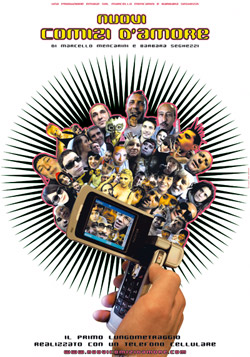 Leafing through my hardcopy of the September/October edition of Filmcomment, published by the Film Society of Lincoln Center, I came across a mini-review of “New Love Meetings,” co-directed by Marcello Mencarini and Barbara Seghezzi. First featured in The Guardian Unlimited, this story was newsworthy because this film is reportedly the first feature (93 minutes) entirely shot with a cell phone. “New Love Meetings” was filmed in MPEG4 format using a Nokia N90, and follows on Pasolini’s 1965 documentary “Love Meetings,” in which he interviewed Italian men and women about their views on sex in postwar Italy. Mencarini and Seghezzi used cell phones to interview about 700 people at regular meeting places such as bars, markets, the beach, etc.
Cell-phone short movies have become ubiquitous in the Internet, and they have achieved some visibility in film festivals, but Mencarini and Seghezzi’s premise is that even though they asked very much the same questions that Pasolini posed, the results of their film are marked by the medium they used to shoot it. The use of a cell phone, an instrument that belongs to people’s daily lives, produced an intimacy absent in Pasolini’s movie. In a way, the filmmakers were very much like normal people using their cell phones to preserve an instant. This leads people to be more spontaneous and open, making the dialogue more like a chat than an interview.
This technique underscores the fact that today, memories can be captured and disseminated instantly thanks to the nature of our networked world, and that the way we preserve them is not the realm of books, not even of traditional films. Memory is instant, intimacy is public, and we communicate more readily than ever before. People have used stone, scrolls, print, wax cylinders, film, and tape, to preserve and disseminate memories, “New Love Meetings” is yet another example of the permeability and plasticity of mediums within which we move today. We cannot apply traditional, orthodox aesthetic values to the hybrid products of the moment. Experimentation doesn’t follow a master plan.
two novels revisited
Near future science fiction is a reflexive art: the present embellished to the point of transformation that, in turn, influences how we envision, and eventually create our future. It is not accurate—far from it—but there is power in determining the vocabulary we use to discuss a future that seems possible, or even probable. I read Neal Stephenson’s Snow Crash in 2000 and thought it was a great read back then. I was twenty-five, the internet was tanking, but the online games were going strong and the Metaverse seemed so close. The Metaverse is an avatar inhabited digital world—the Internet on ‘roids—with extremely high levels of interactivity enabled by the combination of vast computing power, 3-D tracking gloves (think Minority Report), directional headphones, and wraparound goggles that project a fully immersive experience in front of your eyes. This is the technophilic dream: a place where physicality matters less than the ability to manipulate the code. If you control the code, you can make your avatar do just about anything.

Now, five years later, I’ve reread Snow Crash. It continues to be relevant. The depiction of a fractured, corporatized society and of the gulf between rich and poor are more true now than they were five years ago. But there is a special resonance with one idea in particular: the Metaverse. The Metaverse is what many people dream the Internet will eventually become. The Metaverse is, as much as anything, a place to hang out. It’s also a place to buy ‘space’ to build a house, a place for ads to be thrown at you while you are ‘goggled in,’ a place for people to trade information. In 2000, in reality, you would have a blog and chat with your friends on AIM. It didn’t have the same presence as an avatar in the Metaverse, where facial features can communicate as much information as the voice transmission. Even games, like Everquest, didn’t have the same culture as the Metaverse, because they were games, with goals and advancement based on game rules. But now we have Second Life. Second Life isn’t about that—it is a social place. No goals. See and be seen. Make your avatar look the way you want. Buy and build. Sell and produce your own digital culture. Share pictures. Share your life. This is closer to the Metaverse than ever, but I hope that doesn’t mean we’ll get corporate franchise burbclaves as well. Well, at least any more than there already are.

I also reread The Diamond Age. This is a story about society in the age of nanotech and the power of traditional values in an environment of post-materialism. When everything is possible through nanotech, humanity retreats to fortresses of bygone tradition to give life structure and meaning. In the post-nation-state society described in the book, humans live in “phyles,” groups of people with like thoughts and values bound together by will and rules of society. Phyles are separated from each other by geography, wealth, and status; phyle borders are vigorously protected by visible and invisible defenders. This separation of groups by ideology seems especially pertinent in light of the continuing divergence of political affiliation in the US. We live in a politically bifurcated society; it is not difficult to draw parallels between the Red state/Blue state distinction, and the phyles of New Atlantis, Hindustani, and the Celestial Kingdom.
The story focuses on a girl, Nell, and her book, A Young Lady’s Illustrated Primer. The Primer is her guide through a difficult and dangerous life. Her Primer is scientifically advanced enough that it would, if we had it today, appear to be magic. The Primer is aware of its surroundings, and aware of the girl’s position in the surroundings. It is capable of determining relationships and decorating them with the trappings of ‘story’. The Primer narrates the story using the voice of a distant actor, who is on call, connected through the media system (again, the Internet but so much more). The Primer answers any questions Nell asks, expounds and expands on any part of the story she is curious about until she fully satisfies her curiosity. It is a perpetually self-improving, self-generating networked storybook, with one important key: it requires a real human’s input to narrate the words that appear on the page. Without a human voice behind it, it doesn’t have enough emotion to hold a person’s interest. Even in a world of lighter than air buildings and nanosite generated islands, tech can’t figure out how to make a non-human voice convey delicate emotion.
There are common threads in the two novels that are crystal clear. Stephenson illluminates the near future with an ambivalent light. Society is fragile and prone to collapse. The network is likely to be monopolized and overrun with advertising. The social fabric, instead of being interwoven with multiethnic thread, will simply be a geographic patchwork of walled enclaves competing with each other. Corporations (minus governments) will be the ultimate rulers of the world—not just the economic part of it, but the cultural part as well. This is a future I don’t want to live in. And here is where Stephenson is doing us a service: by writing the narrative that leads to this future, he is giving us signs so that we can work against its development. Ultimately, his novels are about the power of human will to work through and above technology to forge meaning and relationships. And that’s a lesson that will always be relevant.
a dictionary in transition
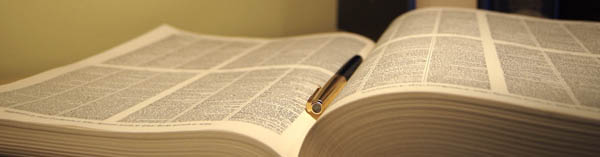
James Gleick had a fascinating piece in the Times Sunday magazine on how the Oxford English Dictionary is reinventing itself in the digital age. The O.E.D. has always had to keep up with a rapidly evolving English language. It took over 60 years and two major supplements to arrive at a second edition in 1989, around the same time Tim Berners-Lee and others at the CERN particle physics lab in Switzerland were creating up with the world wide web. Ever since then, the O.E.D. been hard at work on a third edition but under radically different conditions. Now not only the language but the forms in which the language is transmitted are in an extreme state of flux:
In its early days, the O.E.D. found words almost exclusively in books; it was a record of the formal written language. No longer. The language upon which the lexicographers eavesdrop is larger, wilder and more amorphous; it is a great, swirling, expanding cloud of messaging and speech: newspapers, magazines, pamphlets; menus and business memos; Internet news groups and chat-room conversations; and television and radio broadcasts.
Crucial to this massive language research program is a vast alphabet soup known as the Oxford English Corpus, a growing database of more than a billion words, culled mostly from the web, which O.E.D. lexicographers analyze through various programs that compare and contrast contemporary word usages in contexts ranging from novels and academic papers to teen chat rooms and fan sites. Together this data comprises what the O.E.D. calls “the fullest, most accurate picture of the language today” (I’m curious to know how broadly they survey the world’s general adoption of English. I’m under the impression that it’s still largely an Anglo-American affair).
Marshall McLuhan famously summarized the shift from oral tradition to the written word as “an eye for an ear”: a general migration of thought and expression away from the folkloric soundscapes of tribal society toward encounters by individuals with visual symbols on a page, a movement that climaxed in the age of print, and which McLuhan saw at last reversed in the global village of electronic mass media. The curious thing that McLuhan did not live long enough to witness was the fusion of eye-ear cultures in the fast-moving textual traditions of cell phones and the Internet. Written language has acquired an immediacy and a malleability almost matching oral speech, and the effect is a disorienting blurring of boundaries where writing is almost the same as speaking, reading more like overhearing.
So what is a dictionary to do? Or be? Such fundamental change in the process of maintaining “the definitive record of the English language” must have an effect on the product. Might the third “edition” be its final never-ending one? Gleick again:
No one can say for sure whether O.E.D.3 will ever be published in paper and ink. By the point of decision, not before 20 years or so, it will have doubled in size yet again. In the meantime, it is materializing before the world’s eyes, bit by bit, online. It is a thoroughgoing revision of the entire text. Whereas the second edition just added new words and new usages to the original entries, the current project is researching and revising from scratch — preserving the history but aiming at a more coherent whole.
They’ve even experimented with bringing readers into the process, working with the BBC earlier this year to solicit public aid in locating first usages for a list of particularly hard-to-trace words. One wonders how far they’d go in this direction. It’s one thing to let people contribute at the edges — the 50 words in that list are all from the 20th century — but to open the full source code is quite another. It seems the dictionary’s challenge is to remain a sturdy ark for the English language during this period of flood, and to proceed under the assumption that we may have seen the last of the land.
(image by Kenneth Moyle)
an encyclopedia in my pocket
A while back – last March – there was a great deal of excitement over Wikipodia, an open source project to install Wikipedia on an iPod. Wanting a portable Wikipedia, I installed Linux on my brand new video iPod, a necessary prerequisite, but was disappointed to discover that Wikipodia only worked on older iPods with smaller screens. I’ve waited for an update to Wikipodia since then, but the project seems to have gone dark. Probably Wikipodia wouldn’t have been an ideal solution anyway: it requires you to reboot your iPod into Linux whenever you want to look at Wikipedia. You could have an iPod to listen to music or a Wikipedia to read, but not both at the same time.
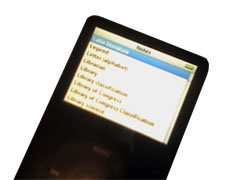 But a partial fulfillment for my desire to have a portable Wikipedia has come along: Matt Swann has posted a script that puts some of the Wikipedia on an iPod, in iPod Notes format. While it’s much simpler than installing a new operating system on your iPod, it’s still not for everybody – it requires using the OS X command line, although there’s an Automator-based version that’s a bit simpler. (PC versions would seem to be available as well, though I don’t know anything about them – check the comments here.) If you’re willing to take the plunge, you can feed the script a page from Wikipedia and it will start filling up your iPod Notes directory with that page and all the pages linked from it. I started from the entry for book; the script downloaded this, then it downloaded the entries for paper, parchment, page, and so on. When it finished those, it downloads all the pages linked from the linked pages, and it keeps doing this until it runs out of space: regardless of iPod size, you can only have 1000 notes in the Notes directory. This doesn’t meant that you get 1000 articles. Because each iPod note can only be 4 kb long, entries that are longer than 4000 characters are split into multiple notes; thus, I wound up with only 216 entries.
Though 216 entries is a tiny subset of Wikipedia, it’s still an interesting experience having a chunk of an encyclopedia in your pocket. What I find most captivating about approaching Wikipedia this was is that I found myself browsing interesting sounding articles rather than searching them directly. The iPod doesn’t have much input functionality: while you can scroll through the list of entries, you can’t search for a subject, as you usually would. (And with only 216 entries, searching would be of limited utility at best. The Wikipodia project promises full text searching, though text entry is a difficult proposition when you only have five keys to type with.) While you can scroll through the list of entries to find something that looks interesting, you’re likely to get sidetracked by something along the way. So you browse.
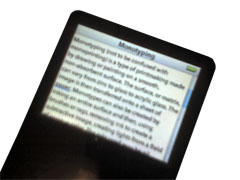 To my mind, browsing is one of the primary virtues of a print encyclopedia: the arbitrary logic of alphabetization makes for a serendipitous reading experience, and you often come away from a print encyclopedia having read something in a nearby article that you didn’t intend to read. This is something that’s generally lost with online reference works: links between articles are supposed to make logical sense. This is also a reflection of our reading behavior: if I search for “book” in Wikipedia, I’m probably looking for something in particular. If I’m interested in book conservation issues, I might click on the link for slow fires. If I’m interested in some other area related to books – how to make vellum, for example – I almost certainly wouldn’t. Instead I’d click on the vellum link and keep looking from there. We tend to be goal-directed when we using Wikipedia online: it’s like going to a library and finding the specific book you want. Wandering in a library is an equally valid behavior: that’s what happens here.
Because you’re not looking for a particular piece of information, you do find yourself reading in a different way. Search-based reading is a different style of reading than browsing, which is slower and more casual. This has a downside when applied to Wikipedia: the often atrocious style is more glaring when you’re reading for pleasure rather than reading for information. And an offline Wikipedia inhibits some of the new reading habits Wikipedia encourages. I caught myself wondering how biased the declarations of the Shāhnāma‘s originality w/r/t other national epics were; without recourse to page histories and talk pages I’m left to wonder until I find myself with an Internet connection.
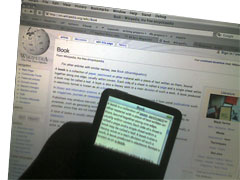 The experience of reading Wikipedia this way isn’t perfect: many links don’t work, and some articles seem to arbitrarily end, some in mid-sentence, some in mid-word. You also realize how many links in Wikipedia aren’t useful at all. If I’m interested in books as a concept, I’m probably not interested in 1907 as a concept, though that is the year that Marc Aurel Stein found The Diamond Sutra, the oldest known block-printed book. Marc Aurel Stein or The Diamond Sutra might be interesting subjects to a book-inclined browser; 1907 isn’t as likely. What you get on your iPod is an arbitrary selection. But there’s something very pleasant about this: it’s nice to have the chance to learn about both Neferirkare Kakai and the Rule of St. Benedict on the subway.
making MediaCommons
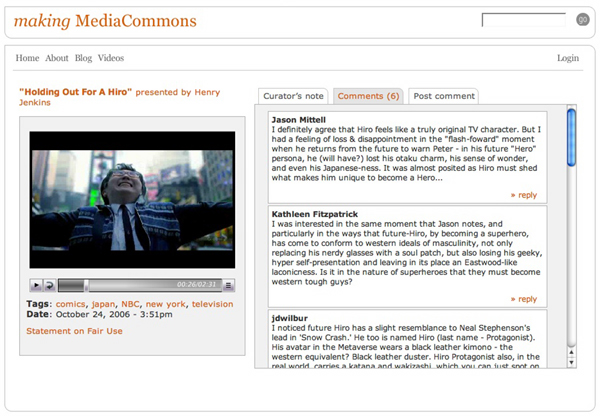
Back in July, we announced plans to build MediaCommons, a new kind of scholarly press for the digital age with a focus on media studies — a wide-ranging network that will weave together various forms of online discourse into a comprehensive publishing environment. At its core, MediaCommons will be a social networking site where academics, students, and other interested members of the public can write and critically converse about a mediated world, in a mediated environment. We’re trying to bridge a number of communities here, connecting scholars, producers, lobbyists, activists, critics, fans, and consumers in a wide-ranging, critically engaged conversation that is highly visible to the public. At the same time, MediaCommons will be a full-fledged electronic press dedicated to the development of born-digital scholarship: multimedia “papers,” journals, Gamer Theory-style monographs, and many other genre-busting forms yet to be invented.
Today we are pleased to announce the first concrete step toward the establishment of this network: making MediaCommons, a planning site through which founding editors Avi Santo (Old Dominion U.) and Kathleen Fitzpatrick (Pomona College) will lead a public discussion on the possible directions this all might take.
The site presently consists of three simple sections:
1) A weblog where Avi and Kathleen will think out loud and work with the emerging community to develop the full MediaCommons vision.
2) A call for “papers” — scholarly projects that engagingly explore some aspect of media history, theory, or culture through an adventurous use of the broad palette of technologies provided by the digital network. These will be the first round of texts published by MediaCommons at the time of its launch.
3) In Media Res — an experimental feature where each week a different scholar will present a short contemporary media clip accompanied by a 100-150 word commentary, alongside which a community discussion can take place. Sort of a “YouTube” for scholars and a critically engaged public, In Media Res is presented as just one of the many possible kinds of collaborative, multi-modal publications that MediaCommons could eventually host. With this feature, we are also making a stand on “fair use,” asserting the right to quote from the media for scholarly, critical and pedagogical purposes. Currently on the site, you’ll find videos curated by Henry Jenkins of MIT, Jason Mittell of Middlebury College and Horace Newcomb of the University of Georgia (and the founder of the Peabody Awards). There’s an open invitation for more curators.
Other features and sections will be added over time and out of this site the real MediaCommons will eventually emerge. How exactly this will happen, and how quickly, is yet to be seen and depends largely on the feedback and contributions from the community that will develop on making MediaCommons. We imagine it could launch as early as this coming Spring or as late as next Fall. Come take a look!
google aquires jotspot

Adding wikis to its evolving online office suite.
blogs and time (links for 11.1.06)
Interesting links that crossed my path over the past few days that I haven’t time to post on (and likely never will):
- “French publishers join fight against Google Book Search”: Le Syndicat National de l’édition (SNE), a trade association of French publishers, has joined a suit brought against Google by the Le Martiniè re conglomerate in August for “counterfeiting and breach of intellectual property rights” in its book digitization program.
- outside.in is a new web service co-created by Steven Johnson and John Geraci that aggregates blog content according to zip code, giving you a regularly updated guide to where you live. It uses a little Google map as a navigation tool — a dynamic table of contents.
- US intelligence agencies use wikis: The CIA and other agencies have begun using an internal wiki site called the “Intellipedia” where staff post current events updates and colloborate on intelligence assessments, supposedly to avoid repeating mistakes like Iraq WMD. “‘I think in the future you’ll press a button and this will be the NIE,’ said Michael Wertheimer, assistant deputy director of national intelligence for analysis.”
- Clay Shirky on “meganiches”
- Wikipedia and the academy: To contribute or not to contribute? Article in Chronicle of Higher Ed. on the fraught relationship between academics and the online encyclopedia. Among other things discusses troubling disparity in quality between science articles and humanities articles. Is there a “two cultures” problem in online scholarly collaboration?
- Ehon: The Artist and the Book in Japan: Glorious exhibit at the New York Public Library. A totally different way of thinking about books.
Should if:book serve as a filter and recommender, providing nutritious lists of links like the one above, or purely as a source of original ideas and commentary? If the answer is both, then what should be the ratio of shorter, “pointier” posts to longer, “thinkier” ones? Blogs are agnostic as to the varying size and speed of thoughts — everything goes into the same sinking scroll, soon vanishing into the catacombs of the monthly archives and category pages.
This works fine for news cycle or daily diary-type blogs, but it’s a handicap for a site like ours where longer meditations — the kind that would benefit from longer exposure — are the more common fare, and where extended, multi-post arcs on a relatively small cluster of central ideas are more what constitute the “story” of this blog than any given week’s smattering of entries. As I write, there are several extended conversations taking place within posts that, though only a few days old, are being pushed further and further down the scroll as newer content accumulates. The only hint of their still being active is the “recent comments” link to the right, which is at best an overheard whisper.
Given these constraints, and figuring that it’s the slower moving ideas that matter most, we generally try to avoid posting quick linkdumps like the one above — useful as they might be for annotating our wider web readings and pointing readers to interesting sites — simply because they have the unfortunate effect of pushing the other stuff down. But this only slightly mitigates the still unsolved problem of portraying complex movements of ideas over time on a dinky little blog.
As a side project, we’re thinking about how we could redesign if:book to keep the thinky stuff visible for longer and tied to past related discussions, while also keeping a swift current of useful annotated links and shorter observational posts. This might mean dividing our content into two separate feeds, as on this site.
We’ve also thought about ways to organize content thematically rather than temporally, so what you see at the top isn’t just the newest content, but a cluster of our most important and long-abiding conversations arranged by subject. We’re also considering changes to the individual permalinked pages of posts, perhaps adding dynamically generated links to related posts.
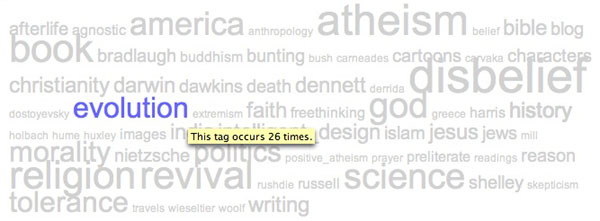
We’ve played around a bit with thematic arrangements on Mitch Stephens’ blog Without Gods. First, just below his banner there’s this tag cloud, which serves as a mental map of Mitch’s writing and interests:
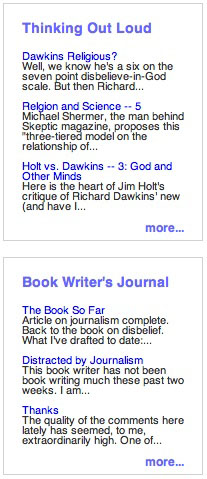
Then there are four side menus with recent posts divided up by general area. “Bonner’s Field” is current events, “Tales of Disbelief” deals with characters in his book, “Thinking Out Loud” is sort of free-form jamming on ideas, and “Book Writer’s Journal” is meta-commentary on the writing process:

I’m also very taken with what this site, an NYU webzine on media and religion called The Revealer. They have a lovely section on the front page that divides articles and blog postings into three distinct tempos, or traffic lanes (which brings us back to the multiple streams/feeds idea):
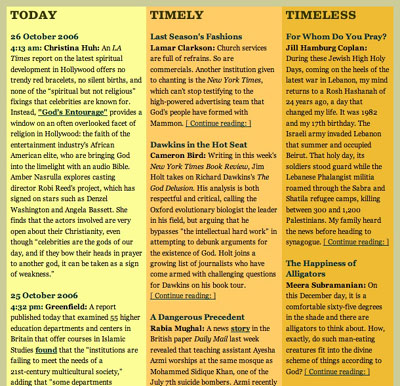
“Time signature” is something we need to add to our design vocabulary for dealing with evolutionary, never-finished documents. Having multiple rates of movement in a single space can create interesting tensions and provide more points of entry to for the reader. I’m hoping we can put some of this into practice with if:book, and soon.
What are other sites that do a good job of handling time? Any other ideas as to how we might do better here?
the library project: a networked art experiment
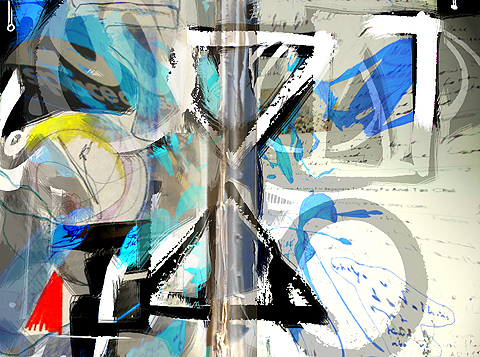
Digital collaboration with me-jade, dou_ble_you and others in the Flickr Library Project
As he recently reflected upon here, Alex Itin has long been working at the border zones of art forms, moving in recent years to the strange intersection of paint and pixels. His blog is one of the most wildly inventive uses of that form, combining blazing low-res images of his paintings with text, photographs, short films, animated GIFs and audio mashups. All of this is done within the constraints of the blog’s scroll-like form — a constraint which Alex embraces, even relishes. I sometimes imagine the scroll endlessly emitting from Alex’s head like tape from a cash register, a continuous record of his transactions with the world.
ITIN place has been on the web for nearly two years now. In his second year, Alex began to explore new avenues out of the blog, establishing a presence on social media sites like Flickr, YouTube, Vimeo (a classier YouTube) and MySpace. Through these networked rovings, Alex has found a larger audience for his work, attracting new “readers” back to the blog where the various transmitted videos and images are reassembled in the scroll. He’s also established relationships with a number of other artists making interesting use of the web, particularly on Flickr and Vimeo. Recently, Alex invited a number of folks from the Flickr community to participate in a collaborative art project — a kind of exquisite corpse game via post. Here’s Alex:
The idea is that one artist takes a hardcover from a book, tears out the pages and draws in one half (or half draws in both halves) of the binder/diptyque. In a nod to Ray Johnson, the two books are mailed (swapped) and Each of these will be finished by the other. The results are posted in a Flicker group called (what else) The Library Project. From this group, hopefully a show will be curated for New York, or Paris, or Basel, or Berlin, or wherever anyone wants to show this project. It should be deliciously portable… get working…get collaborating…get reading!
As of this writing, the Library has racked up 278 members and has 205 images in its pool. A few of these are collaborations that have already made their trek across land, sea and air, others are purely digital combinations, while still others are simply book-inspired works submitted in the spirit of the project.
Alex has been documenting the process on his blog, weaving in some of the images. Styles combine, narratives emerge. In one video (excerpted here) he films himself receiving his first half-completed book from a Canadian artist known as driftwould. He unpacks the drawings and lets out a “wow,” than a sort of humbled sigh. It’s a nice moment of return to the physical world after several years of probing the digital ether.
And here’s how that turned out:
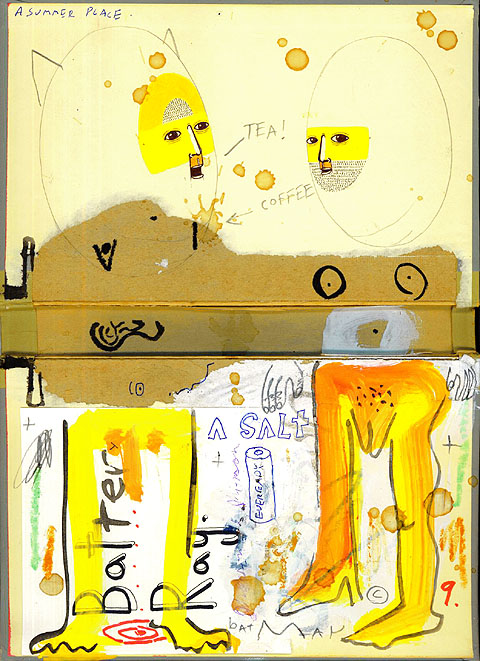
Read Alex’s documentation here and here.
Stay tuned for more — the project has only just begun. Plus, we’ve begun designing a fantastic new interface for Alex’s blog archives, which we’ll talk more about soon.