baudrillard and the net

Sifting through the various Baudrillard obits, I came across this passage from America, a travelogue he wrote in 1989:

…This is echoed by the other obsession: that of being ‘into’, hooked in to your own brain. What people are contemplating on their word-processor screens is the operation of their own brains. It is not entrails that we try to interpret these days, nor even hearts or facial expressions; it is, quite simply, the brain. We want to expose to view its billions of connections and watch it operating like a video-game. All this cerebral, electronic snobbery is hugely affected – far from being the sign of a superior knowledge of humanity, it is merely the mark of a simplified theory, since the human being is here reduced to the terminal excrescence of his or her spinal chord. But we should not worry too much about this: it is all much less scientific, less functional than is ordinarily thought. All that fascinates us is the spectacle of the brain and its workings. What we are wanting here is to see our thoughts unfolding before us – and this itself is a superstition.
Hence, the academic grappling with his computer, ceaselessly correcting, reworking, and complexifying, turning the exercise into a kind of interminable psychoanalysis, memorizing everything in an effort to escape the final outcome, to delay the day of reckoning of death, and that other – fatal – moment of reckoning that is writing, by forming an endless feed-back loop with the machine. This is a marvellous instrument of exoteric magic. In fact all these interactions come down in the end to endless exchanges with a machine. Just look at the child sitting in front of his computer at school; do you think he has been made interactive, opened up to the world? Child and machine have merely been joined together in an integrated circuit. As for the intellectual, he has at last found the equivalent of what the teenager gets from his stereo and his walkman: a spectacular desublimation of thought, his concepts as images on a screen.

When Baudrillard wrote this, Tim Berners-Lee and co. were writing the first pages of the WWW in Switzerland. Does the subsequent emergence of the web, the first popular networked computing medium, trump Baudrillard’s prophecy of rarified self-absorption or does this “superstition” of wanting “to see our thoughts unfolding before us,” this “interminable psychoanalysis,” simply widen into a group exercise? An obsession with being hooked into a collective brain…
I kind of felt the latter last month seeing the little phenomenon that grew up around Michael Wesch’s weirdly alluring “Web 2.0…The Machine is Us/isng Us” video (now over 1.7 million views on YouTube). The viral transmission of that clip, and the various (mostly inane) video responses it elicited, ended up feeling more like cyber-wankery than any sort of collective revelation. Then again, the form itself was interesting — a new kind of expository essay — which itself prompted some worthwhile discussion.
I think the only honest answer is that it’s both. The web both connects and insulates us, breaks down walls and provides elaborate mechanisms for self-confirmation. Change is ambiguous, and was even before we had a network connecting our machines — something that Baudrillard’s pessimism misses.

open source influence on education

The Online Education Database is running a story on the way the Open Source movement changed education, that assumes a causal relationship between the two:

MIT provides just one of the 10 open source educational success stories detailed below. Open source and open access resources have changed how colleges, organizations, instructors, and prospective students use software, operating systems and online documents for educational purposes. And, in most cases, each success story also has served as a springboard to create more open source projects.

This reminds me of something I have often wondered: Was the open source movement the catalyst for opening up education? Or was it simply the advent of instant communication and easy to copy digital media? Haven’t the ideals of open source long existed in academia?

gamer theory 2.0 – visualize this!

Call for participation: Visualize This!
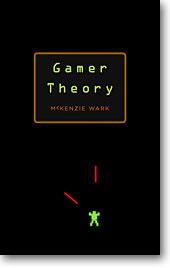
WARGAM.jpg How can we ‘see’ a written text? Do you have a new way of visualizing writing on the screen? If so, then McKenzie Wark and the Institute for the Future of the Book have a challenge for you. We want you to visualize McKenzie’s new book, Gamer Theory.
Version 1 of Gamer Theory was presented by the Institute for the Future of the Book as a ‘networked book’, open to comments from readers. McKenzie used these comments to write version 2, which will be published in April by Harvard University Press. With the new version we want to extend this exploration of the book in the digital age, and we want you to be part of it.
All you have to do is register, download the v2 text, make a visualization of it (preferably of the whole text though you can also focus on a single part), and upload it to our server with a short explanation of how you did it.
All visualizations will be presented in a gallery on the new Gamer Theory site. Some contributions may be specially featured. All entries will receive a free copy of the printed book (until we run out).
By “visualization” we mean some graphical representation of the text that uses computation to discover new meanings and patterns and enables forms of reading that print can’t support. Some examples that have inspired us:

Understand that this is just a loose guideline. Feel encouraged to break the rules, hack the definition, show us something we hadn’t yet imagined.
All visualizations, like the web version of the text, will be Creative Commons licensed (Attribution-NonCommercial). You have the option of making your code available under this license as well or keeping it to yourself. We encourage you to share the source code of your visualization so that others can learn from your work and build on it. In this spirt, we’ve asked experienced hackers to provide code samples and resources to get you started (these will be made available on the upload page).
Gamer 2.0 will launch around April 18th in synch with the Harvard edition. Deadline for entries is Wednesday, April 11th.
Read GAM3R 7H30RY 1.1.
Download/upload page (registration required):
http://web.futureofthebook.org/gamertheory2.0/viz/

a change in social spaces

Last week I went to an exhibit on Robert Moses, the legendary New York city planner, at the Museum of the City of New York. All the while making sure we drove through as much of the city that he helped develop as possible.
While Moses was a complicated man, and views on him vary a great deal, one thing that fascinated me about him was his use of social spaces. Here is a excerpt from a recent New York Times piece:

Perhaps the most powerful architectural expressions of that mission were the 23 public swimming pools with bathhouses Moses built in a five-year period beginning in the mid-1930s. A graceful colonnaded arcade shelters the shops and restaurants at Orchard Beach; the vivid geometric forms and intricate tile and brick work of the McCarren Park Pool in Greenpoint, Brooklyn, celebrate the therapeutic value of communal exercise. For Moses, those projects were part of a broader strategy to reinforce middle-class neighborhoods and deter residents from fleeing to the suburbs.

Moses believed large landmark projects provided an anchor for communities to build around, like the McCarren Park Pool, in our very own Brooklyn, which at it’s peak held 6800 swimmers and served as a social hub.
But such projects could not work today. No one has the type of power Moses had during his reign, and communities are often now built with a Jane Jabobs-like philosophy in mind; that is, emphasis, on restoration, not on construction. But now technology is again changing the idea of a city, and the role of social spaces.
BusinessWeek recently ran a piece that looked at the transformation of the coffee shop into the modern age social office. Technology, especially wireless, is changing how people meet and work together. I wrote a post titled “Reading Buildings,” a few months ago, where I wondered what libraries would be like if accessing of information became even less centralized:

What I find bizarre about all this is that when you walk into a Barnes & Noble all the seats are taken, so it seems that “reading buildings” of some sort have some demand. Maybe it’s the social setting or maybe it’s the Starbucks. Actually, that could be the future of the library: a big empty building that people bring their electronic books to so that they can read and drink their coffee in a social setting… quietly.

While technology poses the potential problem of atomization, it does pose an interesting problem for organizers and builders of social spaces: what sort of emphasis should there be on technology? Does bringing in technology, especially wireless, defeat the purpose of common social spaces? Or is that the new goal? Many websites now encourage meeting offline, but what are they to do once they meet?

emerging libraries at rice: day one

For the next few days, Bob and I will be at the De Lange “Emerging Libraries” conference hosted by Rice University in Houston, TX, coming to you live with occasional notes, observations and overheard nuggets of wisdom. Representatives from some of the world’s leading libraries are here: the Library of Congress, the British Library, the new Bibliotheca Alexandrina, as well as the architects of recent digital initiatives like the Internet Archive, arXiv.org and the Public Library of Science. A very exciting gathering indeed.
We’re here, at least in part, with our publisher hat on, thinking quite a lot these days about the convergence of scholarly publishing with digital research infrastructure (i.e. MediaCommons). It was fitting then that the morning kicked off with a presentation by Richard Baraniuk, founder of the open access educational publishing platform Connexions. Connexions, which last year merged with the digitally reborn Rice University Press, is an innovative repository of CC-licensed courses and modules, built on an open volunteer basis by educators and freely available to weave into curricula and custom-designed collections, or to remix and recombine into new forms.
Connexions is designed not only as a first-stop resource but as a foundational layer upon which richer and more focused forms of access can be built. Foremost among those layers of course is Rice University Press, which, apart from using the Connexions publishing framework will still operate like a traditional peer review-driven university press. But other scholarly and educational communities are also encouraged to construct portals, or “lenses” as they call them, to specific areas of the Connexions corpus, possibly filtered through post-publication peer review. It will be interesting to see whether Connexions really will end up supporting these complex external warranting processes or if it will continue to serve more as a building block repository — an educational lumber yard for educators around the world.
Constructive crit: there’s no doubt that Connexions is one of the most important and path-breaking scholarly publishing projects out there, though it still feels to me more like backend infrastructure than a fully developed networked press. It has a flat, technical-feeling design and cookie cutter templates that give off a homogenous impression in spite of the great diversity of materials. The social architecture is also quite limited, and what little is there (ways to suggest edits and discussion forums attached to modules) is not well integrated with course materials. There’s an opportunity here to build more tightly knit communities around these offerings — lively feedback loops to improve and expand entries, areas to build pedagogical tutorials and to collect best practices, and generally more ways to build relationships that could lead to further collaboration. I got to chat with some of the Connexions folks and the head of the Rice press about some of these social questions and they were very receptive.

*     *     *     *     *

Michael A. Keller of Stanford spoke of emerging “cybraries” and went through some very interesting and very detailed elements of online library search that I’m too exhausted to summarize now. He capped off his talk with a charming tour through the Stanford library’s Second Life campus and the library complex on Information Island. Keller said he ultimately doesn’t believe that purely imitative virtual worlds will become the principal interface to libraries but that they are nonetheless a worthwhile area for experimentation.
Browsing during the talk, I came across an interesting and similarly skeptical comment by Howard Rheingold on a long-running thread on Many 2 Many about Second Life and education:

I’ve lectured in Second Life, complete with slides, and remarked that I didn’t really see the advantage of doing it in SL. Members of the audience pointed out that it enabled people from all over the world to participate and to chat with each other while listening to my voice and watching my slides; again, you don’t need an immersive graphical simulation world to do that. I think the real proof of SL as an educational medium with unique affordances would come into play if an architecture class was able to hold sessions within scale models of the buildings they are studying, if a biochemistry class could manipulate realistic scale-model simulations of protein molecules, or if any kind of lesson involving 3D objects or environments could effectively simulate the behaviors of those objects or the visual-auditory experience of navigating those environments. Just as the techniques of teleoperation that emerged from the first days of VR ended up as valuable components of laparascopic surgery, we might see some surprise spinoffs in the educational arena. A problem there, of course, is that education systems suffer from a great deal more than a lack of immersive environments. I’m not ready to write off the educational potential of SL, although, as noted, the importance of that potential should be seen in context. In this regard, we’re still in the early days of the medium, similar to cinema in the days when filmmakers nailed a camera tripod to a stage and filmed a play; SL needs D.W. Griffiths to come along and invent the equivalent of close-ups, montage, etc.

Rice too has some sort of Second Life presence and apparently was beaming the conference into Linden land.

*     *     *     *     *

Next came a truly mind-blowing presentation by Noha Adly of the Bibliotheca Alexandrina in Egypt. Though only five years old, the BA casts itself quite self-consciously as the direct descendant of history’s most legendary library, the one so frequently referenced in contemporary utopian rhetoric about universal digital libraries. The new BA glories in this old-new paradigm, stressing continuity with its illustrious past and at the same time envisioning a breathtakingly modern 21st century institution unencumbered by the old thinking and constrictive legacies that have so many other institutions tripping over themselves into the digital age. Adly surveyed more fascinating-sounding initiatives, collections and research projects than I can possibly recount. I recommend investigating their website to get a sense of the breadth of activity that is going on there. I will, however, note that that they are the only library in the world to house a complete copy of the Internet Archive: 1.5 petabytes of data on nearly 900 computers.
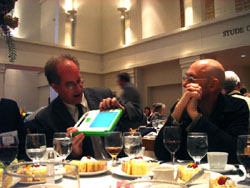
olpckahle.jpg (Speaking of the IA, Brewster Kahle is also here and is closing the conference Wednesday afternoon. He brought with him a test model of the hundred dollar laptop, which he showed off at dinner (pic to the right) in tablet mode sporting an e-book from the Open Content Alliance’s children’s literature collection (a scanned copy of The Owl and the Pussycat)).
And speaking of old thinking and constrictive legacies, following Adly was Deanna B. Marcum, an associate librarian at the Library of Congress. Marcum seemed well aware of the big picture but gave off a strong impression of having hands tied by a change-averse institution that has still not come to grips with the basic fact of the World Wide Web. It was a numbing hour and made one palpably feel the leadership vacuum left by the LOC in the past decade, which among other things has allowed Google to move in and set the agenda for library digitization.
Next came Lynne J. Brindley, Chief Executive of the British Library, which is like apples to the LOC’s oranges. Slick, publicly engaged and with pockets deep enough to really push the technological envelope, the British Library is making a very graceful and sometimes flashy (Turning the Pages) migration to the digital domain. Brindley had many keen insights to offer and described a several BL experiments that really challenge the conventional wisdom on library search and exhibitions. I was particularly impressed by these “creative research” features: short, evocative portraits of a particular expert’s idiosyncratic path through the collections; a clever way of featuring slices of the catalogue through the eyes of impassioned researchers (e.g. here). Next step would be to open this up and allow the public to build their own search profiles.

*     *     *     *     *

That more or less covers today with the exception of a final keynote talk by John Seely Brown, which was quite inspiring and included a very kind mention of our work at MediaCommons. It’s been a long day, however, and I’m fading. So I’ll pick that up tomorrow.

AAUP on open access / business as usual?

On Tuesday the Association of American University Presses issued an official statement of its position on open access (literature that is “digital, online, free of charge, and free of most copyright and licensing restrictions” – Suber). They applaud existing OA initiatives, urge more OA in the humanities and social sciences (out of the traditional focus areas of science, technology and medicine), and advocate the development of OA publishing models for monographs and other scholarly formats beyond journals. Yet while endorsing the general open access direction, they warn against “more radical approaches that abandon the market as a viable basis for the recovery of costs in scholarly publishing and instead try to implement a model that has come to be known as the ‘gift economy’ or the ‘subsidy economy.'” “Plunging straight into pure open access,” they argue, “runs the serious risk of destabilizing scholarly communications in ways that would disrupt the progress of scholarship and the advancement of knowledge.”
Peter Suber responds on OA News, showing how many of these so-called risks are overblown and founded on false assumptions about open access. OA, even “pure” OA as originally defined by the Budapest Open Access Initiative in 2001, is not incompatible with a business model. You can have free online editions coupled with priced print editions, or full open access after an embargo period directly following publication. There are many ways to go OA and still generate revenue, many of which we probably haven’t thought up yet.
But this begs the more crucial question: should scholarly presses really be trying to operate as businesses at all? There’s an interesting section toward the end of the AAUP statement that basically acknowledges the adverse effect of market pressures on university presses. It’s a tantalizing moment in which the authors seem to come close to actually denouncing the whole for-profit model of scholarly publishing. But in the end they pull their punch:

For university presses, unlike commercial and society publishers, open access does not necessarily pose a threat to their operation and their pursuit of the mission to “advance knowledge, and to diffuse it…far and wide.” Presses can exist in a gift economy for at least the most scholarly of their publishing functions if costs are internally reallocated (from library purchases to faculty grants and press subsidies). But presses have increasingly been required by their parent universities to operate in the market economy, and the concern that presses have for the erosion of copyright protection directly reflects this pressure.

According to the AAUP’s own figures: “On average, AAUP university-based members receive about 10% of their revenue as subsidies from their parent institution, 85% from sales, and 5% from other sources.” This I think is the crux of the debate. As the above statement reminds us, the purpose of scholarly publishing is to circulate discourse and the fruits of research through the academy and into the world. But today’s commercially structured system runs counter to these aims, restricting access and limiting outlets for publication. The open access movement is just one important response to a general system failure.
But let’s move beyond simply trying to reconcile OA with existing architectures of revenue and begin talking about what it would mean to reconfigure the entire scholarly publishing system away from commerce and back toward infrastructure. It’s obvious to me, given that university presses can barely stay solvent even in restricted access mode, and given how financial pressures continue to tighten the bottleneck through which scholarship must pass, making less of it available and more slowly, that running scholarly presses as profit centers doesn’t make sense. You wouldn’t dream of asking libraries to compete this way. Libraries are basic educational infrastructure and it’s obvious that they should be funded as such. Why shouldn’t scholarly presses also be treated as basic infrastructure?
Publishing libraries?
Here’s one radical young librarian who goes further, suggesting that libraries should usurp the role of publishers (keep in mind that she’s talking primarily about the biggest corporate publishing cartels like Elsevier, Wiley & Sons, and Springer Verlag):

…I consider myself the enemy of right-thinking for-profit publishers everywhere…
I am not the enemy just because I’m an academic librarian. I am not the enemy just because I run an institutional repository. I am not the enemy just because I pay attention to scholarly publishing and data curation and preservation. I am not the enemy because I’m going to stop subscribing to journals–I don’t even make those decisions!
I am the enemy because I will become a publisher. Not just “can” become, will become. And I’ll do it without letting go of librarianship, its mission and its ethics–and publishers may think they have my mission and my ethics, but they’re often wrong. Think I can’t compete? Watch me cut off your air supply over the course of my career (and I have 30-odd years to go, folks; don’t think you’re getting rid of me in any hurry). Just watch.

Rather than outright clash, however, there could be collaboration and merger. As business and distribution models rise and fall, one thing that won’t go away is the need for editorial vision and sensitive stewardship of the peer review process. So for libraries to simply replace publishers seems both unlikely and undesirable. But joining forces, publishers and librarians could work together to deliver a diverse and sustainable range of publishing options including electronic/print dual editions, multimedia networked formats, pedagogical tools, online forums for transparent peer-to-peer review, and other things not yet conceived. All of it by definition open access, and all of it funded as libraries are funded: as core infrastructure.
There are little signs here and there that this press-library convergence may have already begun. I recently came across an open access project called digitalculturebooks, which is described as “a collaborative imprint of the University of Michigan Press and the University of Michigan Library.” I’m not exactly sure how the project is funded, and it seems to have been established on a provisional basis to study whether such arrangements can actually work, but still it seems to carry a hint of things to come.

alex itin at monkeytown

Last night’s Monkeybook event was a big hit. Thanks to all who came. Very soon, we’ll be announcing the relaunch of IT IN place with its fancy new archive interface. Just fixing a few last bugs. In the meantime, here’s a little clip from last night shot by Vimeo founder Jakob Lodwick:

Alex Itin night at Monkeytown on Vimeo
Vimeo user Alex Itin presented a show last night at Monkeytown, screening videos from Vimeo as well as paintings, animated GIFs, and HTML experiments.
It was an inspiring, relaxing night … just laying around, eating food, drinking wine, and enjoying some commercial free video for a few hours.
Thanks Alex!

feeling random

Following HarperCollins’ recent Web renovations, Random House today unveiled their publisher-driven alternative to Google: a new, full-text search engine of over 5,000 new and backlist books including browsable samples of select titles. The most interesting thing here is that book samples can be syndicated on other websites through a page-flipping browser widget (Flash 9 required) that you embed with a bit of cut-and-paste code (like a YouTube clip). It’s a nice little tool, though it comes in two sizes only — one that’s too small to read, and one that embedded would take up most of a web page (plus it keeps crashing my browser). Compare below with HarperCollins’ simpler embeddable book link:


Worth noting here is that both the search engine and the sampling widget were produced by Random House in-house. Too many digital forays by major publishers are accomplished by hiring an external Web shop, meaning of course that little ends up being learned within the institution. It’s an old mantra of Bob’s that publishers’ digital budgets would be better spent by throwing 20 grand at a bright young editor or assistant editor a few years out of college and charging them with the task of doing something interesting than by pouring huge sums into elaborate revampings from the outside. Random House’s recent home improvements were almost certainly more expensive, and more focused on infrastructure and marketing than on genuinely reinventing books, but they indicate a do it yourself approach that could, maybe, lead in new directions.

were the fears of big brother overstated?

The NY Times published an article yesterday about Stewart Brand’s embrace of nuclear energy and genetically engineered foods. Here is a quote:

He thinks the fears of genetically engineered bugs causing disaster are as overstated as the counterculture’s fears of computers turning into Big Brother. “Starting in the 1960s, hackers turned computers from organizational control machines into individual freedom machines,” he told Conservation magazine last year. “Where are the green biotech hackers?”

So what do you think. Were the fears of Big Brother overstated? Did hackers successfully turn computers into individual freedom machines?