privatizing public goods (our tax dollars at work)

The National Archives is at it again. After announcing in January its exclusive agreement with Footnote.com to digitize and offer priced access to millions of public domain historical records, NARA (National Archives and Records Administration) has now inked a deal with Amazon to distribute significant parts of its vast archival films collection commercially on DVD and online.
As reported by the Cumberland Times News:

The arrangement allows Amazon – and a subsidiary, CustomFlix Labs Inc. – to copy National Archives films and video onto DVDs, and sell them to the public via the Internet.
The Archives will initially make available its collection of Universal Newsreels, dating from 1920 to 1967. Thousands of other public-domain and government films will be made available later.
Included in the initial offerings are events as diverse as the famous 1959 “Kitchen Debate” between then-Vice President Richard Nixon and Soviet Premier Nikita Khrushchev, and footage of a youthful Fidel Castro after the communist revolution in Cuba. Newsreels that will become available later include coverage of the death of President Franklin D. Roosevelt, the end of World War II, and the royal wedding of Princess Margaret.
National Archives officials said the arrangement will greatly expand the availability of the collection. Previously, such films could only be viewed and recorded at the Archives facility in College Park.

No doubt NARA should doing everything in its power to digitize and increase access to its vaults, but locking materials down through commercial partnerships is no way to run a public trust. In a more commendable move, NARA put up a draft of another digitization/distribution agreement it has in the works, this one with the Genealogical Society of Utah (GSU), and they’ve even opened it up to public comment. They ought to do the same with the Amazon deal, and while they’re at it, offer less antiquated mechanisms for the public to make their voices heard. As it stands, comments on the GSU draft can be submitted in the following ways:
* regulations.gov
* fax
* postal mail
* hand delivery or courier
Hey, why not use CommentPress?

ideal ulysses, part two

it occured to me as i read the comments to yesterday’s post that i left out a key element in the equation -? the ovearching vision that determines what gets included in the ideal Ulysses and how. ideally this vision will be a creative amalgam of the perspective of the great teacher, the enquiring reader and the canny editor/producer.
this trinity may seem obvious but i think the question of how to balance the power between the three is something we don’t really know much about. to put differently, if in the print world the hierarchy of AUTHOR/reader has been fiercely protected by those whom it favors, the promise of the networked book to upset these relations is just that, a promise. that will be the case until we come up with new schema powerful enough to be the foundation of a real transformation* (see footnote at bottom of the post)
i think perhaps an interesting next step would be to sit in on classes with some of the great teachers of Ulysses -? the ones who make the book come alive for their students. i’d like to see what characteristics are common to all and which different. then we could think about how to take the essence of this experience into an ideal version. note, that even if the answer in the end is that for teachers to work their magic they need to be live, in front of an audience, then the question for me becomes, how do we get that into a networked book?
So please if you took a great course in Ulysses or know of anyone who did, comment here or send me a note at bob@futureofthebook.org.
_____________________
* footnote -? many years ago a group of us were trying to imagine the encyclopedia of the future. we saw it in part as the ultimate teacher/tutor who knew everything about everything, who waited in the background till called, and who then was able to engage you at your level on any question you put forth. this view, while valid, placed 100% of the value on learner-initiated activities. it seems in retrospect as if foolishly we completely discounted the ability of the teacher/mentor/knowledgeable companion to raise interesting questions which could start the learner off in unexpected but perfectly wonderful directions.

ideal ulysses, part one

ok. i’ll admit it. i haven’t read Ulysses yet. sadly, there are a lot of important books in that category, but i have a particular excuse for this one. Ulysses is daunting for me. for starters, it’s pretty much been at or in contention for the top spot in the canonstakes for as long as i can remember, but more importantly, I’m very sure that if i just go at the text by itself i’ll feel helpless, knowing that i’m only grasping a small, and possibly even least interesting, bit of the whole. so i’m waiting for my dream edition, the highlights of which include:
• a beautifully rendered text, perhaps even with help and guidance of a master typographer.
• a low-footprint interface that the reader can dismiss at will, leaving only the text on the page with all buttons etc. hidden from view. since the book will have copious annotations, it’s important that the reader can hide and reveal whichever graphic indicators indicate the presence of annotation.
• a complete audio version. ideally this might be a recording done with the best actors specifically for this edition, but it could also be assembled from readings done over the years. in any case key passages should be represented by multiple readings. and of course the text and readings should be tied to each other, allowing you to read and listen at the same time.
• a thorough word and phrase glossary with a snappy and intuitive mechanism for getting to it directly from the text.
• the explanation of references -? literary, linguistical, historical, personal, social, political. ideally each of these categories would be represented in some unique way, so that readers can turn specific layers on or off at will. these annotations will be comprised of text, audio, and/or video.
• close readings of key passages by experts from multiple interesting viewpoints.
• for these last two, i’m sure i want there to be a mechanism for people to question and challenge the original authors and each other. the genius of the wikipedia for me is that by revealing the back and forth of an article as it evolves, it brings us closer to the truth -? or at least improves our understanding of the complexity of the factors underlying the subect at hand. so, we’ll need a good way, which i imagine will involve some form of benevolent moderation, of enabling a conversation to emerge in the myriad margins of the work. enabling comments that refer to multiple points in the expanded text is crucial to get beyond the constraints of current commenting schemes which tend to restrict you to paragraph, page or whole.
thoughts -? objections, agreements, additions, subtractions?

commentpress update

The release of CommentPress has made for exciting times here at the institute (the feedback has also been very encouraging). But as with any piece of software, CommentPress will need constant tending, and with quick succession upgrades, we hope to address the most crucial issues – starting with the first major update, CommentPress version 1.1.
This is a very important update, so everyone is encouraged to upgrade as soon as possible.
For a complete list of the changes, check out the CommentPress download page.

ithaka report on scholarly publishing

From a first skim and browsing of initial responses, the new report from the non-profit scholarly technologies research group Ithaka, “University Publishing in a Digital Age,” seems like a breath of fresh air. The Institute was one of the many stops along the way for the Ithaka team, which included the brilliant Laura Brown, former director of Oxford University Press in the States, and we’re glad to see Gamer Theory is referenced as an important experiment with the monograph form.
A good summary of the report and a roundup of notable reactions (all positive) in the academic community is up on Inside Higher Ed. Recommendations center around better coordination among presses on combining services, tools and infrastructure for digital scholarship. They also advocate closer integration of presses with the infrastructure and scholarly life of their host universities, especially the library systems, who have much to offer in the area of digital communications. This is something we’ve argued for a long time and it’s encouraging to see this put forth in what will no doubt be an influential document in the field.
One area that, from my initial reading, is not siginificatnly dealt with is the evolution of scholarly authority (peer review, institutional warrants etc.) and the emergence of alternative models for its production. Kathleen Fitzpatrick ponders this on the MediaCommons blog:

The report calls universities to task for their failures to recognize the ways that digital modes of communication are reshaping the ways that scholarly communication takes place, resulting in, as they say, “a scholarly publishing industry that many in the university community find to be increasingly out of step with the important values of the academy.”
Perhaps I’ll find this when I read the full report, but it seems to me that the inverse is perversely true as well, that the stated “important values of the academy” -? those that have us clinging to established models of authority as embodied in traditional publishing structures -? are increasingly out of step with the ways scholarly communication actually takes place today, and the new modes of authority that the digital makes possible. This is the gap that MediaCommons hopes to bridge, not just updating the scholarly publishing industry, but updating the ways that academic assessments of authority are conducted.

horseless carriages

The “horseless carriage” is a metaphor that’s often used when talking about reading in a screen environment. Offhand, I don’t know where this metaphor started (McLuhan probably had a hand in it). The idea is basic but important: thinking about the automobile as a “horseless carriage” blinds one to what an automobile can do that a carriage can’t do. Metaphors carry historical deadweight.

Last year the Noguchi Museum had an exhibition on collaborations between Isamu Noguchi and Buckminster Fuller which featured video of Fuller’s Dymaxion car. Through the wonder of Youtube, you can watch it now:

One of Fuller’s main innovations with the Dymaxion car was to move the steering from the front – as is the case when you’re steering horses from a carriage – to the rear, which mechanically makes more sense. This video of the Dymaxion car is revelatory: we have so much trouble parallel parking because automotive engineers unthinkingly followed old models.

CommentPress 1.0

At long last, we are pleased to release CommentPress, a free, open source theme for the WordPress blog engine designed to allow paragraph-by-paragraph commenting in the margins of a text. To download it and get it running in your WordPress installation, go to our dedicated CommentPress site. There you’ll find everything you need to get started. This 1.0 release represents the most basic out-of-the-box version of the theme. Expect many improvements and new features in the days and weeks ahead (some as soon as tomorrow). We could have kept refining it for another week but we felt that the time was well past due to get it out in the world and to let the community development cycles begin. So here it is:
/commentpress/ »
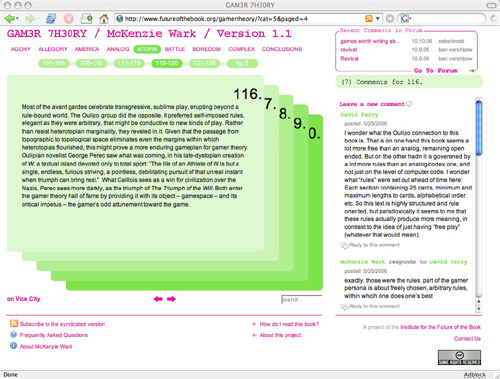
This little tool is the happy byproduct of a year and a half spent hacking WordPress to see whether a popular net-native publishing form, the blog, which, most would agree, is very good at covering the present moment in pithy, conversational bursts but lousy at handling larger, slow-developing works requiring more than chronological organization – ?whether this form might be refashioned to enable social interaction around long-form texts. Out of this emerged a series of publishing experiments loosely grouped under the heading “networked books.” The first of these, McKenzie Wark’s GAM3R 7H30RY 1.1, was a wildly inventive text whose aphoristic style and modular structure lent it readily to “chunking” into digestible units for online discussion. This is how it ended up looking:
gamertheory500.jpg
In the course of our tinkering, we achieved one small but important innovation. Placing the comments next to rather than below the text turned out to be a powerful subversion of the discussion hierarchy of blogs, transforming the page into a visual representation of dialog, and re-imagining the book itself as a conversation. Several readers remarked that it was no longer solely the author speaking, but the book as a whole (author and reader, in concert).
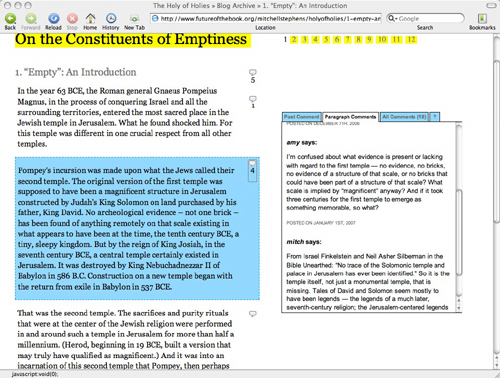
Toying with the placement of comments was relatively easy to do with Gamer Theory because of its unusual mathematical structure (25 paragraphs per chapter, 250 words or lessper paragraph), but the question remained of how this format could be applied to expository texts of more variable shapes and sizes. The breakthrough came with Mitchell Stephens’ paper, The Holy of Holies: On the Constituents of Emptiness. The solution we found was to have the comment area move with you in the right hand column as you scrolled down the page, changing its contents depending on which paragraph in the left hand column you selected. This format was inspired in part by a WordPress commenting system developed by Jack Slocum and by the Free Software Foundation’s site for community review of drafts of the GNU General Public License. Drawing on these terrific examples, we at last managed to construct a template that might eventually be exported as a simple toolset applicable to any text.
holyofholies500.jpg
Ever since “Holy of Holies,” people have been clamoring for us to release CommentPress as a plugin so they could start playing with it, improving it and customizing it for more specialized purposes. Now it’s finally here, with a cleaned-up codebase and a simpler interface, and we can’t wait to see how people start putting it to use. We can imagine a number of possibilities:
-? scholarly contexts: working papers, conferences, annotation projects, journals, collaborative glosses
-? educational: virtual classroom discussion around readings, study groups
-? journalism/public advocacy/networked democracy: social assessment and public dissection of government or corporate documents, cutting through opaque language and spin (like our version of the Iraq Study Group Report, or a copy of the federal budget, or a Walmart press release)
-? creative writing: workshopping story drafts, collaborative storytelling
-? recreational: social reading, book clubs
Once again, there are dozens of little details we want to improve, and no end of features we would love to see developed. Our greatest hope for CommentPress is that it take on a life of its own in the larger community. Who knows, it could provide a base for something far more ambitious.
An important last thought, however. While CommentPress presents exciting possibilities for social reading and writing on the Web, it is still very much bound by its technical origins, the blog. This presents significant limitations both in the flexibility of document structures and in the range of media that can be employed in writing and response. Sure, even in the current, ultra-basic version, there’s no reason a CommentPress document can’t incorporate image, video and sound embeds, but they must be fit into the narrow and brittle textual template dictated by the blog.
All of which is to say that we do not view CommentPress or whatever might grow out of it as an end goal but rather as a step along the way. In fact, this and all of the experiments mentioned above were undertaken in large part as field research for Sophie, and they have had a tremendous impact on its development. While there is still much work to be done, the ultimate goal of the Sophie project is to make a tool that handles all the social network interactions (and more) that CommentPress does but within a far more fluid and easy-to-use composition/reading space where media can mix freely. That’s the larger prize. For the moment though, let’s keep hacking the blog to within an inch of its life and seeing what we can discover.
A million thanks go out to our phenomenal corps of first-run testers, particularly Kathleen Fitzpatrick, Karen Schneider, Manan Ahmed, Tom Keays, Luke Rodgers, Peter Brantley and Shana Kimball, for all the thoughtful and technically detailed feedback they’ve showered upon us over the past few days. Thanks to you guys, we’re getting this out of the gate on solid legs and our minds are now churning with ideas for future development.
Here is a chronology of CommentPress projects leading up to the open source release (July 25, 2007):
GAM3R 7H30RY 1.1 by McKenzie Wark (launched May 22, 2006)
The Holy of Holies: On the Constituents of Emptiness by Mitchell Stephens (December 6, 2006)
The Iraq Study Group Report with Lapham’s Quarterly (December 21, 2006)
The President’s Address to the Nation, January 10th, 2007 with Lapham’s Quarterly (together, the Address and the ISG Report comprised Operation Iraqi Quagmire) (January 10, 2007)
The Future of Learning Institutions in a Digital Age with HASTAC (Humanities, Arts, Science, and Technology Advanced Collaboratory) (January 17, 2007)
Scholarly Publishing in the Age of the Internet by Kathleen Fitzpatrick, published at MediaCommons (March 30, 2007)
(All the above are best viewed in Firefox. The new release works in all major browsers and we’re continuing to work on compatibility.)

cascading phrases

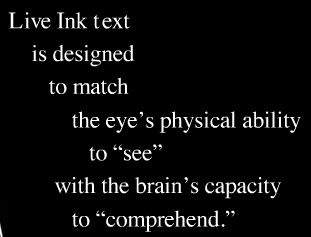
Live Ink is an alternative approach to presenting texts in screen environments, arranging them in series of cascading phrases to increase readability (I saw this a couple of years ago at an educational publishing conference but it was brought to my attention again on Information Aesthetics). Live Ink was developed by brothers Stan and Randall Walker, both medical doctors (Stan an ophthalmologist), who over time became interested in the problems, especially among the young, of reading from computer displays. In their words:
liveinktext.jpg
Here’a screenshot of their sample reader with chapter 1 of Moby-Dick:
liveinkdemo.jpg
Thoughts?

edit the galaxy

Galaxiki is “a new kind of wiki based community portal that allows its members to edit stars, planets and moons in a virtual galaxy, creating an entire fictional world online.” The site uses primarily public domain NASA photography.

Millions of stars, planets, moons, pulsars and black holes can be explored using an intuitive 2D map. The site software manages most of the physical properties and behaviours of the solar systems, from orbits to the chemical composition of planetary atmospheres. Some planets offer conditions that may allow life – the idea behind Galaxiki is that community members can create fictional life forms and write about their histories on their planets….For only USD 12.- (or EUR 10.-) you can purchase your own solar system that only you can edit.

darker side of youtube

There’s a good piece in Slate by Nick Douglas, a writer and video blogger out of San Francisco, that casts YouTube as the Hollywood of web video – ?purveyor of bite-sized crap with mass appeal, while the smaller, more innovative “independents” (the Groupers, Vimeos and blip.tvs) struggle in its shadow. YouTube’s dominance, Douglas argues, leads viewers to expect less of a fledgeling cultural arena that could become the leading edge of filmmaking but instead has been made synonymous with shallow, momentary titillation.
Douglas’ critique is on target, and it’s vital to keep questioning the so-called diversity of the mega-aggregators who increasingly dominate the Web, but I wonder whether serious video producers really ought to be looking to YouTube and its competitors as the ultimate venue. As promotional and browsing sites they work well, but a networked, non-Web video client like Miro could be a better forum for challenging work.