the new promiscuity

A couple more small items for the “content is free, networks are valuable” meme… these w/r/t television. First, this LA Times piece on CBS’s “new internet strategy”:

The idea is to let their online material be promiscuous: Instead of limiting their shows and other online video to CBS.com, the network is letting them couple with any website that people might visit.
“CBS is all about open, nonexclusive, multiple partnerships,” said Quincy Smith, president of CBS Interactive.

A big part of this strategy is building an “audience network,” and to this end the newly revamped CBS site provides a variety of fora – ?message boards, wikis, and user-generated media galleries – ?to try to capture some of the energy of its various fan communities. It’s a fine line to tread, since fan culture is almost by definition self-organizing and thrives on a sort of semi-autonomy. But perhaps this only because the broadcasters have hitherto kept their distance (the occasional self-defeating lawsuit notwithstanding). It’s an interesting (and somewhat yucky) question, and one that applies well beyond TV: to what extent can community be branded?
Compare this with NBC’s more retentive move toward quasi-openness, post-iTunes, with NBC Direct, a service that offers free downloads of shows with auto-destruct DRM that wipes files after a week. I don’t think either network’s got it yet, but these are interesting experiments to watch.
In light of this, it’s worth revisiting Mark Pesce’s 2005 talk, “Piracy is Good?”, available here on Google Video.

dis-content

A few good readings to inject into recent conversation here about a post-copyright world (1, 2, 3), and in light of the death of Times Select and the ripple effect that is likely to have across the Web. First, a two-year-old post by Jeff Jarvis, “Who Wants to Own Content?”, ruminating on the supreme value of trust and conversation in a post-scarcity publishing ecology:

But in this new age, you don’t want to own the content or the pipe that delivers it. You want to participate in what people want to do on their own. You don’t want to extract value. You want to add value. You don’t want to build walls or fences or gardens to keep people from doing what they want to do without you. You want to enable them to do it. You want to join in.
And once you get your head around that, you will see that you can grow so much bigger so much faster with so much less cost and risk.
So don’t own the content. Help people make and find and remake and recommend and save the content they want. Don’t own the distribution. Gain the trust of the people to help them use whatever distribution and medium they like to find what they want.
In these new economics, you want to stand back and interfere and restrict as little as possible. You want to reduce costs to the minimum. You want to join in wherever you are welcome.
So in the content world, it is better help enable and be part of fluid networks of content than it is to create and own content…It is better to find new efficiencies than new blockbusters…It is better to gather than create…It is better to share trust than to horde it.

Whatever the media business models of tomorrow may be, they will almost certainly not revolve around owning content. It will be about, as Jay Rosen says in his Times Select obit, “weaving yourself into the Web”:

…that’s the decision in Web court the New York Times is accepting. Consent decree with the open web. Dismisses all courses of action against Google. Times agrees to drop Times Select, which was a barrier to Google – ?and the blogosphere – ?working the right way.
The decision says you can try to charge, and some people will pay, but there is more money and a brighter future in the open flow of Web traffic, a lot of which is coming sideways into your content stack because Google sends tons of users in that way, not through your pearly gates of news, also called a home page. RSS sends stuff from the middle of the stack out.
When every barrier you create to their participation with your product weakens your revenue stream, which is tied to openness, you’re in the world of the consent decree. Advertising tied to search means open gates for all users. It means link rot cut to zero, playing for the long haul in Web memory and more blogs because they are Web-sticky.

Now back to Jarvis, who in a new post predicts among other things that the Times’ decision will likely be the first domino in a chain of paywall demolitions: Wall Street Journal, Economist, Financial Times. He picks up the thread from his older piece:

It’s the relationship that is valuable. It’s the relationship that is profitable, not the control of the content or the distribution. That is the essential media moral of the internet story. It has taken 13 years of internet history for media companies to learn that, to give up the idea that they control something scarce they can charge consumers for, but they’ve finally learned it. That is the lesson of the death of TimesSelect.


the institute sets up shop in london

Beginning today, i’ll be spending at least ten days per month in London where i’ll be a senior fellow at the London School of Economics and also joining our new colleague, Chris Meade, with the intention of establishing a London base for the institute. Until recently Chris was the director of Booktrust, an organization which among other things gives a package of books to all children born in Britain at the time of their birth and when they start primary school. A year ago Chris signed up for the pioneering Creative Writing & New Media masters program at DeMontfort University and decided to make the leap into the future. He’s landed here with us and will be the co-director of the institute, based in London.

books and the man, part II (sort of)

So in my last post I compared the sentiments expressed in Pope’s Dunciad to those of Andrew Keen’s The Cult of The Amateur, and suggested some parallels between the eighteenth-century print boom and the explosion of user-generated content in web2.0. The point I wanted to make was that the model of content production championed by Keen is historically-specific and relies on an economic context where printed matter is common enough to be marketed to the general public, but still scarce enough to enable writers to make a living from selling units of content to their audiences.
I’ve been gnawing for some time at the question of what happens to creative writers – or artists in general – in a world where success of content is based not on its scarcity (the ‘high art’ model) but on ubiquity and infinite reproducibility. If copyright no longer exists, how can (already often cash-strapped) independent arts workers sell their work? And what will they do if they can’t?
So I was intrigued to come across Meta-Markets, an experiment by MIT media artist Burak Arikan, currently in beta. In this ‘marketplace’, users can ‘IPO’ shares in del.icio.us links, Feedburner feeds, Flickr profile views and the like. It’s pleasing in a surreal way to watch shares in ‘you’ going up and down – particularly as I’m trading from London and most of the others are based in NY, so the stocks go crazy at weird times of the day and night relative to me. But it also provokes some intriguing speculations around the potential to create an economic model for the arts online that is genuinely based on the internet’s drive toward reproducibility rather than scarcity.
One of Arikan’s stated aims with Meta-Markets is to explore ways in which creative types can leverage their immaterial labor as new kinds of ‘currency’ – in other words, to find a business model for trading cultural stuff online that isn’t dependent on price per copyrighted unit. And it starts some intriguing trains of thought. In order to ‘IPO’ a link, you have to have been the first to bookmark it, and at least 10 others have to have bookmarked it after you. So it requires both some minimal popularity, and also a ‘first claim’ ownership. I was irked to find, for example, that I couldn’t bookmark my own website and then sell stocks in it, because someone else already ‘owns’ that link.
So, I wondered, what if real money were involved? Supposing my website suddenly shot up the Alexa rankings, would I be in a position of watching someone else make a fortune on ‘ownership’ of my bookmarks? Or would the first thing to do after launching something online be to bookmark the URL so as to ensure you can trade on its popularity? Following that train of thought a little further, it’s possible to imagine some folksonomic inversion of the centralised copyright law taking the place of the existing system. This might then enable artists and writers to claim a fuzzy, emergent ‘ownership’ of creative online work and thus to find ways of making a living from it.
But I think that’s a long way off, if it ever happens at all. Meanwhile, we’re a long way from having any consistently viable independent revenue model for online artists, who find themselves between starvation, corporate sponsorship and the sometimes rather stodgy world of public/philanthropic arts funding. But again, maybe that’s not such a bad thing, of which more next time…

all the news that’s fit to search

Placing a long-term bet on online advertising and the power of search engines, the New York Times will, effective tomorrow, close down its two-year-old “Select” subscription service (which was actually making money for the paper) and opened up access to columnists, Select blogs, and archives from 1987 to the present, and 1851 to 1922. Nice!
From PaidContent, quoting the Times’ own coverage:

The change is because of what’s happened in the internet in the past two years – ?particularly the power of search.” She [Vivian Schiller, senior vp and general manager of nytimes.com] added later: “Think about this recipe – ?millions and millions of new documents, all seo’d [search engine optimized], double-digit advertising growth.” The Times expects “the scale and the power of the revenue that would come from that over time” to replace the subscriptions revenue and then some.

shock treatment

I’ve never been a fan of book trailers, but this disturbing six-minute agitprop piece promoting Naomi Klein’s new book The Shock Doctrine: The Rise of Disaster Capitalism is genre-transcending. It doesn’t hurt that Klein teamed up with Mexican director Alfonso Cuarón, who made what was for my money the best major release picture of last year, “Children of Men.” Here, Klein and Cuarón are co-writers, Cuarón’s son Jonás directs and edits, and Klein provides narration over a melange of chilling footage and animation that sets up her central thesis and metaphor: that free market capitalist reforms are generally advanced, undemocratically, through breaches in the social psyche created by political, economic, environmental or military shocks. It’s a shocking little video. Make you wanna read the book?

you can’t copyright copyright

The indefatigable Carl Malamud of public.resource.org today sent out a public interest letter to the U.S. Copyright Office demanding that they provide bulk access over the Internet to the catalog of copyrighted monographs, documents and serials, a resource which to date has been accessible in full only through costly subscriptions and access fees to the tune of $86,625 (currently it’s available for free only by individual record queries).

The copyright catalog of monographs, documents, and serials is not a product, it is fuel that makes the copyright system work. Anybody should be able to download the entire database to their desktop, write a better search application, or use this public domain information to research copyright questions.

It also makes the point that under U.S. copyright law, government publications are supposed to be automatically in the public domain, which makes this Library of Congress-sponsored priced access racket particularly hard to swallow. Read the full letter (co-signed by a good group including Peter Brantley and Rick Prelinger) here.
(via O’Reilly.)

candida höfer: the library as museum

The photographs of libraries in “Portugal,” the current exhibition of Candida Höfer at Sonnabend, show libraries as venerable places where precious objects are stored.
hoferlibrary1.jpg
The large format that characterizes Höfer’s photographs of public places, the absence of people, and the angle from which she composes them, invite the viewer “to enter” the rooms and observe. Photography is a silent medium and in Höfer’s libraries this is magnified, creating that feeling of “temple of learning” with which libraries have often been identified. On the other hand, the meticulous attention to detail, hand-painted porcelain markers, ornately carved bookcases, murals, stained glass windows, gilt moldings, and precious tomes are an eloquent representation of libraries as palaces of learning for the privileged. In spite of that, and ever since libraries became public spaces, anyone, in theory, has access to books and the concept of gain or monetary value rarely enters the user’s mind.
hoferlibrary2.jpg
Libraries are a book lover’s paradise, a physical compilation of human knowledge in all its labyrinthine intricacy. With digitization, libraries gain storage capacity and readers gain accessibility, but they lose both silence and awe. Even though in the digital context, the basic concept of the library as a place for the preservation of memory remains, for many “enlightened” readers the realization that human memory and knowledge are handled by for-profit enterprises such as Google, produces a feeling of merchants in the temple, a sense that the public interest has fallen, one more time, into private hands.
As we well know, the truly interesting development in the shift from print to digital is the networked environment and its effects on reading and writing. If, as Umberto Eco says, books “are machines that provoke further thoughts” then the born-digital book is a step toward the open text, and the “library” that eventually will hold it, a bird of different feather.

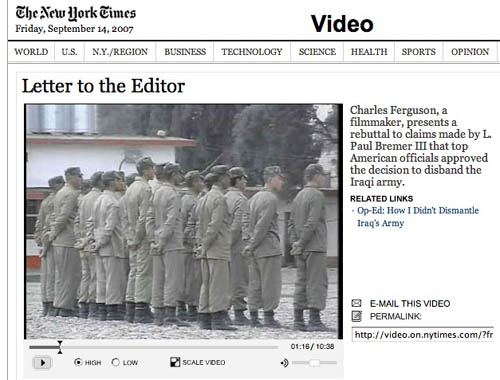
ny times publishes first video letter to the editor

nytvideoletter.jpg
The Times has published its first video “letter to the editor,” a 10-minute mini-documentary by Charles Ferguson on the decision by L. Paul Bremer and other US officials to disband the Iraqi army shortly after the US occupation began. The video is posted as a rebuttal to a recent op-ed by Bremer that tried to redistribute some of the blame for that catastrophic blunder that arguably gave birth to the Sunni insurgency.
This is no doubt a milestone for the paper, although calling it a letter to the editor is slightly disingenuous. Ferguson isn’t just your average concerned reader, he’s a highly respected filmmaker and author who has made a full length doc about Iraq, “No End in Sight,” from which much of this video’s material is taken.
Moreover, at ten minutes, and meticulously edited and produced, filled with interviews with top military brass and gov’t officials, the clip is more on par (at the very least) with a full op-ed. The main opinion page even features it as such – ?under op-ed contributors – ?rather than placing it down among the letters. Will we eventually see actual ad hoc video letters to the editor from “readers” at large? That could be interesting.
Nomenclature aside, though, this is a fantastic broadening of the Times‘ editorial output. Once again, they prove themselves to be one of the more innovative digital publishers around.

learning from youtube

Alex Juhasz, a prof at Pitzer College and member of the MediaCommons community, has just kicked off an exciting experimental media studies course, “Learning From YouTube,” which will be conducted on and through the online video site. The NY Times/AP reports.
The class will be largely student-driven, developed on the fly through the methods of self-organization and viral production that are the MO of YouTube. In Juhasz’s intro to the course (which you can watch below), she expresses skepticism about the corporate video-sharing behemoth as a viable “model for democratic media,” but, in the spirit of merging theory with practice, offers this class as an opportunity to open up new critical conversations about the YouTube phenomenon, and perhaps to devise more “radical possibilities.”

Over on the MediaCommons blog, Avi Santo provides a little context:

…this initiative is part of a long history of distance learning efforts, though taken to another level, both because of the melding of subject matter and delivery options, but also the ways this class blurs classroom boundaries physically and conceptually. We need to acknowledge this history, both innovative and failed, if we want to see Juhasz’s efforts as more than an interesting experiment, but as one emerging out of a long tradition of redefining how learning happens. As media scholars, we are on the forefront of this redefinition, able to both teach about and through these technologies and able to use our efforts to both critique and acknowledge their uses and limitations…