
Ben posted a few weeks back about an intriguing new interactive project in the pipeline from Penguin. WeTellStories, produced for Penguin by ARG studio SixToStart is now out in the open. Comprising six stories based on Penguin Classics, released one a week for the next six weeks, WeTellStories aims to create born-digital riffs on classic books.
I played through (‘read’ doesn’t quite describe it) the first of these earlier today: The 21 Steps by Charles Cumming, based on Buchan’s classic thriller The Thirty-Nine Steps. The 21 Steps is told through narrative bubbles that pop up as the story picks its way across a Google Earth-like satellite map, and describes the experience of a man suddenly caught up in sinister events that he can’t seem to escape.
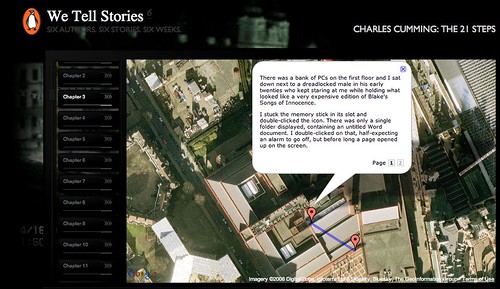
Overall the experience works. The writing is spare enough to keep the pacing high, vital when the other umpteen billion pages I could possibly be surfing are all clamoring for my attention. The dot moving across the map creates a sense of movement forward (as well as some frustration as it crawls between narrative points), and the Google Earth styling is familiar enough as a reading environment for me to focus on enjoying the story rather than diverting too much energy to decoding peripheral material. The interface is simple and tactile in ways that advance the story without distracting from its development, either by offering diverging routes through it or overloading the central ‘chase’ narrative with multimedia clutter. And the satnav pictures add a pleasurable feeling of recognition (‘Look! There’s my house!’) to offset an essentially far-fetched story.
For a single-visit online story experience, it was nearly too long: I found myself checking how many instalments I still had to get through. The ending was somewhat anticlimactic. And though WeTellStories has been rumored to have ARG elements, and is produced by an ARG studio, I did a hunt around for potential ARG-style ‘further reading’ rabbit holes and found nothing. So either it’s too subtle for a journeywoman ARG fan like me, or the overarching ‘game’ element really is just the invitation to follow all six stories and then answer some questions to win a prize.
If so, I’ll be disappointed. But it’s early days still, and there may be more up SixToStart’s sleeve than I’ve seen so far. It’s encouraging to see ‘traditional’ publishers exploring inventive ways of riffing on their swollen backlists’ cachet and immeasurably rich narrative wealth. And The 21 Steps comes closer than most ‘authored’ digital fictions I’ve encountered to achieving some harmony between narrative and delivery mechanism. So though I’m being nitpicky, the project so far hints at the possiblity that we’re beginning to see online creative work that’s finding ways of marrying the Web’s fragmented, kinetic megalomania with the discipline needed for a gripping story.
expressive processing: post-game analysis begins
So Noah’s just wrapped up the blog peer review of his manuscript in progress, and is currently debating whether to post the final, unfinished chapter. He’s also just received the blind peer reviews from MIT Press and is in the process of comparing them with the online discussion. That’ll all be written up soon, we’re still discussing format.
Meanwhile, Ian Bogost (the noted game designer, critic and professor) started an interesting thread a couple of weeks back on the troubles of reading Expressive Processing, and by extension, any long-form text or argument, on the Web:
The peer review part of the project seems to be going splendidly. But here’s a problem, at least for me: I’m having considerable trouble reading the book online. A book, unlike a blog, is a lengthy, sustained argument with examples and supporting materials. A book is textual, of course, and it can thus be serialized easily into a set of blog posts. But that doesn’t make the blog posts legible as a book…
…in their drive to move textual matter online, creators of online books and journals have not thought enough about the materiality of specific print media forms. This includes both the physicality of the artifacts themselves (I violently dogear and mark up my print matter) and the contexts in which people read them (I need to concentrate and avoid distraction when reading scholarship). These factors extend beyond scholarship too: the same could be said of newspapers and magazines, which arguably read much more casually and serendipitously in print form than they do in online form.
I’ve often considered Bolter and Grusin’s term “remediation” to be a derogatory one. Borrowing and refashioning the conventions of one medium in another opens the risk ignoring what unremediated features are lost. The web has still not done much more than move text (or images, or video) into a new distribution channel. Digitizing and uploading analog material is easy and has immediate, significant impact: web, iPod, YouTube. We’ve prized simple solutions because they are cheap and easy, but they are also insufficient. In the case of books and journal articles, to offer a PDF or print version of the online matter is to equivocate. And the fashionable alternative, a metaverse-like 3D web of the sort to which Second Life points, strikes me as a dismal sidestepping of the question.
so when are you going to retire?: a book in process about age, work and identity

I want to give a shout out to a wonderful new project by a dear friend of ours. So When Are You Going to Retire? is -? or will be, or is in the process of becoming -? a book exploring questions of age, work and identity through the stories of people over 80 who continue, against the odds, to work for a living. As of very recently, the author, Ashton Applewhite, has begun documenting her research on a very attractive new weblog, and is inviting readers, writers and experts in the field to join her in conversations and story sharing that hopefully will shape the book’s development. In an email, Ashton explained to me why she’s doing this:
I’m a generalist writing about a broad topic: people in their 80s and 90s who are still in the workforce, and what we can learn from them. Following on the Institute’s work with Siva and Mitchell Stephens, I’m excited about using the blog as a mechanism for thinking out loud as I go through my material, formulate the themes of the book, and write the proposal. I think that ongoing feedback from experts (gerontologists, social scientists, demographers, etc.) and discerning readers will sharpen and inform my thinking -? in other words, that the network will help me build a better book. I also think i’ll end up with a valuable platform for leveraging and disseminating my work over the long run -? one that could radically revise conventional notions of shelf life. Cutting Loose, my book about women and divorce (HarperCollins, 1997) is still in print; imagine what sales would look like if it were at the hub of an ongoing social network, and what a rich site that would be?
Though this isn’t an officially Institute-sponsored project, we’ve done a fair bit of kibbitzing from the sidelines on the conceptual layout of the site and on general strategies for writing it (this being Ashton’s first foray into blogging). We’re also brainstorming with Ashton on that most crucial of issues: building an audience. Most of our networked book projects have been on technology or media-related subjects that naturally appeal to online readerships and get picked up easily in the blogospheric grapevine. Ashton’s book doesn’t have such an obviously built-in wired constituency, although its potential readership is far broader and more diverse than that of any of the works we’ve published. I imagine it will be a gradual, word of mouth kind of thing.
So check out Ashton’s rich and inviting site, join the conversation, and spread the word to anyone you know who might be interested. If you know of any specific sites or online communities that Ashton might want to connect with, let her know through the “email me” link near the top of her site. There’s already quite a lot to delve into since Ashton’s been blogging under the radar for the past several months, cutting her teeth on the form and piling up some wonderful stories (many of which you can listen to in audio). Help start building this network, and this book.
issue magazine
Hot on the heels of Rosa B. (mentioned last week) comes Issue Magazine, another new web-based publication looking at the changing world of publishing and design. Issue #0, edited by Alexandre Leray and Stéphanie Vilayphiou, is undergoing a slow rollout this week, culminating in a live chat with Arie Altena, Jouke Kleerebezem, and Harrisson on Friday. Currently they’re featuring an essay and an interview with David Reinfurt of Dexter Sinister and Dot Dot Dot on the idea of open-source design and publishing; an interview with Kleerebezem and a piece by Roger Chartier will be up before the end of the week.
What’s particularly interesting about the format of Issue – and one area in which it differs from Rosa B. – is the way that commenting has been integrated into the articles: after units of the text, there’s the opportunity for the reader to add comments. It’s a bit like CommentPress in conception, but the prompts to comment in Issue appear less frequently than every paragraph. This makes sense: paragraph-level commenting is invaluable for close-reading, but less necessary for the general discussion of an essay. Because it’s early, there don’t seem to be any comments yet, but it’s a promising model of how the readers can be more immediately integrated into a publication.
hmmm. . . . please discuss
The following quote was in AP story i read in MIT’s Technology Review this morning about Microsoft licensing Adobe’s mobile Flash and PDF software.
“Flash content is the most prolific content on the web today; it is the way people express themselves on the Internet,” Adobe spokesman Gary Kovacs said.
Hmmm . . . . i suppose it might be true that if you add up all the gigabytes of You-Tube videos that more content on the web is in Flash than any other format. But to say that Flash is the way that most people express themselves seems just a tad disingenuous. You-Tube and other sites convert amateur production into Flash; only a small minority of that content is actually created in Flash. But the reason i’m bothering to post this isn’t to call Adobe out for misleading numbers it’s to raise a warning flag — actually two warning flags
1. Converting amateur production into Flash as You-Tube and other for-profit sites do, effectively moves that content into a proprietary format which resists re-use and re-mix. This is not a good thing.
2. Flash is not easy software to master. If it were true that most conent on the web was created natively in Flash rather than converted into it after the fact, that would mean that content creation had moved decisively into the province of the professional, returning us to the built-in the hierarchies of print and broadcast media. Also not a good thing.
step inside the books: new york event this friday (3/21)
If you’re in the New York area, don’t miss this. Friday, March 21, 2008, 7-9pm – ?New York, NY – ?125 Maiden Lane, 2nd Floor.
FOR ONE NIGHT ONLY: Step inside three books, drink free beer and wine, and experience the future of the book:

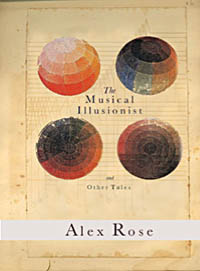
Mark Batty Publisher, Hotel St. George Press, the Institute for the Future of the Book, and the Lower Manhattan Cultural Council‘s Workspace Writers Residency program offer a night of multi-media readings that invite attendees to step inside books, celebrating how new media and traditional publishing fuse to create innovative projects that are more than “just books.” On this night, authors Garth Risk Hallberg, Alex Rose, and Alex Itin demonstrate how their stories rely on more than just words.
Hallberg’s illustrated novella, A Field Guide to the North American Family, documents two fictional families through 63 entries accompanied by evocative photographs contributed by some of today’s freshest photographic talents, as culled from the book’s ongoing companion website, afieldguide.com. Read from start to finish or in a “choose your own adventure” style, Hallberg’s attention to narrative detail makes clear why he was included in the 2008 Harcourt Best New American Voices anthology, and why Print called A Field Guide to the North American Family “a modern illuminated manuscript.” Hallberg will project photographs from the book.
The interwoven, post-modern folktales that comprise The Musical Illusionist by Alex Rose muse upon historical arcana, tethered together by music and topography. Drawing on his experience as a director whose films, videos, and animations have appeared on HBO, MTV, Comedy Central, Showtime, and the BBC, Rose conjures, in the words of the Village Voice, “the playful parables of Jorge Luis Borges . . . exotic maps and exquisite prints further suggest a volume passed down from an epoch much more enthralled with mystery than our own.” Rose will read from the title story of his collection, accompanied by a surround-sound score composed by David Little and recorded by the Formalist Quartet.
As an artist-in-residence at Brooklyn’s Institute for the Future of the Book, Alex Itin uses text, original illustrations and animations, and music to encourage readers to reconsider the definition of a book. Take for example Itin’s Orson Whales: Melville’s Moby Dick meets Orson Welles, and Led Zeppelin. Itin’s multi-media books will be screened.
The LMCC is the leading voice for arts and culture in downtown New York City, producing cultural events and promoting the arts through grants, services, advocacy, and cultural development programs.
googlization of everything now has print publisher
In case you missed the news last week, Siva has locked up a deal with the University of California Press to publish the North American print edition of The Googlization of Everything. It’s due out late summer, 2009. Profile will publish it in the UK and British Commonwealth. We’re currently brainstorming next steps for the blog as Siva moves into intense drafting and revising mode. Congrats, Siva!
in search of jenny everywhere
It’s mainly the literary world that assumes fictional work to be best when the creation of only one person. Most TV shows, movies, games and comics are created by teams. But though creativity here is not bound by the Romantic conception of the individual Artist, neither is it free for all. Fan fiction notwithstanding, as the property of publisher, broadcast company or studio, fictional universes are strictly controlled.
In the comics world, there are a handful of characters that could be described as explicitly ‘open-source’. Mythic characters are no-one’s property. Michael Moorcock’s Jerry Cornelius was created with the intention that he be available for use as an open character. And Octobriana, a kind of socialist Barbarella, is Communist in both origin and legal status. Allegedly – though the story is somewhat murky – the creation of a 1960s Soviet underground group, her genesis outside Western comics publishing has meant that Octobriana has always existed in the public domain, and she has appeared in numerous different universes.

Inspired partly by Octobriana, in 2001 Barbelith founder and Web commentator Tom Coates and comic artist Steven Wintle led a community discussion about open-source narrative figures. As a result of these discussions, the group decided to create their own: in discussions over the next few months, Jenny Everywhere, aka ‘The Shifter’ was born.

Wintle’s original sketch for Jenny (Source: The Shifter Archive)
Jenny has certain core characteristics. She is a multidimensional person able to appear anywhere, in any universe, at any time. She can be in more than one place at a time. Her favorite food is toast, she wears goggles on her forehead, she is usually depicted with short dark hair and comfortable clothing. (The discussion threads where these characteristics were agreed make intriguing reading). But though she as some distinguishing features, she is explicitly available for any artist to use, providing the following text (first associated with Jenny in 2002) appears alongside:
The character of Jenny Everywhere is available for use by anyone, with only one condition. This paragraph must be included in any publication involving Jenny Everywhere, in order that others may use this property as they wish. All rights reversed.
I wasn’t part of Jenny’s genesis. I came across her only recently, while hunting for something else, and was fascinated. An explicitly open-source character: neither a proprietary figure repurposed on the fringes of legality by fan communities, nor a mythic and hence uncopyrightable figure, nor one whose copyright has simply lapsed, but a set of narrative opportunities co-created and available for everyone to use. As much a political gesture as an artistic framework. I wanted evidence that she’d grown beyond that initial idea.
A bit of Web archaeology turned up a cluster of excitement and creative activity between 2001 and 2003 centering on the Barbelith community. She made appearances in numerous webcomics, turned up on blogs, popped up on Boing Boing. But then it all went quiet again.
I’d had hopes that Jenny might be, as the NYT article suggested, a herald of cultures to come. And there’s nothing more dispiriting than to read past predictions for phenomena that never came to be. But websites become flavor of the month so swiftly, and fade just as swiftly: it seemed that Jenny Everywhere just a transient moment in the hyperaccelerated maelstrom of geek subcultures.
But it seems I was wrong. Jenny is making a comeback. A 2007 Jenny competition on Stripfight saw a rash of new appearances; around the same time The Shifter Archive was launched, a new attempt by US comic artist David ‘Fesworks’ Leyk (to whom I’m hugely indebted for the information in this article) to collate and make available all extant Jenny Everywhere work. And new comics are beginning to appear.

A common pattern of relatively self-organizing co-creation sees a notionally ‘flat’ structure in fact driven by a self-selecting ‘core’ that gives the whole collective focus and drives creative energy. When this core steps back, the entire project often falters. I’ve found myself speculating: did Jenny’s initial core creators find their open-source character, unprotected by the corporate interests of a publisher or distributor, mutating to a point where she ceased to interest them? Or was it just a case of people moving on to new projects?
Either way, it points to the fact that for an open-source idea to reproduce, it must be able to outgrow its pioneers. After the initial enthusiasm died down, Jenny is still going strong: not harbored and protected by a close group in the bosom of a web community, but at large and self-reproducing. As ‘Fesworks’ puts it:
“There is no “official” site for Jenny Everywhere. Since she is Public Domain, and open-source […], technically every single Jenny Everywhere comic and story out there is “Fan Fiction”. They only connect to other people’s stories and comic if they choose to connect them.”

Jenny is a tantalizing glimpse of how collaborative, open creativity can be accelerated by the Web. Compared to her print prototype Octobriana, her spread in just seven years is phenomenal. But she raises many questions. For one thing, it is hard to see how a character not possessing quantum superpowers could survive the narrative vicissitudes of starring in the creations of multiple writers without disintegrating to meaninglessness – which in turn may mean that Jenny is a one-off. Then, her genesis and (still short) history is an intriguing case study of the difficulties of balancing creative vision with open collaboration – a problem, arguably, that also faced the Million Penguins wiki-novel and is at the core of the complicated relationship between artists and the Web.
And finally, it’s also about archiving, the fragility of Web history and – Wayback Machine notwithstanding – the rapid decay of old digital artefacts. 2003 is not a long time ago, but many of the old Jenny links are broken. Without the efforts of ‘Fes’, Jenny might be little more than a memory by now. Does any of this matter? If the Web is to become a meaningful locus for creative work, then these are indeed questions to take seriously.
friday projections
It’s all go on the digital publishing scene in the UK with Penguin launching their first ARG next week – go to www.wetellstories.co.uk for more details, and various big companies plotting experiments. Meanwhile this week Gail Rebuck, chief executive of the Random House Group, delivered the Stationers’ Company Annual Lecture on New Chapter or Last Page? Publishing books in a digital age, an upbeat and positively inspirational assessment of the potential for e-reading.
She ends: “This future is ours to grasp, but only if we understand that it is not technology that makes books, but readers, and authors and creativity. It is our collective responsibility to ensure that every child can read, and can have his or her world opened to the extraordinary possibility that only books can offer. Our responsibility is to nurture every last drop of creativity and talent that we have in our society. And finally our responsibility is to protect creativity so that all of us, not just the authors themselves, can be rewarded and enriched.”
All great stuff and well worth reading in full.
Rebuck says, “people who think a new reading device will somehow change the content of the books we love are missing the point: our attraction to narrative is visceral and enduring, an integral part of being human. Whether we choose to read our favourite novelists on a printed page or in E Ink, it simply doesn’t matter, because that core experience of books will remain undiminished.”
Undiminished yes, but changed surely. The next great breakthrough won’t be an e-reader but some born digital piece of transliterate brilliance. Great art stops us in our hectic cultural tracks and forces us to settle down and appreciate it on whatever ‘platform’ it was made for. We need a digital Shakespeare (or even a Rowling) to get readers downloading with passion.
I feel more confident about our enduring cultural richness than the viability of parts of the publishing industry in these turbulent times of convergence and confusion when anyone with a sharp mind, an office full of macs and some financial backing can have a crack at producing pretty much anything . Doing our research for the Arts Council it’s been a delight to meet sparky young independent publishers like Salt and Snow who are doing exciting things to sell books made of paper in a webby way, but it’s tough out there.
I was delighted to be on the panel of ‘Book Futures’ last night, the final event of the London Word Festival, a dynamic new event marketed through a torrent of blogposts, emails and facebookery. Up there with me was Scott Pack, the once much feared buyer of Waterstones – he who decided which books went in the shop windows – whose blog-to-book company The Friday Project appears to be in deep financial trouble. Of course rumours of new backers hover, but it’s hard to tell right now whose waving whose drowning.
trade-offs
Alex Itin just cross-posted a wonderful new piece on his blog, and Vimeo.
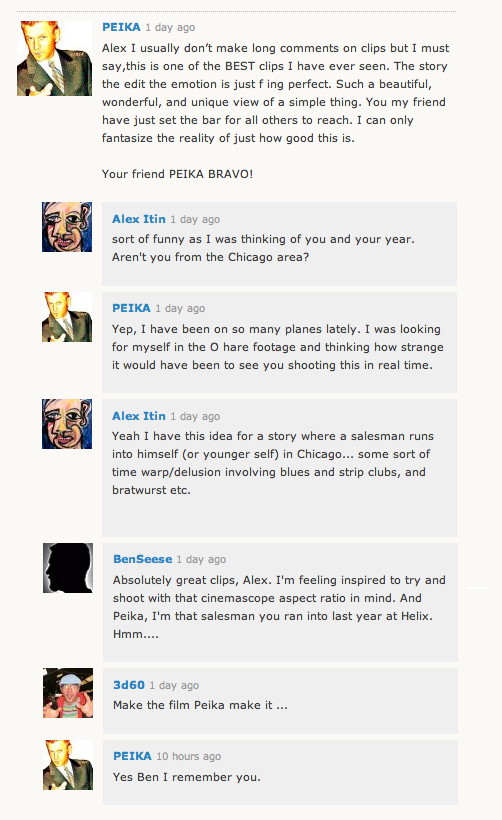
I watched it on Vimeo and was struck by the terrific back and forth discussion between Alex and the people who are looking at his work. It’s gone beyond “cool video dude” and “you rock” to include rather thoughtful sharing of feelings and riffs on ideas for new work. By engaging with his “readers” in the way that he is, Alex is building a community around his work. He is inventing a new medium and unconsciously taking on the role of “author in a networked environment” that we talk about so often on these pages.
Check out this exchange on Vimeo about the video:
I am struck by the compromise Alex has to make as an artist in order to build a community around his work. When we first met, Alex was making brilliant multi-modal works combining his paintings, video and audio mash-ups. While on the one hand he had complete control over how the elements appeared and combined it was done in proprietary software which created standalone documents which seriously limited the size of his potential audience. In 2005 he became the institute’s first artist in residence and we made a blog for him where he started posting a continuous stream of individual works. Moving onto the web provided a much larger audience, but the blog format meant that he lost the ability to make complex layered works. Alex’s big web breakthrough came when he started to post his paintings to Flickr and his videos to Vimeo. This allowed him to begin a dialog with his audience and even to begin a series of exciting collaborations with other artists. But at the expense of having to put his paintings on one site and his videos on another.
The balkanization of art works (video here, photos there, and audio in yet another space) in the web 2.0 environment is frustrating, but i completely understand why it’s better to show your work in a place which fosters a dynamic and lively back and forth. I look forward to the day when artists won’t have to make a trade-off between form/content and community.
Sophie 1.0 is being released next week and Alex is the first artist we’re giving it to. Sophie documents don’t display in a web page (yet) but they do have an online component which enables people to have a conversation about the work in the “margin” of the work itself. Stay tuned, we’ll put an announcement up here of Alex’s first Sophie.