
We’ve now launched a website for if:book london, the British iteration of the Institute, at http://www.futureofthebook.org.uk, and that links both to this blog and one which will focus on UK activities and in particular our work with the literature sector following a very positive reception by Arts Council England to the report by Mary and I: read:write – digital possibilities for literature and the imminent launch of another report, digital livings, how new media writers do, can and could make their way in the world , commissioned by the Institute of Creative Technologies at De Montfort University. We will be making both reports available to download as soon as possible.
I think this if:book blog is wonderful, stimulating, challenging, brilliant – and so somewhat daunting to post on. It has a strong sense of itself and, tell me if you disagree, but it doesn’t feel right to me to start bombarding this space with discussion of very specific issues to do with the UK literary scene and the organisations which work around it. Which isn’t to say that some posts shouldn’t appear in both places.
One reason I’m hesitant about writing here is uncertainty about who I’m talking to.
I would love to know more about if:book readers and wonder if some might be prepared to step forward and tell us briefly about themselves and why they keep an eye on this place.
I would love to see an anthology of if:book’s best bits, in print on page or screen. People have been writing serious, lengthy essays here, some of which quickly stimulate much attention, others drift by unnoticed like leaves in the blogflow and deserve fuller consideration.
Meanwhile Sara Lloyd, Head of digital publishing at Pan Macmillan in the UK quotes if:book in a fascinating book publishers manifesto for the 21st century. You can download it from http://thedigitalist.net/?p=155. It’s more evidence that the future of the book may be arriving shortly in the NOW and, having led the way up to this point, now is a good moment for the Institute to reflect further on what role(s) it wishes to play in a rapidly changing landscape, whether it should be looking much further ahead for next big futurethings or focusing on specific interventions in distribution and creation in the digital here and now.
However on the ‘it’ll-never-catch-on’ front, Doctor Who, Britain’s favourite time traveller, is trapped on a gigantic planet-sized library on BBC 1 this week. Electronic librarians oversee rows of very conventional looking dusty tomes and death lurks in the shadows. The Doctor has already told us how, despite all the advances in technology, future life forms still love nothing better than the smell and feel of a proper old book. No sign of the great grandchildren of Kindle here yet then, but it is only episode one. More next week!
if:janus
It’s been pretty quiet on the blog for the last few weeks. This is partly because there’s a lot of work going on backstage. But it’s also symptomatic of the fact that the research, writing and blogging element of the Institute for the Future of the Book is in the process of serious self-examination.
My first encounter with the Institute for the Future of the Book was via if:book. I posted a comment, received an email from Bob, wrote back, and found myself having tea with him at the Royal Court Theatre in London a week or so later. In my naivete, I hadn’t fully taken on board that it was the output of a think tank, a dedicated group of people whose full-time job it was to think about these things. Because most of the online creative work I was involved in at the time was part-time, voluntary and unpaid, I assumed that if:book worked the same way and asked how I could go about acquiring posting rights.
But the Institute has always been very open-sided. I got my posting rights. Then, shortly after making a first post, I was invited out to NYC to hang out with the team. What had begun as a playful, remote interaction of ideas suddenly took on form and force.
While the Web can often seem more divisive than social – a culture of mouse potatoes unable to interact with other humans save through keyboard and avatar – there are times when it can throw extraordinary, life-changing things your way. The Institute has been one of those for me.
But a lot has changed since I appeared on the scene a year and a half ago, both within the Institute and across the worlds of technology, digital arts and academia in whose cross-fire the Institute found its groove. With Penguin running ARGs, e-readers in the news every second week, and Web2.0 less a buzzword than an enabling condition of contemporary life, thought, debate and activity around discourse and the networked screen has exploded in all directions.
For a blog that explores these things, this poses a challenge. How to keep up with it all? Should it be curated? Should we commission content, generate content, or simply aggregate it and moderate discussion around this? And central to this are still deeper questions. What is such a space for? Who reads if:book? And, more profoundly yet, what will – or should – the Institute be in times to come?
From conversations with Institute members who’ve seen – as I did not – the space evolve from a blank canvas to a phalanx of ideas, an influential position and a series of projects, it’s my understanding that the mood and mode has always been exploratory. One thing might lead to the next, a chance meeting to a new project; a throwaway remark to a runaway success. But it’s not enough to say it’s been an exploration, and that the time for exploration is over.
We’re currently seeing the first shoots of an extraordinary flowering of digital culture. As the Web mainstreams, creators of all kinds – and not just the technologically adept – are finding a voice in the digital space. Let’s say this is no longer the future of the book but its present – a world where print and digital texts interact, interweave, are taggable in Twitter or rendered in digital ink.
One might say that the research, thinking and writing that’s taken place on if:book since late 2004 has helped plow the ground for this. Let’s ask then: when the question is less one of whether books or screens will win, but of (say) best practice in collaborative authorship or the best way to render multimedia authoring programs indexable in search engines, does this world need a think and do tank to lead the way? And if so, what does it think, and what does it do?
We don’t have answers to these questions. But they’re at the core of my task over the coming weeks, which is to delve into the archives of if:book and, from my Johnny-come-lately position of relative naivete, review the story so far. And, hopefully, gain some sense of where it might go next.
A year and a half on, I’m out in NY hanging out with the team again. Over the course of my stay I’ll be exploring the back catalogs, and talking to people in and around the Institute. When I did my first collaborative writing work, I learned that the best way to filter text down to bare bones for Web reading was to send it to a friend and then ask that friend to tell you what they remembered of it without looking at it again. I want to know which of if:book’s posts stuck in that way: which acted as turning points, which inspired some new event or project, which sparked debate or – as in my case – brought new contributors to the team.
Clearly, also, this cannot be confined to if:book personnel past or present. The blog has had a dedicated readership over the last years, occasional guests, and a wide community of support. We welcome suggestions – whether one-liners or paragraphs long – of ideas or articles that have been particularly memorable, fruitful, inspiring – or the reverse. For me, this exercise will be a chance to educate myself about a significant body of work that’s helped shape the conversation around writing and the Web; and hopefully to begin a conversation, review and summary process that can help take that body of work towards its own future.
Comments on the blog are welcome, as always – or if you’d prefer, send them to smary [at] futureofthebook.org and I’ll add them as guest posts.
Place Holder #2
sorry for the extended absence from these pages. we’ve been wonderfully busy at the first Sophie workshop (at USC) this week. news of that and much else next week.
placeholder
We’re taking ben’s leaving as an opportunity to think about the institute’s mission and the role of if:book within that context. and most importantly we’re trying to figure out the best way to involve the readers of if:book in this discussion. if you have any immediate suggestions or thoughts, please comment here or send me an email. we’ll try to kick off the discussion within a week.
looking at libraries
A few weeks back though the auspices of TED, I paid a visit to a private library. The owner doesn’t want publicity, and I won’t reveal details, but it was a staggeringly beautiful (if idiosyncratic) collection, and I can’t imagine that there are many collections in private hands that rival it in value in the United States. Just about every lavish book imaginable was present: an elephant folio of Audobon along with a full set of John Gould‘s more sumptuous prints of birds; a Kelmscott Chaucer; a page from a Gutenberg Bible; a first edition of Johnson’s Dictionary; countless antique atlases of anatomy and cosmography; the Arion Press edition of Ulysses illustrated by Robert Motherwell; hand-illuminated Books of Hours. There were exquisite jeweled bindings, books woven entirely from silk, and doubtless many more things that couldn’t be seen in a three-hour tour. The collector mentioned in passing that he was thinking of buying a Wyclif Bible for around $600,000 because he didn’t have one yet.
Being no stranger to libraries, I’d seen many of these books before. Generally they’re the sort of books you see in the context of a museum or library, occasionally for sale in a gallery. They’re the sort of books that are generally found safely behind glass, books that one wears white gloves to touch. This was not such a collection: it’s not open to the public at all, only to the collector’s friends. A librarian would also be astonished that this collection of 30,000 books has no catalogue – the owner shelves all the books himself (by height, for which there’s historical precedent) and claims that he remembers where he put things. But what was most striking to me about my visit was how freely the books were handled by the owner, and how freely he allowed his guests to handle his books – not in a cavalier way, but in the way one touches a book one owns. The librarian in me suppressed a gasp when the owner explained how in the summer he opens the bay windows of the library and lets the breeze in. I’m sure that’s not how the Morgan Library works.
The collector can afford to let his visitors touch his books. In a way, the books in his collection are functioning as they are intended to function: as objects to be read and appreciated. They’re also functioning as signifiers of luxury. His collection is a repository of wealth in a way less metaphorical than we usually talk about library as repositories. No library, private or public, exists entirely outside of this economic system; it’s an integral part of the way we consider books.
Walking north on Laguardia Place last week, I was struck by how monolithic NYU’s Bobst Library appears from the south: it’s a hulking red-brick edifice that admits no entrance:
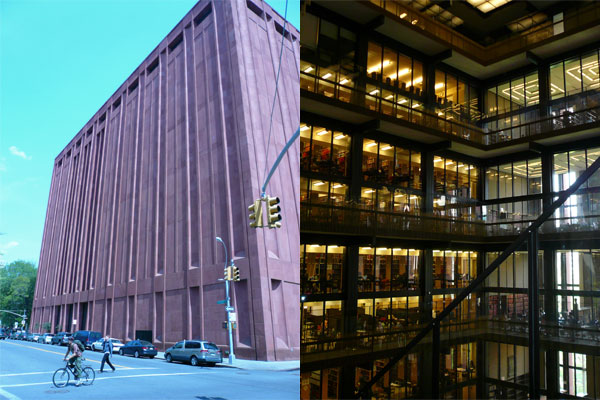
From inside it’s all windows and light, open stacks to be browsed. But: there’s the matter of getting inside, as admission is reserved to those with an NYU ID card. Those without cards are excluded. This is a necessary condition for the library to function: long ago on this blog I bemoaned the condition of the Brooklyn Library, where it’s almost impossible to find any book you’re looking for, though there’s still the pleasure of browsing. The quality of a collection seems to be inversely related to the number of people kept out. Keeping the books in and the world out is demonstrated elegantly by the thin marble windows of Yale’s Beinecke library which admit a small amount of light but not the viewer’s gaze:
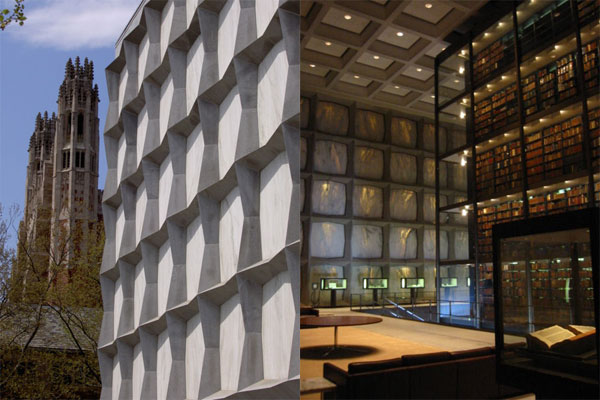
What’s inside and outside – who’s inside and outside – are completely separated. The poet Susan Howe inspects this separation in her book The Midnight, a volume which takes as one of its primary subjects interleaves, the sheets of tissue paper that publishers once put next to plates in books “in order to prevent illustration and text from rubbing together.” Howe’s work tends to be archivally based: she looks at how manuscripts are read or misread, and consequently has spent a lot of time in libraries. In this prose passage from the book, part of a section entitled “Scare Quotes II”, she looks at the way one enters Houghton, Harvard’s analogue to the Beinecke:
1991. Entering Houghton Library: Harvard Yard, 9:00 a.m., a fine June summer morning. At the entrance to the red-brick building designed by Robert C. Dean of Perry, Shaw and Hepburn in 1940, two single wooden doors with hinges, concealing two modernist plate glass doors without frames, have been swung into recesses to the left and right so as to be barely visible during open hours. The only metal fitting in each glass consists of a polished horizontal bar at waist height a visitor must pull to open. I enter an oval vestibule, about 10 feet wide and 5–6 feet deep, before me double doors again; again plate glass.
Passing through this first vestibule I find myself in an oval reception antechamber about 35 feet wide and 20 feet deep under what appears to be a ceiling with a dome at its apex. I think I see sunlight but closer inspection reveals electric light concealed under a slightly dropped form, also oval, illuminating the ceiling above. This first false skylight resembles a human eye and the central oval disc its ‘pupil.’ Maybe ghosts exist as spatiotemporal coordinates, even if they themselves do not occupy space, even if you’ve never seen one, so what? If the design of the antechamber can be read in terms of power and regimes of library control, and if ghosts ‘presently’ ‘occupy’ papers, you need to understand the present tense of ‘occupy.’
To enter this neo-Georgian building (a few Modernist touches added) with its state of the art technology for air filtration, security and controlled temperature and humidity for the preservation of materials, is to turn away from contemporary city life with all its follies and parasites in search of a second coming for dry bones. When the soul of a scholar has an inward bent and bias for an author in the Kingdom of Houghton, it is never at rest, until here. Perversely, nothing in Houghton awakens security sooner than curiosity.
Here – every researcher can be a perpetrator.
( pp. 120–121) While Houghton isn’t as architecturally ostentatious as the Beinecke, Howe’s scrutiny of the architecture of its entrance reveals it to be just as concerned with control. There’s a pessimistic view of human behavior embedded in library construction and the watchfulness of the sentries who guard them: if we, the public, could get at the books, we would most certainly destroy them.
There was the expectation that the barriers would be torn down with the coming of electronic libraries, that once the book’s spirit left its object, it would likewise escape its economic shackles. Certainly it makes sense: an electronic text isn’t degraded by copying in the same way that every reading is an infinitesimal destruction of a physical book. It’s unclear, however, that the media universe that’s unfolding is following this pattern: while sites like archive.org present a new model, projects like Google Books simply reconfigure the gates.
a Sophie workshop — spread the word
Two weeks ago the Instittue for Multimedia Literacy (IML) at USC held a ceremony for the first graduating class of students with honors in multimedia scholarship. two of the students wrote their theses in Sophie. Based on their experience, Holly Willis, the IML director, decided to sponsor a 4-day workshop for scholars who want to use Sophie. there are ten slots which carry a $1,000 honorarium. i’ll be at the workshop, along with my colleague Holladay Penick. please pass the word to anyone you think might be interested. and also, please feel encouraged to ask me any questions about the appropriateness of a particular project to Sophie. (see an earlier post this week for a description of how Sophie differs from presentation apps like Powerpoint or Keynote)
CALL FOR PROPOSALS
SCHOLARLY MULTIMEDIA USING SOPHIE
Deadline for proposals: May 12, 2008
The Institute for Multimedia Literacy is pleased to announce a workshop for faculty and graduate students to create multimedia projects with Sophie, an easy-to-use free software application developed by the Institute for the Future of the Book and presented by USC’s School of Cinematic Arts. Sophie allows users to design interactive texts that incorporate images, video and sound, and it deploys creative formats for analysis, annotation and citation.
Participants will engage in a hands-on workshop May 27 – 30, 2008, with the goal of creating a scholarly project; they will then be free to use the IML labs with support staff during the summer to continue work on the project; and they will be invited to present their completed projects at a showcase event in August. Participants will receive an honorarium of $1,000 for their participation in the workshop.
Sophie is described by the Institute for the Future of the Book as “software for writing and reading rich media documents in a networked environment.” Sophie’s goal is to encourage multimedia authoring and, in the process, “to redefine the notion of a book or ‘academic paper’ to include both rich media and mechanisms for reader feedback and conversation in dynamic margins.”
Successful proposals will be based on an existing paper or body of research; they will articulate how media elements will enhance or transform the paper; and they will indicate a desire to dedicate a full week to the project during the workshop.
Those interested are invited to submit a proposal that includes the following:
Name and affiliation
Paper/project title and brief description
Sophie project description: what do you imagine doing with Sophie?
Why is this an interesting project to translate into an interactive, media-rich, extensible and/or networked format?
What assets (images, video, sound) do you have ready to use?
Please submit proposals by email to Holly Willis, Director of Academic Programs, Institute for Multimedia Literacy hwillis@cinema.usc.edu
Deadline for proposals is 5:00 p.m., Monday, May 12, 2008. Participants will be notified on Friday, May 16, 2008. Questions? Holly Willis: 213-743-2937.
About the Institute for Multimedia Literacy: The IML is an organized research unit within USC’s School of Cinematic Arts dedicated to developing educational programs and conducting research on the changing nature of literacy in a networked culture. The IML’s educational programs promote effective and expressive communication and scholarly production through the use of multiple media applications and tools. The IML also supports faculty research that seeks to transform discipline-based scholarship. http://iml.usc.edu
fail again fail better have fun
A new research paper by Bruce Mason and Sue Thomas on A Million Penguins, the controversial wiki novel created last year by Penguin Books makes fascinating reading.
It includes amongst other delights an analysis of the activities of the contributor known as YellowBanana and whether s/he was vandal, genius or troll, and the report concludes:
“The final product itself, now frozen in time, is more akin to something produced by the wild,untrammelled creativity of the folk imagination. The contributors to A Million Penguins, like the
ordinary folk of Bakhtin’s carnivals, have produced something excessive. It is rude, chaotic, grotesque, sporadically brilliant, anti-authoritarian and, in places, devastatingly funny. As a cultural text it is unique, and it demonstrates the tremendous potential of this form to provide a stimulating social setting for writing, editing and publishing. The contributors may not have written one single novel but they did create something quite remarkable, an outstanding body of work that can be found both in the main sections as well as through the dramas and conversations lacing the backstage pages. And they had a damned good time while doing so.
As the user Crtrue writes.
“Hi hi hi hi hi!
Seriously. This is going to fail horribly. It’s still fun.””
Read more at:
http://www.ioct.dmu.ac.uk/projects/millionpenguins.html
Sophie vs. Powerpoint and Keynote
Longtime visitors to if:book have heard about Sophie, the reading/writing environment we’ve been working on since the inception of the institute in 2004. Version 1.0 of Sophie was quietly released last month. We’ll make a number of Sophie-related posts over the next few months, starting with todays’ which attempts to distinguish Sophie’s feature-set from presentation apps such as Powerpoint or Keynote.
Here is a list of four key features which distinguish Sophie from Powerpoint and Keynote.
[note: PowerPoint and Keynote include a lot of features -? e.g. geometric primitives, transitions or layout tools which make it easier to design the graphic look of a page. however Sophie’s distinguishing features go way beyond manipulating appearance to the affordance of new classes of functionality.
flowing text
since they are entirely page-based, neither Powerpoint or Keynote are useful if an argument needs to be sustained over several pages. when scholars try to use presentation software for “papers” they find that their arguments must of necessity be reduced to bullet point format. Additionally Sophie takes the concept of flowing text well beyond what traditional word processors can do. Sophie allows for completely separate flows to exist on the same page thus enabling bi-lingual editions or texts with commentaries.
timelines
neither Powerpoint or Keynote have the ability create time-based events. here are just a few ways that users might employ timelines in a Sophie document
• create narrated slide-shows which combine audio and illustrations (images or video); this could have huge implications for distance learning modules
• textual commentary tracks which explicate an audio or video presentation (e.g. the close-reading of a piece of music or film).
• sub-titling of video. useful in it’s own right, but also could be the basis of interesting language-learning modules where students are asked to provide English subtitles for a Spanish film or vice versa.
• just-in-time linking which presents hyper-links to a web-page or to other elements in a Sophie doc at specific times -? overlayed on a video or just popping up on a page.
embedding remote objects
one of the substantial problems with multimedia, even in the present period of faster pipes, is that audio and video files are huge. this is particularly a problem for students who often shift from machine to machine (classroom, library, home or dorm room). sophie potentially solves this problem by permitting the “big” media to be left on a central server but embedded in the sophie file as if it were “in the book.” this will be even more powerful as archives of rich media are developed (by professors, academic departments, commercial firms (such as publishers, J-Stor, Art-Stor, etc.) for the use of students. the NEH recently gave us a grant to develop a search gateway within Sophie into the Internet Archive. When completed, a user will be able to search the audio and video holdings of the Internet Archive, choose a file, open it in Sophie, choose IN and OUT points and embed that clip in a Sophie document without the actual audio or video content ever needing to actually be downloaded into the Sophie document.
networked dynamic comment fields
none of the presentation apps allow “readers” to carry on a conversation about the contents of the document from within the document itself. all our experiments so far suggest that this has huge implications for scholarly discourse at all levels from course modules to mechanisms of peer review and the transformation of academic papers into “places” where conversations occur.
stories and places
I found this new site, 217babel.com set up by Brighton based journalist and writer William Shaw, to be a nice example of an online fiction that actually gets you reading rather than admiring it awhile and then glazing over or clicking away. A clean page, simple navigation and, most importantly, words that hook. Knock on the door and take a look.
Last year Shaw created another inspired piece: 41 Places, a city-wide artwork of 41 true stories, installed in the place where they happened – stories of people who live, work and play in Brighton, narrative non-fiction miniatures become something between a giant work of art, scattered through the city, and a treasure hunt of stories. The narratives were collected by Shaw between September 2006 and April 2007 and designed and installed by Richard Wölfstrome, John Easterby and Tom Snell.
floing again
“While businesses based on the sale of paper may or may not be in crisis, those of us with a wider responsibility for ensuring our literary culture thrives have wonderful new tools with which to encourage participation and communication.
The curse of vanity presses can be replaced with free online opportunities to put your words in the public realm and means for the best to be spotted.
Collaborative writing and book sharing sites are democratising the way we share ideas and stories.
“Running small creative teams dealing with quality communications, working across different media platforms; social entrepreneurs finding cost effective means to change lives; experimenters with words and audiences using an art form which has been personalised for centuries, creating a virtual world in the user’s imagination – we are ahead of the game.”
This is an extract from AND YES I SAID YES I WILL YES, a white paper by the FLO consortium of ‘Friendly Literature Organisations’ in the UK, which was launched recently at the London Book Fair. I put up a link here to the first draft, but it’s now been revised so do take a look.
I’d be interested to know if literature organisations in the USA face similar challenges and how they are tackling them.