
 “The Book as Object and Performance exhibition (through January 22 @ Gigantic Art Space in New York, curated by Sara Reisman) presents work by over 20 artists, each using the book as a point of departure to explore the physical, sensual or conceptual dimension of reading and the written word.
But despite lofty ambitions, the exhibit provides little more than light reading. Though several works are visually arresting, few do more than glide over the potentially bottomless themes at hand. Most stick to playful reorganization of materials: a pile of wooden hoops culling newspaper headlines from around the globe; a precarious tower of books with a gaping acid-chewed hole at the top; a doorway filled with crumpled sheets of paper; a dictionary with words dislocated from their definitions. A collection of small, easily forgotten pleasures.
An exception to this is a mysterious piece titled “Perseverance” by Jenny Perlin consisting of a small, worn book in a glass case, above which plays a strange film of man battling anxiety, chewing his nails to the quick. Also memorable was a one-night-only “reading” of the ten commandments by Polish-born artist Maciej Toporowicz, a piece first performed in communist Poland in 1980, and part of small program of live explorations last night, filling out the “performance” part of the equation. The gallery lights are extinguished and Toporowicz takes his place in front of an illuminated glass bowl of water, perched atop an open Bible. He places his face in the water, as though reading through the aqueous medium, and remains there long enough for the audience to start imagining.. what? That he is drowning in this sacred, much-abused text? That he is drawing impossible sustenance from its power? He begins to twitch and tremble. Finally his head rips up out of the water, gasping.
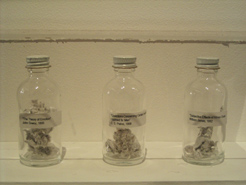
The photo above shows bottles containing philosophical texts that have been literally chewed up and spit out. Click below to see more pictures from the exhibition…
lizards! defying the laws of mass market physics
 Found this yesterday on changethis.com – a site devoted to publishing and disseminating manifestos. Documents are smartly designed pdfs, spread primarily through the viral channels of the blogosphere and personal email mentions.
In “The Long Tail” Wired editor-in-chief Chris Anderson predicts a new age of abundance, in which the Internet elevates niche markets and makes mass market quotas irrelevant. Of course, this is already happening, much to the distress of mass media dinosaurs, who are scrambling to protect their creaking architecture of revenue.
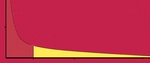
The “long tail” refers to the slender expanse of obscure niche sales enjoyed by a web retailer, as represented on an x-y graph. It extends from the body of high volume, mainstream sales (Wal-Mart and the like) like the caudal appendage of a lizard.
Read Manifesto: The Long Tail
google and big brother
Can Google remain true to its promise to “do no evil,” now that it has shareholders to worry about, advertisers to please, and an ever-increasing reach into the repositories of human knowledge? Google still gives you that warm and fuzzy feeling. It’s got the goofy name, those cute seasonal tailorings of its masthead, the lava lamps. And this is not to mention the various amusing pastimes – the “Google Whack” game in which you try to find two words that cohabit only one of the search engine’s eight billion web pages; or every writer’s guilty pleasure, the Googling of the self, the “auto-Google,” that delicious act of cyber-onanism.
But where might it lead? One day, when I open my fridge, might a sensor not read my searching eye and know that I am looking for milk? And knowing that I have run out, suggest an array of retailers who might be able to replenish my supply? Could Google come to mediate every exchange of information, no matter how inane, or how carnal?
Or could it come to resemble something like the Central Intelligence Corporation in Neal Stephenson’s Snow Crash – a cross between the CIA, the Library of Congress, and DARPA’s “Total Information Awareness” program?
MercuryNews.com | 12/14/2004 | Does Google move augur commercialization of libraries?
the book as object and performance – exhibit in New york
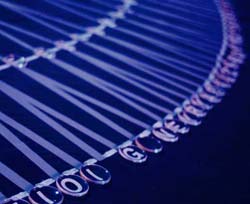
“The Book as Object and Performance is an exhibition of artworks that takes the format of the book as a point of departure to deconstruct that which is bound up in text, image and the physicality of books.”
Through January 22 @ Gigantic Art Space
*Plus: tomorrow night, in conjunction with the exhibition!
Thursday, December 16, 6-8pm: an evening of performances by AUX (Reynard Loki and Christopher Shores), Joseph A. Fish, Jesal Kapadia, Pia Lindman, and Maciej Toporowicz..
Dr. Dial-up
Click here to read more
There is a new initiative underway to make biomedical research immediately available on line and free to the public. According to the Pew Internet & American Life Project, 66% of those with internet access have used it to look for health/medical information. That means that over 85 million Americans (and who knows how many people worldwide) went online last year to doctor themselves. Is this a new kind of do-it-yourselfer, the amateur physician, Google-ing a diagnosis and a cure? And when all of this new “information” becomes available, will the office visit–which the HMOs are already putting the squeeze on–become a thing of the past?
Children and Books: Forming a World-View
When I think about the part books played (and still play) in forming my world-view, I have to think about them as tethered to a set of circumstances. It is impossible to say, for example, whether it was Gardner’s Art Through the Ages that awakened my passion for visual art, or my teacher Gretchen Whitman, who introduced the book to me and led me through it.
The book is part of a matrix that is difficult to parse. How is one’s world-view formed? Certainly books are a part of the process, but maybe they function more as “tools” then as “beings.” Insofar as they are extensions of the people or circumstances that drove us to them. With this in mind, it’s not surprising that very few of these lists are the same.
It’s interesting that nobody confesses that children’s books formed their world-view. I was profoundly influenced by the books I read when I was a child. The Little House on the Prairie series, and the Wizard of Oz still resonate with me. Dorothy and Laura Ingalls were pioneers–girl scouts, who were always prepared and never complained. They were independent, pragmatic survivors. I’m not saying this is the best collection of virtues one could strive for, but, nevertheless I recognize them in myself and think they were engendered, to some extent, by those books. Also, I must mention the fantastic strangeness of Dr. Seuss (who prepared me for surrealism), Maurice Sendack, Shel Silverstein, The Giving Tree, Grimm’s Fairy Tales, Hans Christian Anderson.
Children’s books are there at the beginning, digging into our consciousness. The fact that children must, initially, be read to, illuminates something about how the book functions for humans. My son is 14 months old and he loves books. That is because his grandmother sat down with him when he was six months old and patiently read to him. She is a kindergarten teacher, so she is skilled at reading to children. She can do funny voices and such. My son doesn’t know how to read, he barely has a notion of what story is, but his grandmother taught him that when you open a book and turn its pages, something magical happens–characters, voices, colors–I think this has given him a vague sense of how meaning is constructed. My son understands books as objects printed with symbols that can be translated and brought to life by a skilled reader. He likes to sit and turn the pages of his books and study the images. He has a relationship with books, but he wouldn’t have that if someone hadn’t taught him. My point is, even after you learn to read, the book is still part of a complex system of relationships. It is almost a matter of chance, in some ways, which books are introduced to you and opened to you by someone.
I think people who are resistant to electronic books worry that this intimacy will be lost in a non-paper format. But clearly, it’s not the object itself, it’s the meaning brought to it by and through people. The medium won’t really change that.
books behind bars – the Google library project
How useful will this service be for in-depth research when copyrighted books (which will account for a huge percentage of searchable texts) cannot be fully accessed? In such cases, a person will be able to view only a selection of pages (depending on agreements with publishers), and will find themselves bombarded with a variety of retail options. On a positive note, the search will be able to refer the user to any local libraries where the desired book is available, but still, the focus here remains squarely on digital texts as simply a means of getting to print texts.
Absent a major paradigm shift with regard to the accessibility and inherent virtue of electronic texts, this ambitious project will never achieve its full potential. For someone searching outside the public domain, the Google library project may amount to nothing more than a guided tour through a prison of incarcerated texts. I’ve found this to be true so far with Google Scholar – it turned up a lot of interesting stuff, but much of it was password protected or required purchase.
article in Filter: Google — 21st Century Dewey Decimal System (washingtonpost.com)
Intertextual Community
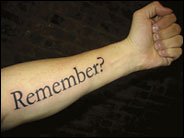 When I read about Shelly Jackson’s new project–to “publish” a story by tattooing each of its 2,095 words onto the body of a different person–I thought what a great idea, and I wondered if it might actually be telling us something about the direction books are going. As the digital book begins to emerge–glorious, ephemeral, and electric–are we going to feel compelled to make something even more intimate and rarified as counterpoint?
“Skin Literature”
Lawrence Lessig on “writing”
Closing the USC conference “Scholarship in the Digital Age,” Lessig spoke on “free culture” and the current legal/cultural crisis that in the next few years will define the constraints on creative production for decades to come. Due to obsessive fixation by a handful of powerful media industries on the issue of piracy, the massive potential of networked digital culture that has briefly flowered in the past decade could be destroyed by draconian laws and code controls embedded in new technologies. In Lessig’s words: “never in our past have fewer exercised more legal control.”
Lessig elegantly picked up one of the conference’s many threads, multimedia literacy, referring to the bundle of new forms of cultural and scholarly production – remixing, reusing, networking peer-to-peer, working across multiple media – as simply “writing.” This is an important step to take in thinking about these new modes of production, and is actually a matter of considerable urgency, considering the legal changes currently underway. The ultimate question to ask is (and this is how Lessig concluded his talk): are we producing a legal culture in which writing is not allowed?
more from USC conference: useful dichotomies for reconsidering scholarship in the digital era
from Tara McPherson:
– content/context
– practice/theory (practice as research in action)
– process/product (embrace productive failure)
– open/closed (what does versioning mean?)
– dialogue/argument (new ways of marshaling evidence; what does it mean when argument shifts into dialogue?)
– pedagogy/scholarship/service (tenure system is archaic; most non-traditional modes of scholarly inquiry are considered nothing more than community service)
– many/single (how do we rethink collaboration?)
– tools/theories (blurring that boundary)
Tara McPherson is Associate Professor of Gender and Critical Studies; Chair, Division of Critical Studies, School of Cinema-Television, USC; and editor of the forthcoming Vectors, an electronic peer-reviewed journal.